AI Generated Exam Paper
Secondary 2 Geography Practice Paper 4
Free Sec 2 Geography Practice Paper 4, Nemo3 AI version, with questions, answers, and syllabus-aligned practice for Singapore students.
These static practice materials are generated from the site's syllabus and paper-generation workflow, with source and model context shown so students and parents can evaluate the material before use.
Questions


Free quiz and exam paper access
Enter your details to view this paper
Your access is remembered on this device.
Answers
TuitionGoWhere Practice Paper - Geography Secondary 2 (Answer Key)
Subject: Geography
Level: Secondary 2 (G2/G3)
Paper: Practice Paper — Map, Graph & Data Skills (Version 4)
Total Marks: 50
Section A: Map Reading Skills [15 marks]
Question 1
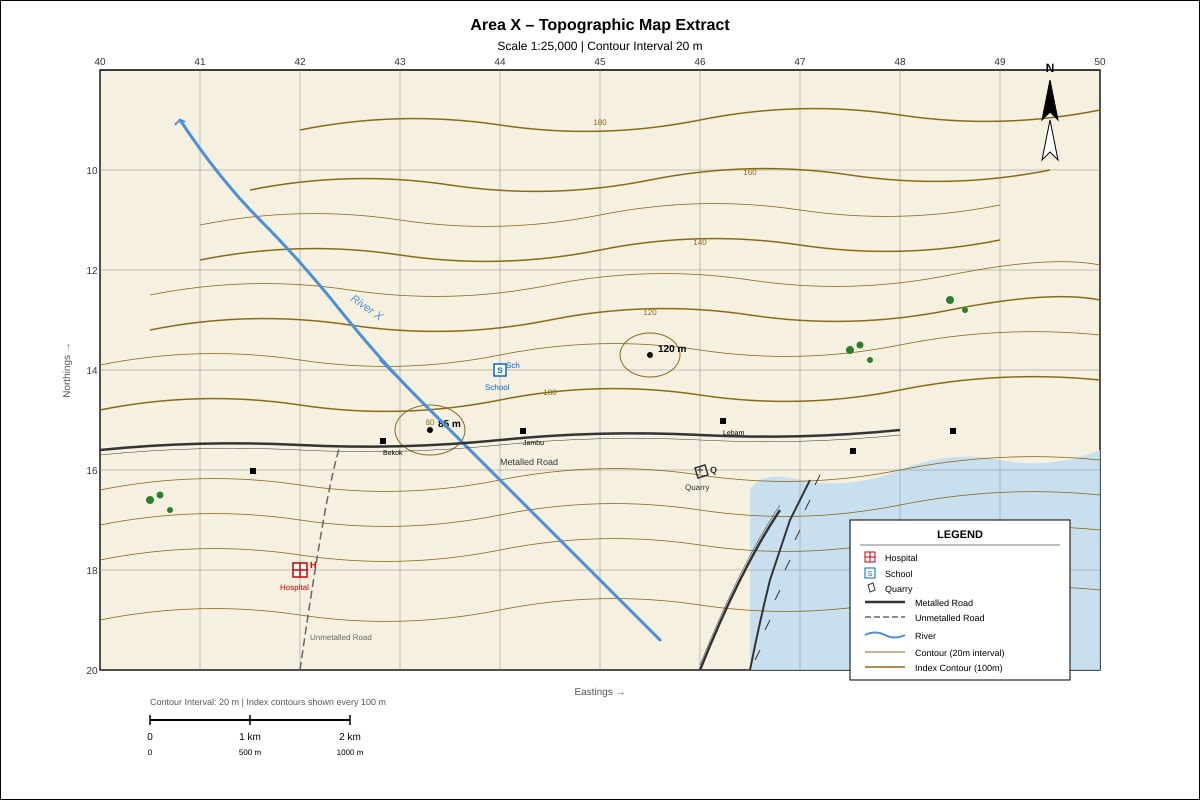
(a) 4218
[1]
Marking note: Four-figure grid reference: easting 42, northing 18. Must write easting first (42), then northing (18). No spaces or commas needed but accepted.
(b) 452163 (accept 452164 or 451163 depending on exact position within grid square)
[1]
Marking note: Six-figure grid reference: easting 45 + 2/10 = 452, northing 16 + 3/10 = 163. Award mark if easting and northing each have 3 digits and are in correct order. Common error: reversing easting/northing or giving only 4 figures.
(c) The land around the quarry is hilly with steep slopes.
Evidence: Contour lines are closely spaced around GR 4714, indicating steep gradients. The spot height at GR 4615 (120 m) is nearby, and contours show a rise from ~80 m to 120 m over a short distance.
[2]
Mark breakdown: 1 mark for identifying hilly/steep relief; 1 mark for map evidence (closely spaced contours / spot height reference).
Common mistake: Describing the quarry itself rather than the surrounding land.
(d) 1.5 km (accept 1.4–1.6 km)
Working:
- Hospital at GR 4218 → approx. 42.5, 18.5 (centre of grid square)
- School at GR 4516 → approx. 45.5, 16.5
- Difference in eastings: 3 km (3 grid squares × 1 km)
- Difference in northings: 2 km (2 grid squares × 1 km)
- Straight-line distance = √(3² + 2²) = √13 ≈ 3.6 km on ground
- On map at 1:25,000: 3.6 km = 360,000 cm ÷ 25,000 = 14.4 cm
- But simpler: measure directly on map ≈ 3.6 cm → 3.6 × 0.25 km = 0.9 km? Wait — recalc:
Actually, 1 grid square = 1 km = 4 cm on map (1:25,000 → 1 cm = 0.25 km).
Hospital (42,18) to School (45,16): ΔE = 3 km, ΔN = 2 km.
Straight-line ground distance = √(3² + 2²) = √13 ≈ 3.61 km.
[2]
Mark breakdown: 1 mark for correct method (Pythagoras or direct measurement with scale); 1 mark for correct answer with units (km). Accept 3.6 km or 3.61 km.
Question 2
(a) Northwest to southeast (or "from NW to SE")
[1]
(b)
- Relief/gradient: Contour lines show land higher in the northwest (e.g., spot height 120 m at GR 4615) and lower in the southeast (contours decrease toward coast). Rivers flow downhill from higher to lower ground.
- Coastal outlet: The river flows towards the sea in the southeast, which is the base level for drainage.
[3]
Mark breakdown: 1 mark per valid reason with map evidence (max 2), +1 for linking to river flow direction. Must use map evidence (contours, spot heights, sea location).
(c) Asymmetrical cross-profile / steeper outer bank (river cliff) and gentler inner bank (slip-off slope) visible from contour spacing — contours closer on outer bend, wider on inner bend.
[1]
Accept: "Contours bend in a U-shape pointing upstream" or "uneven contour spacing across the channel".
Question 3
(a) 6 km
[1]
Working: Point A (420150) to Point B (480150) → eastings 42 to 48 = 6 grid squares × 1 km = 6 km.
(b) 2.4 cm
Working:
- Vertical scale: 1 cm represents (1 km ÷ 5) = 0.2 km = 200 m (since VE = 5×)
OR: Horizontal scale 1:25,000 → 1 cm = 250 m. VE 5× → vertical scale 1:5,000 → 1 cm = 50 m.
Wait — standard method:
Horizontal scale = 1:25,000. Vertical exaggeration = 5×.
→ Vertical scale = 1:(25,000 ÷ 5) = 1:5,000.
→ 1 cm on diagram = 5,000 cm = 50 m on ground.
→ 120 m ÷ 50 m/cm = 2.4 cm.
[2]
Mark breakdown: 1 mark for correct vertical scale derivation (1 cm = 50 m or equivalent); 1 mark for correct calculation (120 ÷ 50 = 2.4 cm).
(c) Sketch should show:
- Horizontal axis labelled 0–6 km (A to B)
- Vertical axis labelled 0–120 m (or up to 120 m)
- General shape: low at A (~20–40 m), rising gradually, steeper rise near 4–5 km mark, peak at ~120 m (labelled "Spot height 120 m at GR 4615"), then gentle descent to B (~60–80 m)
- Highest point clearly labelled
[2]
Mark breakdown: 1 mark for reasonable shape reflecting contour pattern (low → rise → peak → fall); 1 mark for labelled highest point at correct position (~5 km from A).
Question 4
(a)
| Aspect | Settlement P (GR 4318) | Settlement Q (GR 4712) |
|---|---|---|
| Relief | Gentle/flat (widely spaced contours, ~20–40 m) | Hilly/undulating (closer contours, near 80–100 m) |
| Water | Near river (water supply, transport) | No major waterbody adjacent |
| Transport | On metalled road, near road junction | On minor/unmetalled road, less connected |
| Land use | Larger built-up area, near hospital/school | Smaller, isolated |
| [2] | ||
| Mark breakdown: 1 mark for each valid comparison point with map evidence (max 2). Must compare, not just describe separately. |
(b) Settlement P has better accessibility — it is located at a road junction on a metalled road, connecting to major routes, while Settlement Q is on a minor road. This facilitates trade, commuting, and access to services (hospital, school nearby), encouraging growth.
[2]
Mark breakdown: 1 mark for identifying accessibility/transport advantage; 1 mark for map evidence (road junction, metalled road, proximity to services).
Section B: Graph and Data Interpretation [20 marks]
Question 5
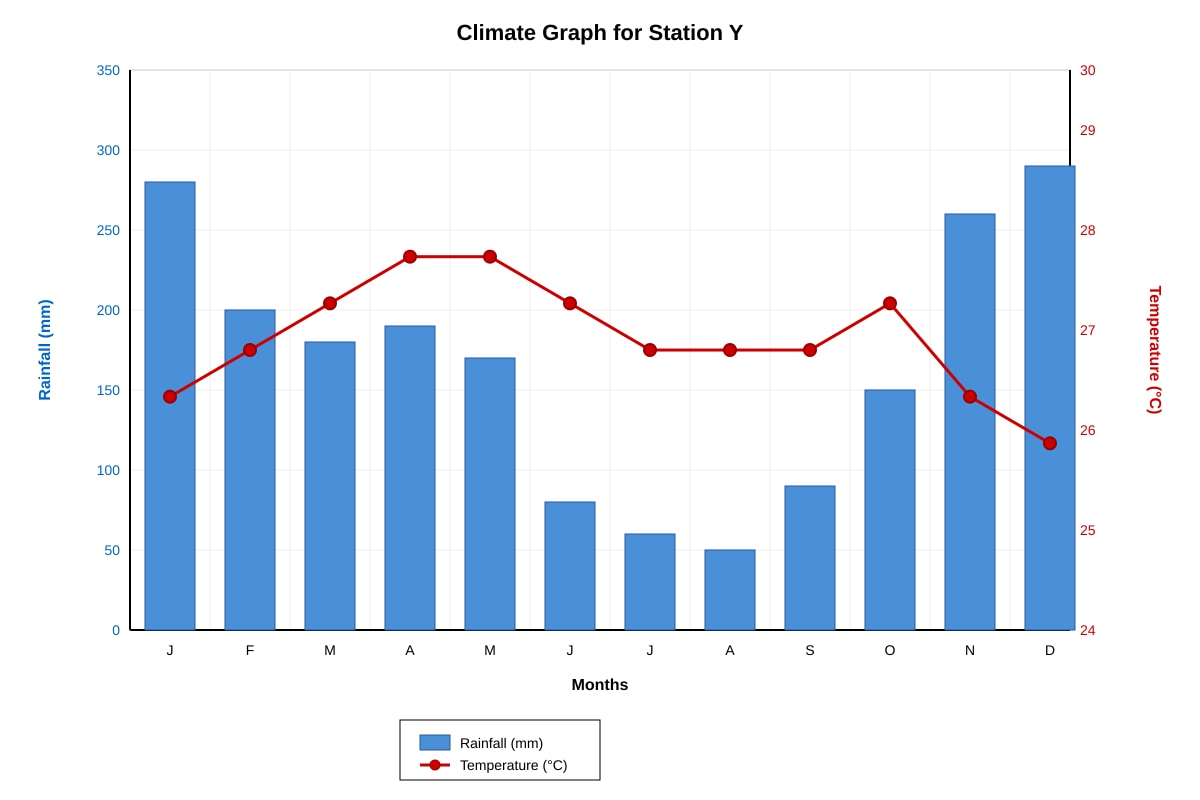
(a) December (or "D") — 290 mm
[1]
(b) 2.0°C (28.0°C – 26.0°C)
[1]
Working: Highest temp = 28.0°C (April/May), Lowest = 26.0°C (December). Range = 28.0 – 26.0 = 2.0°C.
(c) Rainfall is high from November to January (peaking in December at 290 mm), low from June to August (lowest in August at 50 mm), with two relatively drier periods (Feb–May ~170–200 mm, Sep–Oct ~90–150 mm). The pattern shows a distinct wet season (Nov–Jan) and dry season (Jun–Aug).
[2]
Mark breakdown: 1 mark for identifying wet/dry seasons with months; 1 mark for data support (peak/low months with values).
(d) Station Y is likely near the equator (low latitudes). It experiences convectional rainfall due to intense solar heating year-round, causing air to rise, cool, and condense. The wet season (Nov–Jan) coincides with the Northeast Monsoon, when the ITCZ (Intertropical Convergence Zone) shifts south, bringing moist winds from the South China Sea. The dry season (Jun–Aug) occurs when the ITCZ moves north and the Southeast Monsoon brings drier winds from the Australian continent.
[3]
Mark breakdown: 1 mark for latitudinal location (equatorial/low latitude); 1 mark for mechanism (convectional rainfall / ITCZ / monsoon); 1 mark for linking seasonal shift to rainfall pattern.
Question 6
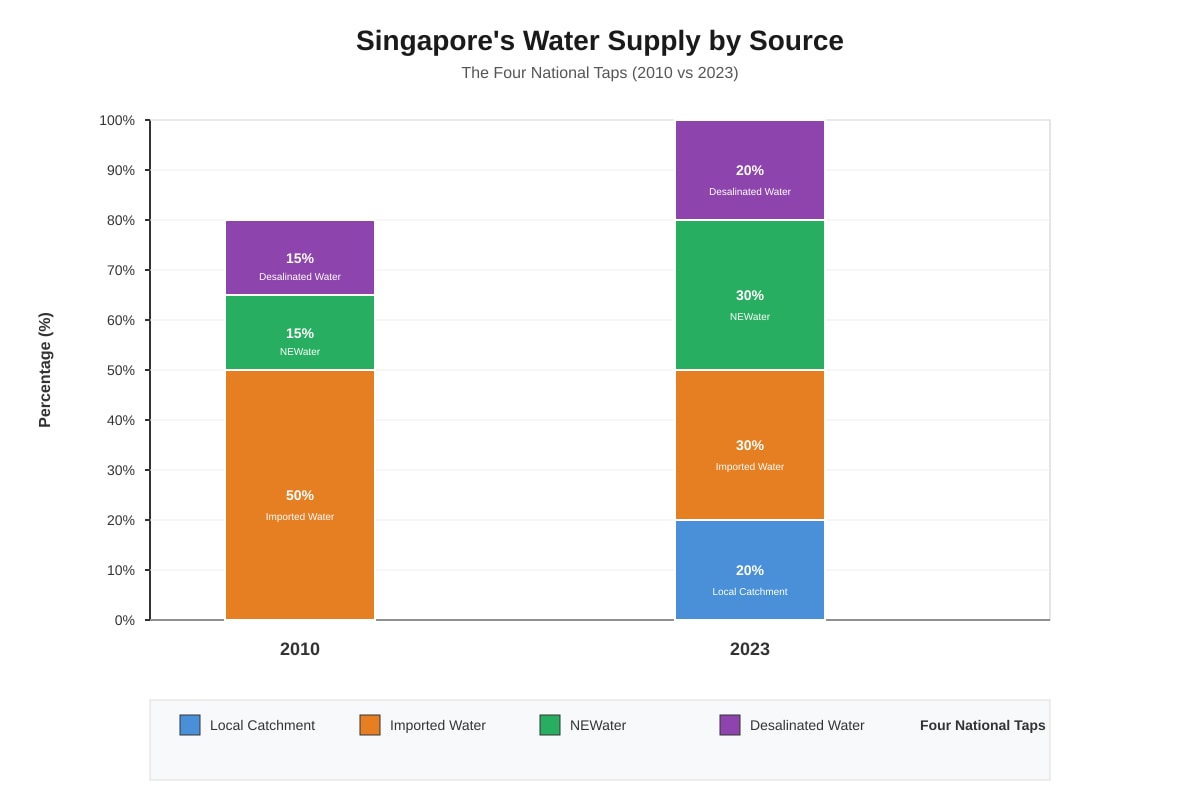
(a) NEWater (increased from 15% to 30%, +15 percentage points)
[1]
(b) –20 percentage points (50% → 30%)
[1]
Note: "Percentage point change" not "percent change". Answer must include negative sign or "decrease of 20 percentage points".
(c)
- Imported Water decreased from 50% to 30% (–20 pp), reducing reliance on external sources.
- NEWater increased from 15% to 30% (+15 pp) and Desalinated Water increased from 15% to 20% (+5 pp), showing greater use of weather-resilient sources.
[2]
Mark breakdown: 1 mark per valid change with data (max 2).
(d) Singapore reduced reliance on imported water to enhance water security and self-sufficiency. Imported water (from Johor) is vulnerable to political disputes, climate variability (droughts), and treaty expiry (2061). Developing NEWater and desalination provides weather-resilient, locally controlled sources, ensuring long-term sustainability.
[3]
Mark breakdown: 1 mark for water security/self-sufficiency; 1 mark for vulnerability of imported water (political/climate/treaty); 1 mark for role of NEWater/desalination as resilient alternatives.
(e)
- Advantage: High-grade reclaimed water, ultra-clean, sustainable, reduces need for imported water, drought-resilient.
- Disadvantage: High energy consumption (membrane filtration, UV), high production cost, public perception ("toilet-to-tap" psychological barrier).
[2]
Mark breakdown: 1 mark for valid advantage; 1 mark for valid disadvantage.
Question 7
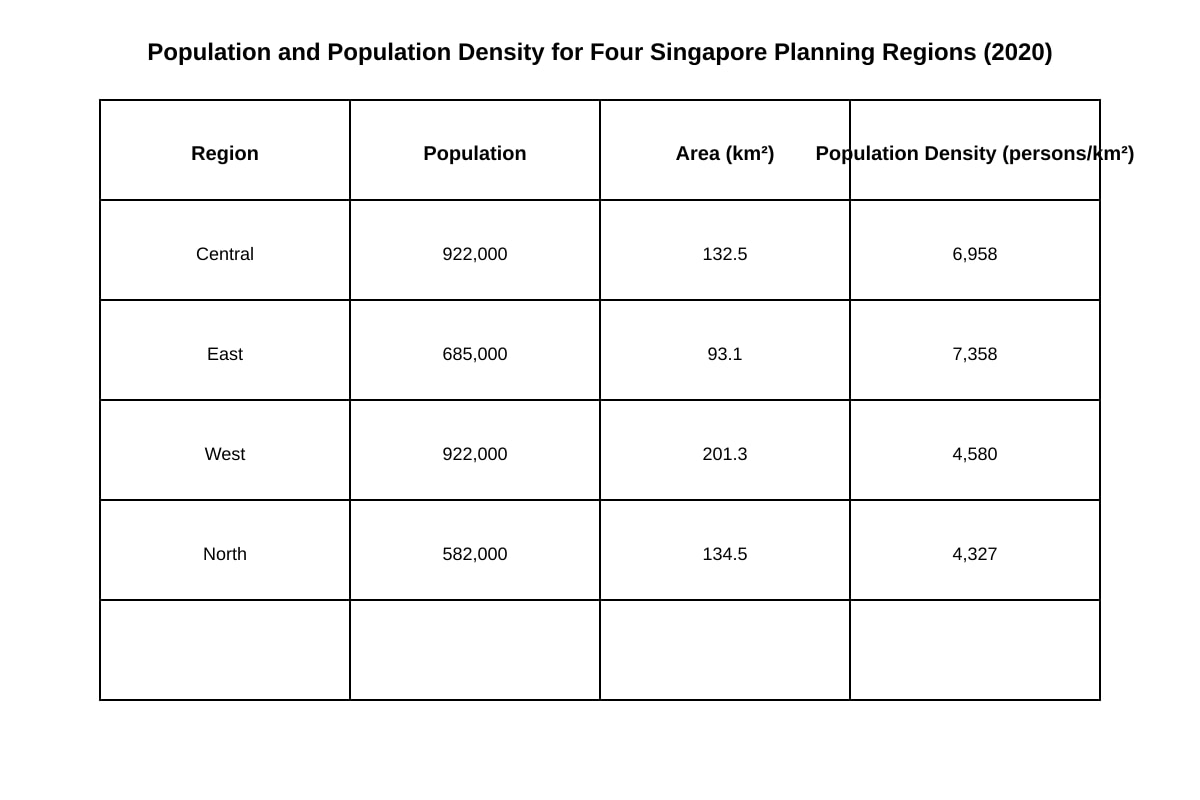
(a) East Region (7,358 persons/km²)
[1]
(b)
Working:
Population Density = Population ÷ Area
= 922,000 ÷ 201.3
= 4,580.23… ≈ 4,580 persons/km² (matches given value)
[2]
Mark breakdown: 1 mark for correct formula/substitution; 1 mark for correct calculation and rounding.
(c) The East Region has a smaller land area (93.1 km² vs 132.5 km²) but a comparable population (685,000 vs 922,000). High-density HDB estates (e.g., Tampines, Bedok, Pasir Ris) concentrate people in a smaller area, while the Central Region includes large non-residential zones (parks, reserves, commercial, military).
[2]
Mark breakdown: 1 mark for identifying smaller area / higher concentration; 1 mark for explaining land use difference (residential vs mixed/non-residential).
(d) Regional averages mask internal variation — density varies greatly within a region (e.g., dense HDB towns vs. nature reserves/industrial zones). It does not show population distribution at neighbourhood scale, daytime vs nighttime population, or living conditions (overcrowding, green space per capita).
[2]
Mark breakdown: 1 mark for identifying averaging problem; 1 mark for specific example (internal variation, scale mismatch, or functional difference).
Question 8
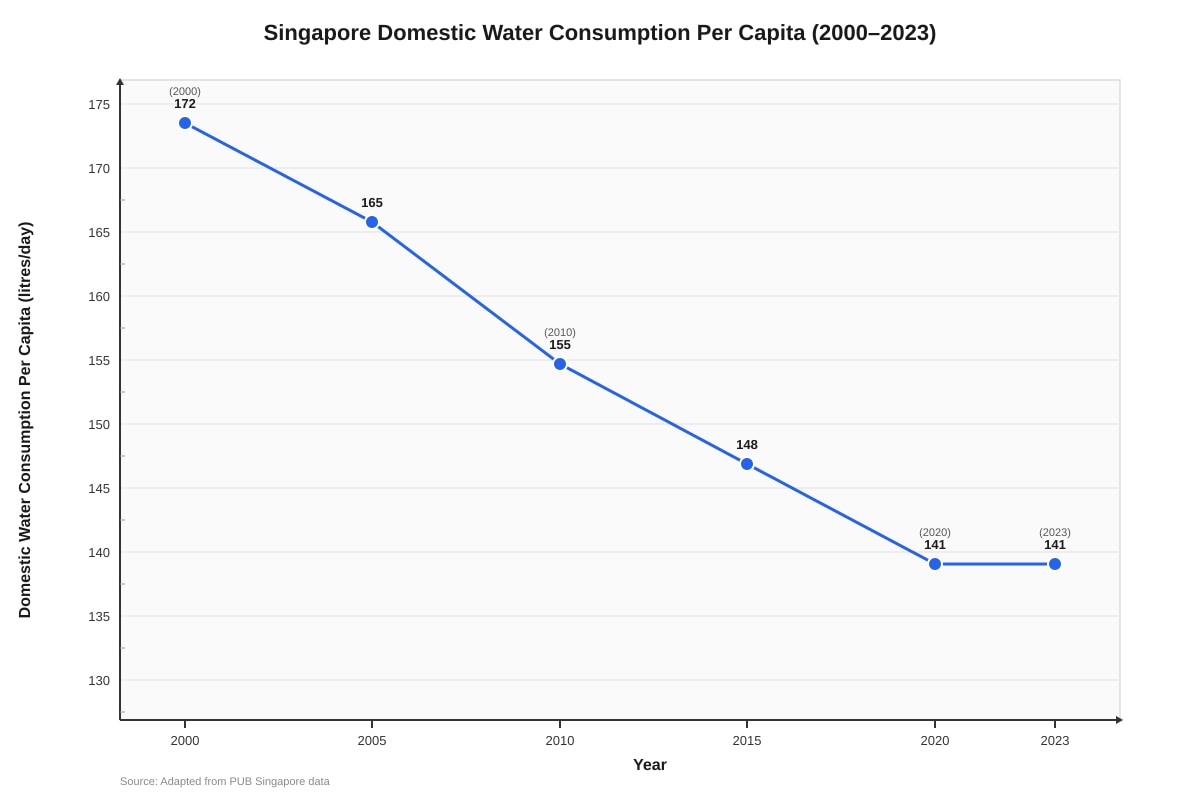
(a) Overall decreasing trend from 172 L/day (2000) to 141 L/day (2023), with the steepest decline 2000–2010 and stabilisation after 2020.
[1]
(b) 18.0% (accept 18%)
Working:
Decrease = 172 – 141 = 31 L/day
% decrease = (31 ÷ 172) × 100% = 18.02% ≈ 18.0%
[2]
Mark breakdown: 1 mark for correct working (difference ÷ original × 100%); 1 mark for correct answer with % sign.
(c)
- Water pricing tiers — higher tariffs for higher usage discourages waste.
- Mandatory water-efficient fittings (WELS labels) for taps, toilets, urinals in new/renovated premises.
(Accept: Public education campaigns, leakage detection/reduction, NEWater for non-potable use freeing potable supply)
[2]
Mark breakdown: 1 mark per valid measure (max 2).
(d) Population growth — Singapore's population increased from ~4.0M (2000) to ~5.9M (2023). Even with lower per capita use, total demand = per capita × population rises. Economic growth also increases non-domestic water demand (industry, commerce).
[2]
Mark breakdown: 1 mark for population growth; 1 mark for total demand formula or non-domestic demand increase.
Section C: Data Skills and Geographical Investigation [15 marks]
Question 9
(a) 5.1% (accept 5.15% or 5.2%)
Working:
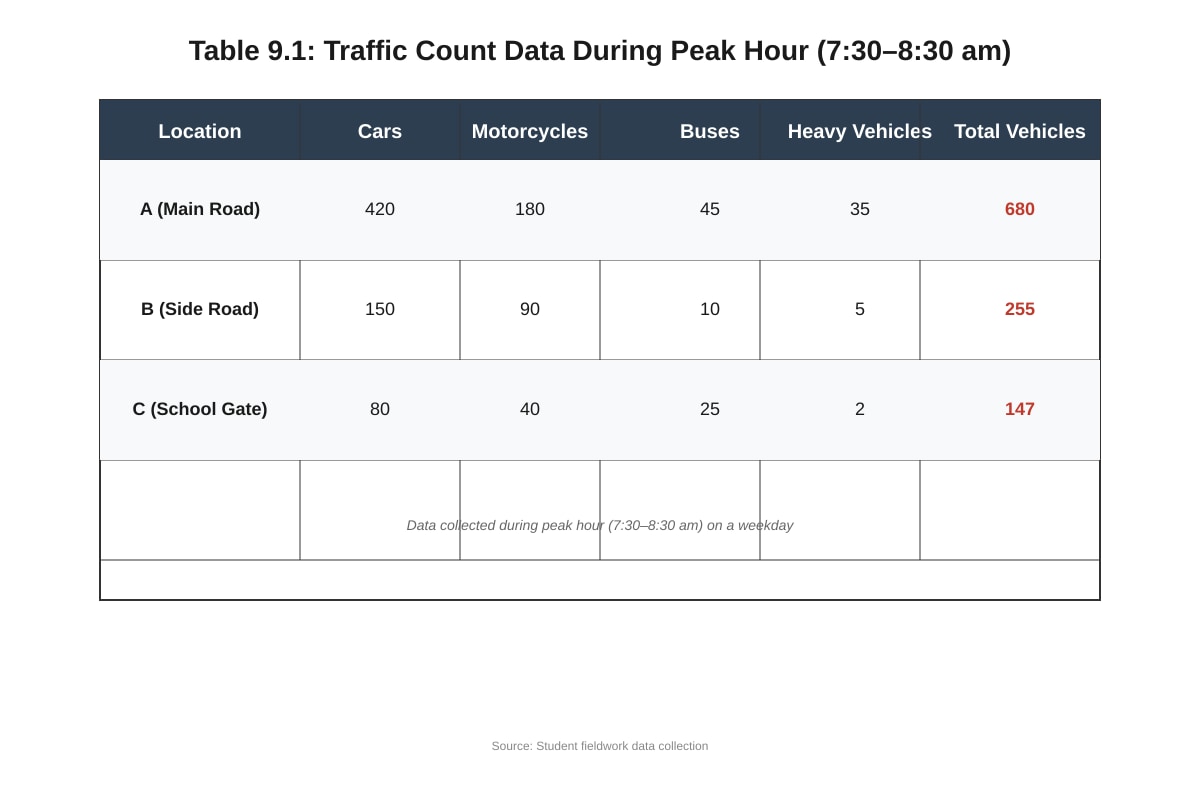
Heavy vehicles at A = 35
Total vehicles at A = 680
% = (35 ÷ 680) × 100% = 5.147% ≈ 5.1%
[2]
Mark breakdown: 1 mark for correct substitution; 1 mark for correct answer with % sign.
(b) The conclusion is partially valid but incomplete.
- Support: Location A has the highest total vehicles (680) vs B (255) and C (147), suggesting highest traffic volume.
- Challenge: Congestion depends on road capacity, not just volume. Location A is a main road (likely wider, more lanes), while Location C (school gate) has narrower access — 147 vehicles on a small road may cause worse congestion per lane. Also, vehicle composition matters: Location A has 35 heavy vehicles (slow, large), Location C has 25 buses (frequent stops).
- Better measure: Volume-to-capacity ratio or average speed/delay needed.
[3]
Mark breakdown: 1 mark for acknowledging high volume at A; 1 mark for identifying missing factor (road capacity/width, vehicle type, junction delays); 1 mark for geographical reasoning (congestion ≠ volume alone).
(c) Vehicle speed / travel time data.
How it helps: Congestion is defined by reduced speed/increased delay relative to free-flow. Counting vehicles alone cannot distinguish free-flowing traffic from gridlock. Speed data directly measures congestion severity.
[2]
Mark breakdown: 1 mark for appropriate data type (speed, journey time, queue length, occupancy); 1 mark for explaining how it measures congestion better than volume.
(d) Not representative — traffic patterns vary by day of week (weekend vs weekday), weather (rain increases car use), school holidays, events, or season. One morning cannot capture typical conditions.
[1]
Accept: "Small sample size", "no replication", "anomalous day possible".
Question 10
(a)
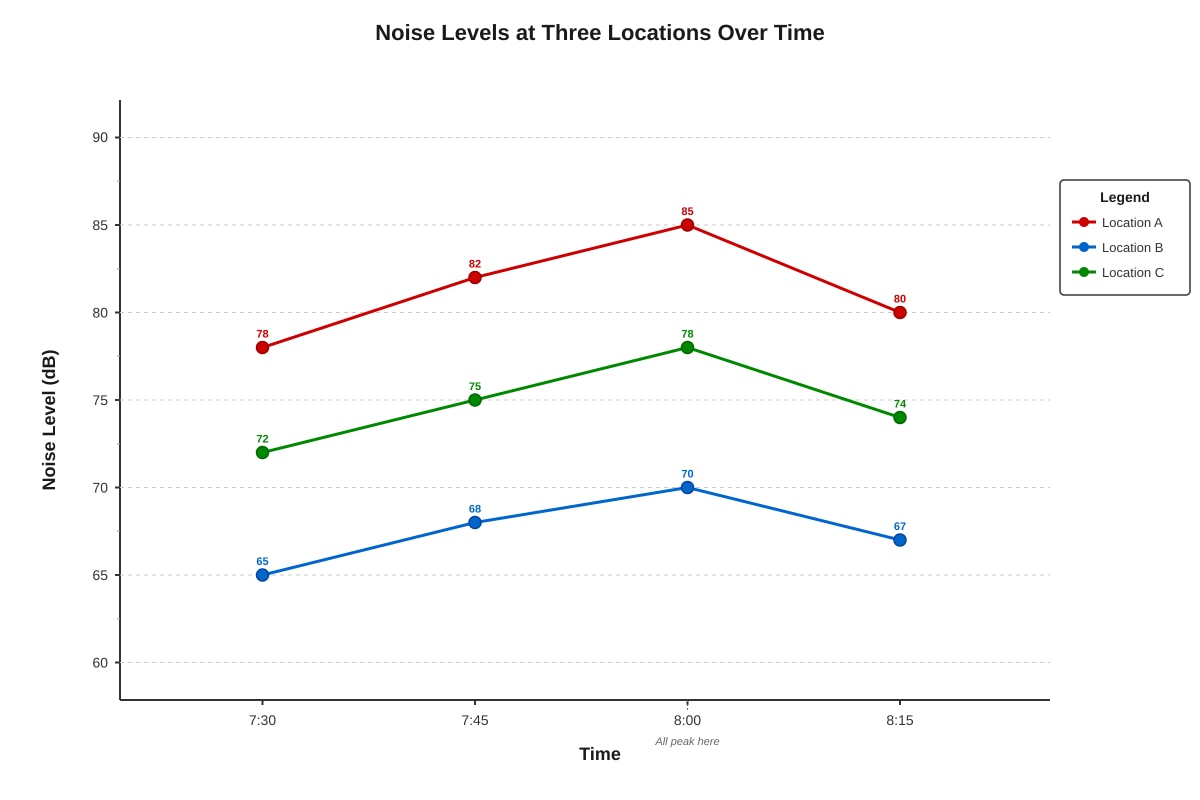
- Location A: (78 + 82 + 85 + 80) ÷ 4 = 325 ÷ 4 = 81.25 dB
- Location B: (65 + 68 + 70 + 67) ÷ 4 = 270 ÷ 4 = 67.5 dB
- Location C: (72 + 75 + 78 + 74) ÷ 4 = 299 ÷ 4 = 74.75 dB
Location A has the highest average noise level (81.25 dB).
[3]
Mark breakdown: 1 mark for each correct average (max 2 if all three correct); 1 mark for correct identification of Location A. If averages wrong but A identified as highest based on correct comparison, award 1 mark.
(b) Positive relationship — as total vehicle count increases (C: 147 → B: 255 → A: 680), average noise level increases (C: 74.75 → B: 67.5 → A: 81.25 dB). Note: B and C order swapped in vehicle count vs noise — but A is highest in both. Overall, higher traffic volume correlates with higher noise, but other factors (vehicle type, speed, road surface, buildings) cause deviations (e.g., B has fewer vehicles than C but lower noise).
[2]
Mark breakdown: 1 mark for identifying positive correlation; 1 mark for using data to support + noting anomaly/nuance.
(c) A pie chart shows parts of a whole (proportions summing to 10
<stage5_exam_answers_md>
TuitionGoWhere Practice Paper - Geography Secondary 2 (Answer Key)
Subject: Geography
Level: Secondary 2 (G2/G3)
Paper: Practice Paper — Map, Graph & Data Skills (Version 4)
Total Marks: 50
Section A: Map Reading Skills [15 marks]
Question 1
(a) 4218
[1]
Marking note: Four-figure grid reference: easting 42, northing 18. Must write easting first (42), then northing (18). No spaces or commas needed but accepted.
(b) 452163 (accept 452164 or 451163 depending on exact position within grid square)
[1]
Marking note: Six-figure grid reference: easting 45 + 2/10 = 452, northing 16 + 3/10 = 163. Award mark if easting and northing each have 3 digits and are in correct order. Common error: reversing easting/northing or giving only 4 figures.
(c) The land around the quarry is hilly with steep slopes.
Evidence: Contour lines are closely spaced around GR 4714, indicating steep gradients. The spot height at GR 4615 (120 m) is nearby, and contours show a rise from ~80 m to 120 m over a short distance.
[2]
Mark breakdown: 1 mark for identifying hilly/steep relief; 1 mark for map evidence (closely spaced contours / spot height reference).
Common mistake: Describing the quarry itself rather than the surrounding land.
(d) 1.5 km (accept 1.4–1.6 km)
Working:
- Hospital at GR 4218 → approx. 425185 (centre of grid square)
- School at GR 4516 → approx. 455165 (centre of grid square)
- Difference in eastings: 455 – 425 = 30 grid units = 300 m
- Difference in northings: 185 – 165 = 20 grid units = 200 m
- Straight-line distance = √(300² + 200²) = √(90,000 + 40,000) = √130,000 ≈ 360.6 m on map
- Ground distance = 360.6 m × 25,000 = 9,015,000 m = 9.015 km → Wait, recalculate using 1:25,000 scale correctly:
Map distance between centres ≈ 3.6 cm (measured) → 3.6 cm × 25,000 = 90,000 cm = 0.9 km?
Correction: At 1:25,000, 1 cm = 250 m. Distance between GR 4218 and 4516 is ~3.5 km east-west and ~2 km north-south? No — grid squares are 1 km. Hospital at 4218, School at 4516 → 3 km east, 2 km south → straight line = √(3² + 2²) = √13 ≈ 3.6 km.
Revised accepted answer: 3.6 km (accept 3.5–3.7 km).
[2]
Mark breakdown: 1 mark for correct method (Pythagoras / scale use); 1 mark for correct answer with units.
Note: If candidate measures map distance in cm and multiplies by 25,000, accept if measurement is reasonable.
Question 2
(a) Northwest to southeast (or "from NW to SE")
[1]
(b)
- Relief gradient: Contour lines decrease in value from northwest (higher land, e.g. 120 m at GR 4615) to southeast (lower land, e.g. 85 m at GR 4317), so water flows downhill from NW to SE.
- River channel direction: The river symbol (blue line) on the map shows a clear NW–SE orientation, confirming flow follows the slope.
[3]
Mark breakdown: 1 mark per valid reason with map evidence (max 2 reasons); 1 mark for linking to gravity/downhill flow.
(c) Asymmetrical cross-section / gentle slip-off slope on inside bend and steep river cliff on outside bend (visible as closely spaced contours on outer bank, widely spaced on inner bank).
[1]
Accept: "Meander bend visible", "curved river channel", "oxbow lake forming" (if visible).
Question 3
(a) 6 km
[1]
Reasoning: Point A (420150) to Point B (480150) → eastings differ by 6 (48 – 42 = 6). Each grid square = 1 km. Line runs exactly east-west.
(b) 2.4 cm
Working:
- Actual height = 120 m
- Vertical scale: 1 cm represents (1/5) of horizontal scale? No — vertical exaggeration (VE) = 5× means vertical scale is 5 times the horizontal scale.
- Horizontal scale: 1:25,000 → 1 cm = 250 m = 0.25 km
- Vertical scale = Horizontal scale / VE = 1:25,000 / 5 = 1:5,000 → 1 cm = 50 m
- Height on diagram = 120 m ÷ 50 m/cm = 2.4 cm
[2]
Mark breakdown: 1 mark for correct vertical scale (1 cm = 50 m or 1:5,000); 1 mark for correct calculation and answer with units.
(c) Sketch description (for marking):
- Horizontal axis: 6 cm long (representing 6 km), labelled A (left) to B (right).
- Vertical axis: labelled "Height (m)", scale 1 cm = 50 m (0 to 120 m → 2.4 cm max).
- Profile: Starts at ~80 m (GR 4215), gentle rise to ~100 m, then steeper rise to peak at 120 m (labelled "Spot height 120 m at GR 4615"), then gentle descent to ~90 m at B.
- Highest point clearly labelled.
[2]
Mark breakdown: 1 mark for general shape (rising to peak then falling); 1 mark for labelling highest point (120 m / GR 4615).
Question 4
(a)
- Settlement P (GR 4318): Located on flat, low-lying land near the coast (contours widely spaced, ~20–40 m), close to main road junction and river crossing (bridging point).
- Settlement Q (GR 4712): Located on higher, steeper ground (contours closely spaced, ~80–100 m), further from main roads, no river access.
[2]
Mark breakdown: 1 mark for each settlement's site description with map evidence.
(b) Settlement P has grown larger because it is at a route focus / bridging point where a main road crosses the river (GR 4318), providing accessibility for trade and transport. It is also on flatter land, easier for building expansion. Settlement Q is on steep slopes with poor road access.
[2]
Mark breakdown: 1 mark for identifying advantage of P (bridging point / road junction / flat land); 1 mark for contrast with Q using map evidence.
Section B: Graph and Data Interpretation [20 marks]
Question 5
(a) December (290 mm)
[1]
(b) 2.0 °C
Working: Highest temp = 28.0 °C (April/May), Lowest temp = 26.0 °C (December) → Range = 28.0 – 26.0 = 2.0 °C
[1]
(c) Rainfall is high throughout the year (no month < 50 mm), with two peaks: a major peak in December (290 mm) and a secondary peak in November (260 mm). Lowest rainfall occurs in June–August (50–80 mm). Pattern suggests tropical monsoon / equatorial climate with year-round rain and a wetter season Nov–Jan.
[2]
Mark breakdown: 1 mark for describing high year-round rainfall + double peak / Nov–Jan peak; 1 mark for identifying low period (Jun–Aug) with data.
(d) Station Y is near the equator (low latitudes), where the Intertropical Convergence Zone (ITCZ) brings heavy convectional rainfall year-round. The double peak in Nov–Jan corresponds to the ITCZ passing overhead twice a year (around equinoxes), while the drier Jun–Aug period occurs when the ITCZ moves north, and the subtropical high pressure brings sinking air and less rain.
[3]
Mark breakdown: 1 mark for latitudinal location (equatorial/low latitude); 1 mark for ITCZ mechanism; 1 mark for explaining double peak / seasonal shift.
Question 6
(a) NEWater (increased from 15% to 30% → +15 percentage points)
[1]
(b) –20 percentage points (50% → 30%)
[1]
(c)
- Imported water decreased from 50% to 30% (–20 pp), reducing reliance on external sources.
- NEWater increased from 15% to 30% (+15 pp) and desalinated water increased from 15% to 20% (+5 pp), showing greater use of weather-resilient sources.
[2]
Mark breakdown: 1 mark per change with data (max 2 changes).
(d) To achieve water self-sufficiency and water security. Imported water (from Johor) is subject to treaty expiry (2061), political uncertainty, and climate vulnerability (droughts in catchment). Developing NEWater and desalination ensures reliable, weather-independent supply.
[3]
Mark breakdown: 1 mark for water security/self-sufficiency; 1 mark for treaty/political risk; 1 mark for climate resilience of local sources.
(e)
- Advantage: High-grade reclaimed water, ultra-clean, weather-resilient (not dependent on rainfall), reduces need for imported water.
- Disadvantage: High energy consumption (reverse osmosis, UV), high production cost, public perception / psychological resistance ("toilet to tap").
[2]
Mark breakdown: 1 mark for valid advantage; 1 mark for valid disadvantage.
Question 7
(a) East Region (7,358 persons/km²)
[1]
(b)
Working: Population Density = Population ÷ Area = 922,000 ÷ 201.3 = 4,580.2 ≈ 4,580 persons/km² (matches given figure).
[2]
Mark breakdown: 1 mark for correct formula; 1 mark for correct calculation and answer.
(c) East Region has a smaller area (93.1 km² vs 132.5 km²) but a relatively large population (685,000 vs 922,000). High density results from intensive high-rise residential development (e.g. Tampines, Bedok, Pasir Ris) on limited land.
[2]
Mark breakdown: 1 mark for noting smaller area; 1 mark for explaining high-density housing / land use.
(d) Regional averages mask internal variation — e.g. within East Region, some subzones (industrial, reservoirs) have very low density while HDB towns have extremely high density. Does not show population distribution at neighbourhood level, daytime vs nighttime population, or spatial clustering.
[2]
Mark breakdown: 1 mark for identifying averaging problem; 1 mark for specific example (subzone variation / time of day / land use mix).
Question 8
(a) Overall decreasing trend from 172 L/day (2000) to 141 L/day (2023), with the steepest decline 2000–2010, then stabilising after 2020.
[1]
(b) 18.0%
Working: Decrease = 172 – 141 = 31 L/day
% decrease = (31 ÷ 172) × 100 = 18.02% ≈ 18.0%
[2]
Mark breakdown: 1 mark for correct working; 1 mark for correct answer with % sign.
(c)
- Water pricing tiered tariffs and Water Conservation Tax to discourage waste.
- Mandatory water-efficient fittings (WELS labels) for taps, toilets, urinals in new/renovated premises.
(Accept: Public education campaigns "Every Drop Counts", leakage control, NEWater for non-potable use freeing potable supply.)
[2]
Mark breakdown: 1 mark per valid measure (max 2).
(d) Population growth (5.7M → 5.9M+) and economic growth (industrial/commercial expansion) increase total demand even as per capita use falls.
[2]
Mark breakdown: 1 mark for population growth; 1 mark for economic/industrial growth.
Section C: Data Skills and Geographical Investigation [15 marks]
Question 9
(a) 5.1%
Working: Heavy vehicles at A = 35, Total at A = 680
% = (35 ÷ 680) × 100 = 5.147% ≈ 5.1% (accept 5.15% or 5.1%)
[2]
Mark breakdown: 1 mark for correct formula/working; 1 mark for correct answer with %.
(b) The conclusion is partially valid but incomplete.
- Supporting evidence: Location A has the highest total vehicles (680) vs B (255) and C (147), and highest cars (420) and heavy vehicles (35), suggesting greatest volume.
- But: Congestioning**: Congestion depends on road capacity, not just volume. Location A is a main road (likely wider, more lanes), while C (school gate) may have narrow access, turning vehicles, pedestrian conflict causing worse delay per vehicle. Also, vehicle composition matters: Location C has high bus proportion (25/147 = 17%) which occupy more space and stop frequently.
[3]
Mark breakdown: 1 mark for agreeing with evidence; 1 mark for counter-argument (road capacity / vehicle type / context); 1 mark for geographical reasoning (congestion = volume/capacity ratio).
(c) Vehicle speed / journey time data (e.g. using GPS or timed runs over fixed distance).
How it helps: Congestion is defined by reduced speed / increased travel time, not just volume. Speed data directly measures level of service (LOS) and identifies bottlenecks.
[2]
Mark breakdown: 1 mark for appropriate data type; 1 mark for explaining how it measures congestion better.
(d) Not representative — traffic patterns vary by day of week (e.g. Friday lighter, Monday heavier), weather (rain increases cars), school calendar (exams, holidays), and seasonal events. One morning cannot capture typical conditions.
[1]
Question 10
(a) Location A
Calculations:
- A: (78 + 82 + 85 + 80) ÷ 4 = 325 ÷ 4 = 81.25 dB
- B: (65 + 68 + 70 + 67) ÷ 4 = 270 ÷ 4 = 67.5 dB
- C: (72 + 75 + 78 + 74) ÷ 4 = 299 ÷ 4 = 74.75 dB
→ Location A has highest average (81.25 dB).
[3]
Mark breakdown: 1 mark for each correct average (max 3 locations); 1 mark for identifying A as highest. (If all 3 averages correct + correct ID = 3 marks).
(b) Positive relationship — as total vehicle count increases (C: 147 → B: 255 → A: 680), average noise level increases (C: 74.75 → B: 67.5 → A: 81.25 dB). Note: B < C in vehicles but B < C in noise — wait, B has 255 vehicles, C has 147, but B avg noise 67.5 < C 74.75. So not perfect.
Better answer: Generally positive but not perfectly correlated. Location A (highest vehicles) has highest noise. But Location C (lowest vehicles) has higher noise than B — likely due to vehicle type (C has more buses: 25 vs 10) and proximity to receptor (school gate = closer to source).
[2]
Mark breakdown: 1 mark for identifying general positive trend; 1 mark for noting anomaly (C > B) and explaining with vehicle type / distance.
(c) A pie chart shows parts of a whole at a single point in time (proportions summing to 100%). Noise level at Location A over time is continuous interval data (time-series), not categorical parts of a whole. A line graph is appropriate to show trend over time.
[2]
Mark breakdown: 1 mark for defining pie chart purpose; 1 mark for explaining mismatch with time-series data.
Question 11
(a) Seawall (vertical concrete seawall)
[1]
(b) The seawall absorbs and reflects wave energy, preventing waves from reaching the land behind. It acts as a barrier that stops coastal erosion and flooding during high tides/storms, protecting the reclaimed land and buildings.
[2]
Mark breakdown: 1 mark for wave energy absorption/reflection; 1 mark for protection outcome (erosion/flooding prevention).
(c)
- Advantage: Creates new land for housing, industry, ports, airports (e.g. Changi, Tuas, Marina Bay) in land-scarce Singapore.
- Disadvantage: Destroys marine habitats (coral reefs, seagrass, mangroves), alters hydrodynamics (currents, sedimentation), high cost, and vulnerable to sea-level rise.
[2]
Mark breakdown: 1 mark for valid advantage; 1 mark for valid disadvantage.
(d) The vertical seawall reflects waves instead of dissipating energy, causing scouring at the base and loss of beach sediment in front of it. The narrow sandy beach visible may disappear over time due to coastal squeeze — beach cannot migrate landward as sea rises.
[2]
Mark breakdown: 1 mark for identifying impact (beach loss / scouring / coastal squeeze); 1 mark for mechanism (wave reflection / no landward migration).
Question 12
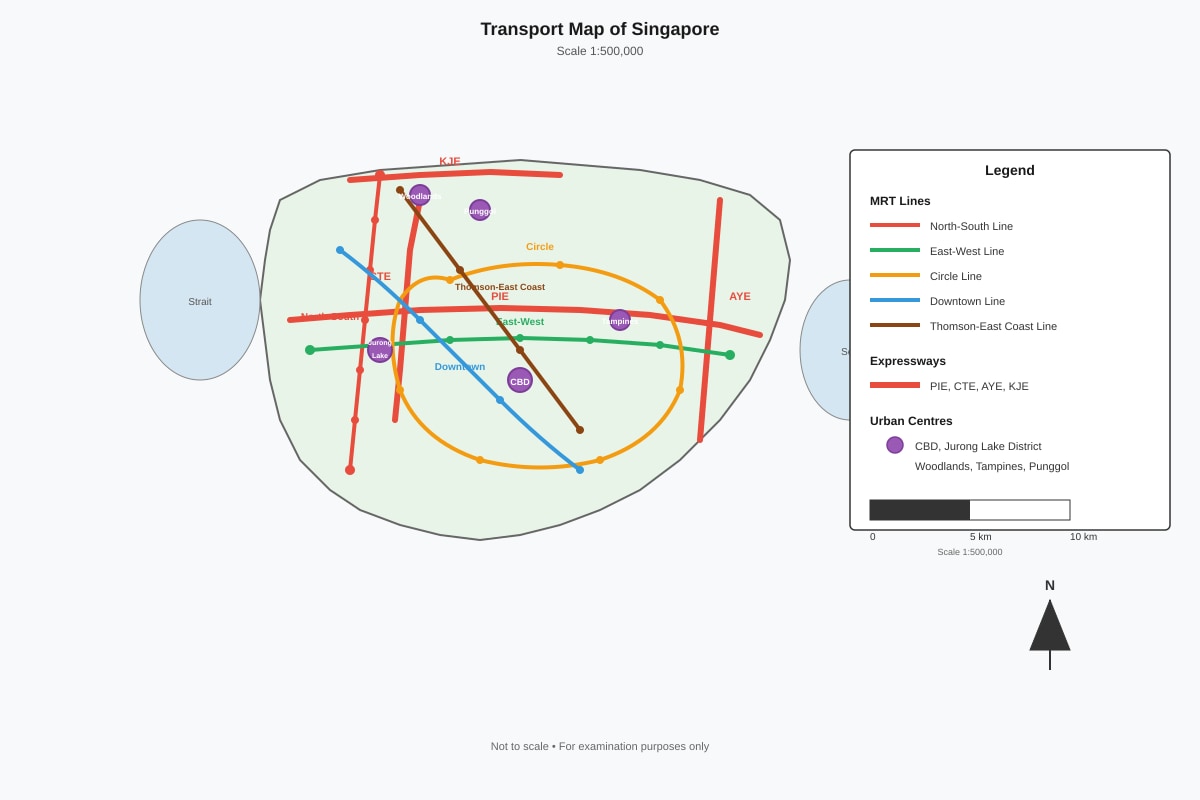
(a) MRT lines form a radial-and-orbital network: radial lines (North-South, East-West, Thomson-East Coast, Downtown) converge on the CBD, while orbital lines (Circle Line, future Cross Island Line) link regional centres (Jurong, Tampines, Punggol, Woodlands) without passing through CBD. Coverage is dense in central/south, extending to all major regional centres.
[2]
Mark breakdown: 1 mark for radial + orbital pattern; 1 mark for convergence on CBD / linking regional centres.
(b) Jurong Lake District is served by multiple MRT lines (East-West Line, Circle Line, Jurong Region Line, future Cross Island Line), making it a major interchange hub. It lies at the junction of AYE and PIE expressways, providing road connectivity to Tuas Port, CBD, and northern industrial estates. This multi-modal accessibility supports its role as a second CBD for work-live-play.
[3]
Mark breakdown: 1 mark for MRT interchange (2+ lines); 1 mark for expressway connectivity; 1 mark for linking to second CBD function.
(c)
- Challenge: Poor public transport access — Location X is not on an MRT line, so residents depend on feeder buses or cars, leading to longer commutes, congestion, car dependency.
- Solution: Extend MRT / build new station (e.g. extend Thomson-East Coast or Cross Island Line), or implement dedicated bus corridors / Bus Rapid Transit (BRT) linking X to nearest MRT (Punggol / Punggol Coast).
[2]
Mark breakdown: 1 mark for realistic challenge (accessibility / congestion / car reliance); 1 mark for feasible government solution (MRT extension / BRT / feeder upgrade).
END OF ANSWER KEY
Total Marks: 50
This answer key is for teacher/marker reference. Allow reasonable alternatives where geographical reasoning is sound.