AI Generated Exam Paper
Secondary 2 Geography Practice Paper 2
Free Sec 2 Geography Practice Paper 2, Nemo3 AI version, with questions, answers, and syllabus-aligned practice for Singapore students.
These static practice materials are generated from the site's syllabus and paper-generation workflow, with source and model context shown so students and parents can evaluate the material before use.
Questions
Free quiz and exam paper access
Enter your details to view this paper
Your access is remembered on this device.
Answers
TuitionGoWhere Practice Paper - Geography Secondary 2 (Answer Key)
Subject: Geography
Level: Secondary 2 (G2/G3)
Paper: Practice Paper 2 (Map, Graph & Data Skills) — Version 2
Total Marks: 50
Section A: Map Skills (20 marks)
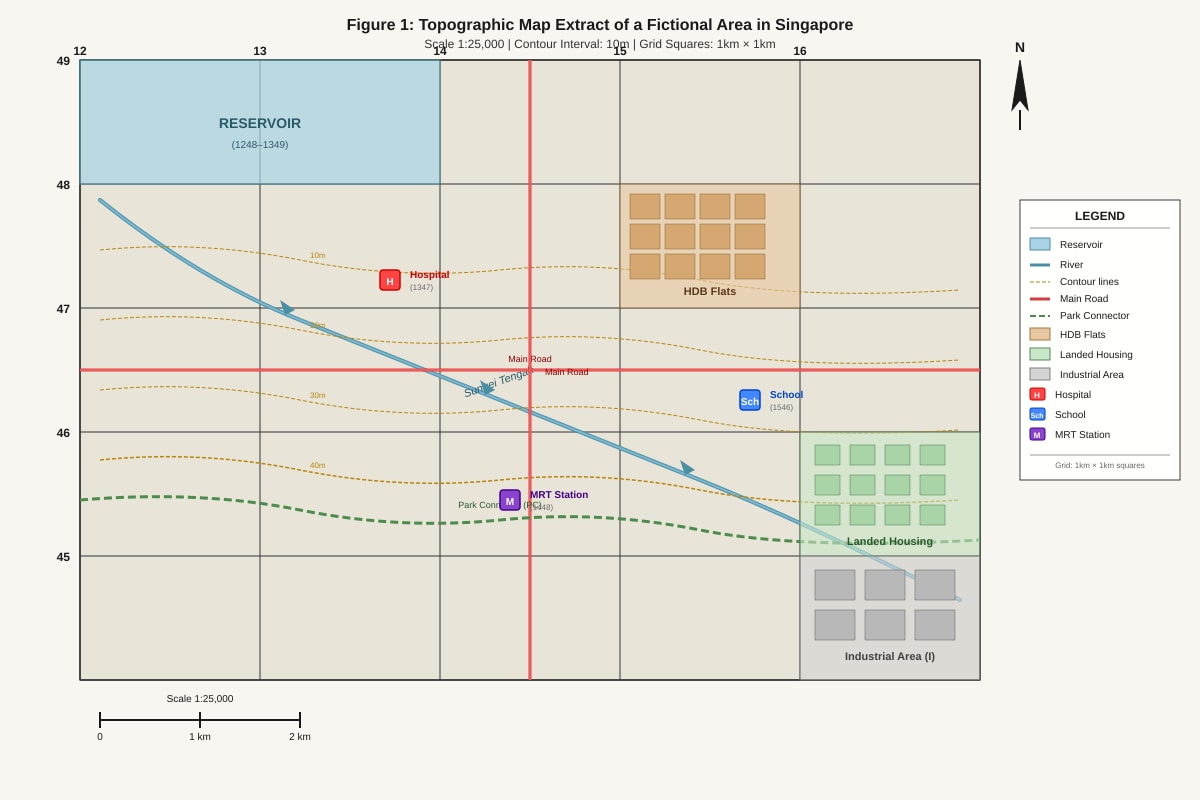
1 1347
[1]
Marking note: Easting (13) first, then northing (47). No marks if reversed (4713) or six-figure given.
2 152462 (or 152463 / 153462 depending on exact position within grid square)
[2]
Marking: 1 mark for correct easting (152–153), 1 mark for correct northing (462–463).
Method: Six-figure grid reference = easting (3 digits) + northing (3 digits). Subdivide grid square 1546 into tenths. School symbol typically centred → 152462 or 153462. Accept reasonable estimates within the grid square.
3 1.0 km (accept 0.9–1.1 km)
[2]
Working:
- Map distance between MRT (1448) and Hospital (1347) ≈ 4 cm (diagonal across one grid square).
- Scale 1:25,000 → 1 cm = 0.25 km.
- 4 cm × 0.25 km/cm = 1.0 km.
Marking: 1 mark for correct measurement (3.5–4.5 cm), 1 mark for correct conversion to km.
4 Sungei Tengah flows from northwest to southeast.
Evidence: The river starts at higher contour values (30–40 m) in the northwest (grid squares 1248–1348) and flows towards lower contour values (10–20 m) in the southeast (grid squares 1446–1545), entering the reservoir.
[2]
Marking: 1 mark for correct direction (NW to SE / north-west to south-east), 1 mark for map evidence (contour values / relief / reservoir location).
5 1:250
[3]
Working:
- Vertical interval (VI) = 40 m – 20 m = 20 m.
- Horizontal equivalent (HE) = distance between grid references 1346 and 1446 = 1 km = 1000 m (one grid square easting).
- Gradient = VI : HE = 20 : 1000 = 1 : 50.
Wait — correction: Grid squares are 1 km × 1 km. Easting 13 to 14 = 1 km = 1000 m.
Gradient = 20/1000 = 1/50 → 1:50.
Marking: 1 mark for VI = 20 m, 1 mark for HE = 1000 m (or 1 km), 1 mark for correct ratio 1:50.
Common mistake: Using cm on map instead of ground distance; forgetting to convert km to m.
6 HDB flats / High-density residential / Public housing
[1]
Marking: Accept any reasonable description of high-rise public housing.
7 Two reasons with map evidence:
- Accessibility – Located near main road and MRT station (1448), allowing easy access for patients and ambulances. [1]
- Central to residential areas – Surrounded by HDB flats (1547, 1447) and landed housing (1346), serving a large population. [1]
- Flat land – Situated on relatively low, gentle slope (contours 20–30 m), suitable for building. [1]
Marking: Any two valid reasons with map evidence. 1 mark per reason (reason + evidence).
8 (a) Southeast / South-easterly
[1]
(b) Physical constraint: Steep slopes / hilly terrain (contour lines close together at 30–40 m near reservoir) may make construction difficult and increase erosion risk.
Human constraint: Existing land use (industrial area at 1347, HDB flats at 1447) may require land acquisition or cause noise/disruption to residents.
[4]
Marking: 1 mark for physical constraint + explanation, 1 mark for human constraint + explanation. Each must be specific to map evidence.
Section B: Graph and Data Interpretation (18 marks)
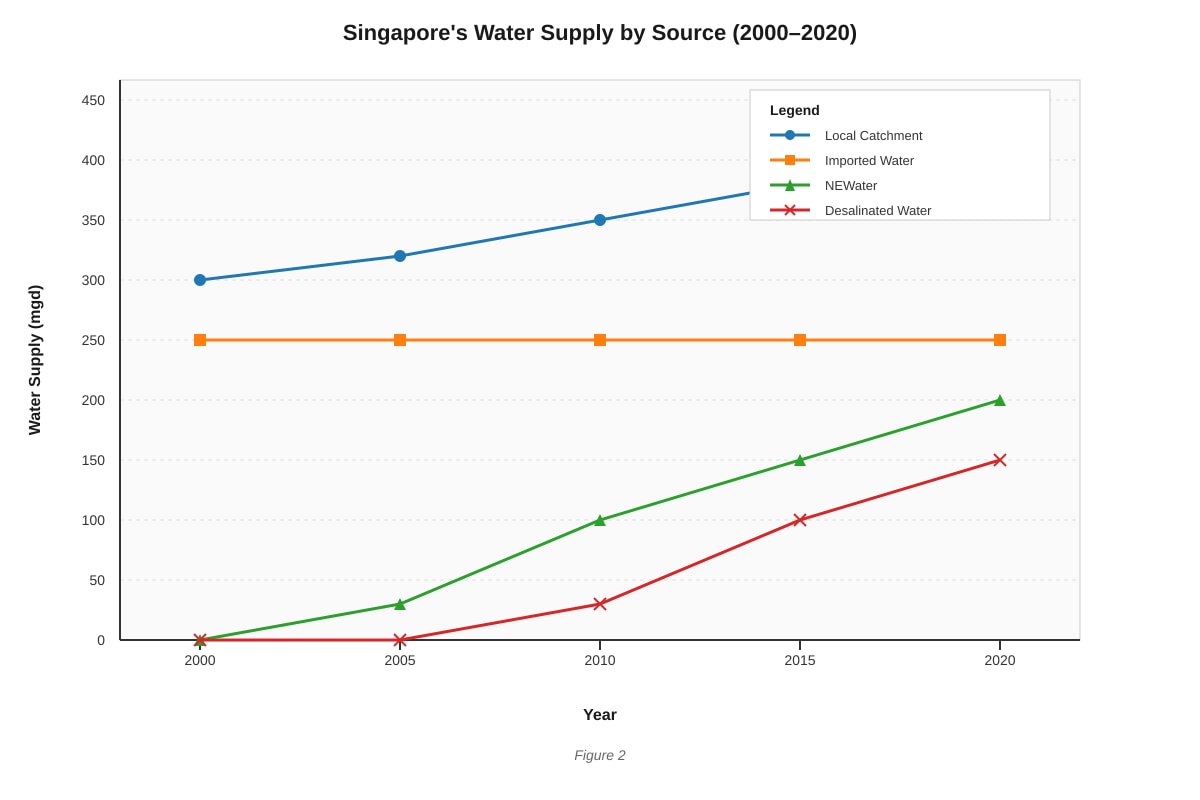
9 1000 mgd (or 1000 million gallons per day)
[1]
Working: 400 (Local) + 250 (Imported) + 200 (NEWater) + 150 (Desal) = 1000 mgd.
10 100%
[2]
Working:
- NEWater 2010 = 100 mgd; NEWater 2020 = 200 mgd.
- Increase = 200 – 100 = 100 mgd.
- % increase = (100 ÷ 100) × 100% = 100%.
Marking: 1 mark for correct values, 1 mark for correct calculation and answer.
11 Imported water supply remained constant at 250 mgd from 2000 to 2020.
[1]
Marking: Must mention "constant", "unchanged", or "remained at 250 mgd".
12 Singapore improved water sustainability by diversifying its water sources and reducing reliance on imported water.
- In 2000, Singapore relied on only two sources: local catchment (300 mgd) and imported water (250 mgd).
- By 2020, NEWater (200 mgd) and desalinated water (150 mgd) were added, making up 35% of total supply.
- Local catchment increased from 300 to 400 mgd through reservoir expansion.
- Imported water remained capped at 250 mgd (per water agreements), so its share dropped from ~45% to 25%.
- This "Four National Taps" strategy ensures resilience against drought and geopolitical risks.
[4]
Marking: 1 mark for identifying diversification / Four National Taps; 1 mark for data reference (NEWater/Desal increase); 1 mark for reduced reliance on imported water; 1 mark for link to sustainability/resilience.
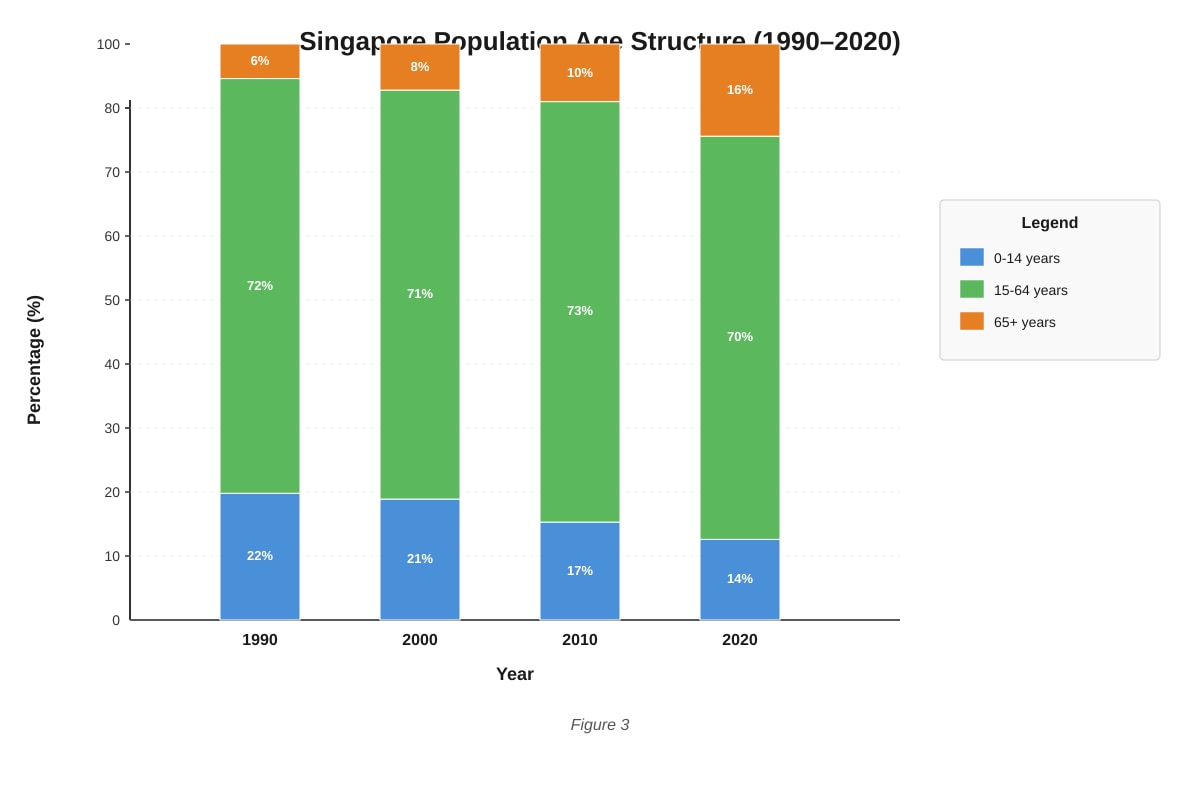
13 2010 (73%)
[1]
14 42.9 (or 43)
[2]
Working:
- Dependents (0–14 + 65+) = 14% + 16% = 30%.
- Working age = 70%.
- Dependency ratio = (30 ÷ 70) × 100 = 42.86 ≈ 42.9.
Marking: 1 mark for correct dependent total (30%), 1 mark for correct formula and answer.
15 Two challenges:
- Ageing population / rising elderly dependency – Elderly (65+) rose from 6% (1990) to 16% (2020), increasing demand for healthcare, eldercare, and pension support, while the working-age share declines.
- Shrinking workforce / labour shortage – Working-age population (15–64) peaked at 73% (2010) and fell to 70% (2020); with low birth rates (0–14 down from 22% to 14%), future labour supply will tighten, affecting economic growth.
[4]
Marking: 2 marks per challenge (1 for identification with data, 1 for explanation of impact). Must use Figure 3 data.
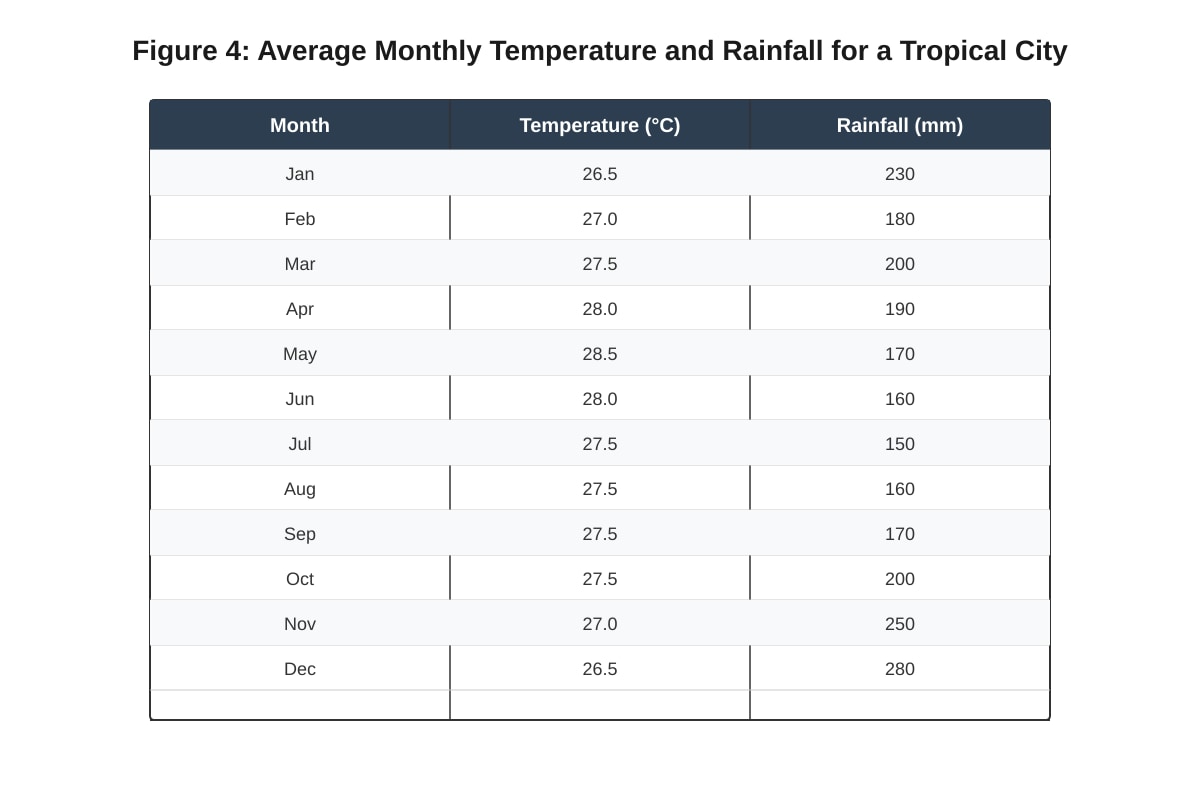
16 2.0 °C
[1]
Working: Highest temp = 28.5 °C (May); Lowest temp = 26.5 °C (Jan/Dec); Range = 28.5 – 26.5 = 2.0 °C.
17 Wettest: December (280 mm); Driest: July (150 mm); Difference: 130 mm
[2]
Marking: 1 mark for correct identification of both months, 1 mark for correct difference (280 – 150 = 130 mm).
Section C: Data Skills and Fieldwork Application (12 marks)
18 (a) Hypothesis: "Traffic congestion near the school is highest at 7:00 am on weekdays due to peak-hour school drop-offs."
[1]
Marking: Must be testable, specific, and related to time/location.
(b) Two types of primary data:
- Vehicle counts by type (cars, buses, motorcycles, heavy vehicles) at each time slot.
- Queue length / waiting time at school entrance or nearby junction.
(Also accept: Pedestrian counts, traffic speed, number of illegal parking incidents.)
[2]
Marking: 1 mark each. Must be primary (collected first-hand) and relevant.
(c) Sampling method: Systematic sampling – Select observation points at fixed intervals (e.g., every 50 m) along the main road leading to the school gate.
Or: Stratified sampling – Divide the zone into entry/exit points, drop-off zones, and main road junctions; select points from each stratum.
[2]
Marking: 1 mark for naming method, 1 mark for description applied to context.
(d) Limitation: Weekday data does not capture weekend/holiday traffic patterns, which may differ due to tuition, enrichment classes, or family activities; thus, conclusions cannot be generalised to all days.
[1]
Marking: 1 mark for valid limitation linked to time/sampling bias.
19 (a) Advantage: Bar graphs allow easy visual comparison of discrete categories (e.g., vehicle counts at 7 am, 12 pm, 6 pm) and show magnitude clearly.
[1]
(b) Disadvantage: Bar graphs do not show continuous change over time (unlike line graphs) and cannot easily display multiple variables (e.g., vehicle types) without becoming cluttered.
[1]
Marking: Accept any valid advantage/disadvantage specific to bar graphs for this data type.
20 Evaluation: The conclusion is partially valid but incomplete.
- Supporting evidence: 7:00 am likely has the highest vehicle count (peak drop-off), so congestion volume is highest.
- Limitations: Congestion depends not only on vehicle count but also on road capacity, traffic light timing, parking behaviour, pedestrian crossings, and weather. A high count at 6:00 pm with narrower roads (e.g., due to parked cars) could cause worse congestion. The students only measured count, not congestion (speed, delay, queue length).
Improvement: Collect traffic speed or queue length data at the same times to directly measure congestion, not just volume.
[3]
Marking: 1 mark for evaluation (valid but limited), 1 mark for explaining why vehicle count ≠ congestion, 1 mark for specific improvement.
TOTAL: 50 MARKS