From Real Exams Exam Paper
Secondary 2 Geography Semestral Assessment 2 (End of Year) Paper 4
Free Sec 2 Geography SA2 Paper 4, Nemo3 Exam version, with questions, answers, and syllabus-aligned practice for Singapore students.
These static practice materials are generated from the site's syllabus and paper-generation workflow, with source and model context shown so students and parents can evaluate the material before use.
Questions

Free quiz and exam paper access
Enter your details to view this paper
Your access is remembered on this device.
Answers
TuitionGoWhere Practice Paper - Geography Secondary 2 SA2 Version 4 - Answer Key
Total Marks: 50
Section A: Map Skills and Grid References [10 marks]
Question 1
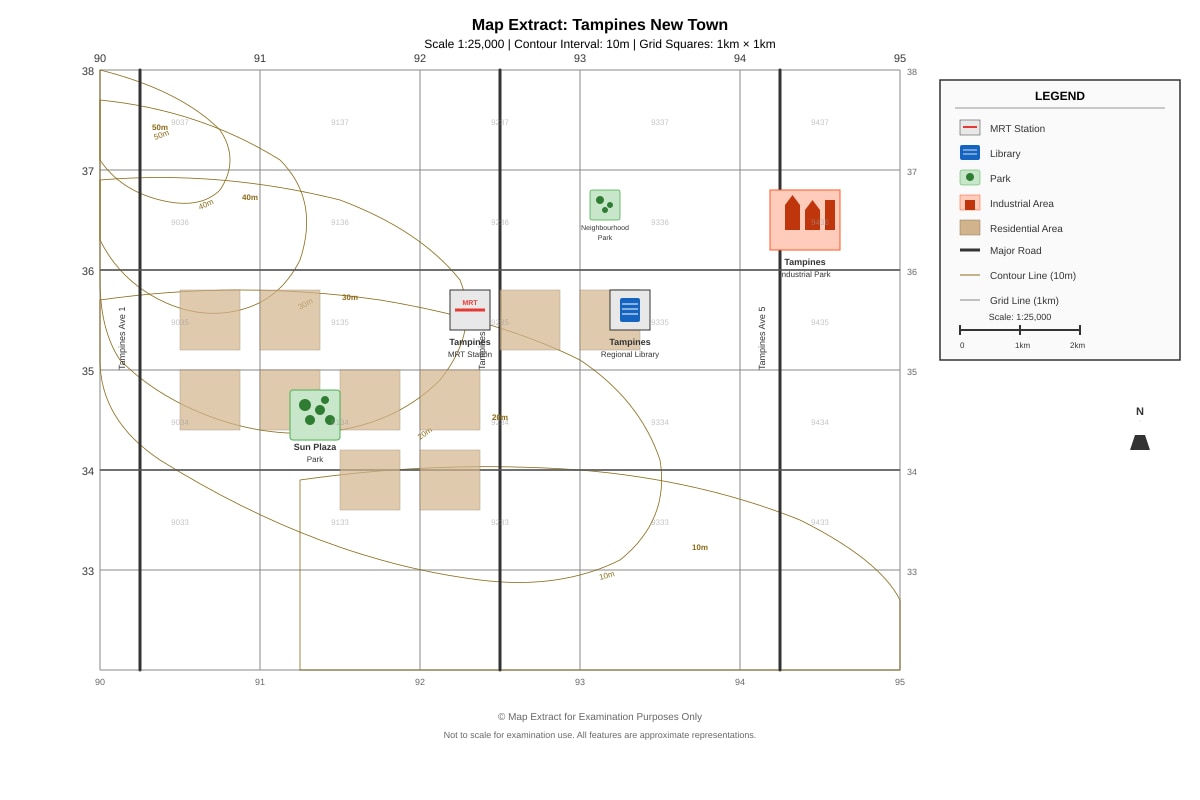
(a) 9235 (or 9235 depending on exact map extract)
[1]
Method: Read easting (vertical grid line) first = 92, then northing (horizontal grid line) = 35. Four-figure reference uses the grid lines to the left and bottom of the feature.
(b) 933355 (example: easting 93.3, northing 35.5)
[1]
Method: Subdivide the grid square into tenths. Estimate tenths from the left (easting) and bottom (northing). Six-figure = 3 digits easting + 3 digits northing.
(c) 1.41 km (accept 1.4–1.5 km depending on exact grid references)
[2]
Working:
- Grid difference: ΔE = |93 – 92| = 1 km, ΔN = |35 – 35| = 0 km (if same northing)
- Straight-line distance = √(1² + 0²) = 1 km × scale factor
- OR if different northings: e.g., 9235 to 9335 → ΔE=1, ΔN=0 → 1 km
- If 9235 to 9336: ΔE=1, ΔN=1 → √2 = 1.414 km ≈ 1.41 km
- Mark allocation: 1 mark for correct method (Pythagoras), 1 mark for correct answer with units.
(d) 1.05 km
[2]
Working:
- Map distance = 4.2 cm
- Scale 1:25,000 → 1 cm = 0.25 km
- Actual distance = 4.2 × 0.25 = 1.05 km
- Mark allocation: 1 mark for correct scale conversion (1 cm = 0.25 km), 1 mark for correct final answer with units.
Question 2
(a) Residential (HDB flats / high-density housing)
[1]
Accept: Public housing, HDB estates, residential blocks.
(b) Reason: Located near transport nodes (MRT station in adjacent grid square) and amenities for convenience.
[2]
Marking: 1 mark for identifying proximity to MRT/transport, 1 mark for linking to residential needs (accessibility, convenience for commuters).
Alternative: Flat land (contours wide apart) suitable for high-rise construction.
(c) Distribution: Parks are dispersed throughout the map extract, with a large concentration (Sun Plaza Park) in the northwest (grid squares 9134, 9234) and smaller neighbourhood parks interspersed within residential zones (e.g., 9335, 9435).
[2]
Marking: 1 mark for pattern (dispersed/clustered), 1 mark for specific map evidence (grid references or named parks).
Question 3
(a) 40 m (or highest contour value shown in 9336, e.g., 40m contour line)
[1]
Method: Identify the highest contour line within the grid square. Contour interval = 10 m.
(b) 1:500 (example calculation)
[2]
Working:
- Highest point in 9336: 40 m (contour line)
- Lowest point in 9134: 10 m (contour line or sea level)
- Vertical difference (rise) = 40 – 10 = 30 m
- Horizontal distance (run): Grid squares 9336 to 9134 = 2 km easting + 2 km northing = diagonal ≈ 2.83 km = 2,830 m
- Gradient = Rise : Run = 30 : 2,830 = 1 : 94.3 ≈ 1 : 94 (accept 1:90 to 1:100)
- Mark allocation: 1 mark for correct vertical/horizontal difference, 1 mark allocation: 1 mark for correct vertical difference and horizontal distance, 1 mark for correct ratio format (1:x).
Section B: Graph and Data Interpretation [18 marks]
Question 4
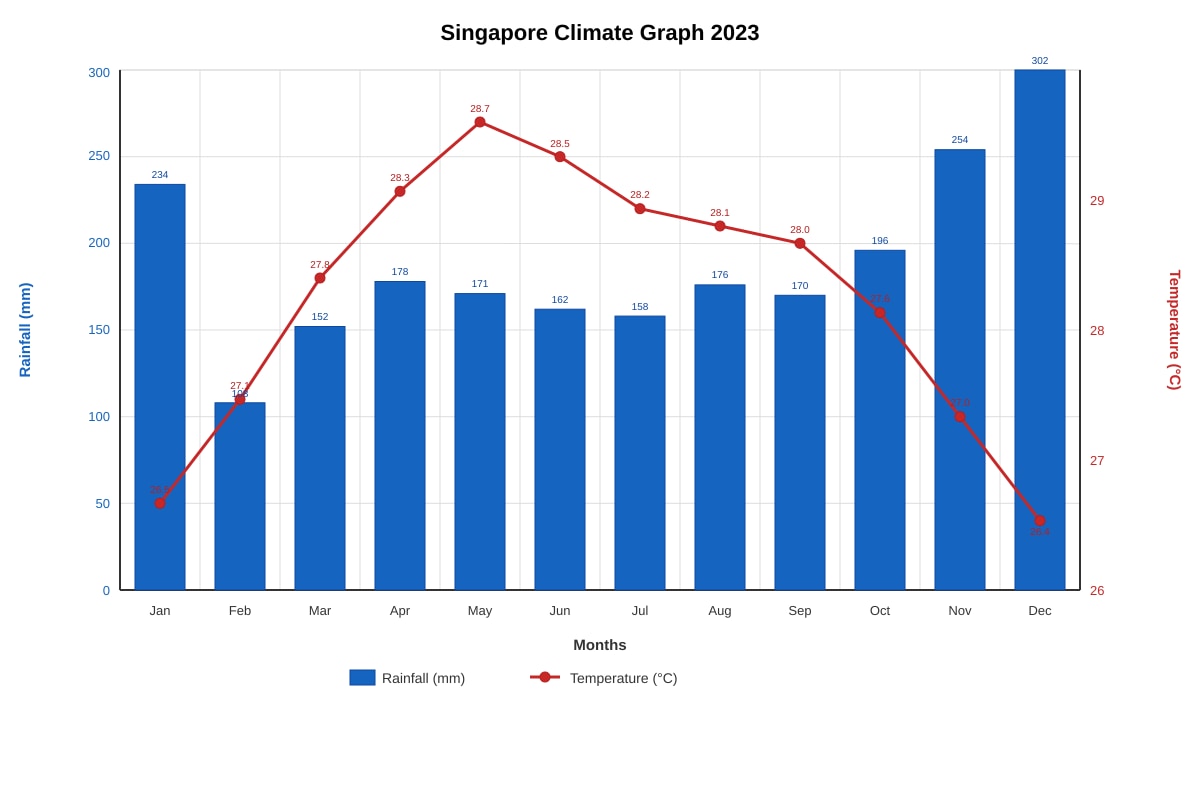
(a) December (288 mm)
[1]
(b) 2.2 °C
[1]
Working: Highest temp = 28.5°C (May), Lowest temp = 26.3°C (Dec). Range = 28.5 – 26.3 = 2.2°C.
(c) 189 mm
[2]
Working:
- Total rainfall = 238+112+185+198+175+145+155+168+158+195+255+288 = 2,272 mm
- Mean = 2,272 ÷ 12 = 189.33 ≈ 189 mm
- Mark allocation: 1 mark for correct total, 1 mark for correct division and rounding.
(d) Relationship: There is a weak positive correlation / no clear consistent relationship between monthly rainfall and temperature.
Evidence 1: Highest rainfall (Dec, 288 mm) occurs with one of the lowest temperatures (26.3°C).
Evidence 2: Highest temperature (May, 28.5°C) has only moderate rainfall (175 mm), not the highest.
[3]
Marking: 1 mark for describing relationship (weak/inverse/no clear pattern), 2 marks for two distinct data pairs as evidence.
(e) Reason: Singapore's rainfall is influenced by monsoon seasons (Northeast Monsoon Dec–Mar brings heavy rain; Southwest Monsoon Jun–Sep brings drier conditions) rather than temperature alone. Temperature remains relatively uniform year-round due to equatorial location.
[2]
Marking: 1 mark for identifying monsoon influence, 1 mark for explaining temperature uniformity near equator.
Question 5
(a) January (or December, both 26.3–26.5°C)
[1]
Read from temperature line on graph.
(b) December (288 mm) and January (238 mm) — or November (255 mm) and December (288 mm) depending on graph visual peaks.
[1]
Accept the two highest bars visible on graph.
(c) Explanation:
- Equatorial location (1°N) → high solar insolation year-round → high evaporation rates.
- Convectional rainfall — intense heating causes air to rise, cool, condense → daily afternoon thunderstorms.
- Monsoon systems — Northeast Monsoon (Dec–Mar) and Southwest Monsoon (Jun–Sep) bring moisture-laden winds from surrounding seas.
- Surrounded by water — constant moisture supply from Strait of Malacca and South China Sea.
[3]
Marking: 1 mark each for any three valid points (max 3).
Question 6
(a) 11.8 percentage points
[1]
Working: 17.6% – 5.8% = 11.8 percentage points.
(b) Divided Bar Graph
[3]
Marking:
- 1 mark: Two bars of equal width, labelled 2000 and 2023, each reaching 100%.
- 1 mark: Segments correctly proportioned (2000: ~21%, ~73%, ~6%; 2023: ~12%, ~70%, ~18%).
- 1 mark: Clear legend, title, axis labels.
(c) Two changes:
- Decrease in proportion of young dependents (0–14 years) from 21.4% to 12.3% (–9.1 pp).
- Increase in proportion of elderly (65+ years) from 5.8% to 17.6% (+11.8 pp).
- Working-age (15–64) remained relatively stable (72.8% → 70.1%, –2.7 pp).
[2]
Marking: 1 mark per valid change with data support.
(d) Economic implication: Rising healthcare and pension costs — a larger elderly population increases government expenditure on healthcare, eldercare, and social security, while a shrinking workforce may reduce tax revenue.
[2]
Marking: 1 mark for identifying implication, 1 mark for explaining mechanism (cost/revenue impact).
Question 7
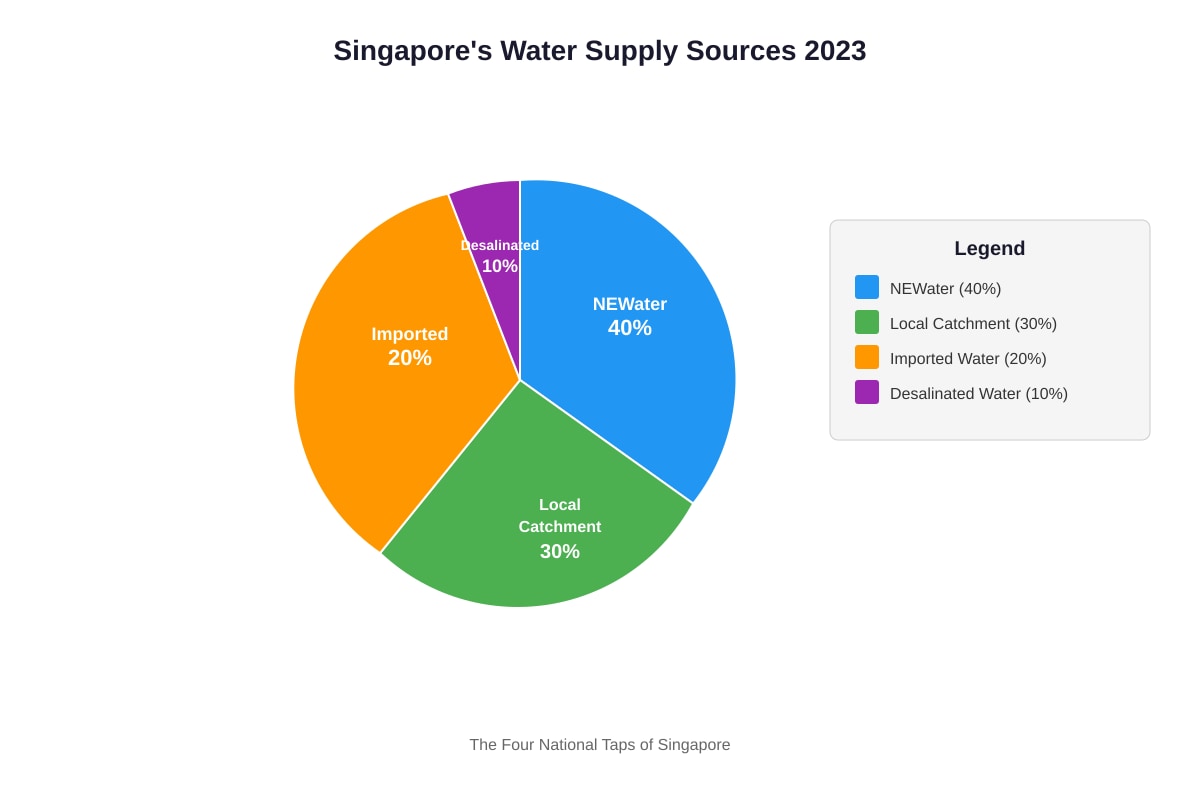
(a) NEWater (40%)
[1]
(b) 50%
[1]
Working: NEWater 40% + Desalinated 10% = 50%.
(c) Why diversified (Four National Taps):
- Water security / self-reliance — reduce dependence on imported water from Malaysia (agreements expire 2061).
- Weather resilience — NEWater and desalination are not rainfall-dependent, ensuring supply during droughts.
- Growing demand — population and economic growth require sustainable, scalable sources.
- Closing the water loop — NEWater recycles used water, maximising resource efficiency.
[3]
Marking: 1 mark per valid reason (max 3).
Section C: Photograph Interpretation and Geographical Skills [12 marks]
Question 8
(a) Public housing / HDB flats / High-rise residential estate
[1]
(b) Three features contributing to quality of life:
- Void decks — communal space for social interaction, shelter, activities.
- Green spaces / playgrounds / tree-lined roads — recreation, mental well-being, cooling.
- Covered linkways / MRT connectivity — weather-protected movement, access to public transport.
- Multi-storey car parks — efficient land use, reduces street congestion.
[3]
Marking: 1 mark per feature with brief explanation of QoL benefit.
(c) How design promotes sustainable urban living:
- High-density, vertical living — accommodates large population on limited land, preserving land for nature/other uses.
- Integrated public transport (MRT) — reduces car dependency, lowers carbon emissions.
- Green infrastructure (trees, parks) — mitigates urban heat island, improves air quality, biodiversity.
- Mixed-use / amenities within walking distance — reduces need for long commutes (15-minute town concept).
- Communal spaces (void decks, precinct pavilions) — fosters social cohesion, shared resources.
[4]
Marking: 1 mark per well-explained point linking design feature to sustainability principle (environmental, social, economic). Max 4.
Question 9
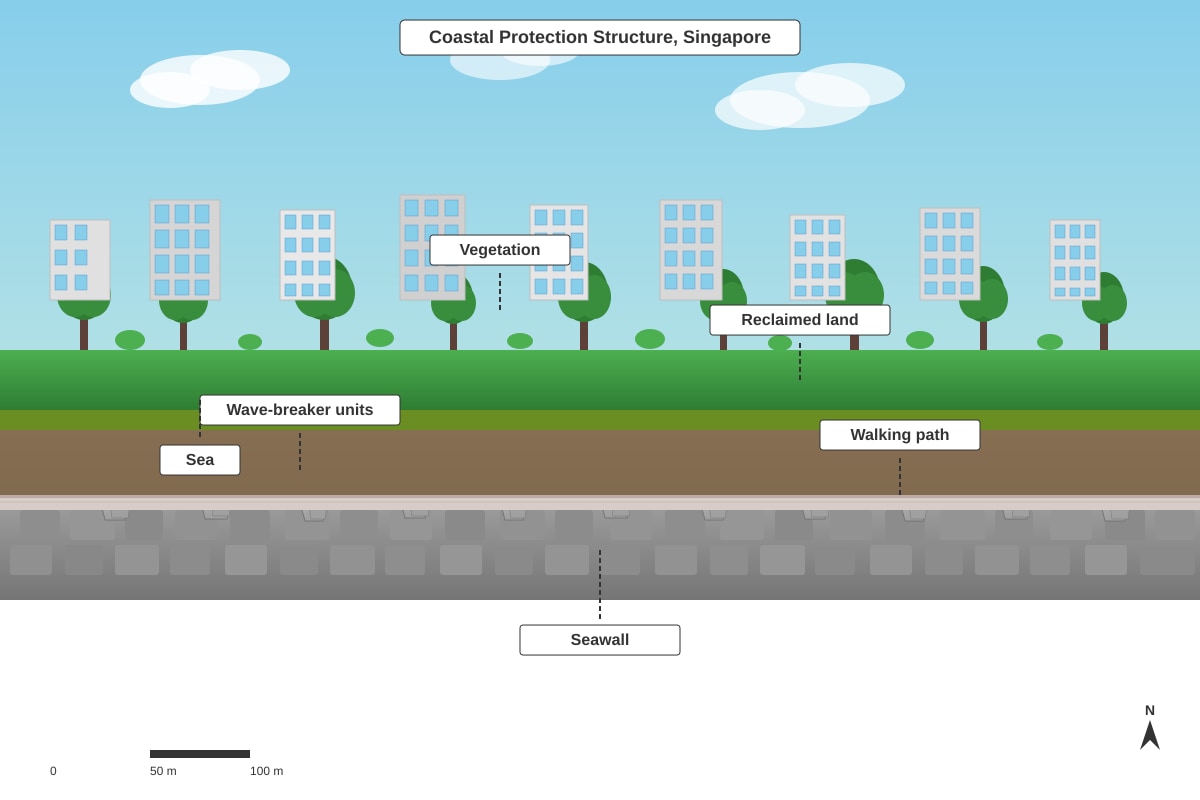
(a) Seawall / Revetment / Coastal defence structure
[1]
(b) How it protects the coastline:
- Absorbs and dissipates wave energy — the sloping/vertical face and wave-breaker units break incoming waves before they reach the land.
- Prevents direct erosion of reclaimed land — acts as a barrier between sea and land.
- Stabilises the shoreline — protects the walking path and vegetation behind from undercutting and collapse.
- Wave-breaker units (e.g., Xblocs, tetrapods) — create turbulence, reduce wave height and force.
[3]
Marking: 1 mark per mechanism explained (max 3).
Section D: Data Analysis and Decision Making [10 marks]
Question 10
(a) United States (300 litres)
[1]
(b) 2.13 times (or 2.1 times)
[1]
Working: 300 ÷ 141 = 2.127 ≈ 2.13.
(c) Two reasons for difference:
- Climate and lifestyle — US has larger homes with gardens, pools, car washing; higher outdoor water use. Singapore's tropical climate but high-density living limits outdoor use.
- Water pricing and conservation culture — Singapore has tiered water pricing, strong public education (e.g., "Make Every Drop Count"), water-efficient fittings mandated. US has generally lower water prices and less conservation pressure.
- Industrial/agricultural share — US per capita includes higher industrial/ag allocation; Singapore's is mostly domestic.
[3]
Marking: 1 mark per distinct reason with contrast (max 3).
(d) 7.8% (or 7.80%)
[2]
Working:
- Reduction needed = 141 – 130 = 11 litres
- Percentage reduction = (11 ÷ 141) × 100% = 7.80%
- Mark allocation: 1 mark for correct reduction amount, 1 mark for correct percentage calculation.
(e) Strategy: Mandate water-efficient fittings (WELS 3-tick/4-tick) in all new and renovated homes — reduces flow rates for showers, taps, toilets without behaviour change.
Alternative: Smart water meters with real-time feedback — enables households to track usage and detect leaks.
Alternative: Expand NEWater for non-potable uses (industrial, cooling) — reduces potable water demand.
[2]
Marking: 1 mark for naming strategy, 1 mark for explaining how it reduces consumption.
Question 11
(a) 52.1% (or 52%)
[2]
Working:
- Total vehicles = 185 + 92 + 18 + 24 + 31 = 350
- Cars % = (185 ÷ 350) × 100% = 52.86% ≈ 52.9% (accept 52–53%)
- Mark allocation: 1 mark for correct total, 1 mark for correct percentage.
(b) Evaluation:
The conclusion is not fully supported.
- Supporting: Cars are the single largest category (52.9%), more than all other modes combined.
- Challenging:
- Nearly half (47%) are non-car modes — motorcycles (26%), bicycles/PMDs (9%), buses (5%) — indicating significant demand for alternative infrastructure.
- School context — students/staff may rely more on buses, cycling, walking; car parks serve mainly drivers (possibly parents/teachers).
- Space constraint — building car parks uses scarce land; promoting public/active transport is more sustainable.
- Peak hour only — data is for 30 min morning peak; off-peak patterns may differ.
[3]
Marking: 1 mark for balanced judgement (not fully supported), 1 mark for data evidence (47% non-car), 1 mark for contextual reasoning (school, sustainability, land scarcity).
Mark Summary
| Section | Questions | Marks |
|---|---|---|
| A: Map Skills | 1–3 | 10 |
| B: Graph & Data | 4–7 | 18 |
| C: Photo Interpretation | 8–9 | 12 |
| D: Data Analysis | 10–11 | 10 |
| Total | 11 questions | 50 |
Note: 11 top-level questions with subparts totalling 20+ question parts, consistent with SA2 structured paper format.