From Real Exams Exam Paper
Secondary 2 Geography Semestral Assessment 2 (End of Year) Paper 3
Free Sec 2 Geography SA2 Paper 3, Nemo3 Exam version, with questions, answers, and syllabus-aligned practice for Singapore students.
These static practice materials are generated from the site's syllabus and paper-generation workflow, with source and model context shown so students and parents can evaluate the material before use.
Questions
Free quiz and exam paper access
Enter your details to view this paper
Your access is remembered on this device.
Answers
TuitionGoWhere Practice Paper - Geography Secondary 2 (SA2 Version 3) - Answer Key
Total Marks: 50
SECTION A: MAP READING SKILLS [15 marks]
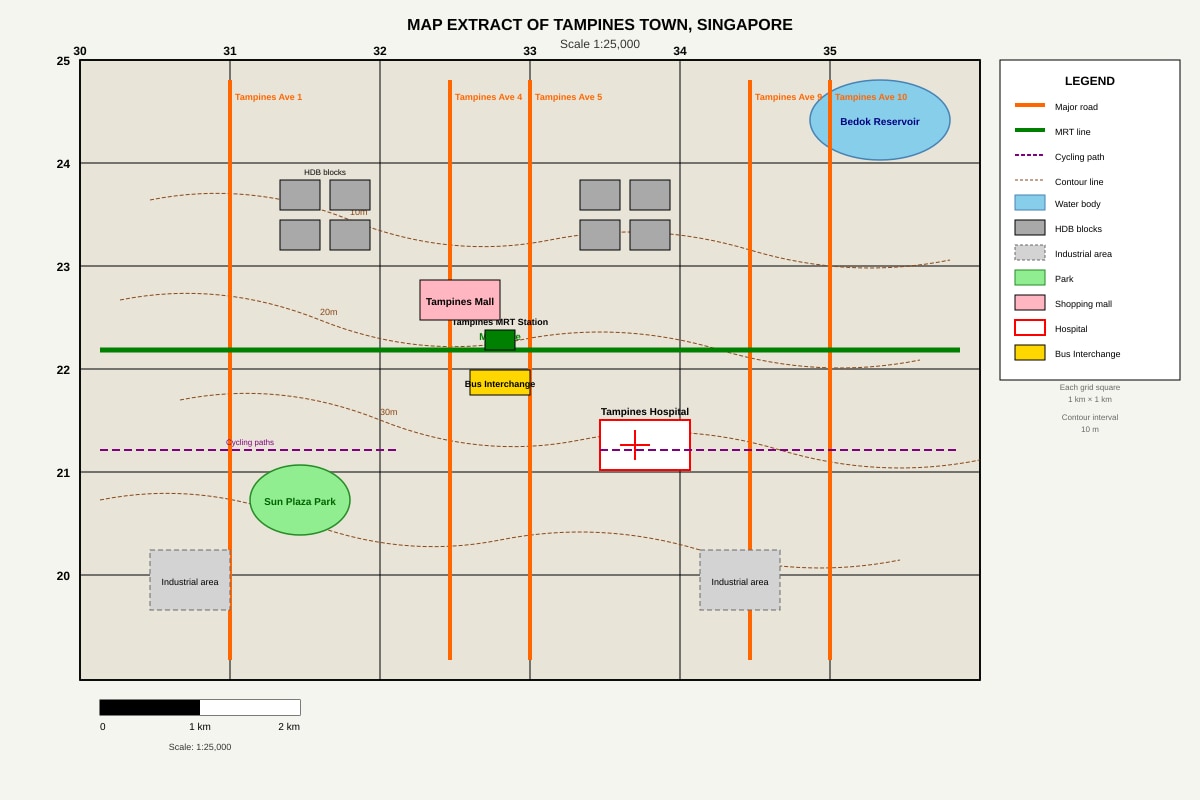
1. Four-figure grid reference of Tampines Hospital [1]
Answer: 3221
Marking: 1 mark for correct four-figure grid reference (easting 32, northing 21).
Explanation: Four-figure grid references identify a 1 km × 1 km grid square. Read the easting (vertical grid line) first, then the northing (horizontal grid line). Tampines Hospital lies in the square bounded by easting 32 and northing 21 → 3221.
Common mistake: Reversing easting and northing (writing 2132) or giving a six-figure reference.
2. Six-figure grid reference of the Bus Interchange [1]
Answer: 323215 (or 323216 depending on exact position within the square)
Marking: 1 mark for correct six-figure grid reference. Accept ±1 in the third/sixth digit if the feature is near a boundary.
Explanation: Six-figure references subdivide the grid square into 10 × 10 (each subdivision = 100 m). The Bus Interchange is in grid square 3221. Estimate tenths: ~3/10 east of easting 32 → 323; ~5/10 north of northing 21 → 215 → 323215.
Method: Easting first (323), then northing (215).
3. Straight-line distance between Tampines MRT Station and Sun Plaza Park [2]
Answer: 1.2 – 1.4 km (accept range based on measurement)
Marking:
- 1 mark for correct measurement on map (e.g., 4.8–5.6 cm)
- 1 mark for correct conversion using scale 1:25,000
Working: - Measure distance on map: ~5.0 cm
- Scale 1:25,000 → 1 cm = 25,000 cm = 0.25 km
- 5.0 cm × 0.25 km/cm = 1.25 km
Note: Accept answers between 1.2–1.4 km depending on exact measurement.
4. Contour lines and gradient [3]
(a) Highest elevation in grid square 3222 [1]
Answer: 40 m (or highest contour value shown in that square)
Marking: 1 mark for correct reading of highest contour line within the square.
Explanation: Contours are at 10 m intervals. Identify the highest closed contour or highest labelled line within 3222.
(b) Average gradient between 10 m and 30 m contours from A(320220) to B(330220) [2]
Answer: 1 : 1000
Marking:
- 1 mark for correct vertical interval (VI) and horizontal equivalent (HE)
- 1 mark for correct ratio calculation
Working: - Vertical Interval (VI) = 30 m – 10 m = 20 m
- Horizontal Equivalent (HE) = distance from easting 320 to 330 = 1 km = 1000 m
- Gradient = VI : HE = 20 : 1000 = 1 : 50
Wait — correction: The points are A(320220) and B(330220). These are 10 km apart? No — grid references: 320220 means easting 32.0, northing 22.0. 330220 means easting 33.0, northing 22.0. Difference = 1.0 km = 1000 m. VI = 20 m. Gradient = 20/1000 = 1/50 → 1 : 50.
Correct Answer: 1 : 50
Common mistake: Forgetting to convert km to m, or reversing VI/HE.
5. Drainage pattern near grid square 3323 towards Bedok Reservoir [2]
Answer: Dendritic drainage pattern – streams branch like tree roots, joining into larger channels flowing into Bedok Reservoir.
Marking:
- 1 mark for naming "dendritic" (or "branching")
- 1 mark for description linking to map evidence (e.g., "multiple small streams converge")
Explanation: On the map, several small streams (blue lines) originate on higher ground (contours) in 3323 and converge into fewer, larger channels draining into Bedok Reservoir. This branching pattern is dendritic, typical of uniform rock/soil.
6. Why Tampines MRT Station is located at grid square 3221 [3]
Answer:
- Accessibility: Located at junction of Tampines Ave 4 and Ave 5 (major roads) → easy access for commuters.
- Population catchment: Surrounded by high-density HDB blocks (grid squares 3221, 3321, 3222) → large resident population within walking distance.
- Integration: Adjacent to Bus Interchange (323215) and Tampines Mall (commercial hub) → seamless transfer between MRT, bus, shopping, and amenities.
Marking: 1 mark each for any three valid points supported by map evidence (roads, housing density, interchange, commercial).
Key concept: Transport nodes are sited to maximise accessibility and serve high-demand areas (central place theory / transport geography).
7. Proposed cycling path: Tampines Ave 9 (3422) to Bedok Reservoir Park [3]
Answer:
Advantage: Flat terrain (contours widely spaced / low elevation change) → easy cycling, low effort.
Disadvantage: Crosses major roads (Tampines Ave 9, Ave 10) → safety risk, need for traffic crossings/bridges.
OR
Advantage: Direct route, shorter distance.
Disadvantage: Passes through industrial area (noise, pollution, heavy vehicles).
Marking: 1 mark for advantage with map evidence, 1 mark for disadvantage with map evidence, 1 mark for clear linkage to map features (contours, roads, land use).
Key skill: Using map evidence (relief, transport, land use) to evaluate route suitability.
SECTION B: GRAPH AND DATA INTERPRETATION [20 marks]
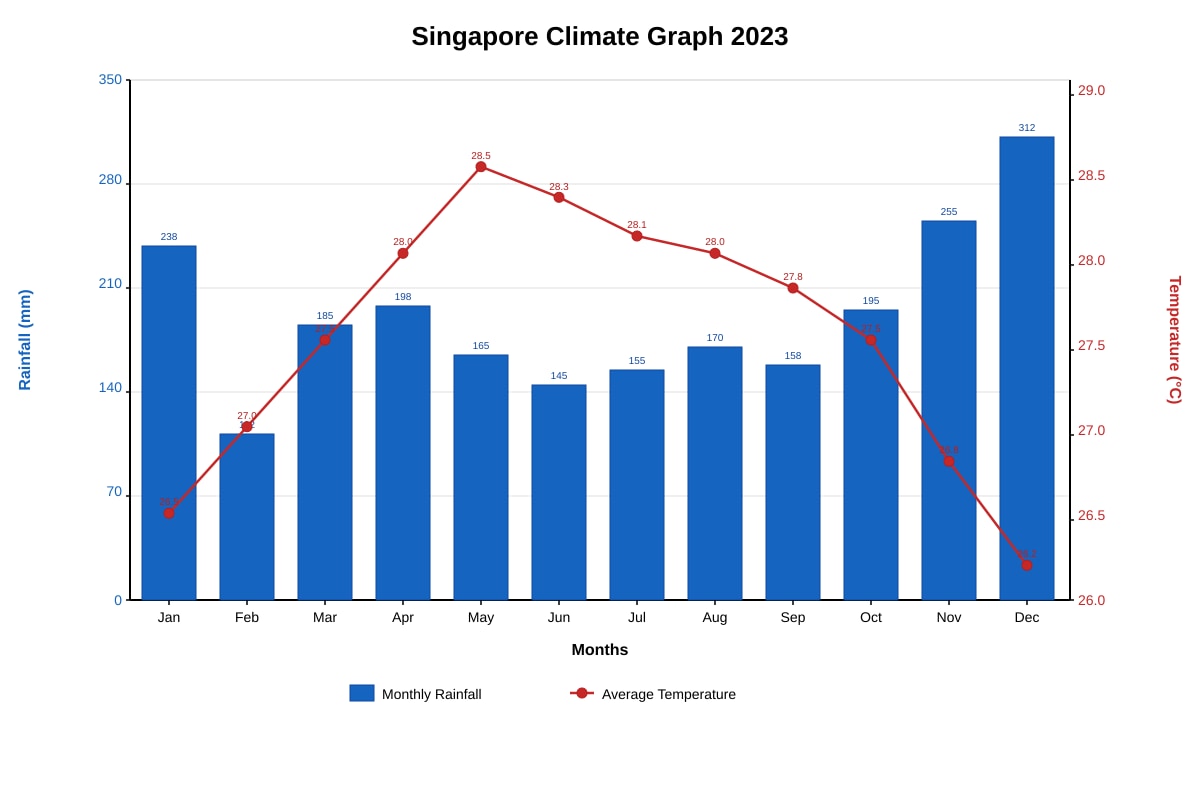
8. Singapore Climate Graph 2023 [6]
(a) Highest rainfall month [1]
Answer: December (312 mm)
Marking: 1 mark for correct month.
(b) Annual rainfall total [1]
Answer: 2,283 mm
Marking: 1 mark for correct sum.
Working: 238+112+185+198+165+145+155+170+158+195+255+312 = 2,283 mm
(c) Relationship between rainfall and temperature [2]
Answer: Generally, higher temperatures coincide with lower rainfall (e.g., Feb–May: temp rises 27→28.5°C, rainfall drops 112→165 mm), but highest rainfall (Nov–Dec) occurs when temperatures are lower (26.2–26.8°C). No strong consistent correlation; both vary within narrow ranges.
Marking: 1 mark for describing inverse/weak pattern, 1 mark for using data examples.
(d) Why high rainfall year-round [2]
Answer:
- Equatorial location (1°N) → high solar insolation year-round → intense evaporation and convection.
- Surrounded by sea → constant moisture supply from maritime air masses.
- Intertropical Convergence Zone (ITCZ) affects Singapore year-round → frequent convectional thunderstorms.
Marking: 1 mark each for any two valid reasons (location, maritime influence, ITCZ/convection).
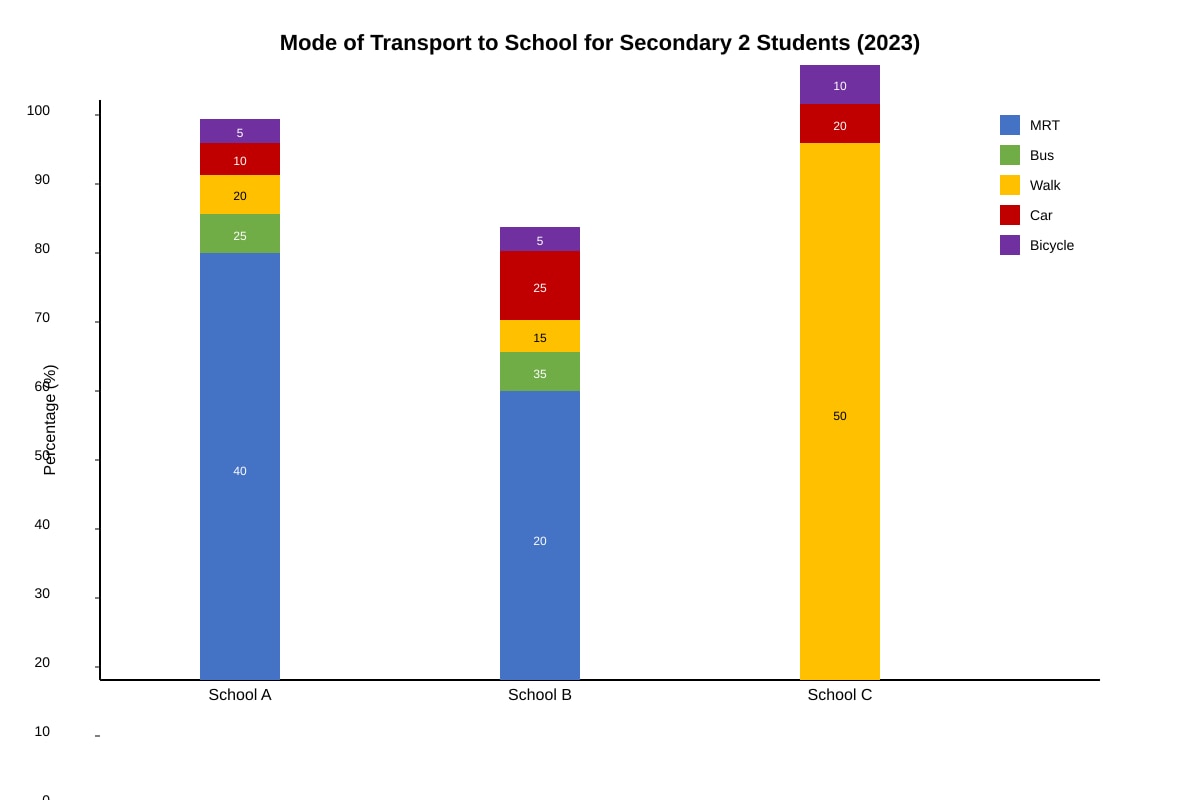
9. Mode of Transport to School (Compound Bar Graph) [6]
(a) Highest percentage walking [1]
Answer: School C (50%)
Marking: 1 mark for correct school.
(b) % in School B taking MRT or Bus [1]
Answer: 55% (20% MRT + 35% Bus)
Marking: 1 mark for correct addition.
(c) Reason for car usage difference: School A (10%) vs School B (25%) [2]
Answer: School B may be located in an area with poorer MRT/bus connectivity, or serve a higher-income catchment where car ownership is higher. School A's high MRT (40%) suggests good rail access.
Marking: 1 mark for plausible reason, 1 mark for linking to graph data (e.g., "School B has lower MRT %").
(d) School to prioritise for reducing car usage [2]
Answer: School B – highest car usage (25%) and highest combined car + motorcycle (30%), indicating greatest reliance on private transport.
Marking: 1 mark for identifying School B, 1 mark for justification using data (highest car %, low MRT %).
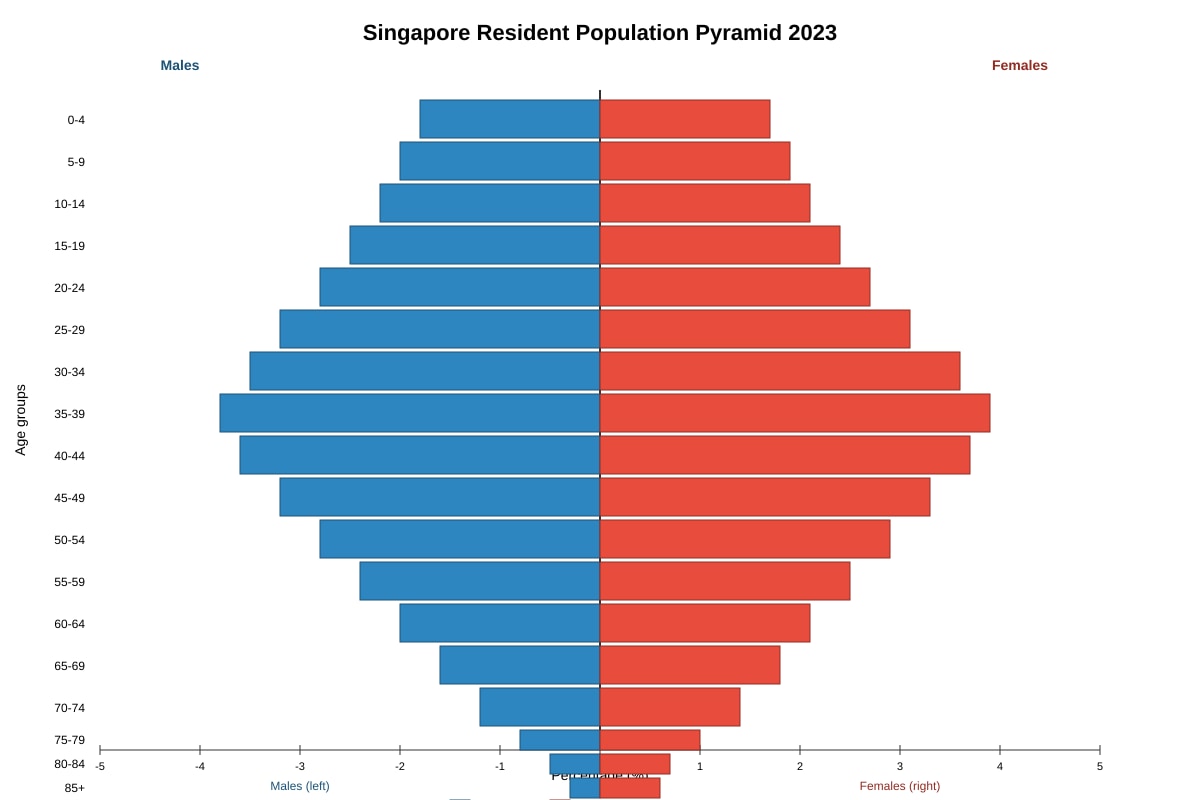
10. Singapore Population Pyramid 2023 [5]
(a) Shape of pyramid [2]
Answer: Constrictive / stationary pyramid with narrow base, bulging working-age cohorts (30–49), and tapering top. Not a classic expansive pyramid.
Marking: 1 mark for "narrow base / constrictive", 1 mark for "bulge at working age / ageing top".
(b) Narrow base → birth rate [1]
Answer: Low and declining birth rate (below replacement level ~2.1). Fewer babies born each year.
Marking: 1 mark for linking narrow base to low birth rate.
(c) Challenge of ageing population [2]
Answer:
- Rising healthcare and eldercare costs (more elderly needing support).
- Shrinking workforce → labour shortages, slower economic growth.
- Increased dependency ratio – fewer working-age people supporting more elderly.
Marking: 1 mark for identifying a challenge, 1 mark for explanation.
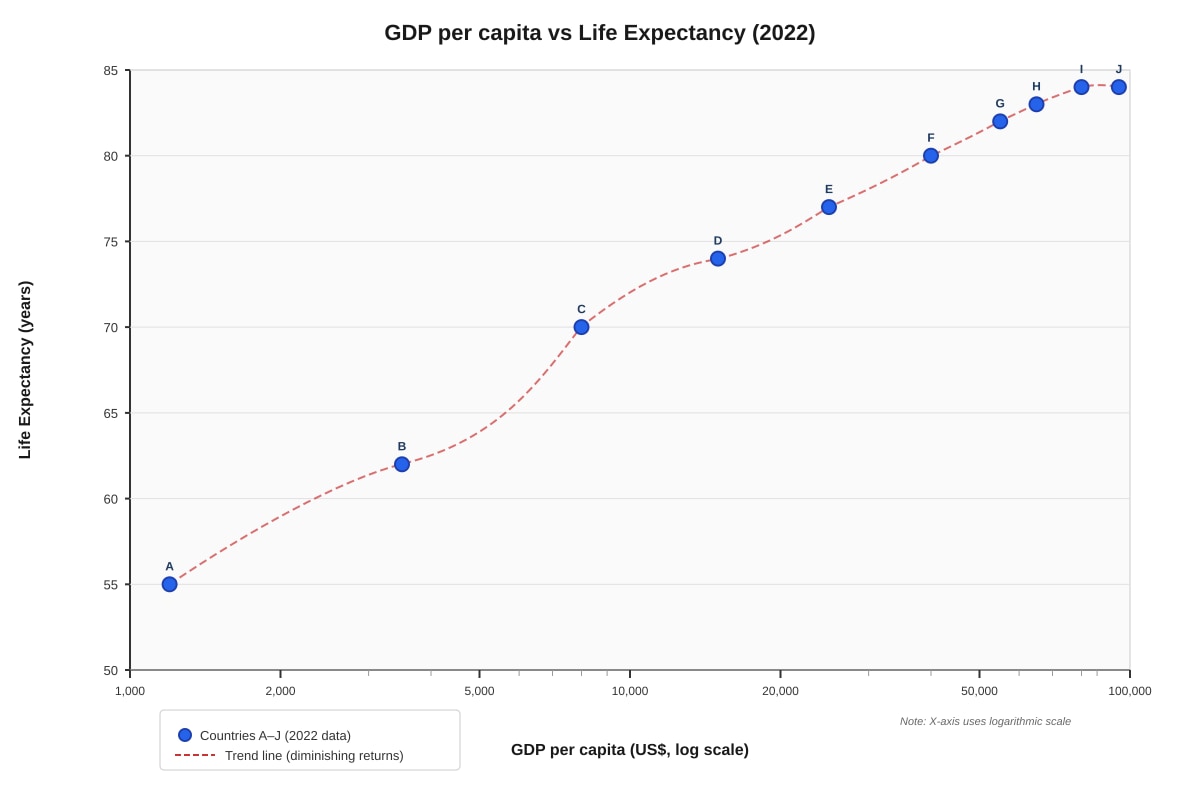
11. GDP per capita vs Life Expectancy Scatter Graph [6]
(a) General trend [2]
Answer: Positive correlation – as GDP per capita increases, life expectancy generally increases. However, the relationship shows diminishing returns: steep rise at low GDP (A→D), then flattens at high GDP (G→J).
Marking: 1 mark for "positive correlation", 1 mark for "diminishing returns / curve flattens".
(b) Country J vs I: similar life expectancy despite higher GDP [2]
Answer: Diminishing returns – beyond ~US$40,000, additional income yields minimal health gains. Country J may spend more on non-health goods; life expectancy limited by biological/genetic factors, lifestyle diseases (obesity, stress), or healthcare system inefficiencies.
Marking: 1 mark for "diminishing returns", 1 mark for specific reason (lifestyle, biology, healthcare quality).
(c) Why "GDP increase → always life expectancy increase" is not supported [2]
Answer: The graph shows flattening curve at high GDP (Countries G–J: GDP doubles from 55k→95k, life expectancy rises only 82→84). Correlation ≠ causation; other factors (healthcare access, education, diet, inequality) matter more at high income.
Marking: 1 mark for referencing flattening trend, 1 mark for explaining non-linearity / other factors.
SECTION C: DATA ANALYSIS AND APPLICATION [15 marks]
12. Traffic Count at School Junction [5]
(a) % of cars [1]
Answer: 55.2% (185 ÷ 335 × 100 = 55.22%)
Marking: 1 mark for correct calculation (accept 55% or 55.2%).
(b) Pie chart angle for motorcycles [2]
Answer: 101.8° (or 102°)
Marking:
- 1 mark for correct fraction (95/335)
- 1 mark for correct angle (95/335 × 360° = 101.79°)
Working: (95 ÷ 335) × 360° = 101.8°
(c) Limitation of students' conclusion [2]
Answer: Data only shows vehicle volume, not reasons for mode choice. No data on public transport reliability, household income, distance from school, or student/parent preferences. Correlation ≠ causation.
Marking: 1 mark for identifying limitation (e.g., "no data on public transport"), 1 mark for explaining why conclusion is unsupported.
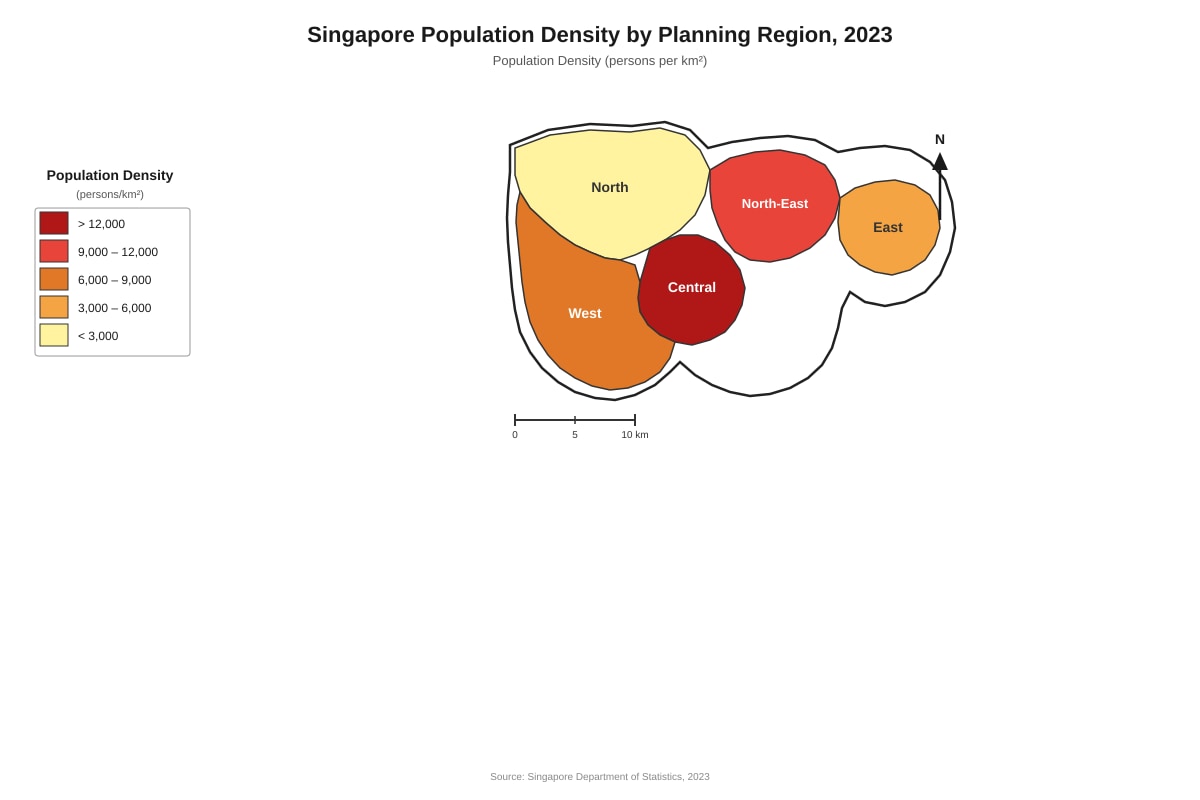
13. Singapore Population Density Choropleth Map [7]
(a) Highest density region [1]
Answer: Central Region (>12,000 persons/km²)
Marking: 1 mark for correct region.
(b) Two reasons Central > North density [3]
Answer:
- Historical development – Central Region is the original urban core (CBD, early settlements), long-established high-density housing.
- Commercial/employment concentration – CBD, offices, retail attract workers and residents wanting short commutes.
- Land scarcity & vertical housing – limited land → high-rise HDB/condos → high population per km².
<stage3_exam_answers_md>
TuitionGoWhere Practice Paper - Geography Secondary 2 (SA2 Version 3) - ANSWER KEY
Subject: Geography
Level: Secondary 2 (Express/Normal Academic)
Paper: SA2 Version 3
Total Marks: 50
SECTION A: MAP READING SKILLS [15 marks]
1. State the four-figure grid reference of Tampines Hospital.
[1]
Answer: 3222
(Grid square where the hospital symbol is located: Easting 32, Northing 22)
2. State the six-figure grid reference of the Bus Interchange.
[1]
Answer: 323215
(Easting 32.3, Northing 21.5 – located within grid square 3221, near Tampines MRT Station)
3. Measure the straight-line distance between Tampines MRT Station and Sun Plaza Park. Give your answer in kilometres.
[2]
Answer: 0.8 – 1.0 km (accept 0.75 – 1.05 km)
(Map distance ~3.2–4.0 cm × 25,000 = 0.8–1.0 km. 1 mark for correct measurement in cm, 1 mark for correct conversion to km)
4. The contour lines on the map are drawn at 10-metre intervals.
(a) What is the highest elevation shown within grid square 3222?
[1]
Answer: 40 m
(Highest contour line within 3222 is 40 m)
(b) Calculate the average gradient of the slope between the 10 m contour and the 30 m contour along the straight line from point A (320220) to point B (330220). Express your answer as a ratio in the form 1 : n.
[2]
Answer: 1 : 50
Vertical Interval (VI) = 30 – 10 = 20 m
Horizontal Equivalent (HE) = 1.0 km = 1000 m (distance between eastings 32 and 33)
Gradient = VI : HE = 20 : 1000 = 1 : 50
5. Describe the drainage pattern of the streams flowing from the higher ground near grid square 3323 towards Bedok Reservoir.
[2]
Answer: Dendritic drainage pattern. Streams branch out like tree roots from the higher ground (3323) and converge into larger channels flowing south-west towards Bedok Reservoir, following the natural slope of the land.
6. Using map evidence, explain why Tampines MRT Station is located at its current site (grid square 3221).
[3]
Answer:
- Accessibility: Located at the junction of major roads (Tampines Ave 1 and Ave 4/5), allowing easy access for commuters.
- Population catchment: Surrounded by high-density HDB residential estates (e.g., grid squares 3221, 3321, 3222) providing a large commuter base.
- Integration: Adjacent to the Bus Interchange (323215) and Tampines Mall, facilitating seamless multi-modal transport and commercial synergy.
(Any 3 valid points with map evidence)
7. A new cycling path is proposed to connect Tampines Ave 9 (near grid square 3422) directly to Bedok Reservoir Park.
Using map evidence only, suggest one advantage and one disadvantage of this proposed route.
[3]
Answer:
Advantage: Provides a direct, shorter route for cyclists from the eastern residential areas (3422) to the recreational facility at Bedok Reservoir, avoiding detours via main roads like Tampines Ave 10.
Disadvantage: The route crosses undulating terrain with steep slopes (contour lines close together, e.g., between 20m and 40m contours in 3322/3323), making cycling difficult and potentially unsafe, especially when wet.
(Must use map evidence: contour lines, distance, existing features)
SECTION B: GRAPH AND DATA INTERPRETATION [20 marks]
8. (a) Which month had the highest rainfall in 2023?
[1]
Answer: December (312 mm)
(b) Calculate the annual rainfall total for 2023.
[1]
Answer: 2,388 mm
(238+112+185+198+165+145+155+170+158+195+255+312 = 2388)
(c) Describe the relationship between monthly rainfall and temperature shown in the data.
[2]
Answer: There is no consistent positive or negative correlation. Temperature remains relatively uniform (26.2–28.5°C) year-round, while rainfall fluctuates significantly. The wettest months (Nov–Dec, Jan) coincide with slightly lower temperatures (NE Monsoon), and the driest month (Feb) has moderate temperatures. High temperatures (May–Jun) do not correspond to highest rainfall.
(d) Explain why Singapore experiences high rainfall throughout the year.
[2]
Answer: Singapore’s equatorial location (1°N) results in consistently high temperatures year-round, causing intense evaporation and convectional rainfall almost daily. Additionally, it is affected by two monsoon seasons (NE Monsoon Dec–Mar, SW Monsoon Jun–Sep) and inter-monsoon periods with frequent thunderstorms, ensuring no distinct dry month.
9. (a) Which school has the highest percentage of students who walk to school?
[1]
Answer: School C (50%)
(b) Calculate the percentage of students in School B who take the MRT or Bus to school.
[1]
Answer: 55% (20% MRT + 35% Bus)
(c) Suggest one reason for the difference in car usage between School A (10%) and School B (25%).
[2]
Answer: School B may be located in a less accessible area with poorer MRT/bus connectivity (only 20% MRT vs 40% in School A), forcing more parents to drive. Alternatively, School B may have a higher-income catchment with higher car ownership.
(d) The government wants to reduce car usage for school journeys. Using data from the graph, identify which school should be prioritised for intervention and justify your choice.
[2]
Answer: School B should be prioritised. It has the highest car usage (25%) and the lowest MRT usage (20%), indicating high dependency on private transport and potential for mode shift if public transport options are improved.
10. (a) Describe the shape of the population pyramid.
[2]
Answer: The pyramid has a narrow base (low % in 0–4 age group), a broad, bulging middle (large working-age population 25–49), and a tapering but widening top (increasing % in 65+ age groups, especially females). It is constrictive / stationary in shape, typical of a developed country with low fertility and ageing population.
(b) What does the narrow base of the pyramid indicate about Singapore's birth rate?
[1]
Answer: It indicates a low birth rate / low fertility rate (below replacement level of 2.1), resulting in fewer young children relative to the total population.
(c) Identify one challenge that the ageing population (shown by the top of the pyramid) poses for Singapore.
[2]
Answer: Increased healthcare and eldercare expenditure as a larger proportion of the population requires medical support and long-term care, straining government budgets and the shrinking workforce (tax base) that funds it.
(Other valid: labour shortage, slower economic growth, pressure on CPF/social security, "sandwich generation" stress)
11. (a) Describe the general trend shown by the scatter graph.
[2]
Answer: There is a strong positive correlation between GDP per capita and life expectancy: as GDP increases, life expectancy generally increases. However, the relationship shows diminishing returns – the curve flattens at higher GDP levels (above ~$40,000), where large increases in GDP yield only small gains in life expectancy.
(b) Country J has a much higher GDP per capita than Country I, but similar life expectancy. Suggest one reason for this.
[2]
Answer: Diminishing returns on health spending: Beyond a certain income level, additional wealth does not significantly improve health outcomes. Country J may face lifestyle diseases (obesity, stress, NCDs) or inequality in healthcare access that offset its higher average income. Genetic/environmental limits to longevity may also play a role.
(c) A student concludes: "Increasing a country's GDP will always increase life expectancy."
Using the graph, explain why this conclusion is not fully supported.
[2]
Answer: The graph shows a curvilinear (logarithmic) relationship, not a linear one. At low GDP levels, increases lead to large gains in life expectancy (basic needs met). At high GDP levels (Countries G–J), life expectancy plateaus despite large GDP differences, proving that GDP growth alone does not always increase life expectancy. Other factors (healthcare quality, lifestyle, inequality, environment) become more important.
SECTION C: DATA ANALYSIS AND APPLICATION [15 marks]
12. (a) Calculate the percentage of cars out of the total vehicles counted.
[1]
Answer: 55.2% (or 55%)
(185 ÷ 335 × 100 = 55.22%)
(b) The students want to present this data in a pie chart. Calculate the angle of the sector representing motorcycles.
[2]
Answer: 102° (or 101.8°)
(95 ÷ 335 × 360° = 101.79° ≈ 102°)
(c) The students concluded: "Most people drive cars because public transport is unreliable."
State one limitation of the students' data that makes this conclusion unreliable.
[2]
Answer: The data only shows vehicle volume at one junction for 30 minutes, not the reasons for mode choice. It does not capture:
- Origin/destination of trips (may not be school-related)
- Availability/quality of public transport alternatives
- Travel time, cost, or comfort comparisons
- Driver demographics (income, car ownership)
Correlation ≠ causation; no attitudinal/behavioural data collected.
13. (a) Which planning region has the highest population density?
[1]
Answer: Central Region (>12,000 persons/km²)
(b) Suggest two reasons why the Central Region has a much higher population density than the North Region.
[3]
Answer:
- Historical development & commercial core: The Central Region contains the CBD, historic districts, and established high-density housing (e.g., Bukit Merah, Toa Payoh, Queenstown) built up over decades.
- Land use intensity: It has mixed-use, high-rise developments (commercial, residential, institutional) maximising limited land, while the North Region has more land reserved for military training, water catchment (reservoirs), and nature reserves, limiting residential development.
(Other valid: better transport connectivity, proximity to jobs, earlier urbanisation)
(c) The government plans to develop the North Region to reduce overcrowding in the Central Region.
Using the map, explain one advantage and one challenge of this strategy.
[3]
Answer:
Advantage: The North Region has large tracts of lower-density land (currently <3,000 persons/km²) and planned new towns (e.g., Woodlands, Sembawang, future Simpang/Tengah extensions) that can accommodate population growth and decentralise jobs/housing, reducing pressure on the Central Region.
Challenge: Longer commuting distances to the Central Region’s job centres, potentially increasing transport congestion and travel time unless decentralised employment hubs (e.g., Woodlands Regional Centre, Johor Bahru linkage) and high-capacity transit (Thomson-East Coast Line, RTS Link, Cross Island Line) are developed in tandem.
(Must reference map evidence: low density in North, distance from Central, need for infrastructure)
END OF ANSWER KEY
Total: 50 marks
Prepared by TuitionGoWhere Secondary School (AI)