From Real Exams Exam Paper
Secondary 2 Geography Semestral Assessment 2 (End of Year) Paper 2
Free Sec 2 Geography SA2 Paper 2, Nemo3 Exam version, with questions, answers, and syllabus-aligned practice for Singapore students.
These static practice materials are generated from the site's syllabus and paper-generation workflow, with source and model context shown so students and parents can evaluate the material before use.
Questions

Free quiz and exam paper access
Enter your details to view this paper
Your access is remembered on this device.
Answers
TuitionGoWhere Practice Paper - Geography Secondary 2 (SA2 Version 2) - Answer Key
Total Marks: 60
Section A: Map Skills [15 marks]
Question 1
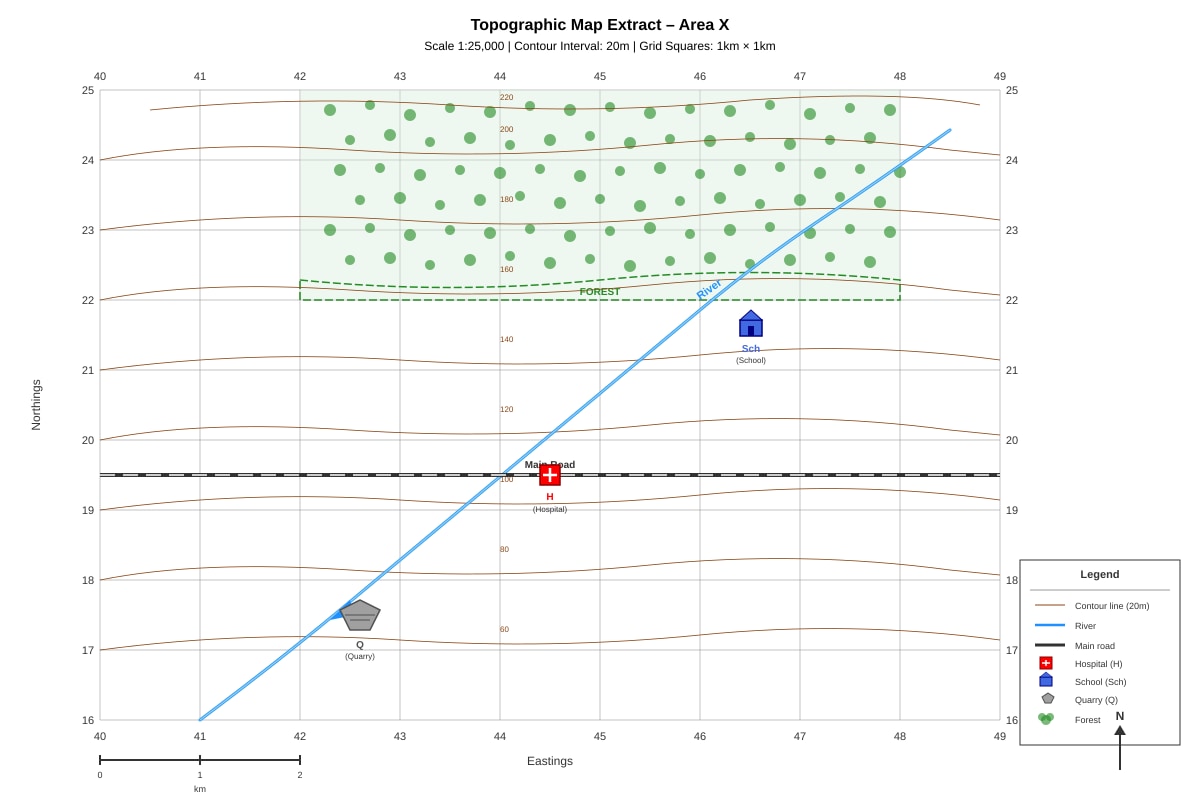
(a) Four-figure grid reference of the hospital: 4520 [1]
Marking: 1 mark for correct four-figure grid reference (easting 45, northing 20).
(b) Six-figure grid reference of the school: 472222 [1]
Marking: 1 mark for correct six-figure grid reference. Easting 472 (47 + 2/10), northing 222 (22 + 2/10). Accept 472222 or 472 222.
(c) Relief around the quarry (4318): [2]
- The quarry is located on relatively flat/low-lying ground (1 mark)
- Evidence: Contour lines are widely spaced / few contour lines / low contour values (e.g., 20-40m) around grid square 4318 (1 mark)
Marking: 1 mark for description (flat/gentle slope), 1 mark for map evidence (contour spacing/values).
(d) Straight-line distance between hospital (4520) and school (4722): [1]
- Map distance: ~2.8 cm (measured from centre of 4520 to centre of 4722)
- Ground distance: 2.8 cm × 25,000 = 70,000 cm = 0.7 km (accept 0.65–0.75 km)
Marking: 1 mark for correct answer with units (km).
Question 2
(a) Direction of flow of the river: Northeast to Southwest / SW [1]
Marking: 1 mark for correct cardinal/intercardinal direction.
(b) Two pieces of map evidence: [2]
- Contour values decrease from northeast (higher contours, e.g., 100m) to southwest (lower contours, e.g., 20m) (1 mark)
- River flows from higher ground (northeast) to lower ground (southwest) / River flows downhill following contour gradient (1 mark)
Alternative evidence: River joins a larger water body in SW; V-shaped contour crossing pointing upstream.
Marking: 1 mark each for two valid pieces of evidence.
(c) Average gradient of river between 4924 (entry) and 4116 (exit): [3]
Working:
- Vertical difference (VI): Elevation at 4924 ≈ 100 m (from contour lines); Elevation at 4116 ≈ 20 m
VI = 100 – 20 = 80 m - Horizontal distance (HE): Grid distance from 4924 to 4116 = 8 km easting difference + 8 km northing difference?
Actually: 4924 to 4116 → ΔEasting = 8 km, ΔNorthing = 8 km → straight-line distance = √(8² + 8²) = √128 ≈ 11.3 km
But river meanders; map distance along river ≈ 14 cm → 14 × 0.25 = 3.5 km? Wait, scale 1:25,000 → 1 cm = 0.25 km. If river length on map = 14 cm → 3.5 km.
Better: Use straight-line distance between grid references for "average gradient" as per standard exam practice.
Straight-line distance = √((49-41)² + (24-16)²) = √(64+64) = √128 ≈ 11.31 km = 11,310 m - Gradient = VI : HE = 80 : 11,310 = 1 : 141.4 ≈ 1 : 141
Marking:
- 1 mark for correct vertical interval (80 m)
- 1 mark for correct horizontal equivalent (11.3 km or 11,300 m)
- 1 mark for correct gradient ratio (1:141) with working shown
Common mistake: Using map distance in cm without converting; reversing VI/HE.
Question 3
(a) Map distance along main road between hospital (4520) and quarry (4318): ~3.2 cm [1]
Marking: 1 mark for reasonable measurement (accept 3.0–3.5 cm).
(b) Actual ground distance: [1]
3.2 cm × 25,000 = 80,000 cm = 0.8 km (accept 0.75–0.85 km)
Marking: 1 mark for correct conversion and units.
(c) Time taken to walk from school (4722) to hospital (4520) via main road at 5 km/h: [2]
- Map distance along road ≈ 4.0 cm (4722 → 4622 → 4520 along road)
- Ground distance = 4.0 × 0.25 = 1.0 km
- Time = Distance / Speed = 1.0 km / 5 km/h = 0.2 h = 12 minutes
Marking: 1 mark for correct distance calculation, 1 mark for correct time in minutes.
Question 4
(a) Four-figure grid reference of southernmost point of forested area: 4423 (example; depends on map) [1]
Marking: 1 mark for correct grid square at southern edge of forest.
(b) Reason for forest on higher ground: [1]
- Steep slopes / high relief (shown by closely spaced contours) make the land unsuitable for agriculture or urban development, so it remains forested.
OR: Higher elevation → cooler/wetter microclimate favours forest growth.
Marking: 1 mark for valid reason linked to map evidence (relief/climate).
Section B: Graph and Data Interpretation [20 marks]
Question 5
(a) Month with highest rainfall: December (280 mm) [1]
(b) Annual temperature range: [1]
Max temp = 28.5°C (May), Min temp = 26.5°C (Jan/Dec)
Range = 28.5 – 26.5 = 2.0°C
Marking: 1 mark for correct calculation with units.
(c) Total annual rainfall: [1]
Sum = 240+160+180+190+170+150+155+160+170+200+250+280 = 2,305 mm
Marking: 1 mark for correct total (accept 2300–2310 mm).
(d) Relationship between rainfall and temperature: [2]
- Generally inverse/negative relationship: Months with higher temperature (Apr–May) have moderate rainfall, while cooler months (Nov–Jan) have higher rainfall (1 mark)
- But not perfectly inverse: Temperature peaks Apr–May (28.5°C) while rainfall peaks Nov–Dec (250–280 mm) when temperature is lower (26.5–27.0°C) (1 mark)
Marking: 1 mark for identifying pattern, 1 mark for accurate description using data.
(e) Reason for high rainfall in Nov–Dec: [2]
- Northeast Monsoon brings moist winds from the South China Sea over Singapore (1 mark)
- Convergence of winds / rising air leads to heavy convective rainfall (1 mark)
Marking: 1 mark for identifying monsoon, 1 mark for mechanism.
Question 6
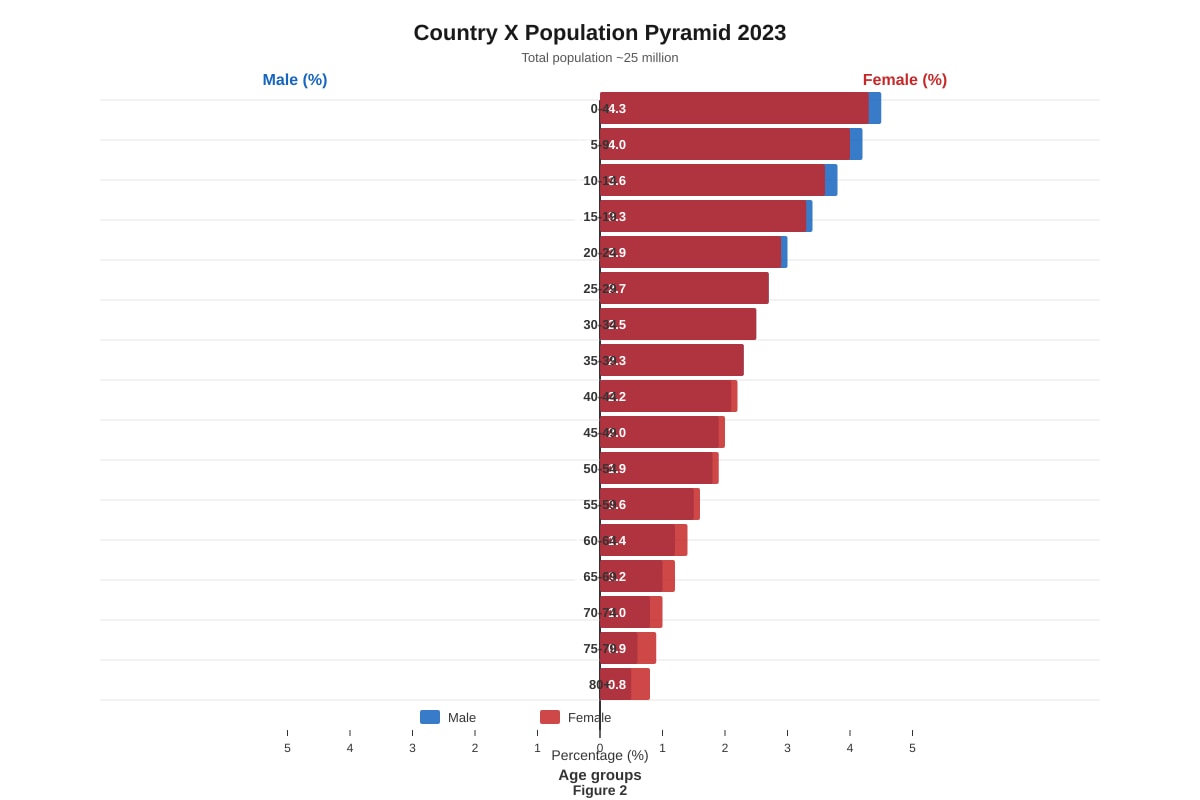
(a) Shape of population pyramid: Broad base, rapidly narrowing sides, concave profile, small apex [1]
Marking: 1 mark for accurate description (e.g., "expansive/pyramidal shape with broad base and narrow top").
(b) Birth rate and death rate: [2]
- High birth rate → broad base (large 0-4, 5-9 age groups) (1 mark)
- High death rate / low life expectancy → rapid narrowing with age, very small elderly cohorts (1 mark)
Marking: 1 mark each for birth rate and death rate inference with evidence.
(c) Percentage aged 0-14 (dependent young): [2]
0-4: 4.5+4.3 = 8.8%
5-9: 4.2+4.0 = 8.2%
10-14: 3.8+3.6 = 7.4%
Total = 8.8 + 8.2 + 7.4 = 24.4%
Marking: 1 mark for correct summation method, 1 mark for correct answer (accept 24–25%).
(d) Economic challenge: [2]
- High youth dependency ratio → large proportion of population not yet in workforce (1 mark)
- Pressure on government spending for education, healthcare, job creation for future workforce (1 mark)
Marking: 1 mark for identifying challenge, 1 mark for explanation.
Question 7
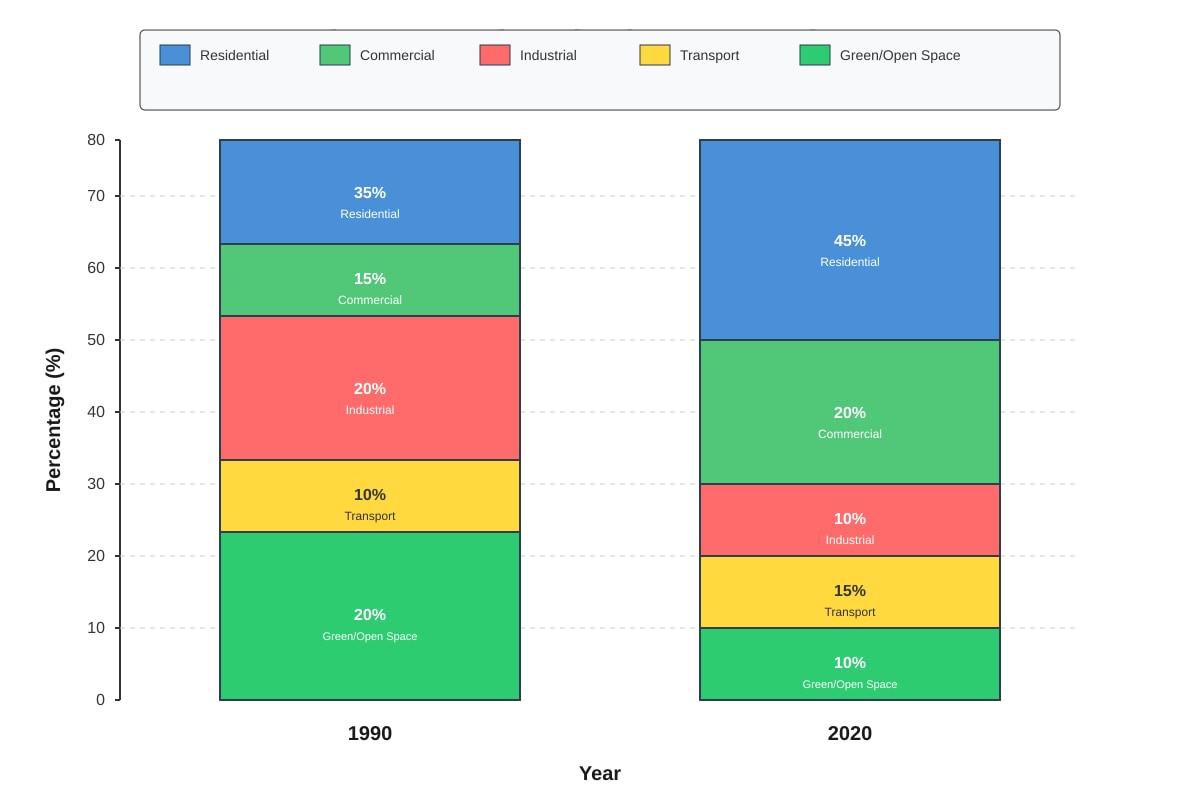
(a) Largest percentage increase: Residential (35% → 45% = +10 percentage points) [1]
Marking: 1 mark for correct category.
(b) Actual area of Green/Open Space in 2020: [1]
10% of 500 km² = 50 km²
Marking: 1 mark for correct calculation with units.
(c) Change in Industrial land use: [1]
Decreased from 20% to 10% (halved / 10 percentage point decrease)
Marking: 1 mark for accurate description with data.
(d) Two reasons for increase in Residential land use: [3]
- Population growth → greater demand for housing (1 mark)
- Urbanisation / rural-urban migration → expansion of residential areas into former green/industrial land (1 mark)
- Government housing policies (e.g., HDB building new towns) (1 mark)
Marking: 1 mark per valid reason (max 3). Accept other reasonable reasons (e.g., rising incomes, smaller household sizes).
Question 8
(a) Percentage increase in total water consumption (2010–2020): [2]
Increase = 850 – 630 = 220 million m³
% increase = (220 / 630) × 100 = 34.9% ≈ 35%
Marking: 1 mark for correct increase, 1 mark for correct percentage.
(b) Largest absolute increase: Non-Domestic (280 – 250 = 30) Wait: Domestic +20, Non-Domestic +30, NEWater +100, Desalinated +70.
Desalinated Water (+70 million m³) [1]
Marking: 1 mark for correct sector.
(c) % of total consumption met by NEWater in 2020: [1]
(150 / 850) × 100 = 17.6% ≈ 18%
Marking: 1 mark for correct calculation.
(d) Why NEWater and desalinated water increased: [3]
- Water security / reduce reliance on imported water (from Malaysia) (1 mark)
- Technological advancement made NEWater/desalination more cost-effective (1 mark)
- Growing demand from population/economic growth requires diversified sources (1 mark)
Marking: 1 mark per valid reason (max 3).
Section C: Data Analysis and Geographical Skills [15 marks]
Question 9
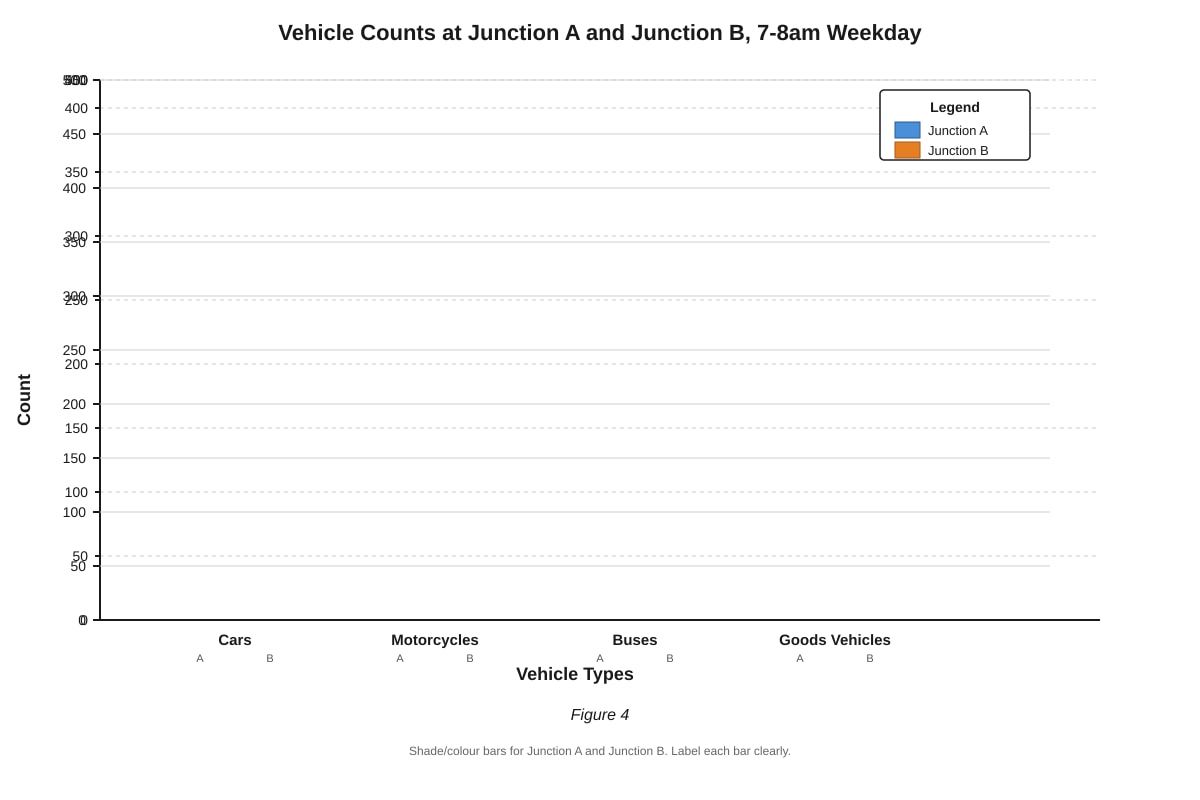
(a) Comparative bar graph: [3]
Marking:
- 1 mark: Correct title and labelled axes (Vehicle Type, Count)
- 1 mark: Accurate plotting of all 8 bars (4 types × 2 junctions) to scale
- 1 mark: Clear legend / colour coding for Junction A vs B, bars side-by-side
(b) Advantage of comparative bar graph: [1]
- Allows direct visual comparison of each vehicle type between the two junctions / easy to see similarities/differences.
Marking: 1 mark for valid advantage.
(c) Evaluate conclusion: "Junction B has heavier traffic..." [3]
- Conclusion is invalid/incorrect (1 mark)
- Evidence: Total vehicles at both junctions = 700 each → traffic volume is equal (1 mark)
- Junction B has more buses (60 vs 40) and motorcycles (220 vs 180), but fewer cars (380 vs 420) and goods vehicles (40 vs 60) (1 mark)
Marking: 1 mark for judgement, 1 mark for total count evidence, 1 mark for breakdown evidence.
Question 10
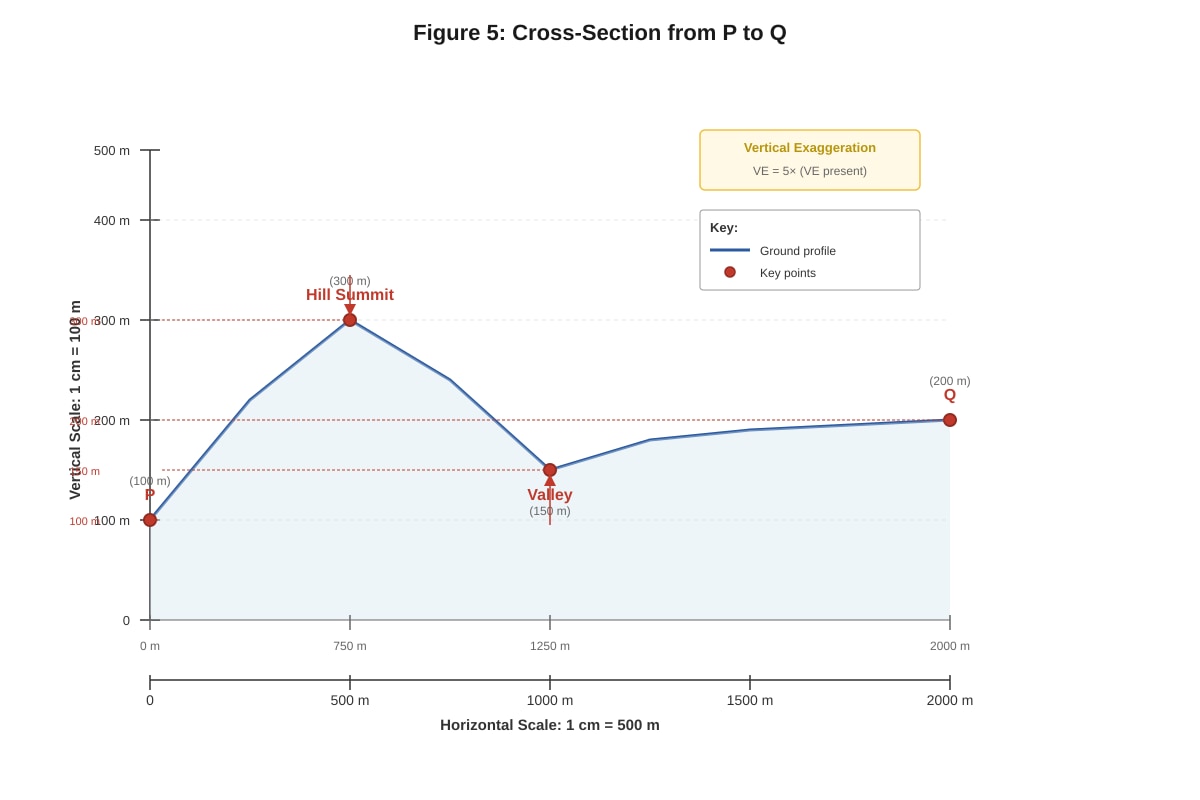
(a) Vertical Exaggeration (VE): [1]
VE = Horizontal Scale / Vertical Scale = (500 m/cm) / (100 m/cm) = 5 times (5×)
Marking: 1 mark for correct calculation.
(b) Gradient from P to hill summit: [2]
- Horizontal distance: 1.5 cm × 500 m/cm = 750 m
- Vertical rise: 300 – 100 = 200 m
- Gradient = VI : HE = 200 : 750 = 1 : 3.75 (or 4:15)
Marking: 1 mark for correct VI and HE, 1 mark for correct ratio.
(c) Walking trail: Hill summit vs valley: [3]
Over hill summit:
- Advantage: Shorter distance (direct route) / scenic views (1 mark)
- Disadvantage: Steep gradient (1:3.75) → difficult for walkers, erosion risk (1 mark)
Through valley:
- Advantage: Gentler slope → easier walk, less erosion (1 mark)
- Disadvantage: Longer distance / possible flooding / less scenic (1 mark)
Marking: 1 mark for advantage of one route, 1 mark for disadvantage of same/other route, 1 mark for balanced comparison. Max 3 marks.
Question 11
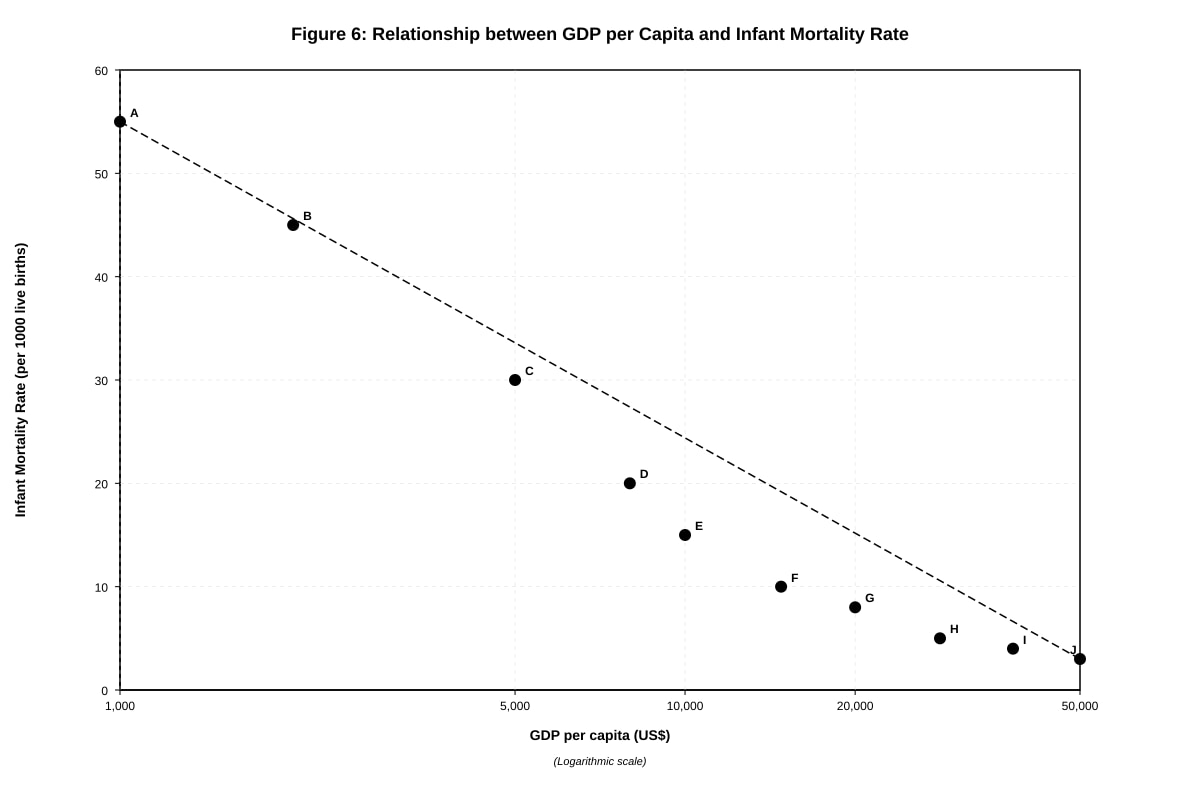
(a) Relationship in Figure 6: [1]
Negative correlation: As GDP per capita increases, infant mortality rate decreases.
Marking: 1 mark for correct description.
(b) Anomalous result: [2]
- Country C (GDP 8,000, IMR 20) fits well.
Actually, all points fit a smooth curve. Perhaps no strong anomaly. But if forced:
**Country A (1000 have IMR >60).
Better: No clear anomaly; relationship is consistent.
Accept: "No clear anomaly; all points follow the general trend." (1 mark for identification, 1 mark for reason)
Or if identifying one: Country F ($15,000, IMR 10) is slightly below trend (better than expected) → strong healthcare system / effective public health policies.
Marking: 1 mark for identifying a point (or stating none), 1 mark for plausible reason.
**(c) Estimate IMR for Country K (GDP 10,000, IMR 15) and F ($15,000, IMR 10) → ~12–13 per 1000
Marking: 1 mark for reasonable estimate (11–14).
(d) Why GDP per capita alone is insufficient: [2]
- Healthcare access/quality varies at same income level (e.g., public vs private systems) (1 mark)
- Other factors: Female education, sanitation, nutrition, disease prevalence, government policy (1 mark)
Marking: 1 mark per valid factor.
Section D: Geographical Investigation and Synthesis [10 marks]
Question 12
(a) Suitable hypothesis: [1]
- "As the percentage of impervious surface increases, surface runoff volume increases."
- "Urbanised catchments have higher peak runoff than forested catchments."
Marking: 1 mark for testable, directional hypothesis linking urbanisation and runoff.
(b) Two primary data collection methods: [2]
- Infiltration rate measurement (using infiltrometer)
- Stream discharge measurement (velocity × cross-section)
- Land use mapping (% impervious surface)
- Rainfall measurement (rain gauge)
Marking: 1 mark each (max 2).
(c) Description of one method (e.g., stream discharge): [2]
- Measure channel width and depth at regular intervals to calculate cross-sectional area (1 mark)
- Measure flow velocity using a flow meter / float method (time over known distance) (1 mark)
- Discharge = Area × Velocity; repeat at multiple sites / times (during/after rain)
Marking: 1 mark for equipment/measurements, 1 mark for procedure.
(d) Way to present data to show relationship: [1]
- Scatter graph of % impervious surface (x-axis) vs peak runoff / discharge (y-axis)
- Comparative hydrographs for urban vs rural catchments
Marking: 1 mark for appropriate graphical method.
(e) Limitation and improvement: [2]
- Limitation: Small sample size / only one rainfall event / short study period → results not representative (1 mark)
- Improvement: Collect data over long-term data / multiple storm events / more sites (1 mark)
Marking: 1 mark for valid limitation, 1 mark for feasible improvement.
Question 13
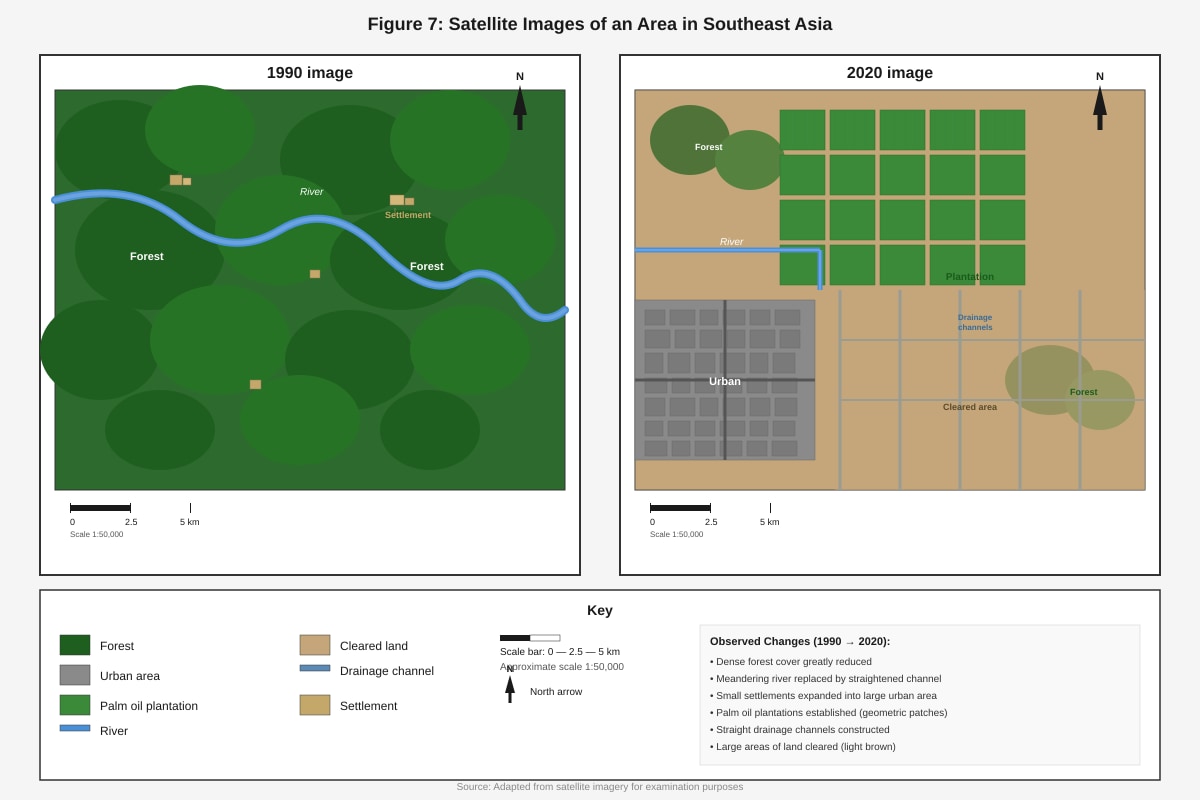
(a) Two land use changes (1990–2020): [2]
- Deforestation: Large areas of dense forest cleared (green → light brown) (1 mark)
- Expansion of palm oil plantations (geometric green patches) / Urban expansion (grey areas) / Straightening of river/drainage channels (1 mark)
Marking: 1 mark per distinct change with visual evidence.
(b) Environmental impact: [2]
- Loss of biodiversity due to habitat destruction (forest → monoculture plantation/urban) (1 mark)
- Increased surface runoff / flooding due to loss of vegetation and soil compaction (1 mark)
OR: Soil erosion, carbon emissions, water pollution from plantations.
Marking: 1 mark for impact, 1 mark for explanation linked to change.
(c) Sustainable management strategy: [2]
- Riparian buffer zones / reforestation of steep slopes to reduce erosion and filter runoff (1 mark)
- Sustainable palm oil certification (RSPO) / zero-burning policy / agroforestry (1 mark)
Marking: 1 mark for strategy, 1 mark for how it reduces impact.
End of Answer Key
Total Marks: 60
Mark allocations per section: A=15, B=20, C=15, D=10