AI Generated Quiz
Secondary 2 English Summary Quiz
Free Sec 2 English Summary quiz, AI version, with questions, answers, and syllabus-aligned practice for Singapore students.
These static practice materials are generated from the site's syllabus and paper-generation workflow, with source and model context shown so students and parents can evaluate the material before use.
Questions
Free quiz and exam paper access
Enter your details to view this paper
Your access is remembered on this device.
Answers
Secondary 2 English Quiz - Summary: Answer Key
Total Marks: 40
Section A: Identifying Key Points (Questions 1–5)
Each question is worth 2 marks (1 mark per correct point).
Passage: The Great Barrier Reef
Question 1:
- Answer: (a) It is the world's largest coral reef system. (b) It stretches over 2,300 kilometres.
- Explanation: The question asks for two key points about the size of the reef. The passage states two facts about its size: its status as the "world's largest" and its length of "over 2,300 kilometres." Students must extract these specific details.
- Marking Notes: Accept any wording that conveys the same meaning. Award 1 mark for each correct point.
Question 2:
- Answer: (a) Over 1,500 species of fish / 400 types of coral / sharks / rays / turtles (any two). (b) Any other from the list.
- Explanation: The passage lists several types of marine life. Students need to identify any two distinct categories.
- Marking Notes: Accept specific examples (e.g., "sharks") or general categories (e.g., "coral"). Award 1 mark for each correct point.
Question 3:
- Answer: (a) It supports livelihoods through tourism. (b) It supports livelihoods through fishing.
- Explanation: The passage states the reef is "a vital ecosystem that supports the livelihoods of thousands of people through tourism and fishing." These are two distinct reasons.
- Marking Notes: Accept paraphrases. Award 1 mark for each correct point.
Question 4:
- Answer: (a) Climate change (which causes coral bleaching). (b) Pollution.
- Explanation: The passage explicitly names "climate change" and "pollution" as threats.
- Marking Notes: Accept "coral bleaching" as a specific example of climate change's effect. Award 1 mark for each correct point.
Question 5:
- Answer: (a) Marine protected areas. (b) Programs to reduce water pollution.
- Explanation: The passage mentions these two specific conservation efforts.
- Marking Notes: Accept paraphrases. Award 1 mark for each correct point.
Section B: Paraphrasing and Condensing (Questions 6–10)
Each question is worth 2 marks.
Passage: Urban Farming
Question 6:
- Answer: Urban farming is growing food in cities, on rooftops or in community gardens. (13 words)
- Explanation: The question requires students to define urban farming in their own words. The key elements are "growing food" and "in urban areas." The examples (rooftops, community gardens) help clarify but are not essential.
- Marking Notes: Award 2 marks for a clear, accurate definition within the word limit. Award 1 mark for a partially correct or slightly over-worded answer. Deduct 1 mark if the answer exceeds 15 words.
Question 7:
- Answer: It reduces carbon emissions by shortening the distance food travels. (10 words)
- Explanation: The passage states that urban farming "reduces the distance food travels... which lowers carbon emissions." Students must identify this environmental benefit.
- Marking Notes: Award 2 marks for a clear statement of the environmental benefit. Accept "improves air quality" or "provides habitats for wildlife" as alternative correct answers.
Question 8:
- Answer: It provides fresh produce to communities without easy access to supermarkets. (12 words)
- Explanation: The passage mentions that urban farms can help "communities that lack access to supermarkets, known as 'food deserts'." This is a social benefit.
- Marking Notes: Award 2 marks for a clear statement of the social benefit.
Question 9:
- Answer: Limited space, high start-up costs, or need for specialised knowledge. (any one)
- Explanation: The passage lists three challenges. Students need to state one.
- Marking Notes: Award 2 marks for identifying any one challenge clearly.
Question 10:
- Answer: Urban farming reduces food transport distance, lowering carbon emissions. (8 words)
- Explanation: The original sentence is 22 words. Students need to condense it to 20 words or fewer while preserving the core meaning: urban farming → reduces food travel distance → lowers carbon emissions.
- Marking Notes: Award 2 marks for a successful paraphrase that retains the cause-and-effect relationship. Award 1 mark if the meaning is partially lost or the word limit is exceeded.
Section C: Writing a Summary (Questions 11–15)
Each question is worth 4 marks.
Passage: The Printing Press
Question 11:
- Answer: The printing press allowed books to be produced quickly and cheaply, making them more widely available. (14 words)
- Explanation: The passage states that before the printing press, books were "copied by hand, a slow and expensive process." The printing press allowed books to be "produced quickly and cheaply." The summary must capture this contrast and the main effect.
- Marking Notes:
- 4 marks: Accurate, concise summary within word limit.
- 3 marks: Accurate but slightly over word limit.
- 2 marks: Partially accurate or significantly over word limit.
- 1 mark: Attempted but inaccurate.
- 0 marks: No attempt or completely off-topic.
Question 12:
- Answer: The printing press increased literacy rates as more people learned to read due to accessible books. (15 words)
- Explanation: The passage states that making knowledge accessible "led to an increase in literacy rates across Europe, as more people learned to read." The summary must link accessible books to increased literacy.
- Marking Notes: Same as Question 11.
Question 13:
- Answer: The printing press fuelled the Renaissance, Reformation, and Scientific Revolution by spreading new ideas rapidly. (15 words)
- Explanation: The passage explicitly links the printing press to these three movements. The summary should mention at least two and explain the connection (rapid dissemination of ideas).
- Marking Notes: Same as Question 11.
Question 14:
- Answer: The printing press helped standardise languages and contributed to the development of national identities. (14 words)
- Explanation: The passage states these two specific impacts. The summary should include both.
- Marking Notes: Same as Question 11.
Question 15:
- Answer: The printing press laid the foundation for modern mass media and the information age by revolutionising information sharing. (16 words)
- Explanation: The passage's final sentence states the long-term significance. The summary should capture this and may include the broader context of revolutionising information sharing.
- Marking Notes:
- 4 marks: Accurate, concise summary within word limit.
- 3 marks: Accurate but slightly over word limit.
- 2 marks: Partially accurate or significantly over word limit.
- 1 mark: Attempted but inaccurate.
- 0 marks: No attempt or completely off-topic.
Section D: Summary from a Visual Source (Questions 16–20)
Each question is worth 4 marks.
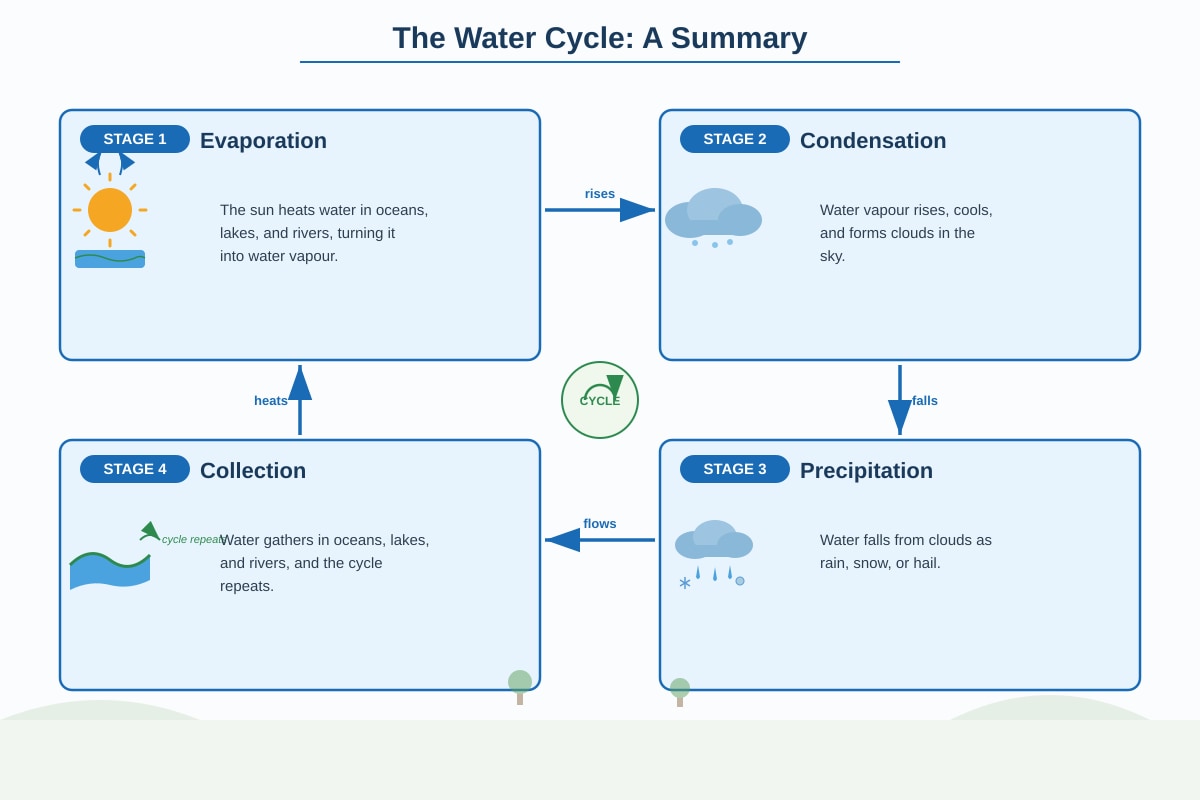
Visual Source: The Water Cycle Infographic
Question 16:
- Answer: The first stage is evaporation. The sun heats water, turning it into water vapour.
- Explanation: The infographic shows evaporation as the first stage. Students must identify the stage and describe the process.
- Marking Notes:
- 4 marks: Correctly identifies stage and provides accurate description within word limit.
- 2 marks: Correctly identifies stage but description is vague or inaccurate.
- 0 marks: Incorrect stage or no attempt.
Question 17:
- Answer: The second stage is condensation. Water vapour rises, cools, and forms clouds.
- Explanation: The infographic shows condensation as the second stage. Students must identify the stage and describe the process.
- Marking Notes: Same as Question 16.
Question 18:
- Answer: The third stage is precipitation. Water falls from clouds as rain, snow, or hail.
- Explanation: The infographic shows precipitation as the third stage. Students must identify the stage and describe the process.
- Marking Notes: Same as Question 16.
Question 19:
- Answer: The fourth stage is collection. Water gathers in oceans, lakes, and rivers.
- Explanation: The infographic shows collection as the fourth stage. Students must identify the stage and describe the process.
- Marking Notes: Same as Question 16.
Question 20:
- Answer: The water cycle has four stages: evaporation (water turns to vapour), condensation (clouds form), precipitation (rain falls), and collection (water gathers in bodies of water). (20 words)
- Explanation: This question requires students to synthesise all four stages into a single, coherent summary. The summary should be cyclical in nature.
- Marking Notes:
- 4 marks: Accurate, concise summary of all four stages within word limit.
- 3 marks: Accurate but slightly over word limit or missing one stage.
- 2 marks: Partially accurate or significantly over word limit.
- 1 mark: Attempted but inaccurate.
- 0 marks: No attempt or completely off-topic.
End of Answer Key