AI Generated Quiz
Secondary 2 English Language Use Quiz
Free Sec 2 English Language Use quiz, HY3 AI version, with questions, answers, and syllabus-aligned practice for Singapore students.
These static practice materials are generated from the site's syllabus and paper-generation workflow, with source and model context shown so students and parents can evaluate the material before use.
Questions
Free quiz and exam paper access
Enter your details to view this paper
Your access is remembered on this device.
Answers
Secondary 2 English Quiz - Language Use: Answer Key
Total Marks: 40
Topic: Language Use (Sec 2 syllabus-aligned, AI-inferred from Stage 4 templates; not claimed as past-year derived)
Section A: Grammar and Editing
1. [1 mark] is
Teaching note: "Basket" is singular, so we use "is". Subject–verb agreement: a singular noun takes a singular verb.
Common mistake: Choosing "are" because "apples" is plural; but the head noun is "basket".
2. [1 mark] She went to the market every day.
Teaching note: Past tense of "goes" is "went". "Every day" stays the same; we only change the verb.
3. [2 marks] She and I went to the library yesterday.
Marking: 1 mark for correct pronouns (She and I, not Him and me), 1 mark for past tense "went".
Teaching note: Use subject pronouns (I, he, she) when they are the subject. "Him and me" are object pronouns and wrong here.
4. [1 mark] an
Teaching note: "Orange" begins with a vowel sound /ɒ/, so we use "an".
5. [2 marks] Although it rained, we went for a walk. (or) We went for a walk although it rained.
Marking: 1 mark for using "although" correctly, 1 mark for combining into one sentence with contrast.
Teaching note: "Although" shows contrast between rain and walking.
6. [1 mark] small (or warm – both are adjectives; accept either underlined)
Teaching note: Adjectives describe nouns. "Small" and "warm" describe "cat" and "mat".
7. [2 marks] "What time is the meeting?" asked John.
Marking: 1 mark for capitalisation and question mark, 1 mark for speech punctuation and capital J.
Teaching note: Direct questions need a question mark. Reported speech: comma before "asked", capital for name.
8. [2 marks] Future perfect tense
Teaching note: "will have finished" = future perfect. It shows an action that will be completed before a future time.
Section B: Vocabulary in Context
9. [2 marks] treacherous
Teaching note: "Treacherous" means dangerous, especially because it can cause harm (loose stones). Context clue: "could cause a fall".
10. [2 marks] a faint light
Teaching note: "Faint" means weak/not bright. The phrase is exact from the passage.
11. [2 marks] very tired / exhausted
Teaching note: From context: after a "long trek" she felt "weary" = tired.
12. [2 marks] treacherous (synonym of dangerous in context)
Teaching note: The writer describes the path as "treacherous" = dangerous.
13. [2 marks] continued / kept going / moved forward
Marking: Accept any phrase meaning she did not stop. "Pressed on" = continued moving forward despite difficulty.
14. [2 marks] "Treacherous" gives a stronger, more specific picture of danger (likely to betray/cause harm) than "bad", which is vague.
Teaching note: Precise words create clearer images. "Bad" does not show the risk of falling.
Section C: Language Effect and Purpose
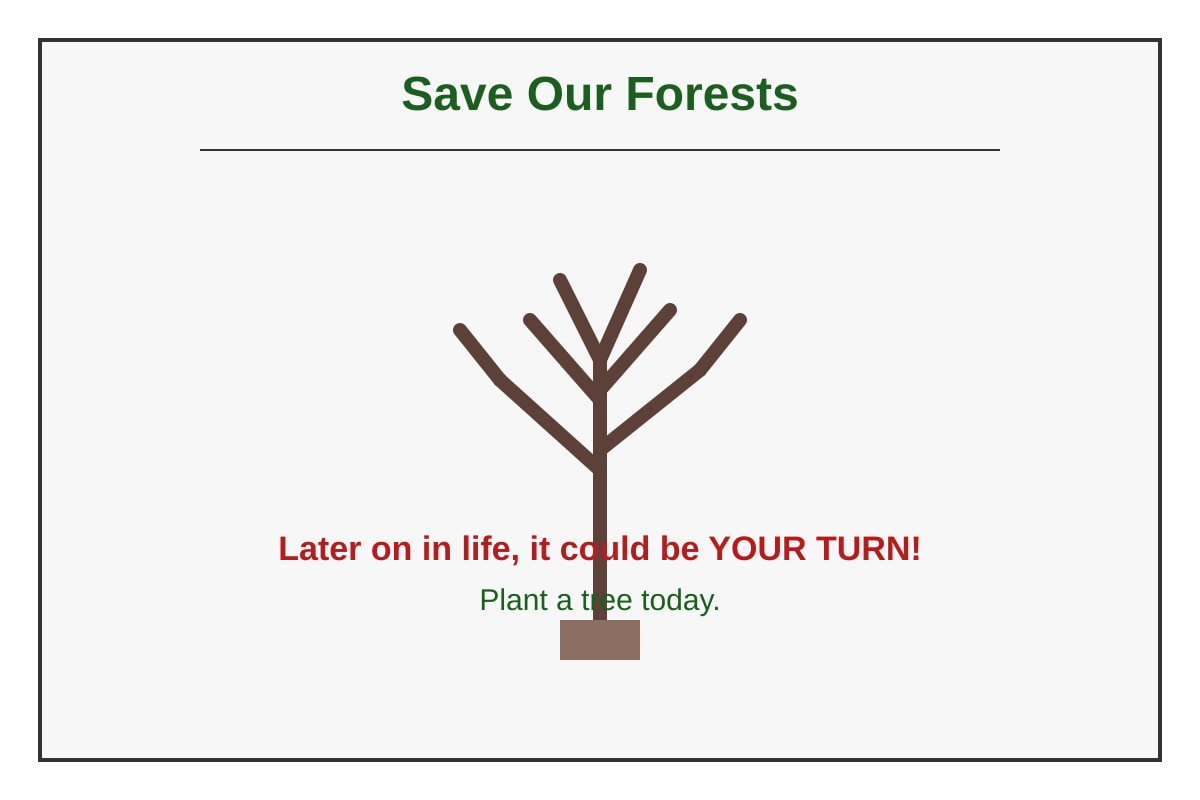
15. [3 marks] The poster means that if we do not act now (plant trees), future generations (including the student) will suffer the same loss of forests. "Your turn" suggests the reader will face the consequence later.
Marking descriptors: 1 mark = identifies future consequence; 1 mark = explains "your turn" = reader affected; 1 mark = links to poster purpose (encourage action).
Teaching note: Posters use second person "you" to make the message personal.
16. [3 marks] The leafless tree is a visual symbol of death/loss. It makes the reader feel sad or worried, showing what happens without action. This creates emotional impact and supports the slogan.
Marking: 1 mark visual feature, 1 mark effect on reader, 1 mark link to message.
17. [4 marks] The simile compares the wind to a wounded animal, suggesting pain and fear. This creates a scary, tense atmosphere. The reader feels the wind is threatening, not just natural.
Marking: 1 mark identify technique, 1 mark explain comparison, 1 mark atmosphere created, 1 mark reader response.
Teaching note: Similes use "like/as" to compare; they help readers picture sound and mood.
18. [3 marks] Personification: "The wind howled like a wounded animal" (or "shadows seemed to move"). Effect: gives human/animal qualities to non-human things, making the scene feel alive and frightening.
Marking: 1 mark quote, 1 mark identify personification, 1 mark effect.
19. [4 marks] Short sentences speed up the pace and show Maya's fear clearly. They make the reader feel sudden shock. The writer uses them to build tension and focus on her feelings.
Marking: 1 mark purpose (pace/tension), 1 mark effect on reader, 1 mark link to feeling, 1 mark use of evidence.
20. [3 marks] The direct speech shows Maya is afraid and unsure. "Whispered" tells us she is quiet from fear. This helps the reader understand her emotion directly.
Marking: 1 mark fear shown, 1 mark "whispered" analysis, 1 mark reader understanding.
Caveat: This quiz is generated from AI-inferred Stage 4 templates and syllabus context. Past-paper evidence for Language Use at Sec 2 is partial; this content is syllabus-first and not claimed as exam-derived.