AI Generated Quiz
Secondary 2 English Comprehension Quiz
Free Sec 2 English Comprehension quiz, Nemo3 AI version, with questions, answers, and syllabus-aligned practice for Singapore students.
These static practice materials are generated from the site's syllabus and paper-generation workflow, with source and model context shown so students and parents can evaluate the material before use.
Questions
Free quiz and exam paper access
Enter your details to view this paper
Your access is remembered on this device.
Answers
Secondary 2 English Quiz - Comprehension (Answer Key)
Total Marks: 40
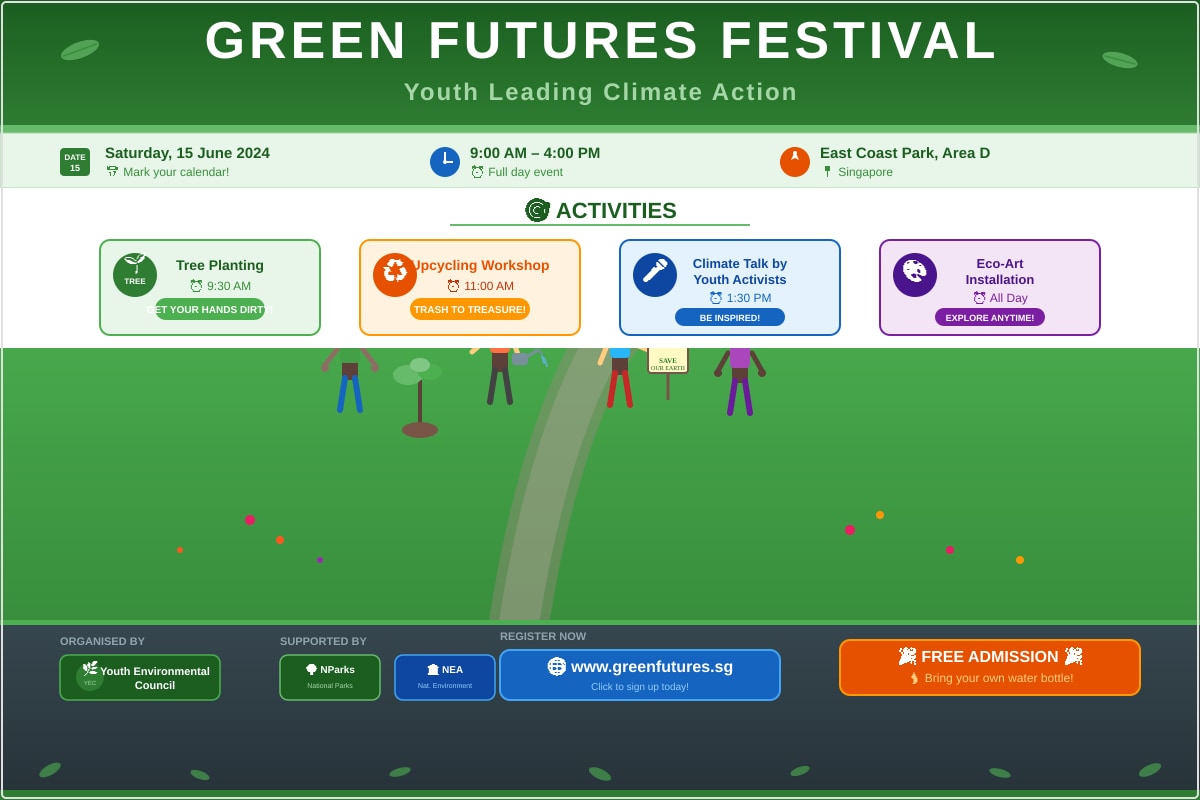
Section A: Visual Text Comprehension [10 marks]
1. Who is the target audience of this poster? Support your answer with one detail from the poster. [2]
Answer: The target audience is youth / young people.
Evidence: The sub-headline states "Youth Leading Climate Action" / the central image shows "diverse teenagers planting trees" / activities are youth-oriented.
Mark breakdown: 1 mark for correct identification of target audience (youth/young people/teenagers), 1 mark for relevant textual/visual evidence.
Common mistake: Identifying "general public" or "everyone" without specific evidence from the poster.
2. Identify two activities that require participants to arrive at a specific time. [2]
Answer: Tree Planting (9:30 AM) and Upcycling Workshop (11:00 AM) / Climate Talk by Youth Activists (1:30 PM).
Mark breakdown: 1 mark each for any two correct activities with their specific times.
Note: "Eco-Art Installation (All Day)" does not require a specific arrival time.
3. What is the purpose of the phrase "Youth Leading Climate Action" in the sub-headline? [2]
Answer: To empower young people by positioning them as leaders/agents of change in environmental action / to inspire youth participation by highlighting their leadership role / to signal that the event is youth-centred and youth-driven.
Mark breakdown: 2 marks for a clear explanation of the persuasive/inspirational purpose linking "youth" and "leading". 1 mark for a partial explanation (e.g., "to attract young people" without explaining the leadership angle).
4. How does the poster encourage environmentally responsible behaviour? Give two ways. [2]
Answer:
- "Bring your own water bottle!" — reduces single-use plastic waste.
- Activities like "Tree Planting" and "Upcycling Workshop" promote direct eco-friendly actions.
- Free admission removes financial barriers to participation in environmental education.
Mark breakdown: 1 mark each for any two valid ways with brief explanation. Accept other reasonable answers supported by poster details.
5. The poster states "Free Admission". Why might the organisers still require registration? [2]
Answer: To manage crowd size / estimate attendance for logistics (materials, space, safety) / collect contact information for updates or future events / ensure sufficient resources (e.g., seedlings for tree planting, workshop materials).
Mark breakdown: 2 marks for a practical, logical reason. 1 mark for a vague answer (e.g., "to know how many people come").
Section B: Narrative Text Comprehension [15 marks]
6. From paragraph 1, write down two expressions that suggest the lighthouse tower feels empty and abandoned. [2]
Answer:
- "echoing in the cylindrical tower like a heartbeat in a hollow chest"
- "not since the automated beacon on the headland made it obsolete" / "The old lighthouse had not been lit in thirty years"
Mark breakdown: 1 mark each for any two accurate quotations. Must use quotation marks.
Common trap: Quoting single words like "hollow" or "obsolete" without the full expressive phrase.
7. In paragraph 2, the writer describes the Fresnel lens as "a crown of glass prisms". What does this metaphor suggest about the lens? [2]
Answer: It suggests the lens is precious, majestic, and valuable (like a crown) / it is the most important/central part of the lighthouse / it has a regal, dignified beauty despite being unused.
Mark breakdown: 2 marks for explaining the connotations of "crown" (precious, central, majestic) applied to the lens. 1 mark for a literal description (e.g., "it is shaped like a crown").
8. From paragraph 3, pick out one expression that shows Mateo views the lighthouse as outdated. [1]
Answer: "Your lens is... decorative" / "Nobody sees it but you" / "The ships follow the GPS buoys now... Satellites."
Mark breakdown: 1 mark for any accurate quotation showing Mateo's dismissive/modernising view.
9. In paragraph 5, Elias says: "The meaning is not in the object, boy. It's in the keeping." Explain in your own words what Elias means by this. [2]
Answer: The value/significance of something lies not in its physical form or utility, but in the care, dedication, and commitment to maintaining it / the act of preserving something matters more than the thing itself.
Mark breakdown: 2 marks for a clear paraphrase capturing "care/dedication/commitment" vs "physical object/utility". 1 mark for partial understanding (e.g., "it's about looking after it" without contrasting with the object).
Common trap: Quoting the text instead of explaining in own words.
10. From paragraph 7, identify one detail that suggests the council's plan is motivated by profit rather than preservation. [1]
Answer: "Turn it into a viewing platform with a café" / "'Heritage tourism,' he calls it" (the quotation marks suggest scepticism about the label).
Mark breakdown: 1 mark for identifying the commercial element (café, tourism).
11. The writer describes the rainbows as "painting his face in fragments of colour" (paragraph 6). What effect does this imagery create? [2]
Answer: It creates a visual effect of Mateo being touched/transformed by the lighthouse's beauty / suggests the light's magic reaches even the sceptic / fragments imply broken/refracted light mirroring Mateo's shifting perspective / artistic, almost deliberate beauty imposed on a reluctant face.
Mark breakdown: 2 marks for explaining the visual and/or symbolic effect. 1 mark for identifying it as a metaphor/imagery without explaining effect.
12. In paragraph 8, the writer states: "The light had never actually shone in his lifetime... but he had inherited the duty." What does this reveal about Elias's character? [2]
Answer: He is dutiful, principled, and committed to a promise beyond practical outcomes / he values tradition and inherited responsibility over tangible results / he is steadfast/loyal to a cause that exists only symbolically.
Mark breakdown: 2 marks for identifying character traits supported by the evidence. 1 mark for a trait without textual support.
13. The passage ends with Elias whispering, "I keep the light." How does this final line connect to the title "unofficial keeper" in paragraph 1? [2]
Answer: It confirms/fulfils the self-given title — though unofficial and unrecognised, his keeping is real and deliberate / the whisper shows quiet conviction matching the "quiet respect" of villagers / it transforms the title from description to declaration of identity.
Mark breakdown: 2 marks for linking the final declaration to the earlier title with insight. 1 mark for noting the repetition/connection without deeper explanation.
14. Based on the passage, do you think Mateo's attitude towards the lighthouse changes by the end of the conversation? Support your answer with evidence from the text. [3]
Answer: Yes, his attitude shifts from dismissive to reflective/respectful.
Evidence:
- Initially: "Nobody sees it but you... Your lens is... decorative" (mocking/dismissive)
- Middle: "My father says the council wants to demolish the tower" (sharing insider info, showing engagement)
- Later: "Will you fight it?" (concern, alignment with Elias)
- The silence and "rainbows painting his face" suggest internal change.
Mark breakdown: 1 mark for clear stance (Yes), 1 mark for evidence of initial attitude, 1 mark for evidence of shift.
Note: "No" is acceptable if well-supported (e.g., he remains pragmatic about demolition), but "Yes" is better supported.
Section C: Non-Narrative Text Comprehension [15 marks]
15. From paragraph 1, identify two phrases that show community gardens are growing in unexpected urban spaces. [2]
Answer:
- "void decks"
- "rooftops" / "roadside verges" / "corridors of HDB blocks" / "spaces once overlooked"
Mark breakdown: 1 mark each for any two accurate phrases. Must use quotation marks.
16. In paragraph 2, the writer mentions that the movement's growth "has been driven by residents themselves." What evidence from the same paragraph supports this claim? [2]
Answer:
- Growth from 50 to over 2,000 gardens despite CIB programme providing only "initial framework"
- Madam Lim's account: "It started with a few pots... Now we harvest enough vegetables to share with the whole block" (shows resident initiative and expansion)
- "The children know where their food comes from" (community-driven education)
Mark breakdown: 1 mark each for any two distinct pieces of evidence. Must reference paragraph 2.
17. From paragraph 3, write down one benefit of community gardens for education and one benefit for biodiversity. [2]
Answer:
- Education: "living classrooms" / "students... study plant life cycles, pollination, and composting"
- Biodiversity: "over 150 species of butterflies and bees returning" / "creating corridors of biodiversity"
Mark breakdown: 1 mark each for correct benefit with textual support.
18. In paragraph 4, the writer states: "And not all residents welcome the insects and occasional mess that accompany nature." What does the word "accompany" suggest about the relationship between nature and these inconveniences? [2]
Answer: "Accompany" suggests that insects and mess are inseparable/inevitable/natural consequences of having nature / they come together as a package / you cannot have the benefits of nature without accepting these drawbacks.
Mark breakdown: 2 marks for explaining the inseparable/inevitable relationship. 1 mark for defining "accompany" as "come with" without the nuance of inevitability.
19. Dr. Tan Wei Ling describes the gardens' value as "social resilience" (paragraph 5). Explain how the example given in the same paragraph illustrates this concept. [3]
Answer:
- "Social resilience" = ability of community to withstand crises through social bonds.
- Example: During pandemic, garden networks became "lifelines" — gardeners (1) checked on elderly residents (care), (2) shared produce (resource sharing), (3) maintained mental wellbeing through collective purpose (psychological support).
- This shows pre-existing trust networks enabled practical and emotional support during crisis.
Mark breakdown: 1 mark for defining social resilience, 1 mark for linking to specific pandemic actions, 1 mark for explaining how this demonstrates resilience (pre-existing networks → crisis response).
20. The article ends with Madam Lim's statement: "The soil remembers what the papers forget." What does this metaphor suggest about the relationship between community action and government policy? [2]
Answer: Community action (gardening/soil) is enduring, grounded, and has lasting memory/impact, while government policies ("papers") are transient, changeable, and forgettable / the physical, lived practice of gardening outlasts bureaucratic documents / true change happens through sustained community practice, not policy alone.
Mark breakdown: 2 marks for contrasting enduring community action vs transient policy with metaphorical insight. 1 mark for literal interpretation (soil vs paper) without relational insight.
End of Answer Key