From Real Exams Quiz
Secondary 2 English Summary Quiz
Free Sec 2 English Summary quiz, Exam version, with questions, answers, and syllabus-aligned practice for Singapore students.
These static practice materials are generated from the site's syllabus and paper-generation workflow, with source and model context shown so students and parents can evaluate the material before use.
Questions
Free quiz and exam paper access
Enter your details to view this paper
Your access is remembered on this device.
Answers
Secondary 2 English Quiz - Summary: Answer Key
Total Marks: 40
Section A: Understanding Summary (Questions 1–5)
(5 marks)
Question 1 (1 mark)
- Answer: The main topic is the Great Barrier Reef and the threat of coral bleaching caused by climate change.
- Explanation: A summary begins with identifying the main topic. The passage focuses on the Great Barrier Reef and the problem of coral bleaching.
- Marking: Award 1 mark for identifying the reef and coral bleaching. Accept "coral bleaching on the Great Barrier Reef" or similar.
Question 2 (1 mark)
- Answer: Rising sea temperatures / climate change.
- Explanation: The passage states "rising sea temperatures caused by climate change have led to widespread coral bleaching." The cause is the increase in water temperature.
- Marking: Award 1 mark for "rising sea temperatures" or "climate change." Do not accept "warm water" alone without reference to the cause.
Question 3 (1 mark)
- Answer: Corals expel the algae in their tissues and turn white. / The corals may die if the water does not cool down.
- Explanation: The passage describes two effects: corals expel algae and turn white, and they may die. Accept either effect.
- Marking: Award 1 mark for either effect. Accept "corals turn white" or "corals die."
Question 4 (1 mark)
- Answer: Breeding heat-resistant corals AND reducing pollution in the water.
- Explanation: The passage lists two actions: "breeding heat-resistant corals and reducing pollution in the water." Both must be stated for the mark.
- Marking: Award 1 mark only if both actions are listed. Accept paraphrases like "creating corals that can survive heat" and "cutting down water pollution."
Question 5 (1 mark)
- Answer: Coral bleaching happens when warm water causes corals to expel the algae living inside them, turning them white.
- Explanation: A one-sentence summary should capture the key process: cause (warm water), action (expel algae), and result (turn white).
- Marking: Award 1 mark for a clear, complete sentence that captures the process. Do not accept a sentence that only states one part of the process.
Section B: Identifying Key Points (Questions 6–10)
(10 marks)
Question 6 (3 marks)
- Answer: Any three of the following:
- Reduces carbon footprint
- Transforms unused spaces into green areas
- Improves air quality
- Provides habitats for local wildlife
- Creates job opportunities
- Brings communities together
- Explanation: The passage lists several benefits. Students must identify three distinct benefits from the text.
- Marking: Award 1 mark for each correct benefit. Accept paraphrases. Do not accept "fresh produce" or "access to food" as these are not listed as benefits in the passage.
Question 7 (1 mark)
- Answer: Any one of: limited space, high start-up costs, need for specialised knowledge.
- Explanation: The passage states "urban farming faces challenges such as limited space, high start-up costs, and the need for specialised knowledge."
- Marking: Award 1 mark for any one challenge. Accept paraphrases.
Question 8 (2 marks)
- Answer: Urban farming reduces the carbon footprint because food is grown locally in the city, so it does not need to be transported over long distances, which reduces the amount of fuel burned and emissions released.
- Explanation: The key link is between local food production and reduced transportation. Students must explain the connection, not just restate "reduces carbon footprint."
- Marking:
- 1 mark for stating that food is grown locally / in the city
- 1 mark for explaining that this reduces transportation / fuel / emissions
- Award 0 marks for simply repeating "reduces carbon footprint" without explanation.
Question 9 (1 mark)
- Answer: C) Reduces water usage
- Explanation: The passage does not mention water usage as a benefit. The other three options (A, B, D) are explicitly stated.
- Marking: Award 1 mark for circling C. No partial credit.
Question 10 (3 marks)
- Answer: Urban farming is growing in popularity because it provides fresh food locally, reduces carbon emissions, and creates green spaces, but it faces challenges such as limited space and high costs.
- Explanation: A good one-sentence summary should include:
- Main idea: urban farming is popular / growing
- At least one benefit (e.g., reduces carbon footprint, creates green spaces)
- At least one challenge (e.g., limited space, high costs)
- Marking:
- 1 mark for stating the main idea
- 1 mark for including a benefit
- 1 mark for including a challenge
- Deduct 1 mark if the sentence is unclear or poorly constructed.
Section C: Summarising a Longer Text (Questions 11–15)
(15 marks)
Question 11 (1 mark)
- Answer: To explain how the printing press revolutionised the sharing of information and its impact on society.
- Explanation: The passage's main purpose is to describe the invention of the printing press and its transformative effects.
- Marking: Award 1 mark for identifying the purpose as explaining the impact/revolution of the printing press. Accept "to describe how the printing press changed the world."
Question 12 (2 marks)
- Answer: Any two of the following:
- Books became cheaper and more accessible
- Literacy rates increased
- Ideas spread quickly
- Challenged traditional authorities
- Sparked the Protestant Reformation
- Standardised languages
- Helped preserve knowledge
- Explanation: The passage lists multiple effects. Students must identify two distinct effects.
- Marking: Award 1 mark for each correct effect. Accept paraphrases.
Question 13 (2 marks)
- Answer: Books were rare before the printing press because they were copied by hand, which was a slow and expensive process, so only the wealthy and religious institutions could afford them.
- Explanation: The passage gives two reasons: the slow, manual process of copying and the high cost that limited ownership.
- Marking:
- 1 mark for mentioning hand-copying / slow process
- 1 mark for mentioning high cost / limited to wealthy
- Award 0 marks for simply saying "books were rare" without explanation.
Question 14 (2 marks)
- Answer: The printing press allowed Martin Luther's 95 Theses to be printed and distributed widely, which helped spread his criticism of the Catholic Church and sparked the Protestant Reformation.
- Explanation: The key point is that the printing press enabled mass distribution of the document, which amplified its impact.
- Marking:
- 1 mark for stating that the printing press allowed mass production / printing of the Theses
- 1 mark for explaining that this helped spread the ideas / sparked the Reformation
- Award 0 marks for simply naming the Theses without linking to the printing press.
Question 15 (8 marks)
- Sample summary (58 words):
Gutenberg's printing press revolutionised information sharing by enabling mass production of books. This made books cheaper and more accessible, increasing literacy. Ideas about science, religion, and politics spread quickly, challenging authorities and sparking the Protestant Reformation. The press also standardised languages and preserved knowledge, laying the foundation for modern society.
- Explanation: A good summary should:
- State the main idea (printing press revolutionised information sharing)
- Include at least three key points (e.g., mass production, increased literacy, spread of ideas, Reformation, standardised languages, preserved knowledge)
- Be in the student's own words (not copied directly from the passage)
- Be within the word limit (no more than 60 words)
- Marking scheme:
- Content (5 marks):
- 1 mark for stating the main idea
- 1 mark for each key point included (up to 4 marks)
- Language and style (3 marks):
- 1 mark for using own words (not copying)
- 1 mark for clear and concise writing
- 1 mark for staying within the word limit
- Deduct 1 mark for every 10 words over the limit (up to 2 marks deducted).
- Award 0 marks if the summary is entirely copied from the passage.
- Content (5 marks):
Section D: Summary Writing from a Visual Source (Questions 16–20)
(10 marks)
Question 16 (1 mark)
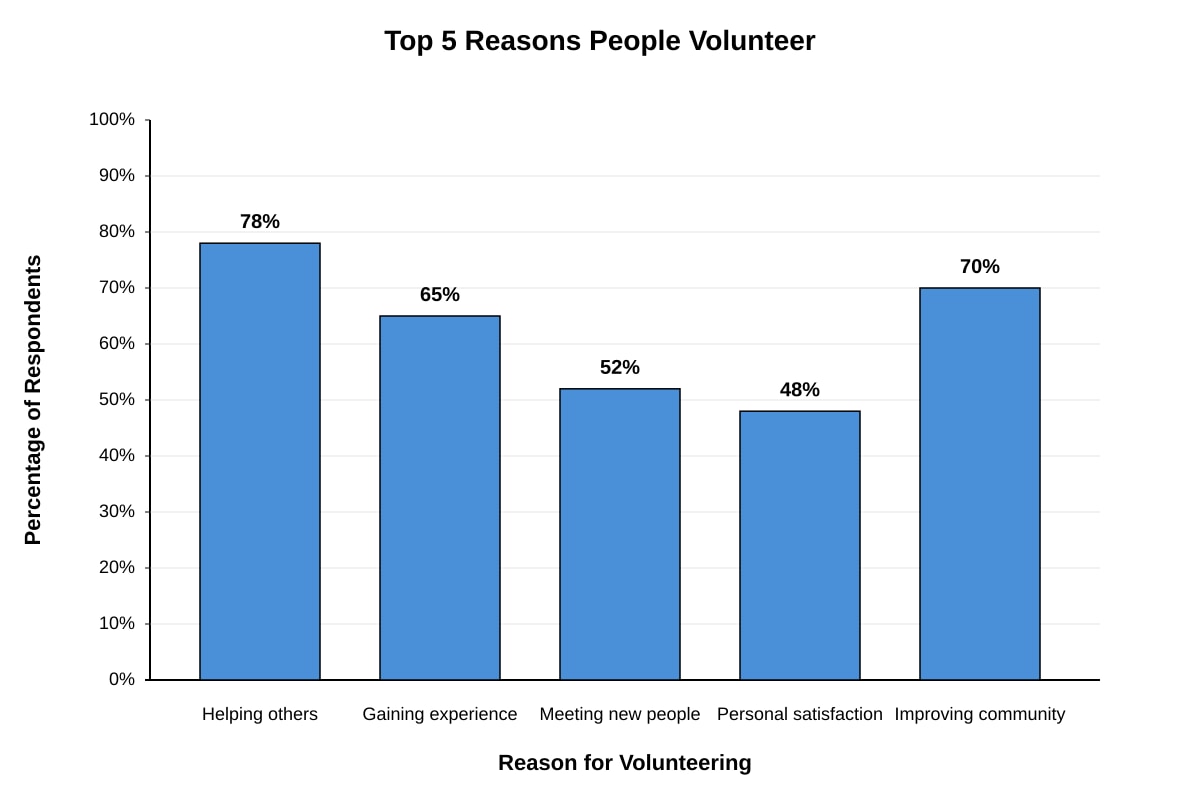
- Answer: Helping others (78%)
- Explanation: The bar chart shows "Helping others" as the tallest bar at 78%, making it the most common reason.
- Marking: Award 1 mark for "Helping others." Accept "helping others (78%)."
Question 17 (2 marks)
- Answer: Any two of: Gaining experience (65%), Meeting new people (52%), Personal satisfaction (48%).
- Explanation: These three reasons directly benefit the volunteer themselves, unlike "Helping others" and "Improving community" which benefit others.
- Marking: Award 1 mark for each correct reason. Accept the percentage as well.
Question 18 (1 mark)
- Answer: 70%
- Explanation: The bar for "Improving community" reaches 70%.
- Marking: Award 1 mark for "70%." Accept "70 percent."
Question 19 (2 marks)
- Answer: Gaining experience is a personal benefit because it allows volunteers to learn new skills, build their resume, or gain knowledge that can help them in their career or personal development.
- Explanation: Students must explain why this is a personal benefit, not just restate the phrase.
- Marking:
- 1 mark for identifying that it helps the individual
- 1 mark for providing a specific example or explanation (e.g., learning skills, career help)
- Award 0 marks for simply saying "it benefits the person" without elaboration.
Question 20 (4 marks)
- Sample summary (38 words):
The infographic shows the top five reasons people volunteer. The most common reason is helping others (78%), followed by improving the community (70%). Personal benefits like gaining experience and meeting people are also important motivators.
- Explanation: A good summary should:
- State the main trend (most common reason is helping others)
- Include at least two specific data points (percentages)
- Be in the student's own words
- Be within the word limit (no more than 40 words)
- Marking scheme:
- Content (3 marks):
- 1 mark for stating the main trend
- 1 mark for each specific data point included (up to 2 marks)
- Language and style (1 mark):
- 1 mark for clear, concise writing within the word limit
- Deduct 1 mark if the summary exceeds 40 words.
- Award 0 marks if the summary is entirely copied from the infographic labels.
- Content (3 marks):
— End of Answer Key —