From Real Exams Quiz
Secondary 2 English Comprehension Quiz
Free Sec 2 English Comprehension quiz, Nemo3 Exam version, with questions, answers, and syllabus-aligned practice for Singapore students.
These static practice materials are generated from the site's syllabus and paper-generation workflow, with source and model context shown so students and parents can evaluate the material before use.
Questions
Free quiz and exam paper access
Enter your details to view this paper
Your access is remembered on this device.
Answers
Secondary 2 English Quiz - Comprehension (Answer Key)
Total Marks: 40
Section A: Visual Text Comprehension [10 marks]
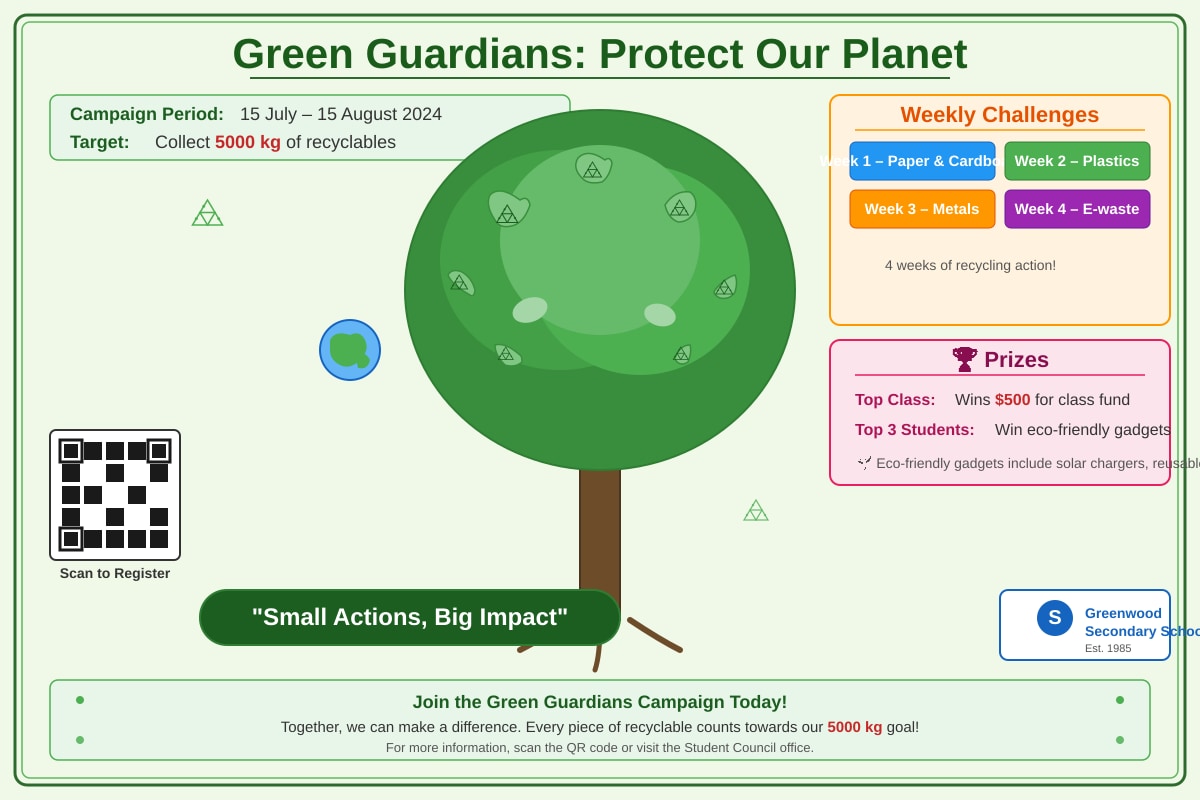
1. What is the main goal of the "Green Guardians" campaign? [1]
Answer: To collect 5000 kg of recyclables. / The target is to collect 5000 kg of recyclables.
Marking Note: Must mention "5000 kg" and "recyclables" or "collect". Accept "Collect 5000 kg of recyclables during the campaign period."
Common Mistake: Writing "protect the planet" or "raise awareness" — these are themes, not the specific measurable goal stated.
2. Identify two weekly challenges mentioned in the poster. [2]
Answer (any two):
- Week 1: Paper & Cardboard
- Week 2: Plastics
- Week 3: Metals
- Week 4: E-waste
Marking Note: 1 mark per correct challenge. Must specify the material (e.g., "Paper & Cardboard", not just "Week 1").
3. Which phrase in the poster suggests that individual efforts can lead to significant change? [1]
Answer: "Small Actions, Big Impact"
Marking Note: Must quote the exact phrase including capitalisation and punctuation as shown.
4. A student wants to participate but missed Week 1. Can the student still join? Support your answer with evidence from the poster. [2]
Answer: Yes, the student can still join. The campaign runs from 15 July to 15 August (4 weeks), and there are weekly challenges for Weeks 2, 3, and 4 (Plastics, Metals, E-waste), so the student can participate in the remaining weeks.
Marking Breakdown:
- 1 mark for "Yes" / "Can still join"
- 1 mark for evidence: campaign lasts 4 weeks / there are challenges for Weeks 2–4 / registration via QR code is still open
Common Mistake: Saying "No" because Week 1 is over, missing that the campaign continues for three more weeks.
5. How does the visual of the tree with hand-shaped leaves support the campaign's message? [2]
Answer: The tree represents the environment/nature, and the hand-shaped leaves holding recycling symbols show that human actions (hands) directly protect and nurture nature. This visual reinforces the tagline "Small Actions, Big Impact" by illustrating how individual efforts (hands) collectively sustain the planet (tree).
Marking Breakdown:
- 1 mark for identifying what the tree represents (environment/nature)
- 1 mark for explaining the significance of hand-shaped leaves holding recycling symbols (human action protecting nature / link to tagline)
Common Mistake: Only describing the image ("a tree with hands") without linking to the campaign message.
Section B: Narrative Text Comprehension [15 marks]
6. From paragraph 1, write down two expressions that suggest the attic was a place the children were not supposed to enter. [2]
Answer (any two):
- "forbidden mystery"
- "pause mid-sentence whenever the ceiling creaked"
- "fingers would tighten around her teacup"
- "warnings louder than words"
Marking Note: 1 mark per expression. Must be quoted exactly from paragraph 1. Minimum 2-word phrases. Single words like "forbidden" or "mystery" alone may not earn the mark.
Common Trap: Quoting from later paragraphs or giving explanations instead of quotations.
7. Why does the writer describe the silence in the house as "that particular silence that only comes when adults are distracted by their own conversations"? [2]
Answer: It emphasises that the adults are preoccupied and not paying attention to the children, giving the writer the opportunity to explore the attic without being stopped or noticed.
Marking Breakdown:
- 1 mark for identifying adults are distracted/preoccupied
- 1 mark for explaining the consequence: writer can act without supervision / opportunity to explore
Teaching Note: This question tests inference — reading between the lines to understand why the writer chooses this specific description.
8. In paragraph 3, the writer says the cardboard boxes "stood like silent sentinels." What does this simile suggest about the atmosphere in the attic? [2]
Answer: It suggests the attic feels still, watchful, and slightly ominous or mysterious, as if the boxes are guarding the space and its secrets.
Marking Breakdown:
- 1 mark for "still/quiet/guarding" atmosphere
- 1 mark for "watchful/ominous/mysterious/guarding secrets" connotation
Teaching Note: A "sentinel" is a guard. The simile personifies the boxes as silent guards, creating a sense of forbidden territory and hidden secrets.
9. Write down one word from paragraph 3 that shows the wooden chest was noticeable in the dim attic. [1]
Answer: "beacon" / "catching" (as in "catching the light like a beacon")
Marking Note: Must be a single word from paragraph 3. "Beacon" is the strongest answer — it directly implies visibility and prominence in darkness.
10. The writer describes the mist in the bottles as "swirling, luminous" and says the colours "shifted — amber, violet, emerald — as if alive." What effect does this description create? [2]
Answer: It creates a sense of magic, wonder, and preciousness, making the bottles seem mystical and alive rather than ordinary objects.
Marking Breakdown:
- 1 mark for "magical/wondrous/mystical/precious" atmosphere
- 1 mark for "alive/animated/shifting" quality
Teaching Note: The dash-separated colours (amber, violet, emerald) slow the reading pace, forcing the reader to visualise each hue. "As if alive" transforms objects into beings.
11. From paragraph 5, quote one expression that shows the writer handled the notebook with care. [1]
Answer: "opened it carefully" / "carefully"
Marking Note: Must be from paragraph 5. "Carefully" alone is acceptable but the phrase is better.
12. The first entry in the notebook is dated "twenty years before my birth." What does this suggest about the owner of the notebook? [2]
Answer: It suggests the owner is from the previous generation — likely the writer's mother or another older relative — and has been keeping this collection for a long time, since before the writer was born.
Marking Breakdown:
- 1 mark for identifying the owner is from an older generation / likely the mother
- 1 mark for the long-term nature: started before writer's birth / has been collecting for decades
Teaching Note: This connects to paragraph 1 where Mother reacts to attic sounds — foreshadowing her connection to the chest.
13. The entry reads: "Captured the scent of rain on hot pavement today. Childhood summer, preserved." What does the word "preserved" suggest about the purpose of the bottles? [2]
Answer: It suggests the bottles are used to store and keep memories or sensory experiences (like scents) intact over time, preventing them from fading or being lost, like preserving a specimen.
Marking Breakdown:
- 1 mark for "store/keep memories or sensory experiences"
- 1 mark for "prevent fading/loss over time" / "keep intact"
Teaching Note: "Preserved" links to scientific preservation (specimens in jars) but applied to intangible memories — a metaphor for holding onto the past.
14. Based on the passage, do you think the writer's mother knew about the chest and its contents? Support your answer with two details from the text. [3]
Answer: Yes, she likely knew.
- In paragraph 1, she pauses and tightens her grip on her teacup whenever the ceiling creaks, showing she is aware of the attic and anxious about it.
- The notebook's first entry is dated twenty years before the writer's birth, which aligns with the mother's childhood — suggesting she started the collection.
Marking Breakdown:
- 1 mark for "Yes" / inference that she knew
- 1 mark for Detail 1: Mother's reaction to attic sounds (para 1)
- 1 mark for Detail 2: Notebook timeline matches mother's childhood (para 5) / Mother's warnings were "louder than words" implying knowledge
Alternative Answer (No): Acceptable if supported by two textual details, e.g., "Mother never explicitly said not to go up" and "the boxes' labels were faded to illegibility suggesting long neglect." But "Yes" is better supported.
Section C: Non-Narrative Text Comprehension [15 marks]
15. From paragraph 1, identify two resources that trees were traditionally thought to compete for. [2]
Answer (any two):
- Sunlight
- Water
- Nutrients
Marking Note: 1 mark each. Must be from paragraph 1. "Carbon" and "nitrogen" are from paragraph 2 (what they actually share), not what they were thought to compete for.
16. In paragraph 2, the author refers to the fungal network as the "Wood Wide Web." Why is this an effective metaphor? [2]
Answer: It compares the underground fungal network to the internet (World Wide Web), suggesting trees are "connected" and "exchange information/resources" like computers sharing data online, making the complex scientific concept relatable and vivid.
Marking Breakdown:
- 1 mark for identifying the comparison to the internet/WWW
- 1 mark for explaining the similarity: connection, communication, exchange of resources/signals
Teaching Note: Effective metaphors use familiar concepts (internet) to explain unfamiliar ones (mycorrhizal networks). "Playfully call it" signals the author's deliberate choice.
17. According to paragraph 3, how do mother trees increase the survival rates of their seedlings? [2]
Answer: Mother trees recognise their own seedlings and funnel them extra carbon and nutrients through the fungal network, increasing survival rates by up to four times.
Marking Breakdown:
- 1 mark for "recognise their own seedlings"
- 1 mark for "funnel extra carbon and nutrients" / "share resources via fungal network"
Common Mistake: Omitting "recognise their own seedlings" — the selectivity/kinship recognition is key.
18. From paragraph 4, explain how Douglas firs and paper birches help each other at different times of the year. [2]
Answer: In summer, Douglas firs share excess carbon with shaded paper birches. In autumn, when birches lose their leaves, the flow reverses and birches share carbon with firs.
Marking Breakdown:
- 1 mark for summer: firs → birches (carbon)
- 1 mark for autumn: birches → firs (carbon) / flow reverses
Teaching Note: This reciprocity (mutual give-and-take) directly challenges "nature is purely competitive" — a key argument in the passage.
19. In paragraph 5, the writer states that "replanted monocultures lack the diversity needed to rebuild the network." What does "monocultures" mean in this context? [1]
Answer: Forests planted with only a single species of tree. / Areas where only one type of tree is grown.
Marking Note: Must convey "single species" or "one type of tree". "Monoculture" = mono (one) + culture (cultivation).
20. The final paragraph claims that forests are "complex, intelligent communities." Using evidence from the passage, explain two ways in which trees demonstrate intelligence or cooperation. [3]
Answer (any two, well-explained):
- Communication & Warning: Mother trees send chemical distress signals through the fungal network to warn kin of insect attacks or drought (para 3).
- Kin Recognition & Preferential Care: Mother trees recognise their own seedlings and funnel them extra carbon/nutrients, boosting survival 4x (para 3).
- Reciprocal Resource Sharing: Different species (Douglas firs and paper birches) exchange carbon seasonally based on who has excess (para 4).
- Network Integration: Trees connect via mycorrhizal fungi to exchange carbon, nitrogen, water, and signals across the forest (para 2).
Marking Breakdown:
- 1 mark for "Yes/claim supported" (implied)
- 1 mark per distinct way (max 2 ways × 1 mark each)
- 1 mark for specific textual evidence/reference per way
Full Marks Response Example: "First, mother trees demonstrate intelligence by recognising their own seedlings and sending them extra carbon and nutrients through the fungal network, increasing survival rates fourfold (paragraph 3). Second, trees of different species cooperate through reciprocal sharing — Douglas firs give carbon to shaded birches in summer, and birches return the favour in autumn (paragraph 4)."
End of Answer Key