From Real Exams Quiz
Secondary 2 English Argument Evaluation Quiz
Free Sec 2 English Argument Evaluation quiz, HY3 Exam version, with questions, answers, and syllabus-aligned practice for Singapore students.
These static practice materials are generated from the site's syllabus and paper-generation workflow, with source and model context shown so students and parents can evaluate the material before use.
Questions
Free quiz and exam paper access
Enter your details to view this paper
Your access is remembered on this device.
Answers
Secondary 2 English Quiz - Argument Evaluation (Answer Key)
Total Marks: 40
Topic: Argument Evaluation
Section A: Identifying Argument Parts (1 mark each)
1. Claim: "Students should wear school uniforms"
Teaching note: A claim is the point the writer wants you to accept. The word "because" introduces the reason, not the claim.
2. Evidence: "a 2022 study of 500 students"
Teaching note: Evidence is the fact or source used to support the claim "Homework helps learning".
3. Appeal type: fear
Teaching note: "otherwise, no one will listen" warns of a bad result, which is a fear appeal, not a proven fact.
4. Counterargument: "games waste time"
Teaching note: The counterargument is the opposite view ("Some say…") before the writer's "but".
5. Link: strong
Teaching note: Eating breakfast → improves focus → canteen opens earlier is a clear, logical link.
6. Conclusion signal: "therefore"
Teaching note: "Therefore" shows the result or conclusion drawn from the reason.
7. Personal opinion: "I think it is right"
Teaching note: "I think" marks a personal view, not shared evidence.
8. Expected result: "we help the planet"
Teaching note: After "if", the result stated is the outcome expected from recycling more.
9. Cause: "The bus was late"
Teaching note: The cause is the event that led to missing the test.
10. Flaw: hasty generalisation
Teaching note: "Everyone" from unseen cases is a broad claim without proof.
Section B: Explaining Argument Parts (2 marks per part)
11.
(a) Claim: "Buy local food" (or "We should buy local food"). [1] Clear call to action. [1]
(b) Evidence: "supports our farmers" and/or "cuts pollution from transport". [2] Any one.
Teaching note: Claim is what is urged; evidence gives reasons.
12.
(a) Position: School starts too early. [2]
(b) Evidence: (i) teens need 9 hours sleep [1] (ii) current start allows only 7 hours [1].
Teaching note: Position = writer's view; evidence = facts given.
13.
(a) Counterargument: Books are cheaper and do not break (against tablets). [2]
(b) Presented to: show a downside of tablets and support books. [2]
Teaching note: "However" introduces the opposing view used to weaken the first.
14.
(a) Claim: We should have a canteen day. [2]
(b) Not fully; only one event cited, no proof it will work again. [2] Reason expected.
Teaching note: Past success is evidence but not guarantee.
15.
(a) Reasons: causes stress; leaves no time for sports. [1 each]
(b) Missing: student survey, research, or other schools' data. [2]
Teaching note: Strong arguments use broader evidence.
16.
(a) Claim: Our class is the best. [2]
(b) No; one contest is limited proof, other classes may also win. [2]
Teaching note: Single case is weak evidence.
Section C: Evaluating Arguments
17. (4 marks)
Strong argument.
- Reason 1: Uses survey evidence (8/10 remembered more) [2]
- Reason 2: Gives real learning benefit beyond books [2]
Marking: 2 pts per valid reason from text.
18. (3 marks)
Strong: "soft" is a real pet trait [1].
Weak 1: "my sister has one" is not proof cats are better [1].
Weak 2: No comparison data with dogs [1].
Teaching note: Personal case ≠ general proof.
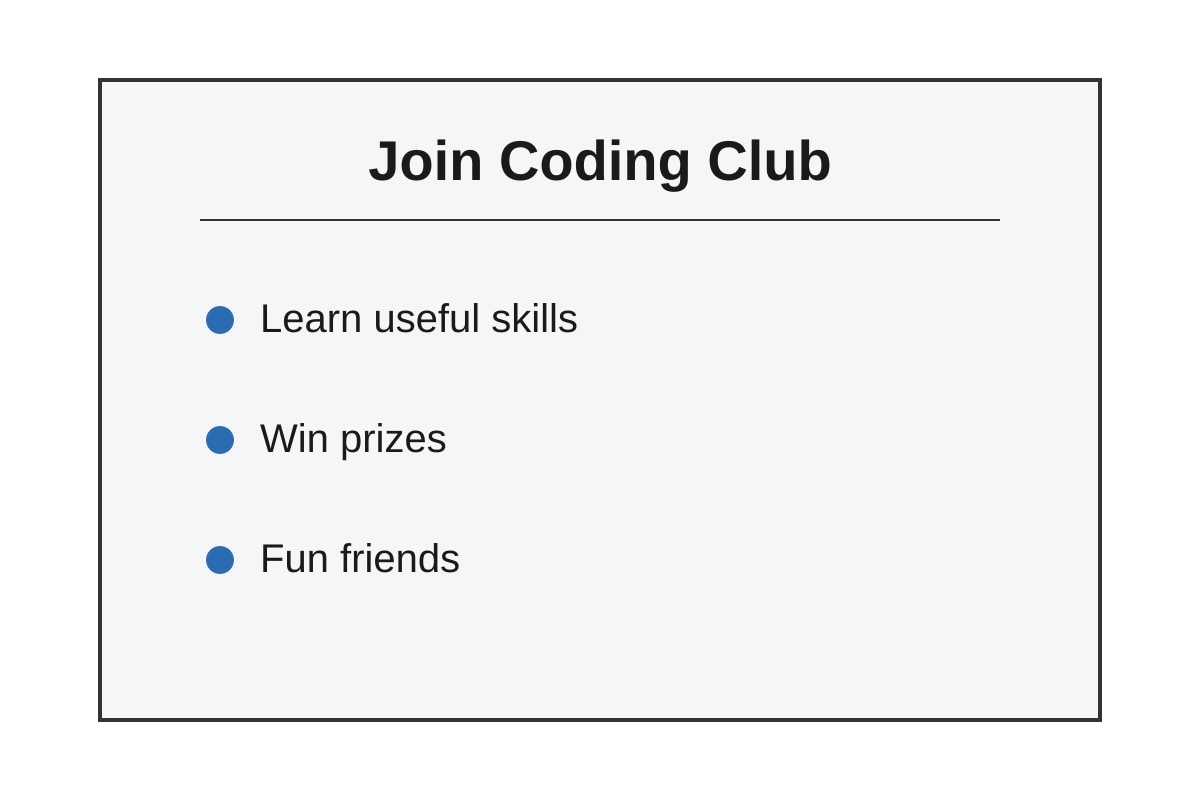
19. (3 marks)
Points from poster:
- Appeal to fun/friends not hard evidence [1.5]
- "Learn useful skills" is a claim, not proven [1.5]
Based on placeholder: poster shows headings/bullets only, no data.
20. (4 marks)
Weak because:
- "I am hungry" is personal, not general [2]
- "Other schools allow" is not proof it suits this school [2]
Marking descriptors: Identify two flaws with explanation.