AI Generated Exam Paper
Secondary 2 English Practice Paper 5
Free Sec 2 English Practice Paper 5, LongCat AI version, with questions, answers, and syllabus-aligned practice for Singapore students.
These static practice materials are generated from the site's syllabus and paper-generation workflow, with source and model context shown so students and parents can evaluate the material before use.
Questions
Free quiz and exam paper access
Enter your details to view this paper
Your access is remembered on this device.
Answers
TuitionGoWhere Practice Paper — Answer Key
English Language, Secondary 2 — Comprehension Practice Paper (Version 5)
Section A: Reading Comprehension (10 marks)
Question 1 (1 mark)
Answer: "their canvas awnings glowing under strings of warm yellow lights"
Marking Notes:
- Award 1 mark for any phrase from paragraph 1 that describes the visual appearance of the stalls.
- Acceptable answers include: "canvas awnings glowing under strings of warm yellow lights," "strings of warm yellow lights," or "stalls stretched endlessly in both directions."
- Do not accept single words (e.g., "glowing" alone) — the answer must be a phrase of at least 3 words.
- The answer must come from paragraph 1.
Question 2 (2 marks)
Answer: (a) "Vendors called out to passersby in a chorus of Malay, Mandarin, and English" (b) "their voices rising above the sizzle of hot woks and the rhythmic thud of a doughnut maker's paddle"
Marking Notes:
- Award 1 mark for each correct detail, up to 2 marks.
- Acceptable alternatives for (a): "a chorus of Malay, Mandarin, and English" or "Vendors called out to passersby."
- Acceptable alternatives for (b): "the sizzle of hot woks" or "the rhythmic thud of a doughnut maker's paddle."
- Answers must be from paragraph 1.
- Students must quote directly from the passage, not paraphrase.
Question 3 (2 marks)
Answer: Amira felt amazed, excited, and overwhelmed by the new experience of visiting the night market. The phrase "wide with wonder" suggests she was seeing everything for the first time and was filled with awe and curiosity. This is supported by the context in paragraph 2, which says "everything felt new and overwhelming" to her.
Marking Notes:
- Award 2 marks for a clear explanation that identifies Amira's feelings (amazement, excitement, awe) AND links the phrase "wide with wonder" to the context of her first visit.
- Award 1 mark for identifying the correct emotion without explanation, or for an explanation that lacks reference to the passage.
- Award 0 marks for vague or unsupported answers (e.g., "she was happy" with no explanation).
- Key concept: This question tests understanding of descriptive language and what it reveals about a character's emotions.
Question 4 (2 marks)
Answer: (a) "his face broke into a wide grin" (b) "Limah! Sudah lama tak jumpa!" (or: he exclaimed, reaching across the counter to clasp her hand)
Marking Notes:
- Award 1 mark for each correct detail from paragraph 5, up to 2 marks.
- Acceptable alternatives for (b): "reaching across the counter to clasp her hand" or the exclamation "Sudah lama tak jumpa!" (meaning "Long time no see!").
- Answers must be from paragraph 5.
- Students should quote directly; paraphrasing is acceptable if the meaning is clearly conveyed.
Question 5 (3 marks)
Answer: Pak Razak's method of making kuih lapis reveals that he is a patient, dedicated, and careful person who takes pride in his craft. He explains that "each layer must be steamed before the next is added" and that there are "nine layers, nine times the waiting." This shows he is willing to invest significant time and effort to achieve perfection. His statement "If you rush, the colours will bleed together and the texture will be wrong" further shows that he values quality over speed and has deep knowledge of his craft. This reveals a person who respects tradition and believes in doing things properly.
Marking Notes:
- Award 3 marks for a well-developed response that identifies at least TWO character traits (e.g., patient, dedicated, careful, traditional) AND supports each with evidence from the passage.
- Award 2 marks for a response that identifies character traits with limited evidence or explanation.
- Award 1 mark for a response that identifies a character trait but provides no evidence from the passage.
- Award 0 marks for answers that only summarise the method without discussing character.
- Marking descriptors:
- Band 3 (3 marks): Clear explanation of character traits with direct quotation and thoughtful interpretation.
- Band 2 (2 marks): Some explanation with at least one piece of evidence.
- Band 1 (1 mark): Basic identification of a trait without evidence.
Section B: Language Use and Comprehension (15 marks)
Question 6 (1 mark)
Answer: "patina" (or "barely legible" or "veiled" or "creaking" — any word suggesting age and neglect)
Marking Notes:
- Award 1 mark for any word from paragraph 1 that conveys neglect or the passage of time.
- Best answer: "patina" (the greenish coating on the brass nameplate, indicating years of exposure).
- Also accept: "barely legible," "veiled," "faded," "creaking," "tired."
- The word must come from paragraph 1.
Question 7 (2 marks)
Answer: The simile "curiosity tugged at him like an invisible hand" suggests that Ravi's curiosity was strong and almost physical — it felt like something was pulling him toward the library despite his hesitation. The word "tugged" implies a forceful, persistent pull, and "invisible hand" suggests the feeling was beyond his conscious control. This shows Ravi was deeply curious and found it difficult to resist entering the library, even though he knew he probably shouldn't.
Marking Notes:
- Award 2 marks for an explanation that interprets both parts of the simile ("tugged" and "invisible hand") and connects them to Ravi's state of mind.
- Award 1 mark for a partial explanation that addresses only one part of the simile.
- Award 0 marks for simply restating the simile without interpretation.
- Key concept: A simile compares two things using "like" or "as." Here, curiosity is compared to a physical force to show its strength.
Question 8 (2 marks)
Answer: (a) Impressive: "Tall shelves lined every wall, reaching up to a ceiling painted with faded murals of Malaysian landscapes" (or: "magnificent") (b) In poor condition: "Most of the shelves still held books, though many had slumped sideways or fallen to the floor" (or: "A thick layer of dust covered everything")
Marking Notes:
- Award 1 mark for each correct detail, up to 2 marks.
- One detail must show the library was impressive; the other must show it was in poor condition.
- Acceptable "impressive" answers: reference to the murals, tall shelves, the word "magnificent," or the painted ceiling.
- Acceptable "poor condition" answers: books fallen to the floor, thick dust, slumped shelves, cracked leather covers.
- Answers must be from paragraph 3.
Question 9 (1 mark)
Answer: Simile
Marking Notes:
- Award 1 mark for "simile."
- The phrase uses "like" to compare floating dust particles to "tiny golden stars."
- Do not accept "metaphor" — a metaphor does not use "like" or "as."
- Key concept: A simile is a comparison using "like" or "as"; a metaphor is a direct comparison without those words.
Question 10 (2 marks)
Answer: The book titles suggest the library contains stories about Malaysian history, culture, and heritage. Titles like The Adventures of Hang Tuah and Tales of the Malaysian Rainforest suggest traditional stories and local folklore, while A History of the Straits Settlements suggests historical non-fiction. This tells us the library was a place dedicated to preserving Malaysian identity and knowledge, which connects to the theme of heritage that runs through the passage.
Marking Notes:
- Award 2 marks for an explanation that identifies the themes (Malaysian history, culture, heritage) AND connects them to the idea of preserving identity.
- Award 1 mark for identifying the themes without further explanation.
- Award 0 marks for simply listing the book titles without interpretation.
Question 11 (2 marks)
Answer: The phrase "felt a shiver run down his spine" tells us that Ravi was deeply moved and emotionally affected by what he read in the letter. It suggests a feeling of awe and connection to history — he realised he was reading the words of a real person who had lived through Malaysia's independence. This is supported by the context: the letter described the celebrations of 15th August 1957 and the feeling of hope, which made the moment feel real and personal to Ravi rather than just something from a textbook.
Marking Notes:
- Award 2 marks for explaining the emotional impact AND connecting it to the content of the letter (independence, real history).
- Award 1 mark for identifying the emotion (awe, being moved) without connecting to the passage.
- Award 0 marks for vague answers (e.g., "he was scared").
Question 12 (3 marks)
Answer: The writer means that the library contains valuable stories — both in the books and in the handwritten letters — that are important and worth preserving, but that have been forgotten or overlooked. The passage supports this idea throughout: the library is described as "forgotten" and "abandoned," yet it holds books about Malaysian heritage and a collection of letters spanning decades of the nation's history. The letter from Mr. Tan Cheng Bock, written on Independence Day, shows that the library was meant to be a place where "our stories are preserved for generations to come." The fact that the library is now closed and neglected makes this statement poignant — these stories are at risk of being lost. Ravi's discovery and his decision to return suggest that someone needs to remember and value these stories.
Marking Notes:
- Award 3 marks for a thoughtful response that explains the meaning of the statement, references specific evidence from the passage (the letters, the books, the library's condition), and connects to the theme of heritage/preservation.
- Award 2 marks for a response that explains the meaning with some evidence.
- Award 1 mark for a basic interpretation without evidence.
- Award 0 marks for answers that only summarise the plot.
- Marking descriptors:
- Band 3: Insightful interpretation with multiple pieces of evidence and thematic connection.
- Band 2: Clear interpretation with at least one piece of evidence.
- Band 1: Basic understanding without evidence.
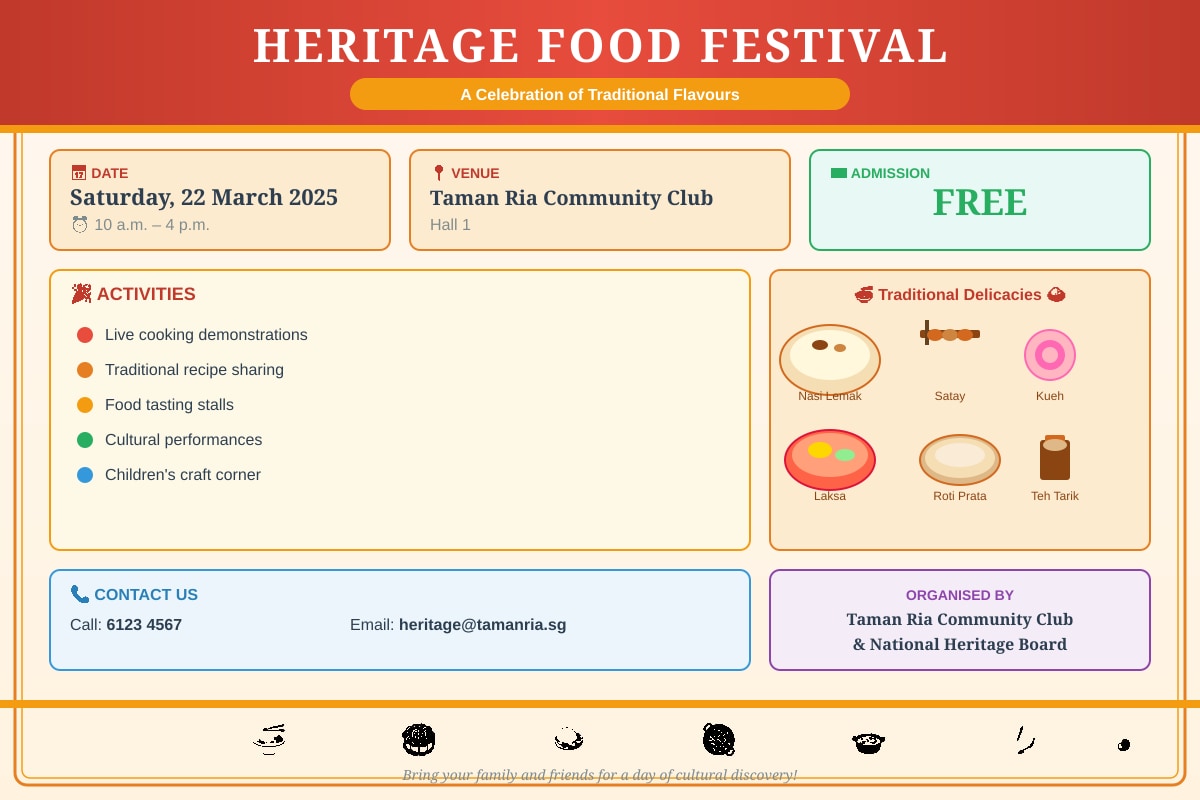
Section C: Visual Text Comprehension and Applied Comprehension (15 marks)
Question 13 (3 marks)
(a) (1 mark) Answer: The Heritage Food Festival will be held on Saturday, 22 March 2025, from 10 a.m. to 4 p.m. at Taman Ria Community Club, Hall 1.
Marking Notes:
- Award 1 mark for correctly stating both the date/time AND the venue.
- Partial credit is not available for this part — both elements are required for the mark.
(b) (2 marks — 1 mark for each activity, but question asks for 2 activities for 1 mark total) Answer: Any two from: Live cooking demonstrations, Traditional recipe sharing, Food tasting stalls, Cultural performances, Children's craft corner.
Marking Notes:
- Award 1 mark for listing two correct activities from the poster.
- Both activities must be correct to receive the mark.
(c) (1 mark) Answer: By calling 6123 4567 or emailing [email protected].
Marking Notes:
- Award 1 mark for stating either the phone number OR the email address (or both).
Question 14 (2 marks)
Answer: The organisers likely chose not to charge an entry fee to encourage more people to attend, especially families and members of the community who might not be able to afford a ticket. Since the event is about sharing heritage and culture, making it free ensures that everyone can participate regardless of their financial situation. It also aligns with the community-focused nature of the event, which is organised by a community club and the National Heritage Board.
Marking Notes:
- Award 2 marks for a well-reasoned suggestion with a clear explanation (e.g., to encourage wider attendance, to make it inclusive, to promote heritage awareness).
- Award 1 mark for a valid reason without explanation.
- Award 0 marks for unsupported or illogical answers.
- Acceptable reasons include: to attract more visitors, to make it accessible to all, to promote cultural heritage, to encourage community bonding.
Question 15 (2 marks)
Answer: The likely target audience is families and community members of all ages. This is supported by the inclusion of a "Children's craft corner," which suggests the event is designed to be family-friendly. Additionally, the free admission and the variety of activities (cooking demonstrations, cultural performances, food tasting) appeal to a broad audience rather than a specific age group.
Marking Notes:
- Award 2 marks for identifying a reasonable target audience AND providing evidence from the poster.
- Award 1 mark for identifying the audience without evidence, or for evidence without identifying the audience.
- Acceptable audiences: families, children, community members, food enthusiasts, people interested in heritage/culture.
Question 16 (1 mark)
Answer: B) To propose solutions to reduce food waste in the school canteen
Marking Notes:
- Award 1 mark for the correct option only.
- The letter is not primarily about food quality (A), praising vendors (C), or requesting more options (D). While Priya mentions vendors and the NEA statistic, her main purpose is to propose solutions to the food waste problem.
Question 17 (2 marks)
Answer: (a) "Last Friday alone, I counted at least fifteen trays with significant amounts of rice, noodles, and vegetables discarded at the cleaning station." (b) "over 700,000 tonnes of food are wasted annually according to the National Environment Agency"
Marking Notes:
- Award 1 mark for each correct piece of evidence from paragraph 1, up to 2 marks.
- Acceptable alternatives: "students throwing away large portions of food they have barely touched" (observation) or the NEA statistic.
- Answers must be from paragraph 1.
- Students should quote directly or paraphrase accurately.
Question 18 (2 marks)
Answer: This suggests that Priya values respect, gratitude, and consideration for others. She believes that the effort of the canteen vendors should not be taken for granted, and that wasting food is a form of disrespect toward the people who prepared it. This shows Priya is empathetic and thinks about the impact of her peers' actions on others. It also suggests she values hard work and believes people should appreciate the labour that goes into providing for them.
Marking Notes:
- Award 2 marks for identifying a value (respect, gratitude, empathy) AND explaining how the evidence supports this.
- Award 1 mark for identifying a value without explanation.
- Award 0 marks for answers that only restate the quote.
Question 19 (2 marks)
Answer: One solution is the "right-size" portion system, which would allow students to choose between small, medium, and large portions based on their appetite. This would help reduce food waste because students would only take the amount of food they can finish, rather than being given a standard portion that might be too large for some. This directly addresses the problem of students discarding "large portions of food they have barely touched."
Marking Notes:
- Award 2 marks for correctly stating one solution AND explaining how it reduces food waste.
- Award 1 mark for stating the solution without explanation.
- Acceptable solutions: (1) right-size portion system, (2) weekly "clean plate" challenge with rewards.
Question 20 (2 marks)
Answer: Yes, Priya's letter is effective because she provides specific evidence to support her concern (counting fifteen trays of wasted food, citing the NEA statistic of 700,000 tonnes of annual food waste) and offers practical, realistic solutions (right-size portions and a clean plate challenge). This combination of evidence and actionable suggestions makes her argument convincing and shows the school administration that she has thought carefully about the problem. Her tone is also respectful and constructive, which makes the letter more likely to be well-received.
Marking Notes:
- Award 2 marks for a clear opinion (yes or no) supported by at least one piece of evidence from the letter.
- Award 1 mark for an opinion with weak or no evidence.
- Award 0 marks for an opinion with no justification.
- Acceptable reasons for "yes": specific evidence, practical solutions, respectful tone, clear structure.
- Acceptable reasons for "no" (if well-justified): lacks authority, solutions may be impractical, etc.
End of Answer Key
Total Marks: 40
Mark Distribution Summary:
| Section | Marks |
|---|---|
| Section A: Reading Comprehension | 10 |
| Section B: Language Use and Comprehension | 15 |
| Section C: Visual Text and Applied Comprehension | 15 |
| Total | 40 |