AI Generated Exam Paper
Secondary 2 English Practice Paper 3
Free AI-Generated Owl Alpha Secondary 2 English Practice Paper 3 practice paper with questions and answers for Singapore students. This page is rendered as a direct URL so the questions and answers can be discovered without pressing in-page buttons.
These static practice materials are generated from the site's syllabus and paper-generation workflow, with source and model context shown so students and parents can evaluate the material before use.
Questions
TuitionGoWhere Practice Paper - English Secondary 2
TuitionGoWhere Practice Paper (AI)
Subject: English Language
Level: Secondary 2
Paper: Practice Paper — Comprehension
Version: 3 of 5
Duration: 1 hour 30 minutes
Total Marks: 50
Name: ________________________
Class: ________________________
Date: ________________________
Instructions
- This paper consists of three sections: Section A, Section B, and Section C.
- Answer all questions in the spaces provided.
- Read each passage carefully before attempting the questions.
- Marks for each question are indicated in brackets [ ].
- Write your answers clearly and in complete sentences where required.
- You are advised to spend approximately 25 minutes on Section A, 30 minutes on Section B, and 30 minutes on Section C, leaving 5 minutes for review.
Section A: Visual Text Comprehension (10 marks)
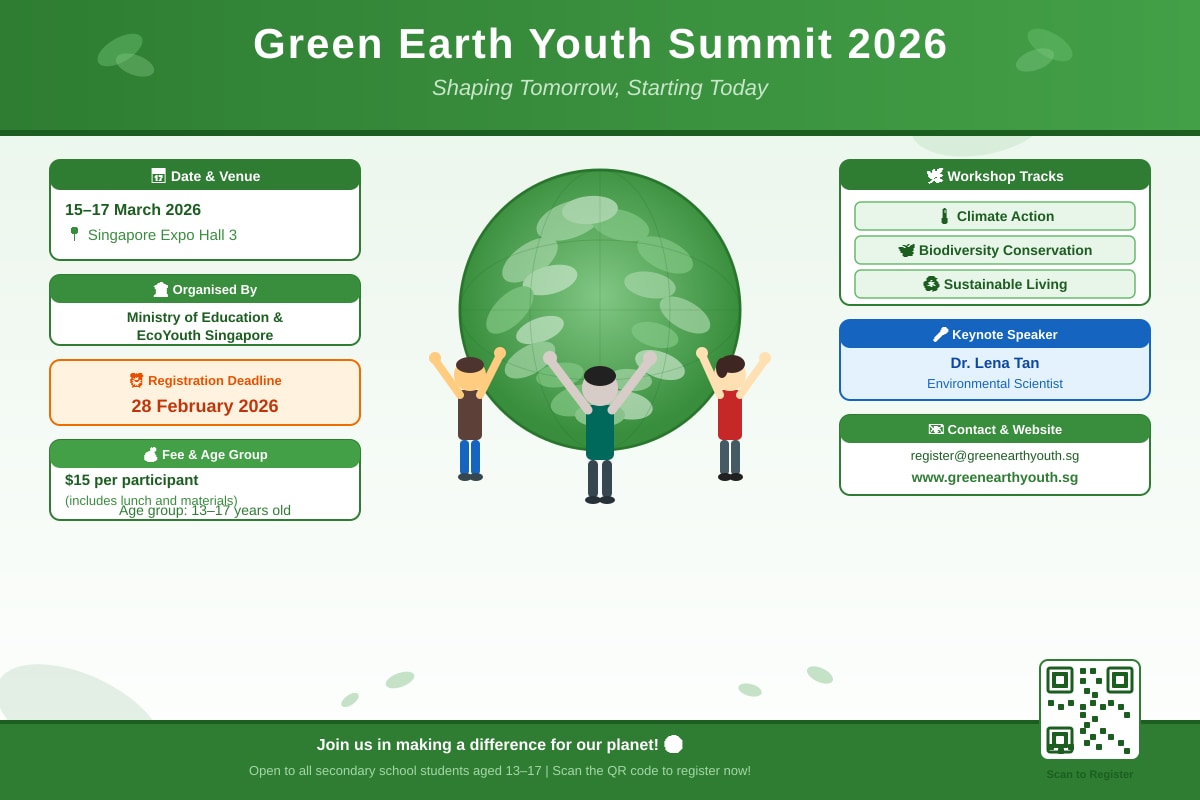
Study the poster below and answer Questions 1 to 5.
<image_placeholder> id: Q1-fig1 type: source_image linked_question: Q1-Q5 description: A promotional poster for the "Green Earth Youth Summit 2026" environmental conference for secondary school students. The poster has a green and white colour scheme with an illustration of young people holding a globe made of leaves. labels: Event title "Green Earth Youth Summit 2026", subtitle "Shaping Tomorrow, Starting Today", date "15–17 March 2026", venue "Singapore Expo Hall 3", organiser "Ministry of Education & EcoYouth Singapore", registration deadline "28 February 2026", website "www.greenearthyouth.sg", contact email "[email protected]", three workshop tracks listed: "Climate Action", "Biodiversity Conservation", "Sustainable Living", keynote speaker "Dr. Lena Tan — Environmental Scientist", fee "$15 per participant (includes lunch and materials)", age group "13–17 years old", QR code for registration must_show: All labels listed above must be clearly visible and legible. The poster should look professional and visually appealing to teenagers. Include the QR code as a small square in the bottom-right corner. </image_placeholder>
1. What is the name of the event, and who is the target audience? [2]
Name of event: _______________________________________________
Target audience: _______________________________________________
2. According to the poster, what are the three workshop tracks available at the summit? [3]
(a) _______________________________________________
(b) _______________________________________________
(c) _______________________________________________
3. How much does it cost to attend the summit, and what does the fee include? [2]
Cost: _______________________________________________
Includes: _______________________________________________
4. State one method a student can use to register for the event, according to the poster. [1]
5. The poster uses the tagline "Shaping Tomorrow, Starting Today." What does this suggest about the organisers' message? [2]
Section B: Narrative Comprehension (20 marks)
Read the following passage carefully and answer Questions 6 to 15.
Passage
The old lighthouse had stood on the cliff for over a hundred years, its beam cutting through the darkest nights like a silver sword. Marina had always been fascinated by it, ever since her grandmother first told her the story of the keeper who had saved an entire fishing fleet during the great storm of 1952.
Now, at sixteen, Marina found herself standing at the base of the lighthouse for the first time. The stone walls were covered in thick ivy, and the iron door groaned as she pushed it open. Inside, the spiral staircase seemed to stretch endlessly upward, each step worn smooth by decades of footsteps.
As she climbed, Marina noticed something peculiar. On the walls between the windows, someone had carved small symbols — circles, triangles, and what looked like waves. She ran her fingers over them, wondering who had left these marks and why. Were they messages? Warnings? Or simply the idle doodles of a lonely keeper?
At the top, the lantern room was smaller than she had expected. The great Fresnel lens dominated the space, its prisms catching the afternoon sunlight and scattering tiny rainbows across the curved walls. Marina stood at the railing and looked out at the sea. The water was impossibly blue, stretching to the horizon where it met the sky in a thin, shimmering line.
She thought about the keeper from her grandmother's story — a man named Thomas who had kept the light burning for three days straight during the storm, even when the winds threatened to tear the roof from the tower. He had saved forty-seven lives that night. Marina wondered if she would have been as brave.
A sound behind her made her turn. An elderly man stood in the doorway, leaning on a wooden stick. His face was weathered and lined, but his eyes were sharp and clear.
"You must be Marina," he said. "I'm Henry. I've been looking after this lighthouse for the past forty years. Your grandmother wrote to me about you."
Marina stared at him. "You knew my grandmother?"
Henry smiled. "We were friends, a long time ago. She used to visit this lighthouse when she was your age. She was the one who first showed me those symbols on the wall." He pointed to the carvings with his stick. "They're not random, you know. Each one tells a story — a record of every storm the lighthouse has weathered. Thomas started the tradition, and every keeper since has added to it."
Marina looked at the symbols with new eyes. What had seemed like simple scratches were actually a living history, carved into the very bones of the lighthouse.
"I'd like to show you something," Henry said. He led her to a small wooden box on a shelf near the lens. Inside were dozens of folded papers, yellowed with age. "These are the log entries from every keeper. Thomas's are the oldest. You're welcome to read them."
Marina carefully unfolded the first page. The handwriting was shaky but determined, and the ink had faded to a soft brown. She read the first line: "The storm is upon us, but the light will not go out."
Something stirred in Marina's chest — a feeling she could not quite name. It was as if the past and the present had folded together, and she was standing in both at once.
6. From paragraph 1, identify two expressions that make the lighthouse seem powerful or impressive. [2]
(a) _______________________________________________
(b) _______________________________________________
7. What had Marina's grandmother told her about the lighthouse keeper? Answer in your own words. [2]
8. In paragraph 2, the writer describes the iron door as groaning. What does this suggest about the lighthouse? [1]
9. From paragraph 3, write down one question Marina asks herself about the symbols on the wall. [1]
10. Look at paragraph 4. What effect does the Fresnel lens have on the light in the lantern room? [2]
11. According to the passage, how many lives did Thomas save during the great storm of 1952? [1]
12. In your own words, explain what the symbols on the wall actually represent. [2]
13. Why does Henry say that the symbols are "a living history"? Explain with reference to the passage. [3]
14. What does the phrase "The storm is upon us, but the light will not go out" reveal about Thomas's character? [2]
15. The passage ends by saying Marina felt "as if the past and the present had folded together." What does this suggest about her experience? [2]
Section C: Information Text Comprehension (20 marks)
Read the following article carefully and answer Questions 16 to 20.
Passage
The Rise of Urban Farming in Singapore
In a city-state where land is scarce and over 90 percent of food is imported, a quiet revolution is taking place above the rooftops and between the walls of Singapore's high-rise buildings. Urban farming — the practice of growing food in densely populated areas — has gained remarkable momentum in recent years, transforming the way Singaporeans think about food security and sustainability.
The movement began modestly in the early 2010s, when a handful of community gardens sprang up in housing estates. Residents grew vegetables such as kai lan, bayam, and kangkong in shared plots, driven by a desire to reconnect with nature and reduce their reliance on imported produce. What started as a hobby soon evolved into something far more ambitious.
Today, Singapore is home to over 200 community gardens and a growing number of commercial urban farms. Among the most impressive is a 3,500-square-metre rooftop farm atop a multi-storey car park in Ang Mo Kio, which produces over 200 kilograms of vegetables each month using hydroponics — a method of growing plants without soil, using nutrient-rich water solutions. The farm supplies fresh produce to nearby hawker centres and supermarkets, reducing the distance food travels from farm to plate to mere kilometres.
The government has played a significant role in this transformation. In 2019, Singapore launched the "30 by 30" initiative, aiming to produce 30 percent of the nation's nutritional needs locally by 2030. To support this goal, the Singapore Food Agency has provided grants and technical assistance to urban farmers, while the Housing Development Board has designated rooftop spaces in public housing estates for farming projects.
Technology has been a key enabler. Vertical farming systems, which stack plant trays in layers to maximise growing space, have allowed farmers to produce up to ten times more crops per square metre than traditional farming. LED grow lights mimic sunlight, enabling plants to photosynthesise indoors regardless of weather conditions. Some farms even use artificial intelligence to monitor plant health, adjusting water and nutrient levels automatically.
Despite these advances, challenges remain. Urban farming in Singapore is still a small fraction of total food production, and the high cost of technology and limited space mean that locally grown produce is often more expensive than imported alternatives. Critics argue that the "30 by 30" target is overly ambitious given these constraints.
However, advocates counter that urban farming is about more than just food production. It fosters community spirit, educates young people about sustainability, and provides therapeutic benefits for elderly residents who find joy in tending to plants. For many Singaporeans, the true harvest of urban farming is not measured in kilograms, but in the connections it builds and the awareness it raises.
As one urban farmer put it: "We are not just growing vegetables. We are growing a mindset."
16. From paragraph 1, identify two phrases that emphasise Singapore's limited natural resources. [2]
(a) _______________________________________________
(b) _______________________________________________
17. What does the phrase "a quiet revolution" (paragraph 1) suggest about the urban farming movement? [2]
18. According to paragraph 3, how much vegetables does the Ang Mo Kio rooftop farm produce each month, and what method does it use? [2]
Amount: _______________________________________________
Method: _______________________________________________
19. Explain two ways in which technology has helped urban farming in Singapore, according to paragraph 5. [4]
(a) _______________________________________________
(b) _______________________________________________
20. In paragraph 6, the writer mentions that "critics argue that the '30 by 30' target is overly ambitious." What is the "30 by 30" target, and why do critics think it is difficult to achieve? Answer in your own words. [3]
The "30 by 30" target: _______________________________________________
Why critics think it is difficult: _______________________________________________
End of Paper
Answers
TuitionGoWhere Practice Paper — English Secondary 2
Comprehension Practice Paper: Answer Key (Version 3 of 5)
Section A: Visual Text Comprehension (10 marks)
1. What is the name of the event, and who is the target audience? [2]
- Name of event: Green Earth Youth Summit 2026 [1]
- Target audience: Secondary school students / young people aged 13–17 [1]
Marking note: Award 1 mark for each correct answer. Accept "students aged 13–17" or "teenagers" for the target audience.
2. According to the poster, what are the three workshop tracks available at the summit? [3]
(a) Climate Action [1] (b) Biodiversity Conservation [1] (c) Sustainable Living [1]
Marking note: Award 1 mark for each correct track. Order does not matter. Do not accept partial or abbreviated answers such as "Climate" alone.
3. How much does it cost to attend the summit, and what does the fee include? [2]
- Cost: $15 per participant [1]
- Includes: Lunch and materials [1]
Marking note: Award 1 mark for the correct amount and 1 mark for both inclusions. Accept "food" as an alternative to "lunch."
4. State one method a student can use to register for the event, according to the poster. [1]
- Answer: By scanning the QR code / by visiting the website (www.greenearthyouth.sg) / by emailing [email protected] [1]
Marking note: Award 1 mark for any one valid method shown on the poster.
5. The poster uses the tagline "Shaping Tomorrow, Starting Today." What does this suggest about the organisers' message? [2]
- Answer: The organisers want to convey that young people have the power to make a difference for the future, and that they should begin taking action now rather than waiting. [2]
Marking note: Award 2 marks for a clear explanation that captures both the idea of youth agency/impact and the urgency of starting now. Award 1 mark for a partial answer that addresses only one of these ideas.
Section B: Narrative Comprehension (20 marks)
6. From paragraph 1, identify two expressions that make the lighthouse seem powerful or impressive. [2]
(a) "its beam cutting through the darkest nights like a silver sword" [1] (b) "stood on the cliff for over a hundred years" [1]
Marking note: Award 1 mark for each correct expression. Accept any two expressions from paragraph 1 that convey power, age, or impressiveness. Other acceptable answers include "the great storm of 1952" (if linked to the lighthouse's endurance) or "saved an entire fishing fleet." Do not accept single words without context.
7. What had Marina's grandmother told her about the lighthouse keeper? Answer in your own words. [2]
- Answer: Marina's grandmother told her about a lighthouse keeper who saved a fishing fleet during a severe storm in 1952. [2]
Marking note: Award 2 marks for a clear paraphrase that includes both the keeper's heroic action (saving the fleet) and the context (the 1952 storm). Award 1 mark if only one element is mentioned. Do not accept direct quotations from the passage.
8. In paragraph 2, the writer describes the iron door as groaning. What does this suggest about the lighthouse? [1]
- Answer: It suggests that the lighthouse is old, heavy, and perhaps unused for some time. [1]
Marking note: Award 1 mark for any reasonable inference about age, neglect, or the passage of time. Accept "it is very old" or "no one has opened it in a long time."
9. From paragraph 3, write down one question Marina asks herself about the symbols on the wall. [1]
- Answer: "Were they messages? Warnings? Or simply the idle doodles of a lonely keeper?" [1]
Marking note: Award 1 mark for any one of the three questions quoted. The answer must be a direct quotation from paragraph 3.
10. Look at paragraph 4. What effect does the Fresnel lens have on the light in the lantern room? [2]
- Answer: The Fresnel lens catches the afternoon sunlight and scatters tiny rainbows across the curved walls of the lantern room. [2]
Marking note: Award 2 marks for a complete answer that mentions both the catching of light and the scattering of rainbows. Award 1 mark for mentioning only one effect.
11. According to the passage, how many lives did Thomas save during the great storm of 1952? [1]
- Answer: Forty-seven lives. [1]
Marking note: Award 1 mark for the correct number. Accept "47" in numerals.
12. In your own words, explain what the symbols on the wall actually represent. [2]
- Answer: The symbols are a record of every storm the lighthouse has weathered. Each keeper has added a symbol to document the storms they experienced, creating a continuous historical record. [2]
Marking note: Award 2 marks for a clear explanation that the symbols represent storms and that they form a historical record maintained by successive keepers. Award 1 mark for mentioning only one of these ideas.
13. Why does Henry say that the symbols are "a living history"? Explain with reference to the passage. [3]
- Answer: Henry calls the symbols "a living history" because they are not just old markings — they are an ongoing record that continues to grow. Thomas started the tradition of carving a symbol for each storm, and every keeper since has added to it. This means the history is still being written, making it "living" rather than something frozen in the past. [3]
Marking note: Award 3 marks for a well-developed explanation that (1) defines what the symbols record, (2) explains the tradition started by Thomas, and (3) connects the idea of continuity to the word "living." Award 2 marks for two of these elements, and 1 mark for one.
14. What does the phrase "The storm is upon us, but the light will not go out" reveal about Thomas's character? [2]
- Answer: It reveals that Thomas was determined, courageous, and committed to his duty. Despite the danger of the storm, he refused to let the light go out, showing his sense of responsibility and bravery. [2]
Marking note: Award 2 marks for identifying two character traits (e.g., determination, courage, dedication, selflessness) with brief explanation. Award 1 mark for one trait without explanation.
15. The passage ends by saying Marina felt "as if the past and the present had folded together." What does this suggest about her experience? [2]
- Answer: It suggests that Marina felt deeply connected to the history of the lighthouse and to her grandmother's past. Reading Thomas's log entry and learning about the symbols made her feel as though she was sharing the same experience as those who came before her, bridging the gap between generations. [2]
Marking note: Award 2 marks for an explanation that captures the sense of connection across time and the emotional impact of the experience. Award 1 mark for a partial answer that mentions connection but lacks depth.
Section C: Information Text Comprehension (20 marks)
16. From paragraph 1, identify two phrases that emphasise Singapore's limited natural resources. [2]
(a) "land is scarce" [1] (b) "over 90 percent of food is imported" [1]
Marking note: Award 1 mark for each correct phrase. Both must be direct quotations from paragraph 1. Other acceptable answers include "densely populated areas" if linked to limited space.
17. What does the phrase "a quiet revolution" (paragraph 1) suggest about the urban farming movement? [2]
- Answer: It suggests that the urban farming movement is significant and transformative, but it has grown gradually and without dramatic fanfare. The word "quiet" implies steady, understated progress, while "revolution" indicates a fundamental change in how Singaporeans approach food production. [2]
Marking note: Award 2 marks for an explanation that addresses both "quiet" (gradual, unassuming) and "revolution" (major change). Award 1 mark for addressing only one aspect.
18. According to paragraph 3, how much vegetables does the Ang Mo Kio rooftop farm produce each month, and what method does it use? [2]
- Amount: Over 200 kilograms [1]
- Method: Hydroponics [1]
Marking note: Award 1 mark for each correct answer. Accept "200 kg" or "more than 200 kilograms" for the amount.
19. Explain two ways in which technology has helped urban farming in Singapore, according to paragraph 5. [4]
(a) Vertical farming systems stack plant trays in layers, allowing farmers to produce up to ten times more crops per square metre than traditional farming. [2]
(b) LED grow lights mimic sunlight, enabling plants to photosynthesise indoors regardless of weather conditions. [2]
Marking note: Award 2 marks for each correct way, with explanation. Accept "artificial intelligence to monitor plant health and adjust water and nutrient levels" as an alternative to either (a) or (b). For each point, award 1 mark for identifying the technology and 1 mark for explaining its benefit.
20. In paragraph 6, the writer mentions that "critics argue that the '30 by 30' target is overly ambitious." What is the "30 by 30" target, and why do critics think it is difficult to achieve? Answer in your own words. [3]
-
The "30 by 30" target: Singapore's goal to produce 30 percent of the nation's nutritional needs locally by the year 2030. [1]
-
Why critics think it is difficult: Critics believe it is difficult because urban farming still accounts for only a small fraction of total food production. The high cost of technology and the limited available space in Singapore mean that locally grown produce is often more expensive than imported alternatives, making large-scale local production challenging. [2]
Marking note: Award 1 mark for correctly defining the target. Award 2 marks for explaining at least two reasons why critics find it difficult (high technology costs, limited space, small current production scale, higher prices of local produce). Award 1 mark if only one reason is given.
End of Answer Key
Total Marks: 50