AI Generated Exam Paper
Secondary 2 English Practice Paper 2
Free Sec 2 English Practice Paper 2, Nemo3 AI version, with questions, answers, and syllabus-aligned practice for Singapore students.
These static practice materials are generated from the site's syllabus and paper-generation workflow, with source and model context shown so students and parents can evaluate the material before use.
Questions
Free quiz and exam paper access
Enter your details to view this paper
Your access is remembered on this device.
Answers
TuitionGoWhere Practice Paper - English Secondary 2 (Answer Key)
Subject: English
Level: Secondary 2
Paper: Practice Paper 2 (Comprehension & Language Use)
Total Marks: 50
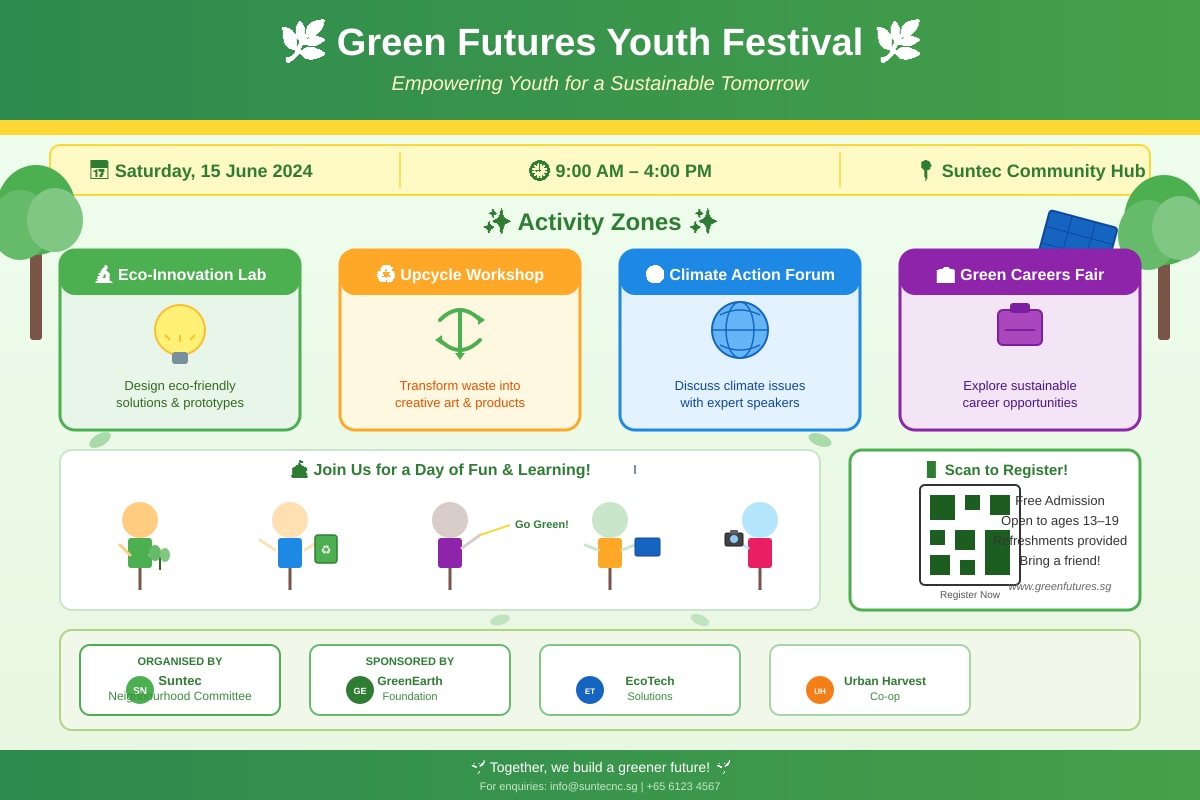
SECTION A: VISUAL TEXT COMPREHENSION [10 marks]
1. What is the main purpose of this poster? [1]
Answer: To promote / advertise the "Green Futures Youth Festival" and encourage youth to register/attend.
Marking Note: Accept any answer that conveys promotion of the event to young people. Do not accept "to inform" alone — must include persuasive intent.
2. Identify two details from the poster that suggest the event is targeted at young people. [2]
Answer (any two):
- The event title includes "Youth Festival"
- The tagline says "Empowering Youth"
- Activity zones like "Eco-Innovation Lab" and "Green Careers Fair" appeal to students/young people
- The illustrations show teenagers engaged in activities
- Registration via QR code (appeals to tech-savvy youth)
Marking Note: 1 mark per valid detail. Must be explicitly from the poster. "Bright colours" alone is insufficient without linking to youth appeal.
3. Which activity zone would be most suitable for a student interested in learning about environment-related jobs? [1]
Answer: Green Careers Fair
Marking Note: Exact wording required. No partial credit.
4. The tagline reads: "Empowering Youth for a Sustainable Tomorrow."
Explain in your own words what "sustainable" means in this context. [2]
Answer: Able to be maintained / continued over the long term without depleting natural resources or harming the environment / meeting present needs without compromising future generations' ability to meet theirs.
Marking Note: 1 mark for "long-term / lasting / continued", 1 mark for "without harming environment / preserving resources for future". Do not accept "eco-friendly" or "green" alone — must show understanding of the duration/balance concept.
5. A friend says, "This poster is effective because it uses bright colours and illustrations."
Give one other feature of the poster that makes it effective, and explain why. [2]
Answer (any one with valid explanation):
- Clear organisation into four activity zones with icons — helps visitors quickly find relevant activities
- Prominent date, time, venue — gives essential practical information at a glance
- QR code for registration — allows immediate, convenient sign-up
- Sponsor logos (GreenEarth Foundation, etc.) — builds credibility and trust
- Tagline "Empowering Youth for a Sustainable Tomorrow" — emotionally engaging, communicates purpose
Marking Note: 1 mark for identifying feature, 1 mark for explaining effectiveness. Feature must be visual/textual element from poster (not "bright colours/illustrations" again).
SECTION B: NARRATIVE COMPREHENSION [30 marks]
6. From paragraph 1, write down two expressions that suggest the lighthouse is in a state of neglect. [2]
Answer (any two):
- "grey and weathered"
- "glass lantern room cracked and dark"
- "not been lit in thirty years" (accept as expression showing neglect)
- "stood grey and weathered against the cliff edge"
Marking Note: Must quote exact phrases. Single words like "grey" or "cracked" alone = 0 marks. Must be from paragraph 1 only.
7. In paragraph 2, the writer describes Mr. Chen's hands as "gnarled from decades of hauling nets and coiling rope." What does this description suggest about Mr. Chen's past? [1]
Answer: He worked as a fisherman / did manual labour at sea for many years.
Marking Note: Must convey occupation (fisherman/sailor) and duration (decades/long time). "He is old" = 0 marks.
8. "He moved with a sure-footedness that belied his age." (Paragraph 2)
Explain what "belied" means in this context. [1]
Answer: Contradicted / gave a false impression of / did not match / was not consistent with.
Marking Note: Accept "showed his age was not a limitation" or "hid his true age". Do not accept "lied" — must show contrast between appearance and reality.
9. From paragraph 4, identify one detail that shows Elias Varela tried to prevent the disaster. [1]
Answer: He had warned the supply officer weeks before (about the contaminated oil).
Marking Note: Must mention warning and timing (weeks before). "He knew the oil was contaminated" = 0 marks (shows knowledge, not action).
10. "The air in the stairwell seemed to thicken. Maya felt the weight of the story press against her ribs." (Paragraph 6)
What effect does the writer create by using these two sentences together? [2]
Answer: Creates a sense of oppressive atmosphere / emotional heaviness / tension — the story feels physically suffocating to Maya, showing how deeply the history affects her / the gravity of the revelation.
Marking Note: 1 mark for identifying atmosphere (suffocating/heavy/tense), 1 mark for explaining effect on Maya (emotional impact / realisation of gravity). Must link physical metaphor to emotional response.
11. Why does Mr. Chen give Maya the brass key? [2]
Answer: To entrust her with the responsibility of maintaining the lighthouse light / to make her the new keeper — because the fuel depot (run by the supply officer's grandson) still cuts corners, and someone who cares is needed to check fuel and polish the glass.
Marking Note: 1 mark for "to make her the new keeper / give her responsibility", 1 mark for reason (ongoing danger from corner-cutting / need for someone who cares). Must connect past negligence to present need.
12. In paragraph 10, Mr. Chen says: "Then you'll know. And that knowing matters more than the climbing."
What does he mean by "that knowing"? [2]
Answer: Self-awareness / understanding whether she truly cares enough to take on the responsibility / realising her own values and willingness to commit.
Marking Note: 1 mark for "self-knowledge / understanding herself", 1 mark for "whether she cares / is willing to take responsibility". Do not accept "knowing how to climb" or "knowing the history".
13. The passage ends with Maya looking "up — really looked — at the dark lantern room above her, waiting."
What does the word "waiting" suggest about the lantern room? [2]
Answer: Personification — suggests the lantern room is expectant / patient / ready for its purpose to be fulfilled — as if it has been dormant but anticipates being lit again / serving its function.
Marking Note: 1 mark for identifying personification / human quality, 1 mark for explaining meaning (readiness for purpose / anticipation of being used again). "It is empty" = 0 marks.
14. Based on the passage, state whether each of the following statements is True or False, and provide a reason from the text for your answer. [3]
| Statement | True/False | Reason |
|---|---|---|
| (a) Maya had never noticed the lighthouse before today. | False | "Maya had passed it countless times on her way to school, barely glancing up." (Para 1) — she saw it but didn't pay attention. |
| (b) The Meridian sank because of a mechanical failure in the lighthouse lamp. | False | "Not the mechanism — the oil. Contaminated." (Para 4) — it was fuel failure, not mechanical. |
| (c) Mr. Chen believes Maya will definitely become the new lighthouse keeper. | False | "What if I'm not that person?" / "Then you'll know. And that knowing matters more than the climbing." (Para 9–10) — he leaves the choice to her. |
Marking Note: 1 mark per row. Both T/F and reason must be correct for the mark. Reason must be textual evidence (quote or close paraphrase).
15. The writer uses the contrast between light and darkness throughout the passage.
Give one example of this contrast from the first half of the passage (paragraphs 1–5) and one example from the second half (paragraphs 6–11). Explain the effect of each example. [4]
First half (any one):
- Example: "white tower... now stood grey" / "beacon for ships... now... dark" / "torch beam cutting through the gloom"
- Effect: Highlights the lighthouse's fall from purpose / emphasises Mr. Chen as a guiding presence in darkness / shows the physical and symbolic loss of the light.
Second half (any one):
- Example: "brass key burning in her hand" (warmth/light metaphor) vs "dark lantern room" / "looked up — really looked — at the dark lantern room... waiting" (darkness holding potential for light)
- Effect: Suggests hope / potential renewal / the possibility of the light returning through Maya / contrasts past failure with future possibility.
Marking Note: 1 mark per example (must quote/identify specific contrast), 1 mark per effect explanation. Effect must link contrast to meaning/theme.
16. Which of the following best describes Maya's character development in the passage? Tick one box. [1]
☐ She remains indifferent to the lighthouse and its history.
☐ She becomes curious but ultimately rejects the responsibility offered to her.
☑ She moves from indifference to a moment of realisation and potential acceptance.
☐ She is eager to take on the lighthouse keeper's role from the beginning.
Marking Note: Only the third option is correct. No partial credit.
17. The passage explores the theme of responsibility across generations.
Using details from the text, explain how this theme is developed through both the past (Elias Varela) and the present (Mr. Chen and Maya). [4]
Answer (sample response):
Past (Elias Varela): Elias took his duty as keeper seriously — he warned the supply officer about contaminated oil weeks before the disaster, showing responsibility for lives at sea. His failure was not negligence but betrayal by others who cut corners.
Present (Mr. Chen & Maya): Mr. Chen has maintained the mechanism for decades despite the light being unused, preserving it for a future need. He passes the key to Maya, entrusting her with the same duty — to care enough to "climb these stairs every evening." Maya's acceptance of the key ("closed her fingers around the key") and her final look at the "waiting" lantern room suggest she may continue this generational chain of stewardship.
Marking Note: 2 marks for past (Elias's warning + contrast with supply officer's greed), 2 marks for present (Mr. Chen's maintenance + passing key + Maya's response). Must cover both time periods for full marks. Award 1 mark per valid point up to 4.
18. Do you think the ending of the passage is hopeful? Support your answer with two details from the final three paragraphs. [3]
Answer: Yes, it is hopeful.
Detail 1: Mr. Chen smiles ("a slow crinkling at the corners of his eyes") — shows warmth and confidence in Maya.
Detail 2: Maya looks "up — really looked — at the dark lantern room... waiting" — the personification of "waiting" and her deliberate attention suggest readiness and potential for the light to return.
(Alternative Detail 2: The brass key is "warm from his skin" / "burning in her hand" — symbolising living responsibility passed on.)
Marking Note: 1 mark for "Yes" stance (accept "No" if well-supported, but "Yes" is better supported), 1 mark per valid detail from final 3 paragraphs (paras 9–11) with explanation. Max 3 marks.
SECTION C: SUMMARY WRITING [10 marks]
19. Write a summary of the challenges faced by urban trees and the benefits they provide, based on the passage above. [10]
Content Points (8 points required for full content marks):
Challenges (4 points):
- Compacted soil prevents root spread and water absorption
- Pollution coats leaves, blocking sunlight and clogging stomata
- Reflected heat from concrete/asphalt creates hotter microclimates
- Road salt damages roots and alters soil chemistry
- Aggressive pruning for power lines disfigures crowns and invites disease
- Construction damage to root zones kills trees years later
Benefits (4 points): 7. Absorb CO₂ (up to 150 kg/year) and release oxygen 8. Canopy shade reduces surface temperatures (up to 15°C) and cooling costs 9. Roots stabilise soil, reduce stormwater runoff (30%), filter pollutants 10. Lower respiratory illness, reduce traffic speeds, increase property values 11. Hospital patients with tree views recover faster, need less pain medication 12. Children with green access show better concentration, reduced ADHD symptoms
Sample Summary (76 words):
Urban trees face numerous challenges such as compacted soil restricting root growth and water absorption, pollution coating leaves and blocking sunlight, reflected heat from paved surfaces creating hotter microclimates, and road salt damaging root systems. Aggressive pruning for power lines disfigures trees and invites disease, while construction harms root zones. Yet they absorb carbon dioxide, release oxygen, lower temperatures through shade, reduce stormwater runoff, filter pollutants, improve respiratory health, calm traffic, raise property values, speed patient recovery, and enhance children's concentration.
Marking Scheme:
- Content: 8 marks (1 mark per distinct point, max 8)
- Language: 2 marks
- 2 marks: Excellent paraphrase, fluent, concise, own words
- 1 mark: Some lifting, occasional awkwardness, mostly own words
- 0 marks: Heavy lifting, not in continuous writing, exceeds 80 words significantly
Word Count Check: Sample = 76 words (within 80-word limit).
Penalty: Exceeding 80 words → language mark capped at 1; severe excess → 0 language marks.