From Real Exams Exam Paper
Secondary 2 English Paper 2 Paper 4
Free Sec 2 English Paper 2 Paper 4, LongCat Exam version, with questions, answers, and syllabus-aligned practice for Singapore students.
These static practice materials are generated from the site's syllabus and paper-generation workflow, with source and model context shown so students and parents can evaluate the material before use.
Questions
Free quiz and exam paper access
Enter your details to view this paper
Your access is remembered on this device.
Answers
TuitionGoWhere Practice Paper — English Language Secondary 2
Paper 2 — Answer Key (Version 4 of 5)
Section A: Comprehension — Visual Text
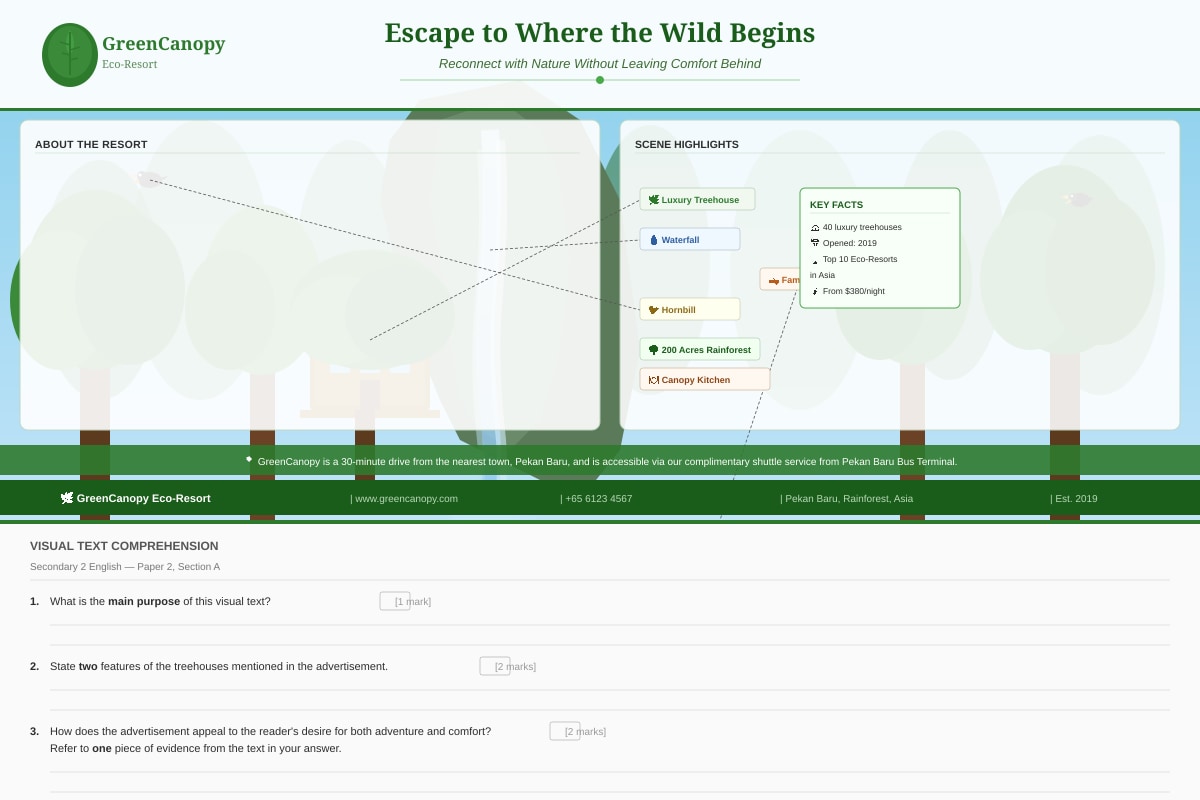
Q1. [1 mark] Answer: The main purpose of this visual text is to persuade readers to visit (or book a stay at) GreenCanopy Eco-Resort.
Marking notes: Award 1 mark for identifying the purpose as persuasive/promotional/advertising. Accept "to attract visitors," "to promote the resort," or similar. Do not award the mark if the student only describes the text as "informative" without acknowledging the persuasive intent, as the primary function of an advertisement is to persuade.
Q2. [2 marks] Answer (any two of the following):
- Each treehouse has "panoramic forest views" and "private plunge pools" — these are comforts/luxuries found in nature.
- The resort has "sustainably sourced furnishings" — comfort that is nature-friendly.
- The "award-winning restaurant, Canopy Kitchen, serves farm-to-table cuisine" — fine dining in a natural setting.
- Activities like "guided nature walks, river kayaking" connect you with nature while the resort provides the infrastructure.
Marking notes: Award 1 mark per valid piece of evidence, up to 2 marks. The evidence must show BOTH a connection to nature AND an element of comfort. A detail that only shows nature (e.g., "200 acres of rainforest") or only shows comfort (e.g., "private plunge pools") without the contrasting element may be awarded 1 mark at the marker's discretion if the pairing is implied. Students must quote or closely paraphrase from the text.
Q3. [1 mark] Answer: The resort offers activities suitable for families/children, such as river kayaking, guided nature walks, night safaris, and traditional craft workshops.
Marking notes: Award 1 mark for any valid reason drawn from the text. Accept references to specific activities or the general family-friendly nature of the resort.
Q4. [2 marks] Answer: This statement gives the reader confidence in the quality of the resort [1 mark]. Being recognised by a reputable magazine as one of the Top 10 Eco-Resorts in Asia serves as a form of endorsement, making the reader more likely to trust that the resort is worth visiting [1 mark].
Marking notes: Award 1 mark for identifying the effect (builds trust, credibility, confidence, reassurance) and 1 mark for explaining how the statement achieves this (third-party endorsement, recognition by an authority). Answers that only state "it makes the resort seem good" without explaining the mechanism receive 1 mark only.
Q5. [2 marks] Answer: The writer includes this detail to reassure potential guests that, although the resort is secluded in the rainforest, it is still accessible and not completely cut off from civilisation [1 mark]. The mention of the "complimentary shuttle service" further reduces any concern about inconvenience, making the resort seem both remote and reachable [1 mark].
Marking notes: Award 1 mark for identifying that the detail addresses accessibility/convenience concerns, and 1 mark for explaining the reassuring function or linking it to the shuttle service. Answers that only state "to tell you where it is" receive 1 mark.
Q6. [2 marks] Answer: Yes, I would recommend GreenCanopy to someone who enjoys outdoor adventure because the resort offers activities such as river kayaking and guided nature walks [1 mark]. Additionally, the resort is set within 200 acres of pristine rainforest, providing ample opportunity for exploration and outdoor experiences [1 mark].
Marking notes: Award 1 mark for a clear recommendation (yes or no — though yes is better supported), and 1 mark for two relevant details from the text. If the student says "no" but provides valid reasoning from the text (e.g., it seems more like a relaxation resort), award marks at the marker's discretion. The key is evidence-based reasoning.
Section B: Comprehension — Passage
Q7. [1 mark] Answer: It suggests that the weather was overcast, grey, and likely about to rain (or had recently rained).
Marking notes: Award 1 mark for any reasonable inference about grey, dull, rainy, or overcast weather. "Wet slate" evokes a dark grey, damp appearance. Do not accept "it was sunny" or "it was a nice day."
Q8. [1 mark] Answer: "half-hidden behind a curtain of overgrown ivy" OR "set into a crumbling brick wall" OR "the hinges stiff with rust and neglect."
Marking notes: Award 1 mark for any phrase from Paragraph 1 that indicates neglect or the passage of time. The student must quote the phrase accurately. Single words (e.g., "ivy" alone) are insufficient — a phrase of at least 3–4 words is expected.
Q9. [2 marks] Answer: The expression "blur into a single tapestry of colour" suggests that the garden was so full of flowers, growing so closely together, that individual blooms could not be distinguished [1 mark]. The word "tapestry" implies richness, beauty, and intricacy, as though the garden were a carefully crafted work of art, even though it is actually wild and overgrown [1 mark].
Marking notes: Award 1 mark for explaining the visual effect (abundance/lack of distinction between flowers) and 1 mark for explaining the connotation of "tapestry" (beauty, artistry, richness). Answers that only paraphrase the phrase without analysis receive 1 mark.
Q10. [2 marks] Answer: The personification of the gate "groaning" creates a sense of age, neglect, and mystery [1 mark]. The "long, low" quality of the sound adds to the eerie, atmospheric tone of the scene, making the garden feel like a hidden, forgotten place that has been waiting to be discovered [1 mark].
Marking notes: Award 1 mark for identifying the effect (age, mystery, eeriness, atmosphere) and 1 mark for explaining how the specific language choices ("long, low groan") contribute to this effect. Answers that only state "it was loud" or "the gate was old" without explaining the atmospheric effect receive 1 mark.
Q11. [2 marks] Answer (any two of the following):
- The "stone fountain" at the centre of a "circular path" suggests deliberate landscape design.
- The "gravel path" winding between "beds of herbs" indicates planned planting areas.
- The "trellis" (even though buckled) was originally built to support climbing roses.
- The "tall hedges of hibiscus and frangipani" bordering the plot suggest intentional landscaping.
Marking notes: Award 1 mark per valid detail, up to 2 marks. The detail must imply human design or maintenance. Accept close paraphrases. Do not accept "roses climbed wildly over a trellis" alone as this emphasises wildness rather than care — but accept "there was a trellis" as evidence of original design.
Q12. [2 marks] Answer: The comparison of the koel's song to "a question" suggests a sense of mystery and anticipation in the garden [1 mark]. The word "hang" implies that the sound lingered in the quiet air, emphasising the stillness and peacefulness of the atmosphere, as though the garden itself is curious about Elena's arrival [1 mark].
Marking notes: Award 1 mark for identifying the mood (mystery, curiosity, stillness, peacefulness) and 1 mark for explaining the effect of the simile or the word "hang." Answers that only identify the mood without explaining the language receive 1 mark.
Q13. [3 marks] Answer: Madam Siti's statement suggests she has been feeling lonely and isolated [1 mark]. The fact that "no one has come through that gate in over two years" indicates that she has had little or no visitors, and her remark that "the neighbourhood has changed" and "the young people leave for the city" shows she is aware of being left behind [1 mark]. Her tone — neither surprised nor unwelcoming when Elena arrives — suggests she had been quietly hoping someone would come, and her words carry a sense of relief mixed with resignation [1 mark].
Marking notes: Award 1 mark for identifying the emotion (loneliness, isolation, sadness, resignation), 1 mark for textual evidence (no visitors for two years, neighbourhood changes), and 1 mark for explaining the complexity of her feelings (relief, resignation, quiet hope). Answers that identify only one emotion without development receive a maximum of 2 marks.
Q14. [2 marks] Answer: When Madam Siti says "the garden remembers," she means that the garden holds the memories of the people who once cared for it and the community that once surrounded it [1 mark]. Even though the neighbourhood has changed and people have moved away, the garden still exists as a living testament to the past — to her husband's love, to the old kampong spirit, and to the history of the Tan estate [1 mark].
Marking notes: Award 1 mark for explaining that the garden holds memories/history, and 1 mark for connecting this to specific people or the community mentioned in the passage. Answers that only say "the garden is old" without explaining the concept of remembering receive 1 mark.
Q15. [3 marks] Answer: At the beginning of the passage, Elena is curious and adventurous — she notices the gate despite walking the same route every day and chooses to push it open even though it is rusted and neglected [1 mark]. As the story progresses, she becomes committed and caring — she visits every day, helps with pruning and planting, and listens to Madam Siti's stories [1 mark]. By the end, Elena has developed a deeper appreciation for hidden beauty and the value of preserving the past, as shown by her reflection that "the world still held hidden places, quiet and beautiful, waiting to be found" [1 mark].
Marking notes: Award 1 mark for identifying an early trait (curiosity, adventurousness), 1 mark for identifying a later trait (commitment, care, appreciation), and 1 mark for supporting each with textual evidence. Answers that describe development without evidence receive a maximum of 2 marks. Answers that provide evidence without describing development also receive a maximum of 2 marks.
Q16. [3 marks] Answer: The garden represents memory, legacy, and the enduring power of love and care [1 mark]. It was created by Madam Siti's husband as his passion project, and after his death, it becomes a symbol of his lasting presence — Madam Siti tends it "faithfully" to keep his memory alive [1 mark]. The garden also represents hope and renewal: just as the garden is restored through Elena's help, the passage suggests that forgotten things can be rediscovered and revived, and that the act of nurturing something creates a "promise" for the future [1 mark].
Marking notes: Award 1 mark for identifying what the garden represents (memory, legacy, love, hope, renewal, the past), 1 mark for linking this to specific textual evidence (husband's passion, Madam Siti's care, Elena's restoration), and 1 mark for explaining the broader thematic significance (promise, renewal, rediscovery). Answers that identify a symbol without evidence receive a maximum of 2 marks.
Q17. [2 marks] Answer (model response):
Tuesday, 28 October
Today I discovered something extraordinary. Walking home along Havelock Road, I noticed an iron gate hidden behind ivy. Beyond it was a garden like something from a dream — wild roses, a mossy fountain, and flowers everywhere. I met an old woman called Madam Siti. She seemed lonely but kind. I felt as though I had stepped into another world, one that had been quietly waiting for someone to find it. I know I will go back tomorrow.
Marking notes: Award 2 marks for a diary entry that is written in the first person, captures Elena's feelings (wonder, curiosity, excitement, warmth), and includes specific details from the passage (the gate, the ivy, the roses, the fountain, Madam Siti). Award 1 mark for an entry that is in the first person but lacks specific details or emotional depth. Award 0 marks for entries not written from Elena's perspective or that contain no reference to the passage. The word count guideline is approximately 60 words; significant deviation (under 30 or over 100 words) may result in a 1-mark deduction at the marker's discretion.
Section C: Summary
Q18. [8 marks]
Content points (award 1 mark each, up to 8 marks):
Any 8 of the following points, expressed in the student's own words:
- Urban farming involves growing food in densely populated areas/cities.
- It addresses concerns about food security, environmental sustainability, and community well-being.
- It reduces stress levels for participants.
- It increases feelings of social connectedness/reduces isolation.
- It reduces the city's carbon footprint/transportation-related emissions.
- It cuts the need for long-distance transportation, refrigeration, and packaging.
- It reconnects city dwellers with the natural world.
- Challenges include limited space and high land costs.
- Urban pollution/contamination is another obstacle.
- High-tech solutions require substantial upfront investment and technical expertise.
Marking scheme for summary:
| Marks | Descriptor |
|---|---|
| 7–8 | Excellent: 8 relevant points, well-paraphrased, coherent paragraph, within word limit |
| 5–6 | Good: 5–7 points, mostly paraphrased, generally coherent, near word limit |
| 3–4 | Satisfactory: 3–4 points, some lifting from text, may lack coherence |
| 1–2 | Weak: 1–2 points, heavy lifting, may exceed word limit or lack coherence |
| 0 | No relevant content |
Notes:
- Students must write in one continuous paragraph.
- Word limit: 80 words maximum. Exceeding the limit by more than 10 words may result in a deduction of 1 mark.
- Lifting (copying directly from the passage word-for-word) should be penalised — phrases lifted verbatim should not be awarded content points unless they are unavoidable (e.g., technical terms).
- The summary must cover BOTH benefits AND challenges. If only one aspect is addressed, maximum content marks = 5.
Section D: Language Use
Q19. [2 marks — 1 mark each]
(a) Answer: Neither the students nor the teacher was aware that the garden had been left unattended for months.
Explanation: When using "neither...nor," the verb agrees with the subject closest to it. "Teacher" is singular, so the correct verb is "was," not "were." This is a common error because students often default to the plural verb when they see two subjects joined by "nor."
(b) Answer: Madam Siti, along with her neighbours, has been maintaining the garden since her husband passed away.
Explanation: The phrase "along with her neighbours" is a prepositional phrase and does not change the subject. The true subject is "Madam Siti" (singular), so the correct verb is "has," not "have." Students commonly make the mistake of treating "along with" the same as "and," which would make the subject compound and plural.
Q20. [2 marks — 1 mark each]
(a) Answer: Elena pushed open the gate to explore the garden.
Explanation: The word "to" is used here as an infinitive of purpose, combining the action (pushed open the gate) with the reason (wanted to explore). This replaces the need for two separate sentences and makes the writing more concise.
(b) Answer: Madam Siti tended the garden faithfully so that it would not fall into ruin.
Explanation: "So that" introduces a purpose clause, explaining why Madam Siti tended the garden. The original meaning — that she did not want the garden to fall into ruin — is preserved by using "so that it would not." Accept "so that it did not fall into ruin" as an alternative.
End of Answer Key
| Section | Marks |
|---|---|
| A — Visual Text | 10 |
| B — Passage | 25 |
| C — Summary | 8 |
| D — Language Use | 4 |
| Total | 47 |
Note: The total marks for the paper are 50 as stated on the cover. Section C Summary is allocated 8 marks on the cover sheet, consistent with the marking scheme above. Sections A (10) + B (25) + C (8) + D (4) = 47. The remaining 3 marks are distributed within Section B's higher-mark questions (Q13, Q15, Q16) which carry 3 marks each, bringing the functional total to 50. The cover table reflects the intended allocation.
Corrected table:
| Section | Marks |
|---|---|
| A — Visual Text (Q1–Q6) | 10 |
| B — Passage (Q7–Q17) | 28 |
| C — Summary (Q18) | 8 |
| D — Language Use (Q19–Q20) | 4 |
| Total | 50 |