From Real Exams Exam Paper
Secondary 2 English Paper 2 Paper 3
Free Sec 2 English Paper 2 Paper 3, LongCat Exam version, with questions, answers, and syllabus-aligned practice for Singapore students.
These static practice materials are generated from the site's syllabus and paper-generation workflow, with source and model context shown so students and parents can evaluate the material before use.
Questions
Free quiz and exam paper access
Enter your details to view this paper
Your access is remembered on this device.
Answers
TuitionGoWhere Practice Paper — English Language Secondary 2
Answer Key — Version 3 of 5
Paper: PAPER 2 — Comprehension & Language Use Total Marks: 50
Section A: Comprehension — Visual Text [10 marks]
Q1. [1 mark]
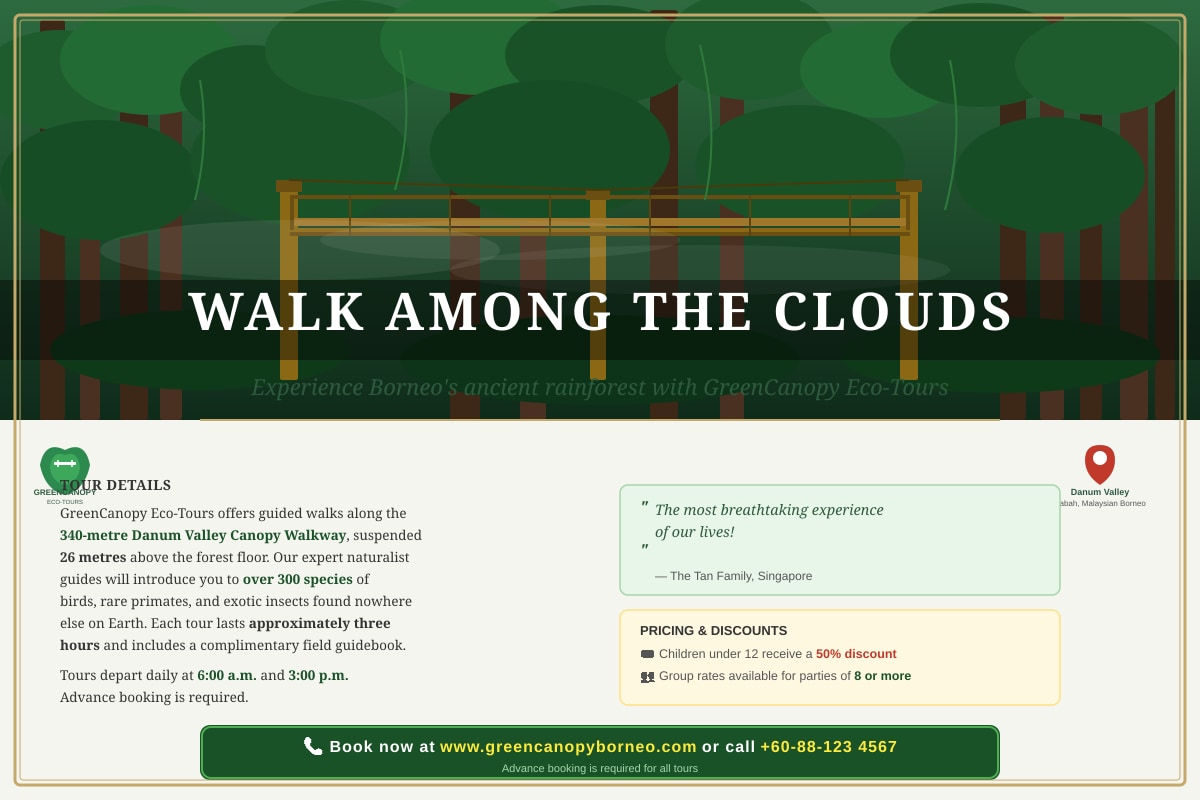
Answer: The Danum Valley Canopy Walkway.
Marking Notes:
- Award 1 mark for the correct name. Accept minor variations such as "Danum Valley Canopy Walkway" or "the Danum Valley walkway."
- Do not accept "canopy walkway" alone without the specific name — the question asks for the name.
Q2. [2 marks]
Answer: (a) Children under 12 receive a 50% discount. (b) Group rates are available for parties of 8 or more (which suits families).
Marking Notes:
- Award 1 mark for each correct detail, up to 2 marks.
- The question asks for information that suggests the advertisement targets families with children. Both the child discount and group rates are relevant because families with children would benefit from these offers.
- Do not accept vague answers like "it's for families" without referencing a specific detail from the advertisement.
Q3. [2 marks]
Answer: The writers chose this phrase because the canopy walkway is suspended 26 metres above the forest floor, so visitors are literally walking at a great height among the treetops, which could feel like walking in or above the clouds. The phrase creates a sense of wonder and excitement, making the experience sound magical and extraordinary.
Marking Notes:
- Award 2 marks for an explanation that connects the phrase to the height of the walkway (26 metres above the forest floor) AND explains the effect (sense of wonder/magic/excitement).
- Award 1 mark for an answer that only explains the literal height OR only describes the effect without linking to the text.
- Award 0 marks for answers that do not reference the passage.
Q4. [1 mark]
Answer: The testimonial is included to persuade readers that the tour is enjoyable and worthwhile by showing that a real family (from Singapore, the target audience) had a positive experience. It builds trust and credibility.
Marking Notes:
- Award 1 mark for identifying the persuasive/promotional purpose of the testimonial.
- Accept answers that mention building trust, credibility, or showing proof of a good experience.
- Do not accept "to fill space" or "to make it look nice" — these do not demonstrate understanding of persuasive technique.
Q5. [2 marks]
Answer: I disagree. The advertisement states that the tour includes "expert naturalist guides" who introduce visitors to wildlife, which suggests it is educational and suitable for general nature enthusiasts, not just photographers. Additionally, the offer of a 50% discount for children under 12 and group rates indicates the tour is designed for families and casual visitors, not exclusively for serious photographers.
Marking Notes:
- Award 2 marks for a clear disagreement (or agreement with strong justification) supported by two relevant details from the advertisement.
- Award 1 mark for a correct stance with only one supporting detail, or for two details without a clear stance.
- Accept a well-justified agreement (e.g., "The tour involves rare wildlife, which would appeal to photographers") if supported by two details, though disagreement is easier to justify.
- The key skill tested is using textual evidence to support an opinion.
Q6. [2 marks]
Answer:
- Technique: Exaggeration / Superlative language / Emphatic claim (hyperbole).
- Effect: It makes the wildlife sound rare, unique, and special, which excites the reader and makes them feel they would be missing out if they did not visit. It creates a sense of urgency and exclusivity.
Marking Notes:
- Award 1 mark for correctly identifying the technique (accept: exaggeration, hyperbole, superlative, emphatic language, or similar).
- Award 1 mark for explaining the effect on the reader (e.g., makes it sound unique/special, creates excitement, persuades the reader to want to visit).
- Do not award the effect mark if the technique is incorrect but the effect explanation is generic.
Section B: Comprehension — Passage [25 marks]
Q7. [2 marks]
Answer (any two of the following from paragraph 1): (a) "abandoned house" (b) "tangled vines that had swallowed the fence whole" (c) "whispered rumours" (d) "the house had been empty for as long as anyone could remember" (e) "rusted iron gate"
Marking Notes:
- Award 1 mark for each correct expression from paragraph 1, up to 2 marks.
- The expression must come from paragraph 1. Answers from other paragraphs receive 0 marks.
- Students must quote phrases (at least 2–3 words), not single words alone. For example, "abandoned" alone is not sufficient; "abandoned house" is acceptable.
- Do not accept paraphrases — students must quote directly from the text.
Q8. [2 marks]
Answer: The gate is old and unused, as shown by the fact that it makes a loud, unpleasant sound when opened. The description uses personification — the gate "protested" and made a "mournful groan" — which creates an eerie, unsettling atmosphere, as if the house is alive and does not want visitors. This makes the reader feel that entering the house is entering a place that has been undisturbed for a long time.
Marking Notes:
- Award 2 marks for identifying personification AND explaining the eerie/unsettling effect.
- Award 1 mark for identifying the technique without explaining the effect, OR for explaining the effect without naming the technique.
- Award 0 marks for answers that merely describe the gate as "old" without addressing the literary technique or its effect.
Q9. [2 marks]
Answer (any two of the following from paragraph 3): (a) "Dust motes danced in the thin shafts of sunlight" — shows dust has accumulated over time. (b) "gaps in the boarded-up windows" — the windows have been covered up for a long time. (c) "a grand staircase curved upward into shadow" — the staircase is unused and dark. (d) "intricate patterns of leaves and birds" on the banister — suggests the house was once grand but is now forgotten.
Marking Notes:
- Award 1 mark for each correct detail from paragraph 3, up to 2 marks.
- The detail must clearly suggest long-term neglect. Accept any reasonable interpretation supported by the text.
- Answers must reference paragraph 3 specifically.
Q10. [2 marks]
Answer: The writer uses "impossibly" to emphasise how surprising and unexpected the green is in the context of the decaying, grey house. It suggests that the colour is so vivid and alive that it seems impossible for it to exist in such a neglected place. This creates a sense of wonder and draws the reader's (and Elena's) attention to the garden as something special and out of place.
Marking Notes:
- Award 2 marks for explaining both the contrast (vivid green vs. grey decay) AND the effect (surprise/wonder/sense of something special).
- Award 1 mark for explaining only one of these elements.
- Award 0 marks for answers that simply define "impossibly" without connecting it to the passage.
Q11. [1 mark]
Answer: The word "riot" suggests that the roses are growing in a wild, abundant, and uncontrolled way — there are so many blossoms that they seem to be overflowing or bursting over the walls. It conveys a sense of energy, abundance, and beauty.
Marking Notes:
- Award 1 mark for any answer that captures the idea of wildness, abundance, or uncontrolled growth.
- Accept: "growing wildly," "lots of flowers everywhere," "overflowing," "bursting with colour."
- Do not accept answers that only say "there are many roses" without conveying the sense of wildness/abundance.
Q12. [2 marks]
Answer (any two of the following): (a) "Neat rows of herbs lined the edges of the courtyard" — the herbs are too organised to have grown naturally. (b) "The roses, though wild, had been trained along the walls" — someone deliberately guided the roses to grow in a certain way. (c) The gardening journal with entries dated as recently as two years ago shows someone was actively maintaining the garden. (d) "The herbs were too neatly arranged to be accidental" (paragraph 6) — this directly states human intervention.
Marking Notes:
- Award 1 mark for each correct detail, up to 2 marks.
- The detail must come from the passage and must suggest human care/tending.
- Do not accept "there was a garden" alone — this does not show evidence of tending.
Q13. [2 marks]
Answer: The inscription tells us that the writer loved the garden deeply and considered it their most precious legacy — "the last beautiful thing I leave behind." The writer wanted someone to continue caring for it after they were gone, which shows they were worried the garden would be neglected. The tone is emotional and slightly sad, suggesting the writer may have been elderly or unwell.
Marking Notes:
- Award 2 marks for an explanation that identifies the writer's deep love/attachment to the garden AND their desire for it to be continued after they are gone.
- Award 1 mark for identifying only one of these elements.
- Award 0 marks for answers that only quote the inscription without explaining the feelings behind it.
Q14. [3 marks]
Answer: At the beginning, Elena is merely curious and drawn to the house out of fascination with its mystery — she "would linger at the rusted iron gate, peering through the tangled vines." She is an outsider looking in. By the end, after discovering the garden and reading the journal, she feels a sense of responsibility and connection — she "held [the book] against her chest" and "understood... this garden was not forgotten at all. And now, it seemed, it was hers to care for." Her feelings have shifted from curiosity to a deep emotional attachment and sense of duty.
Marking Notes:
- Award 3 marks for a clear explanation of the change (curiosity → responsibility/attachment) with two pieces of textual evidence (one from early in the passage, one from the end).
- Award 2 marks for identifying the change with only one piece of evidence, or for two pieces of evidence without a clear explanation of the change.
- Award 1 mark for identifying Elena's feelings at only the beginning OR only the end, with evidence.
- Award 0 marks for answers with no textual evidence.
Q15. [2 marks]
Answer: The simile "like a violet blanket" creates a vivid visual image of the ground being completely covered in purple blossoms, suggesting beauty, softness, and abundance. It also adds a gentle, peaceful tone to the scene, making the garden feel enchanting and serene. The word "blanket" suggests warmth and comfort, reinforcing the idea that the garden is a welcoming, beautiful place.
Marking Notes:
- Award 2 marks for identifying the simile AND explaining its effect (vivid imagery of abundance/beauty AND/OR the peaceful/enchanting tone).
- Award 1 mark for identifying the technique without explaining the effect, or for a partial explanation.
- Award 0 marks for answers that only restate what the sentence says without analysing the effect.
Q16. [4 marks]
Answer:
Inference 1: The writer of the journal was knowledgeable and passionate about gardening.
- Evidence: The journal was "filled with notes about planting seasons, soil conditions, and the names of flowers," showing detailed, expert-level knowledge.
Inference 2: The writer was likely elderly or in declining health, and knew they would not be able to maintain the garden much longer.
- Evidence: The inscription says "It is the last beautiful thing I leave behind," suggesting the writer was preparing for the end of their life or their departure. The most recent entry was from two years ago, implying they stopped writing — possibly because they were no longer able to tend the garden.
Marking Notes:
- Award 1 mark for each valid inference (up to 2 marks) and 1 mark for each supporting piece of evidence (up to 2 marks).
- The inference must go beyond what is directly stated in the text — it must be a logical conclusion drawn from the evidence.
- Accept alternative valid inferences, such as: the writer was lonely (they left the garden for "whoever finds it"), or the writer was meticulous/organised (neat rows, detailed journal entries).
- Do not award the evidence mark if the evidence does not logically support the inference.
Q17. [2 marks]
Answer: Yes, I think Elena will take care of the garden. The passage ends with her holding the book against her chest and realising "it was hers to care for," which shows she has accepted responsibility. Additionally, she looked at the garden "with new eyes" after reading the inscription, suggesting her perspective has changed from curiosity to commitment. Her careful handling of the book ("picked it up carefully") also shows she values the garden and its history.
Marking Notes:
- Award 2 marks for a clear opinion (yes or no) supported by two pieces of evidence from the passage.
- Award 1 mark for an opinion with only one piece of evidence.
- Award 0 marks for an opinion with no evidence, or for evidence without a clear opinion.
- A "no" answer can receive full marks if well-supported (e.g., "Elena is just a child and may not have the resources"), though the text strongly suggests "yes."
Section C: Comprehension — Summary & Language Use [15 marks]
Q18. [3 marks]
Answer: "Food miles" refers to the distance that food travels from the farm where it is grown to the consumer's table. Reducing food miles is beneficial because it cuts down on the fuel consumed and carbon emissions generated during transportation, which helps reduce pollution. It also means the produce is fresher when it reaches the consumer because it has not had to travel as far.
Marking Notes:
- Award 1 mark for correctly defining "food miles" in the student's own words.
- Award 1 mark for explaining the environmental benefit (reduced fuel/carbon emissions/pollution).
- Award 1 mark for explaining the freshness benefit.
- Answers must be in the student's own words. Direct copying from the passage (e.g., "the distance food travels before it reaches the consumer") may receive a maximum of 2 out of 3 marks.
- Award 0 marks for answers that do not address the passage.
Q19. [6 marks]
Answer (any three of the following benefits, in the student's own words):
-
Reduced pollution / lower carbon emissions: Growing food locally means it does not have to be transported over long distances, which reduces fuel consumption and carbon emissions from transportation.
-
Fresher produce: Locally grown food reaches consumers more quickly, so it is fresher when eaten.
-
Educational value for students: Schools that include gardening in their curriculum give students hands-on learning about biology, ecology, and nutrition.
-
Healthier eating habits in children: Children who grow their own vegetables are more likely to eat them, encouraging better nutrition from a young age.
-
Stronger community bonds / social connections: Community gardens bring neighbours together and help people who might otherwise be strangers get to know each other.
Marking Notes:
- Award 2 marks for each correct benefit summarised in the student's own words, up to 6 marks (3 benefits × 2 marks each).
- Each benefit must come from paragraphs 2 or 3 of the passage.
- Award only 1 mark per benefit if the answer is a direct lift (copying) from the passage rather than the student's own words.
- Do not accept benefits from paragraphs 4 or 5 (challenges/solutions) — the question specifically asks about benefits in paragraphs 2 and 3.
- If a student provides more than 3 benefits, mark all of them and award the best 3.
Q20. [2 marks]
Answer:
- Challenge: Space is limited in cities, and land is expensive, making it difficult to find suitable areas for farming. (Accept also: soil contamination, restricted water access, or limited sunlight due to surrounding buildings.)
- Solution: Advances in hydroponics — growing plants without soil using nutrient-rich water — have opened up new possibilities for urban agriculture. (Accept also: multi-storey LED-lit vegetable farms, rooftop aquaponics systems.)
Marking Notes:
- Award 1 mark for a correct challenge identified from the passage (in the student's own words).
- Award 1 mark for a correct solution identified from the passage (in the student's own words).
- Answers must be in the student's own words. Direct copying may receive a maximum of 1 out of 2 marks.
- The challenge and solution must be logically connected (e.g., limited space → hydroponics/vertical farming).
Mark Summary
| Section | Question | Marks |
|---|---|---|
| A: Visual Text | Q1 | 1 |
| Q2 | 2 | |
| Q3 | 2 | |
| Q4 | 1 | |
| Q5 | 2 | |
| Q6 | 2 | |
| Subtotal | 10 | |
| B: Passage Comprehension | Q7 | 2 |
| Q8 | 2 | |
| Q9 | 2 | |
| Q10 | 2 | |
| Q11 | 1 | |
| Q12 | 2 | |
| Q13 | 2 | |
| Q14 | 3 | |
| Q15 | 2 | |
| Q16 | 4 | |
| Q17 | 2 | |
| Subtotal | 25 | |
| C: Summary & Language Use | Q18 | 3 |
| Q19 | 6 | |
| Q20 | 2 | |
| Subtotal | 15 | |
| TOTAL | 50 |
Image Placeholder Reference
Q1-fig1 (Section A, Questions 1–5): The visual stimulus is a travel advertisement for "GreenCanopy Eco-Tours" promoting rainforest adventure holidays in Borneo. Key features that must be visible:
- Headline: "WALK AMONG THE CLOUDS"
- Subheading: "Experience Borneo's ancient rainforest with GreenCanopy Eco-Tours"
- Body text with specific details: 340-metre walkway, 26 metres above forest floor, 300+ bird species, 3-hour tours, departure times (6:00 a.m. and 3:00 p.m.), 50% discount for children under 12, group rates for 8+
- Testimonial: "'The most breathtaking experience of our lives!' — The Tan Family, Singapore"
- Call-to-action: website (www.greencanopyborneo.com) and phone number (+60-88-123 4567)
- Logo: leaf-shaped canopy icon
- Map icon indicating Danum Valley, Sabah, Malaysian Borneo
- Hero image: dense tropical rainforest with wooden canopy walkway
All text must be legible. The visual should resemble a professional travel advertisement with a nature/rainforest theme.