From Real Exams Exam Paper
Secondary 2 English Paper 2 Paper 2
Free Sec 2 English Paper 2 Paper 2, LongCat Exam version, with questions, answers, and syllabus-aligned practice for Singapore students.
These static practice materials are generated from the site's syllabus and paper-generation workflow, with source and model context shown so students and parents can evaluate the material before use.
Questions
Free quiz and exam paper access
Enter your details to view this paper
Your access is remembered on this device.
Answers
TuitionGoWhere Practice Paper - English Secondary 2
PAPER 2 (Comprehension) — Version 2 of 5
ANSWER KEY AND MARKING SCHEME
Section A: Reading Comprehension [20 marks]
Question 1 [2 marks]
Answer: Any two of the following expressions from paragraph 1:
- "dark and shuttered"
- "a wild tangle of overgrown bougainvillea"
- "branches reaching out like grasping fingers"
- "abandoned for over thirty years"
- "passed away under mysterious circumstances"
Marking notes:
- Award 1 mark for each correct expression (maximum 2 marks).
- The expression must be quoted directly from paragraph 1.
- Single words alone (e.g., "dark" or "abandoned") are not sufficient — the student must provide a phrase of at least 2–3 words.
- Do not accept answers from other paragraphs.
Common mistakes:
- Students may quote only single words instead of full expressions.
- Students may provide their own description rather than a direct quotation from the text.
Question 2 [1 mark]
Answer: The phrase suggests that the house appears lifeless, unwelcoming, or as if it is deliberately ignoring or shutting out the outside world. It gives the house a sense of abandonment and secrecy.
Marking notes:
- Award 1 mark for any response that conveys the idea of the house being closed off, lifeless, or unwelcoming.
- The answer should reflect an understanding of the metaphor (comparing shuttered windows to closed eyes).
Teaching note: This is a metaphor — the writer is comparing the shuttered windows of the house to eyes that are closed. This creates an image of the house as something alive that is deliberately turning away from the world.
Question 3 [2 marks]
Answer: Any two of the following details from paragraph 2:
- "Stone pathways wound between beds of wildflowers"
- "a cracked marble fountain stood at the centre"
- "traces of what had once been a magnificent garden"
Marking notes:
- Award 1 mark for each correct detail (maximum 2 marks).
- The detail must be from paragraph 2.
- The answer should show evidence of past care and design (e.g., structured pathways, a fountain).
Common mistakes:
- Students may describe the current wild state of the garden rather than evidence of past maintenance.
- Students may reference details from other paragraphs.
Question 4 [2 marks]
Answer: Maya was surprised because the plants had survived for over thirty years without anyone to tend or care for them. The house had been abandoned since Dr. Lim's death, so there was no gardener to water or maintain the plants.
Marking notes:
- Award 1 mark for stating that the plants had survived without care/attention.
- Award 1 mark for referencing the thirty-year period or the fact that the house was abandoned.
- Answers should be in the student's own words.
Teaching note: The key surprise is the contrast between expectation (plants dying without care) and reality (plants thriving). Students should connect the time frame (thirty years) with the absence of a caretaker.
Question 5 [1 mark]
Answer: The word "iridescent" tells us that the plants' leaves had a shimmering, rainbow-like, or multi-coloured glow. They reflected light in a way that ordinary plants do not.
Marking notes:
- Award 1 mark for describing the shimmering, glowing, or rainbow-like quality of the leaves.
- Accept synonyms such as "shimmering," "glowing with multiple colours," or "rainbow-like."
Teaching note: "Iridescent" describes a surface that appears to change colour depending on the angle of view or light — like a soap bubble or a peacock's feather. In this context, it emphasises how unusual and extraordinary Dr. Lim's engineered plants are.
Question 6 [2 marks]
Answer: Dr. Lim's life's work was the creation of a self-sustaining ecosystem. He engineered plants that could photosynthesise more efficiently, drawing moisture from the air and nutrients from the soil in ways that ordinary plants could not.
Marking notes:
- Award 1 mark for identifying the creation of a self-sustaining ecosystem.
- Award 1 mark for explaining what this involved (e.g., engineering plants with enhanced abilities to draw moisture/nutrients from the air/soil).
- Answers should be in the student's own words.
Common mistakes:
- Students may simply quote "self-sustaining ecosystem" without explaining what it means.
- Students may describe the plants' appearance rather than Dr. Lim's scientific work.
Question 7 [2 marks]
Answer: Dr. Lim meant that his garden would continue to survive and thrive on its own, without needing anyone to look after it. He had designed it to be fully self-sufficient, so it would last long after he was gone.
Marking notes:
- Award 1 mark for explaining that the garden would survive without human care.
- Award 1 mark for explaining that Dr. Lim had designed it to be complete/self-sufficient.
- Answers must be in the student's own words — do not accept direct quotations from the passage as the full answer.
Teaching note: This question tests the ability to interpret figurative or philosophical statements. Students need to translate Dr. Lim's poetic language into plain meaning: the garden is self-sustaining and permanent.
Question 8 [2 marks]
Answer:
- Example of personification: "the house itself had closed its eyes to the world" OR "branches reaching out like grasping fingers" OR "a crow cawed mournfully."
- Effect: It creates a vivid, eerie, or lifelike atmosphere. It makes the setting feel alive and adds to the mysterious mood of the passage.
Marking notes:
- Award 1 mark for correctly identifying an example of personification from the passage.
- Award 1 mark for explaining its effect (e.g., creating mood, making the scene vivid, adding mystery).
- The example must be a direct quotation.
Teaching note: Personification is a literary device where human qualities are given to non-human things. Here, the house "closing its eyes" and branches "reaching out like grasping fingers" give the garden a sense of being alive and watchful, which adds to the mysterious atmosphere.
Question 9 [3 marks]
Answer: At the beginning, Maya was merely curious and drawn to the house out of interest. By the end, she feels a deep sense of wonder and respect for Dr. Lim and his creation.
Evidence:
- Beginning: "Maya had always been drawn to the old house" — shows curiosity.
- End: "She felt a deep sense of wonder and respect for the old botanist" — shows admiration and emotional connection.
Marking notes:
- Award 1 mark for describing Maya's initial feeling (curiosity/interest).
- Award 1 mark for describing Maya's final feeling (wonder/respect/admiration).
- Award 1 mark for providing textual evidence to support the change.
- Answers should show a clear contrast between the two states.
Common mistakes:
- Students may describe only one feeling without showing the change.
- Students may provide evidence without explaining the feelings.
Question 10 [1 mark]
Answer: "A living legacy" means something that Dr. Lim created during his life that continues to exist and thrive after his death. The garden is alive and will endure for future generations, serving as a lasting reminder of his work and vision.
Marking notes:
- Award 1 mark for explaining that it is something lasting that continues after death.
- The answer should connect "living" (the garden is alive) with "legacy" (something left behind).
Teaching note: A "legacy" is something handed down from one generation to the next. The word "living" is significant here because the garden is literally alive — it is not just a memory or an object, but a thriving ecosystem.
Section B: Visual Text Comprehension [10 marks]
Question 11 [1 mark]
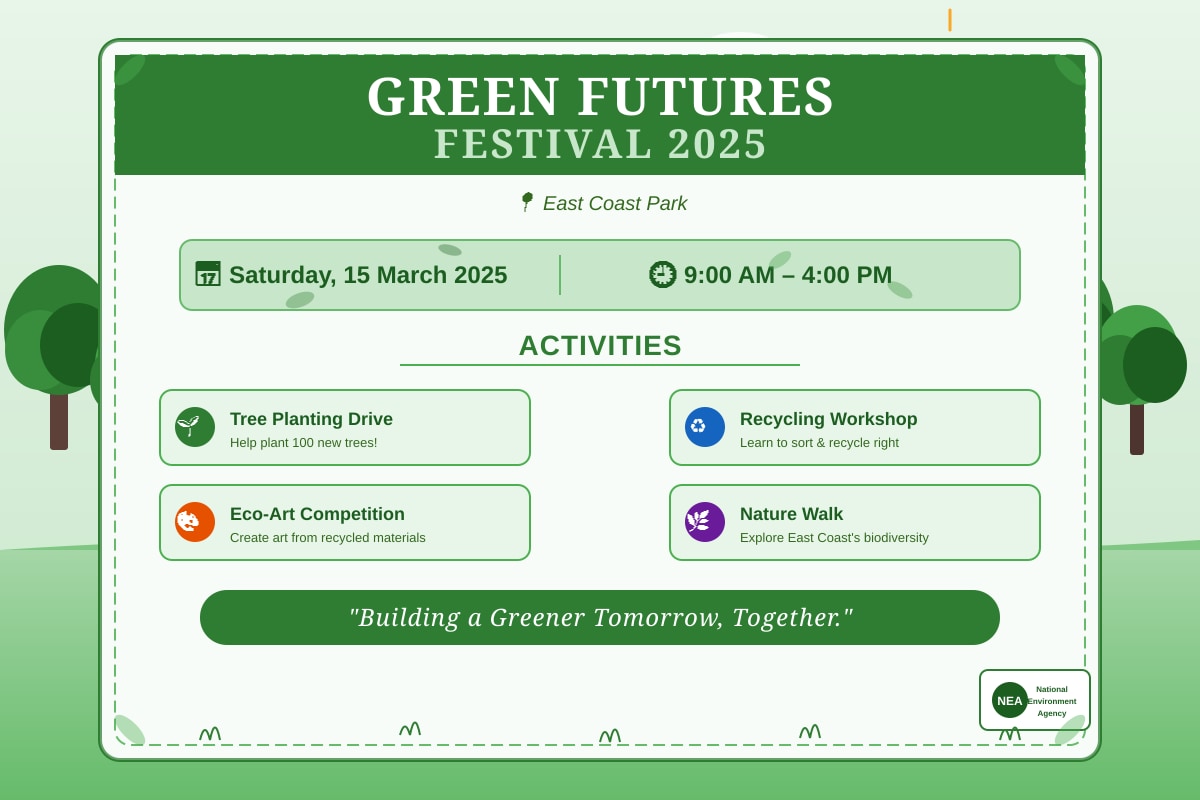
Answer: The purpose of the poster is to inform the public about the Green Futures Festival 2025 and to encourage them to attend the event.
Marking notes:
- Award 1 mark for identifying the purpose as informing/advertising/promoting the event.
- Accept any response that conveys the idea of publicising or raising awareness about the festival.
Question 12 [2 marks]
Answer: Any two of the following activities:
- Tree Planting Drive
- Recycling Workshop
- Eco-Art Competition
- Nature Walk
Marking notes:
- Award 1 mark for each correct activity (maximum 2 marks).
- The activity must be taken directly from the poster.
- Accept any two of the four listed activities.
Question 13 [2 marks]
Answer: The organiser is likely the National Environment Agency (NEA). This can be told from the NEA logo displayed in the bottom right corner of the poster.
Marking notes:
- Award 1 mark for identifying the National Environment Agency (NEA) as the organiser.
- Award 1 mark for referencing the NEA logo as evidence from the poster.
- Accept any reasonable inference based on the visual evidence.
Question 14 [2 marks]
Answer: The tagline suggests that the event's message is about collective action and shared responsibility for the environment. It emphasises that building a sustainable future requires everyone to work together — it is not something one person or organisation can do alone.
Marking notes:
- Award 1 mark for identifying the idea of collective action or working together.
- Award 1 mark for connecting this to environmental protection or sustainability.
- Answers should interpret the meaning of "Together" in the tagline.
Question 15 [3 marks]
Answer: I would look at the activities list on the poster, which mentions the "Eco-Art Competition." However, the poster does not provide full details about this activity. I would expect to find additional information such as the competition rules, age categories, submission guidelines, prizes, and a contact number or website for registration.
Marking notes:
- Award 1 mark for identifying where the Eco-Art Competition is mentioned on the poster (the activities list).
- Award 1 mark for noting that the poster lacks detailed information about the competition.
- Award 1 mark for suggesting what additional information might be needed (e.g., rules, prizes, registration details, contact information).
Teaching note: This question tests critical thinking about visual texts. Students should recognise that posters are designed to attract attention and provide basic information, but detailed information is usually found elsewhere (e.g., a website, registration form, or information desk).
Section C: Comprehension Cloze [10 marks]
Question 16 [2 marks]
Answer: dark / dim / gloomy / shaded
Marking notes:
- Award 2 marks for "dark" or "dim."
- Award 1 mark for "gloomy" or "shaded."
- The word must fit the context of sunlight barely reaching the forest floor.
Teaching note: The context clue is "sunlight barely reaches the forest floor," which indicates that the conditions on the forest floor are dark or dim due to the dense canopy above.
Question 17 [2 marks]
Answer: symbiotic / interdependent / mutual
Marking notes:
- Award 2 marks for "symbiotic" or "interdependent."
- Award 1 mark for "mutual."
- The word must describe a relationship where both parties benefit and depend on each other.
Teaching note: The passage describes a relationship where plants and animals rely on each other for survival — this is a symbiotic (or interdependent) relationship. "Symbiotic" is the most precise scientific term.
Question 18 [2 marks]
Answer: cut down / removed / destroyed / felled / cleared
Marking notes:
- Award 2 marks for "cut down," "felled," or "cleared."
- Award 1 mark for "removed" or "destroyed."
- The word must fit the context of deforestation and the loss of animal habitats.
Teaching note: The context is deforestation — the removal of trees for logging or agriculture. "Cut down" and "felled" are the most natural collocations in this context.
Question 19 [2 marks]
Answer: essential / important / crucial / necessary / vital
Marking notes:
- Award 2 marks for "essential," "crucial," or "vital."
- Award 1 mark for "important" or "necessary."
- The word must convey urgency and importance in the context of taking action to protect rainforests.
Teaching note: The sentence structure "It is therefore _____ that we take immediate action" requires an adjective that conveys strong necessity. "Essential" and "crucial" are the most natural fits.
Question 20 [2 marks]
Answer: survives / endures / remains / lasts / continues to exist
Marking notes:
- Award 2 marks for "survives" or "endures."
- Award 1 mark for "remains" or "lasts."
- The word must fit the context of the rainforest continuing to exist for future generations.
Teaching note: The passage is about conservation — ensuring that the rainforest continues to exist. "Survives" and "endures" are the most natural choices, echoing the language used in Section A ("The garden will endure").
Summary of Marks
| Section | Marks |
|---|---|
| Section A: Reading Comprehension (Q1–Q10) | 20 |
| Section B: Visual Text Comprehension (Q11–Q15) | 10 |
| Section C: Comprehension Cloze (Q16–Q20) | 10 |
| Total | 40 |