From Real Exams Exam Paper

Secondary 2 English Paper 2 Paper 2

Free Exam-Derived NVIDIA Nemotron 3 Ultra 550B A55B Free Secondary 2 English Paper 2 Paper 2 practice paper with questions and answers for Singapore students. This page is rendered as a direct URL so the questions and answers can be discovered without pressing in-page buttons.

These static practice materials are generated from the site's syllabus and paper-generation workflow, with source and model context shown so students and parents can evaluate the material before use.

Secondary 2 English From Real Exams Generated by NVIDIA Nemotron 3 Ultra 550B A55B Free Updated 2026-06-07

Questions

<!-- TuitionGoWhere generation metadata: stage=3-1; model=nvidia/nemotron-3-ultra-550b-a55b:free; model_label=NVIDIA Nemotron 3 Ultra 550B A55B Free; generated=2026-06-06; Sources: Stage 2-1 real exam-derived templates and Stage 2-2 exam-enriched syllabus. -->

TuitionGoWhere Practice Paper - English Secondary 2

TuitionGoWhere Secondary School (AI)
Subject: English Language
Level: Secondary 2
Paper: Paper 2 (Comprehension & Language Use)
Duration: 1 hour 30 minutes
Total Marks: 50
Version: 2 of 5

Name: ________________________
Class: ________________________
Date: ________________________


INSTRUCTIONS TO CANDIDATES

  1. Write your name, class, and date in the spaces provided above.
  2. Answer all questions.
  3. Write your answers in the spaces provided in this question paper.
  4. The number of marks is given in brackets [ ] at the end of each question or part question.
  5. The total number of marks for this paper is 50.
  6. You are reminded of the need for good English and clear presentation in your answers.

SECTION A: VISUAL TEXT COMPREHENSION [5 marks]

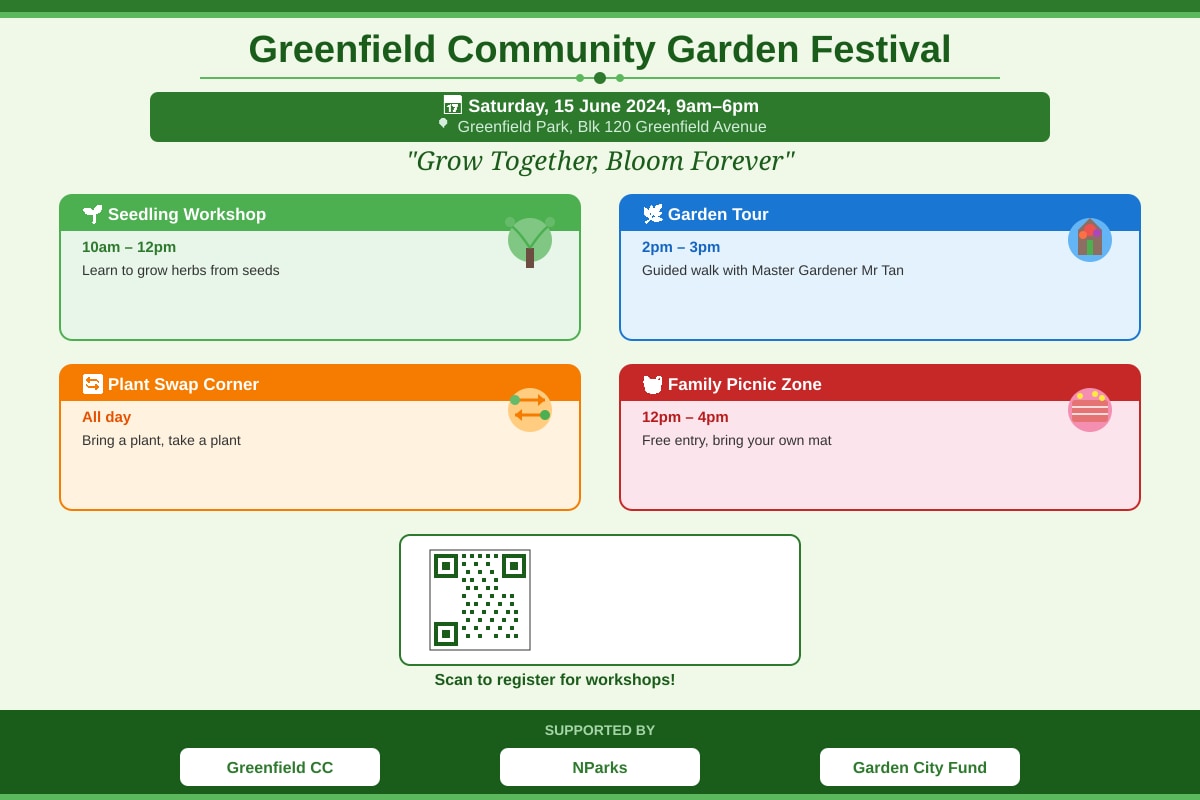
Study the poster below carefully and answer Questions 1–5.

<image_placeholder> id: Q1-fig1 type: source_image linked_question: Q1 description: A colourful poster promoting a "Community Garden Festival" at "Greenfield Neighbourhood Park". The poster includes: a main title "Community Garden Festival", date "Saturday, 15 June 2024", time "9:00 AM – 4:00 PM", venue "Greenfield Neighbourhood Park", a tagline "Grow Together, Bloom Forever", four activity boxes with icons: (1) "Seed Planting Workshop" with a trowel icon, "Learn to plant herbs & vegetables", "10:00 AM & 2:00 PM"; (2) "Eco-Craft Corner" with a leaf icon, "Create art from recycled materials", "All day"; (3) "Garden Tour" with a butterfly icon, "Guided walk through themed gardens", "11:00 AM & 3:00 PM"; (4) "Community Potluck" with a picnic basket icon, "Bring a dish to share", "12:30 PM". At the bottom: "Free Admission | All Ages Welcome", "Organised by Greenfield Residents' Committee", "Sponsored by Bloom & Grow Nursery", "Follow us @GreenfieldGardenFest", and a QR code with caption "Scan for programme details & registration". labels: Title, Date, Time, Venue, Tagline, Four activity boxes with icons/titles/descriptions/times, Free Admission note, Organiser, Sponsor, Social media handle, QR code with caption values: Date: Saturday, 15 June 2024; Time: 9:00 AM – 4:00 PM; Venue: Greenfield Neighbourhood Park; Activity times as listed must_show: All text must be legible; icons visually distinct; layout resembles a real community event poster </image_placeholder>

1 What is the main purpose of this poster? [1]


2 Write down the tagline of the festival. [1]


3 If you want to learn how to plant herbs and vegetables, which activity should you join and at what time(s)? [1]


4 Which activity runs throughout the entire day without a specific start time? [1]


5 How can a visitor get the full programme details and register for activities? [1]


SECTION B: NARRATIVE TEXT COMPREHENSION [20 marks]

Read the passage below carefully and answer Questions 6–15.

The old lighthouse had not been lit in thirty years. Its white tower, once a beacon for ships navigating the treacherous coastline, now stood like a bleached bone against the grey sky. Maya had climbed the spiral staircase countless times as a child, her small hands trailing along the cold iron railing, counting each step — one hundred and twelve, she remembered — until she reached the lantern room with its massive Fresnel lens, dark and dormant now, like a giant's eye closed in sleep.

Today, the air tasted of salt and coming rain. Maya stood at the base of the tower, her fingers brushing the peeling paint. She had returned to this coast after a decade away, drawn by a letter from the harbour master: The council has approved the restoration. We need someone who knows the light. Will you come?

She had not expected the weight of memory. The lighthouse keeper's cottage, where she had spent summers with her grandfather, sat empty behind the tower. Its garden had surrendered to wind and salt-spray, the lavender and rosemary replaced by tough coastal grasses. Inside, the logbook still lay open on the desk, its last entry dated October 1993: Light extinguished. Automation complete. End of an era. Her grandfather's handwriting, precise and fading.

Maya climbed. The staircase groaned under her weight, each step releasing a puff of dust. At the lantern room, she found the lens intact, its prisms catching the dim afternoon light and fracturing it into ghostly rainbows across the curved glass. The mechanism — clockwork gears and counterweights — was frozen by rust, but complete. She ran her palm over the brass housing, feeling the cold metal warm slowly beneath her touch.

A movement at the window caught her eye. A gull, or perhaps a tern, wheeled against the darkening sky. Beyond it, the sea stretched to the horizon, a slate-grey expanse flecked with white. Somewhere out there, a ship would be watching for a light that had not shone in thirty years.

She thought of her grandfather's voice: The light does not save the ship. The light shows the ship where safety lies. The captain must still steer.

Maya reached into her bag and withdrew a small brass key. It fit the oil cabinet. Inside, three tins of lamp oil — sealed, preserved — waited beside polished wicks. The council's contractors would arrive next week with electric lamps and solar panels. But tonight, if she chose, the old light could breathe once more.

6 From paragraph 1, write down two expressions that make the lighthouse resemble something from a magical or dreamlike story. [2]


7 In paragraph 2, the writer mentions that the logbook's last entry was dated October 1993. What does this detail suggest about the lighthouse's history? [1]


8 Why did Maya return to the coast after a decade away? Answer in your own words as far as possible. [2]


9 In paragraph 4, the writer describes the Fresnel lens as "catching the dim afternoon light and fracturing it into ghostly rainbows". What is the effect of this description? [2]


10 "The mechanism — clockwork gears and counterweights — was frozen by rust, but complete." (Paragraph 4)
What does the word "complete" suggest about the mechanism? [1]


11 From paragraph 5, identify one detail that shows the sea conditions were rough or dangerous. [1]


12 Explain what Maya's grandfather meant when he said: "The light does not save the ship. The light shows the ship where safety lies. The captain must still steer." [2]


13 In paragraph 7, the writer mentions "electric lamps and solar panels". What does this contrast with? [1]


14 The passage ends with: "But tonight, if she chose, the old light could breathe once more."
What does the phrase "breathe once more" suggest about the lighthouse? [2]


15 The passage explores the theme of tradition versus modernity.
Give one example from the text that represents tradition and one that represents modernity. [2]

Tradition: ____________________________________________________________________

Modernity: ____________________________________________________________________


SECTION C: NON-NARRATIVE TEXT COMPREHENSION [15 marks]

Read the passage below carefully and answer Questions 16–20.

Urban farming is no longer a niche hobby — it is becoming a necessity. As cities expand and arable land shrinks, the distance between food production and consumption grows. The average meal in Singapore travels over 1,500 kilometres before reaching a plate. This "food mileage" carries a heavy carbon footprint: transportation emissions, refrigeration energy, and packaging waste. Meanwhile, Singapore imports over 90% of its food, making the nation vulnerable to global supply chain disruptions, climate shocks, and geopolitical instability.

Rooftop farms, vertical growing systems, and community gardens offer a partial solution. A 2023 study by the Singapore Food Agency found that optimising existing rooftop space could produce up to 15% of the nation's leafy vegetable demand. Vertical farms, using hydroponic or aeroponic systems, achieve yields 50–100 times higher per square metre than traditional soil farming, while using 90% less water. These systems operate year-round, unaffected by weather extremes, and eliminate pesticide use through controlled environments.

However, challenges remain. High setup costs, energy consumption for artificial lighting, and technical expertise requirements limit widespread adoption. A typical vertical farm rack system costs 15,00015,000–30,000 per square metre. Energy costs can account for 30–50% of operating expenses. Critics argue that staple crops — rice, wheat, root vegetables — are not economically viable in vertical systems, which excel only at high-value, fast-growing leafy greens and herbs.

The "30 by 30" goal — producing 30% of nutritional needs locally by 2030 — drives policy innovation. Grants, research funding, and regulatory support aim to lower barriers. Schools now integrate urban farming into curricula. Community gardens transform vacant lots into social hubs. The vision extends beyond food security: urban farming reconnects city dwellers with natural cycles, builds community resilience, and reimagines the concrete jungle as a living ecosystem.

16 From paragraph 1, write down two reasons why long "food mileage" is problematic. [2]


17 In paragraph 2, the writer states that vertical farms achieve "yields 50–100 times higher per square metre than traditional soil farming". What does this comparison emphasise? [1]


18 Identify two challenges of vertical farming mentioned in paragraph 3. [2]


19 Why are staple crops like rice and wheat "not economically viable in vertical systems"? Answer in your own words. [2]


20 The passage ends with: "reimagines the concrete jungle as a living ecosystem."
Explain how urban farming contributes to this reimagining. Support your answer with two details from the passage. [3]


SECTION D: SUMMARY WRITING [10 marks]

21 Using your own words as far as possible, summarise the benefits and challenges of urban farming as described in the non-narrative text (Section C).

Your summary must:

  • Be in continuous writing (not note form)
  • Not exceed 80 words
  • Focus only on the non-narrative text

Benefits and challenges of urban farming:


[Word count: ________]


END OF PAPER

Answers

<!-- TuitionGoWhere generation metadata: stage=3-1; model=nvidia/nemotron-3-ultra-550b-a55b:free; model_label=NVIDIA Nemotron 3 Ultra 550B A55B Free; generated=2026-06-06; Sources: Stage 2-1 real exam-derived templates and Stage 2-2 exam-enriched syllabus. -->

TuitionGoWhere Practice Paper - English Secondary 2 (Answer Key)

Paper: Paper 2 (Comprehension & Language Use)
Level: Secondary 2
Total Marks: 50
Version: 2 of 5


SECTION A: VISUAL TEXT COMPREHENSION [5 marks]

1 What is the main purpose of this poster? [1]
Answer: To promote / advertise the Community Garden Festival and encourage people to attend.
Marking note: Accept "promote", "advertise", "inform about", or "encourage attendance at" the festival. Must convey the persuasive/informational purpose.

2 Write down the tagline of the festival. [1]
Answer: Grow Together, Bloom Forever
Marking note: Exact wording required. No marks for paraphrasing.

3 If you want to learn how to plant herbs and vegetables, which activity should you join and at what time(s)? [1]
Answer: Seed Planting Workshop at 10:00 AM or 2:00 PM (accept either or both times).
Marking note: Must name the correct activity. Time must be accurate.

4 Which activity runs throughout the entire day without a specific start time? [1]
Answer: Eco-Craft Corner
Marking note: Exact activity name required.

5 How can a visitor get the full programme details and register for activities? [1]
Answer: Scan the QR code (on the poster) for programme details and registration.
Marking note: Must mention QR code. Accept "scan the QR code" or "follow @GreenfieldGardenFest" (social media) as alternative if QR code is mentioned as primary.


SECTION B: NARRATIVE TEXT COMPREHENSION [20 marks]

6 From paragraph 1, write down two expressions that make the lighthouse resemble something from a magical or dreamlike story. [2]
Answer (any two of the following):

  • "stood like a bleached bone against the grey sky"
  • "like a giant's eye closed in sleep"
  • "fracturing it into ghostly rainbows" (from paragraph 4, but if student quotes from para 1 only: "massive Fresnel lens, dark and dormant now, like a giant's eye closed in sleep")
    Marking note:
  • 1 mark per correct expression (complete phrase, not single words).
  • Must be from paragraph 1. "Ghostly rainbows" is from paragraph 4 — do not award if quoted for this question.
  • Common trap: quoting single words like "bleached", "bone", "giant's", "sleep" — award 0 for that expression.
  • Accept "like a bleached bone" / "like a giant's eye closed in sleep" as the two similes.

7 In paragraph 2, the writer mentions that the logbook's last entry was dated October 1993. What does this suggest about the lighthouse's history? [1]
Answer: The lighthouse was deactivated / automated / stopped operating in October 1993 (over 30 years ago).
Marking note: Accept any answer indicating the light was extinguished/automated/ended around 1993. Must show understanding that the date marks the end of the lighthouse's active operation.

8 Why did Maya return to the coast after a decade away? Answer in your own words as far as possible. [2]
Answer: She received a letter from the harbour master asking her to help with the lighthouse restoration because she knew the light / had knowledge of the lighthouse.
Marking note:

  • 1 mark: Received a letter from harbour master / council approved restoration.
  • 1 mark: They needed someone who knew the light / her expertise.
  • "Own words" requirement: Do not lift "The council has approved the restoration. We need someone who knows the light. Will you come?" directly. Must paraphrase.

9 In paragraph 4, the writer describes the Fresnel lens as "catching the dim afternoon light and fracturing it into ghostly rainbows". What is the effect of this description? [2]
Answer: It creates a magical / beautiful / ethereal atmosphere, suggesting the lens is still alive with potential despite being dormant, and transforms the gloomy setting into something wondrous.
Marking note:

  • 1 mark: Identifies the visual effect (rainbows, light fracturing, beauty/magic).
  • 1 mark: Explains the atmosphere/mood created (magical, ethereal, hopeful, wondrous, contrast with decay).
  • Accept: "shows the lens is still capable of producing light/beauty", "makes the scene seem magical/dreamlike", "contrasts with the dust and rust".

10 "The mechanism — clockwork gears and counterweights — was frozen by rust, but complete." (Paragraph 4)
What does the word "complete" suggest about the mechanism? [1]
Answer: All its parts are still there / intact / nothing is missing, even though it is not working.
Marking note: Accept "intact", "whole", "all parts present", "not broken or missing pieces". Do not accept "working" or "functional" — the text says it was "frozen by rust".

11 From paragraph 5, identify one detail that shows the sea conditions were rough or dangerous. [1]
Answer (any one):

  • "slate-grey expanse flecked with white" (whitecaps/waves)
  • "treacherous coastline" (from paragraph 1, but if restricted to paragraph 5: "darkening sky" suggests storm)
  • "A movement at the window caught her eye. A gull, or perhaps a tern, wheeled against the darkening sky." — the darkening sky implies worsening weather.
    Marking note: Best answer: "slate-grey expanse flecked with white" (indicates whitecaps/rough seas). Accept "darkening sky" as implying storm conditions.

12 Explain what Maya's grandfather meant when he said: "The light does not save the ship. The light shows the ship where safety lies. The captain must still steer." [2]
Answer: The lighthouse provides guidance/warning, but it cannot control the ship; the captain is responsible for making decisions and taking action to reach safety.
Marking note:

  • 1 mark: Light shows the way / indicates danger / guides.
  • 1 mark: Captain/human must act / take responsibility / make choices.
  • Accept metaphorical interpretations (guidance vs. agency).

13 In paragraph 7, the writer mentions "electric lamps and solar panels". What does this contrast with? [1]
Answer: The old oil-based / traditional / mechanical lighthouse system (lamp oil, wicks, clockwork mechanism).
Marking note: Accept "the old light", "traditional oil lamps", "the brass key and oil cabinet", "the clockwork mechanism". Must show contrast between old and new technology.

14 The passage ends with: "But tonight, if she chose, the old light could breathe once more."
What does the phrase "breathe once more" suggest about the lighthouse? [2]
Answer: It suggests the lighthouse is like a living thing that has been dormant/asleep and can be revived/brought back to life; it implies a temporary, organic reawakening rather than permanent modernisation.
Marking note:

  • 1 mark: Personification — lighthouse as living/breathing entity.
  • 1 mark: Idea of revival/reawakening from dormancy, temporary/choice-based ("if she chose"), contrast with permanent electric conversion.
  • Accept: "it can work again", "it has life left in it", "she can relight it the old way one last time".

15 The passage explores the theme of tradition versus modernity.
Give one example from the text that represents tradition and one that represents modernity. [2]
Answer:
Tradition: The oil lamp / brass key / clockwork mechanism / Fresnel lens / grandfather's logbook / manual lighting of the lighthouse.
Modernity: Electric lamps / solar panels / automation / contractors / "30 by 30" goal (if inferred, but better: electric lamps and solar panels explicitly mentioned).
Marking note: 1 mark each. Must be specific textual details. Accept any clear old vs. new technology pair from the text.


SECTION C: NON-NARRATIVE TEXT COMPREHENSION [15 marks]

16 From paragraph 1, write down two reasons why long "food mileage" is problematic. [2]
Answer (any two):

  • Transportation emissions / carbon footprint
  • Refrigeration energy
  • Packaging waste
  • Makes the nation vulnerable to supply chain disruptions / climate shocks / geopolitical instability (accept any one vulnerability)
    Marking note: 1 mark per reason. Must be from paragraph 1. Lifting phrases acceptable: "transportation emissions, refrigeration energy, and packaging waste" count as three separate reasons.

17 In paragraph 2, the writer states that vertical farms achieve "yields 50–100 times higher per square metre than traditional soil farming". What does this comparison emphasise? [1]
Answer: The space efficiency / land-use efficiency / high productivity of vertical farming compared to traditional farming.
Marking note: Accept "vertical farms use much less land to produce the same amount", "extremely high yield per area", "efficient use of limited space".

18 Identify two challenges of vertical farming mentioned in paragraph 3. [2]
Answer (any two):

  • High setup costs / capital costs (15,00015,000–30,000 per square metre)
  • High energy consumption for artificial lighting (30–50% of operating expenses)
  • Technical expertise requirements
  • Staple crops not economically viable (only leafy greens/herbs work well)
    Marking note: 1 mark per challenge. Must be from paragraph 3.

19 Why are staple crops like rice and wheat "not economically viable in vertical systems"? Answer in your own words. [2]
Answer: They are low-value crops that take a long time to grow and need large space, while vertical farms are expensive to run and only profitable for high-value, fast-growing crops like leafy greens.
Marking note:

  • 1 mark: Staple crops are low value / low profit margin.
  • 1 mark: Vertical farms have high operating costs / only suit fast-growing, high-value crops.
  • "Own words": Do not lift "staple crops — rice, wheat, root vegetables — are not economically viable in vertical systems, which excel only at high-value, fast-growing leafy greens and herbs" verbatim. Must paraphrase.

20 The passage ends with: "reimagines the concrete jungle as a living ecosystem."
Explain how urban farming contributes to this reimagining. Support your answer with two details from the passage. [3]
Answer: Urban farming transforms unused urban spaces (rooftops, vacant lots) into productive green areas that produce food, build community (community gardens as social hubs), and reconnect people with nature (school curricula, natural cycles).
Marking note:

  • 1 mark: Identifies transformation of urban spaces (rooftops/vacant lots → farms/gardens).
  • 1 mark: Detail 1 — e.g., "community gardens transform vacant lots into social hubs" or "schools integrate urban farming into curricula".
  • 1 mark: Detail 2 — e.g., "reconnects city dwellers with natural cycles" or "builds community resilience" or "produces food locally".
  • Must use details from the passage. General answers without textual support: max 1 mark.

SECTION D: SUMMARY WRITING [10 marks]

21 Summary of benefits and challenges of urban farming (max 80 words, continuous writing). [10]

Content points (benefits):

  1. Reduces food mileage / carbon footprint / emissions / packaging waste
  2. Enhances food security / reduces import dependence / vulnerability to supply shocks
  3. High yield per square metre (50–100× traditional) / space-efficient
  4. Uses 90% less water
  5. Year-round production / unaffected by weather
  6. No pesticides needed / controlled environment
  7. Community building / social hubs / reconnects people with nature
  8. Educational value (school curricula)

Content points (challenges):
9. High setup costs (15,00015,000–30,000 per m²)
10. High energy consumption / costs (30–50% of expenses)
11. Requires technical expertise
12. Not viable for staple crops (rice, wheat) — only leafy greens/herbs

Marking scheme:

  • Content (6 marks): 1 mark per valid point, up to 6 points (must include both benefits and challenges for full marks).
  • Language (4 marks):
    • 4: Excellent paraphrase, fluent, concise, own words, within word limit.
    • 3: Good paraphrase, mostly fluent, minor lifting, within word limit.
    • 2: Some paraphrase, occasional lifting, mostly fluent, may slightly exceed word limit.
    • 1: Heavy lifting, disjointed, exceeds word limit significantly.
    • 0: Copied wholesale, not in continuous writing, or incomprehensible.

Sample summary (approx. 70 words):
Urban farming reduces food mileage and import dependence while achieving far higher yields per square metre using less water and no pesticides. It enables year-round production and strengthens communities through shared gardens and education. However, high setup and energy costs, the need for technical expertise, and the inability to grow staple crops economically limit its scope to high-value leafy vegetables.

Word count: 68 words.

Common mistakes:

  • Exceeding 80 words (penalise language mark).
  • Writing in bullet points / note form (penalise language mark).
  • Including only benefits or only challenges (max 3 content marks).
  • Lifting large chunks without paraphrase (language mark 1–2).
  • Including irrelevant details (e.g., "30 by 30 goal" without linking to benefits/challenges).

END OF ANSWER KEY