From Real Exams Exam Paper
Secondary 2 English Paper 2 Paper 1
Free Sec 2 English Paper 2 Paper 1, LongCat Exam version, with questions, answers, and syllabus-aligned practice for Singapore students.
These static practice materials are generated from the site's syllabus and paper-generation workflow, with source and model context shown so students and parents can evaluate the material before use.
Questions
Free quiz and exam paper access
Enter your details to view this paper
Your access is remembered on this device.
Answers
TuitionGoWhere Practice Paper — English Language Secondary 2
Answer Key — Version 1 of 5
Paper: PAPER 2 (Comprehension & Language Use) Total Marks: 50
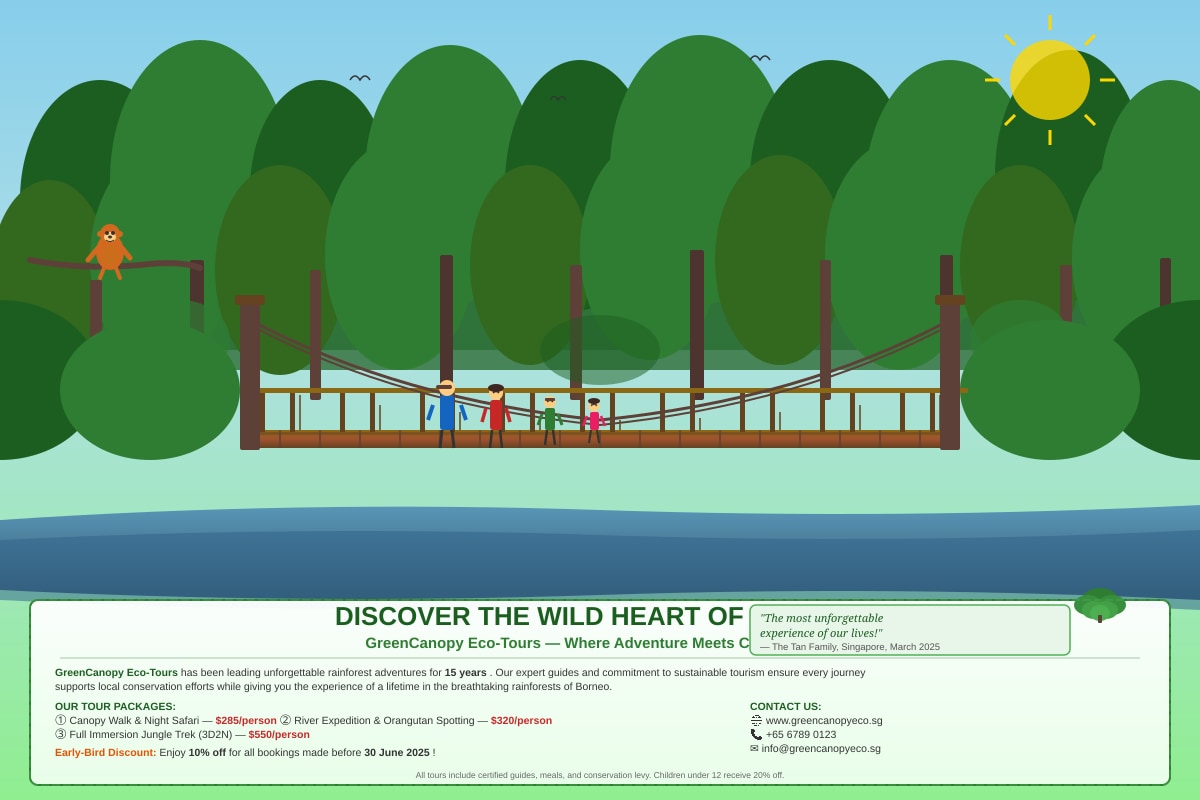
Section A: Comprehension — Visual Text [10 marks]
Question 1 [1 mark]
Answer: GreenCanopy Eco-Tours
Marking Notes:
- Award 1 mark for the correct company name.
- Accept minor variations in capitalisation (e.g., "greencanopy eco-tours") as long as the name is clearly identifiable.
- Do not accept incomplete answers such as "GreenCanopy" alone — the full company name as shown in the advertisement is required.
Question 2 [2 marks]
Answer (any two of the following):
- Certified guides
- Meals
- Conservation levy
Marking Notes:
- Award 1 mark for each correct feature, up to a maximum of 2 marks.
- The advertisement states: "All tours include certified guides, meals, and conservation levy."
- Students must extract the features directly from the text. Do not accept vague answers like "tours" or "guides" without the qualifier "certified."
- Paraphrasing is acceptable as long as the meaning is preserved (e.g., "trained guides" for "certified guides").
Question 3 [2 marks]
Answer:
- Original price of "River Expedition & Orangutan Spotting" tour = $320
- Early-bird discount = 10% of 32
- Discounted price = 32 = $288
Marking Notes:
- Award 1 mark for correct working (calculating 10% of 32).
- Award 1 mark for the correct final answer ($288).
- If the student shows correct working but makes an arithmetic error, award 1 mark for the method.
- Accept 288" as the final answer.
Question 4 [2 marks]
Answer: The advertiser includes the detail about "15 years of experience" to establish credibility and trustworthiness. It suggests that the company is experienced, reliable, and knowledgeable about what they offer. This reassures potential customers that they are choosing a well-established and safe tour operator, making them more likely to book a tour.
Marking Notes:
- Award 1 mark for identifying the purpose (to show credibility/experience/reliability).
- Award 1 mark for explaining the effect on the reader (builds trust, makes them feel confident about booking, reassures them about safety/quality).
- Answers should go beyond simply restating the detail. Students must explain why the advertiser chose to include it.
- Accept answers that mention "trust," "reliability," "reputation," "confidence," or similar concepts.
Question 5 [3 marks]
(a) [1 mark]
Answer: The purpose of including a testimonial is to persuade potential customers by providing social proof — showing that other people have had a positive experience with the company. It makes the advertisement more convincing because the recommendation comes from a real customer rather than the company itself.
Marking Notes:
- Award 1 mark for identifying the purpose: to persuade / provide social proof / build credibility through a real customer's experience.
- Do not accept vague answers like "to make it look good" without further explanation.
(b) [2 marks]
Answer: The testimonial is effective for two reasons:
-
Words chosen: The phrase "the most unforgettable experience of our lives" uses superlative language ("most unforgettable") and the word "lives" (plural), which emphasises that this was the best experience among many experiences the family has had. This strong, emphatic language creates a powerful impression on the reader.
-
Source of the testimonial: The testimonial comes from "The Tan Family, Singapore, March 2025." This is effective because the family is from Singapore — the same country as the target audience — making the recommendation more relatable and trustworthy. The recent date (March 2025) also suggests the experience is current and relevant.
Marking Notes:
- Award 1 mark for explaining the effectiveness of the words chosen (superlative, emphatic language, emotional impact).
- Award 1 mark for explaining why the source is effective (same nationality as target audience, recent date, relatability).
- Students must address both the words chosen and the source to receive full marks.
- Accept other valid explanations, such as the use of an exclamation mark to convey enthusiasm, or the fact that it is a family endorsement (suggesting the tour is suitable for families).
Section B: Comprehension — Passage [25 marks]
Question 6 [1 mark]
Answer: This suggests that Elena was feeling emotional — possibly a mix of nostalgia, sadness, or anxiety about returning to a place she had not visited in a long time. The "tightness" indicates a physical sensation associated with strong emotions.
Marking Notes:
- Award 1 mark for identifying that Elena was feeling emotional.
- Accept a range of specific emotions: nostalgic, sad, anxious, overwhelmed, apprehensive, or a combination.
- Do not accept "she was sick" or purely physical interpretations — the context makes it clear this is an emotional response.
Question 7 [2 marks]
Answer (any two of the following):
- The planks are described as "weathered grey" — showing the wood has been worn down by time and weather.
- The zinc roof is "patched with rust" — showing deterioration and age.
- The house is described as "weathered" — indicating it has been exposed to the elements for a long time.
Marking Notes:
- Award 1 mark for each correct detail from Paragraph 2, up to a maximum of 2 marks.
- Students must quote or closely paraphrase details from Paragraph 2 specifically.
- Accept "weathered grey planks," "zinc roof patched with rust," or similar phrasing.
- Do not accept details from other paragraphs (e.g., the collapsed well in Paragraph 3).
Question 8 [2 marks]
(a) [1 mark]
Answer: Simile
Marking Notes:
- Award 1 mark for identifying the literary device as a simile.
- The phrase uses "like" to compare two things (petals and coins), which is the defining feature of a simile.
- Do not accept "metaphor" — a metaphor does not use "like" or "as."
(b) [1 mark]
Answer: The comparison creates an image of the petals as precious, beautiful, and abundant — like coins scattered on the ground. It suggests that the garden was once a place of value and beauty, and the falling petals were like something precious being freely given. It also conveys a sense of natural wealth and generosity.
Marking Notes:
- Award 1 mark for explaining the effect of the comparison.
- Accept answers that mention beauty, preciousness, abundance, value, or the idea of something treasured being scattered.
- The explanation should go beyond simply identifying what coins are — students must explain what the comparison suggests about the petals or the garden.
Question 9 [2 marks]
Answer: Elena's emotional state is one of detachment and emotional numbness. The passage states that she "expected sadness, or perhaps nostalgia" but instead "felt nothing at all." She describes the garden as "just a patch of land" and the house as "just a building," using the word "just" to diminish their significance. This suggests she has disconnected from her memories and emotions, possibly as a defence mechanism. Her wondering if "something inside her had gone numb" confirms that she is aware of this emotional emptiness and is troubled by it.
Marking Notes:
- Award 1 mark for identifying Elena's emotional state (numbness, detachment, emptiness, disconnection).
- Award 1 mark for using evidence from the passage to support the answer (e.g., "felt nothing at all," "just a patch of land," "something inside her had gone numb").
- Answers must include textual evidence to receive the second mark.
- Accept references to Elena's emotional suppression or defence mechanisms as valid interpretations.
Question 10 [2 marks]
Answer (any two of the following):
- The grandmother has aged physically — her back is curved, suggesting the toll of old age and years of hard work.
- She may be bent or stooped from age, illness, or a lifetime of physical labour.
- The comparison to a "question mark" suggests there is more to her story — she has wisdom, history, and experiences that are yet to be revealed or asked about.
- It creates a sense of curiosity or mystery — like a question waiting to be answered, the grandmother has things to share with Elena.
Marking Notes:
- Award 1 mark for each valid idea, up to a maximum of 2 marks.
- Students should offer both a literal interpretation (physical ageing) and a figurative one (mystery, wisdom, unanswered questions) for the best answers.
- Accept other reasonable interpretations supported by the text.
Question 11 [2 marks]
Answer: The mood is one of calm, stillness, and quiet intimacy. The writer achieves this through:
- Silence: "Neither of them spoke" creates a peaceful, contemplative atmosphere.
- Gentle sounds: The "gecko chirped" — a small, natural sound that emphasises the quietness of the scene rather than breaking it.
- Visual imagery: "The afternoon light fell in long golden shafts through the gaps in the roof" — the word "golden" creates a warm, gentle, almost sacred quality, and "long shafts" suggests a slow, peaceful passage of time.
Together, these details create a moment of stillness and connection between Elena and her grandmother, before the difficult conversation begins.
Marking Notes:
- Award 1 mark for identifying the mood/atmosphere (calm, peaceful, still, intimate, contemplative, warm).
- Award 1 mark for explaining how the writer achieves this, with reference to specific details from the paragraph.
- Students must reference at least one specific detail from the text to receive the second mark.
- Accept other valid mood descriptions such as "serene," "tranquil," or "reflective."
Question 12 [2 marks]
Answer: This reveals that Elena's relationship with her mother is strained or distant. Elena feels that her mother has betrayed her confidence by sharing personal information (Elena's trouble at school) with her grandmother. The phrase "no right" suggests Elena feels her privacy has been violated. This indicates a lack of trust between mother and daughter, and that Elena may feel her mother does not respect her boundaries.
Marking Notes:
- Award 1 mark for identifying the nature of the relationship (strained, distant, lacking trust, conflicted).
- Award 1 mark for explaining what the specific words reveal (Elena feels her privacy was violated; there is a lack of trust; she is angry at her mother).
- Accept answers that mention Elena feeling betrayed, angry, or that her boundaries were crossed.
- Do not accept overly simplistic answers like "they don't get along" without explanation.
Question 13 [2 marks]
Answer: The frangipani tree symbolises the family's resilience, hope, and continuity. The grandmother planted it when Elena's mother was born and believed that "as long as the tree bloomed, our family would be all right." This connects the tree's survival to the family's wellbeing. Even after the tree was struck by lightning and seemingly destroyed, a new green shoot emerges from the dead stump — symbolising that hope and new growth can emerge from loss and hardship. The tree represents the enduring strength of the family bond, even through difficult times.
Marking Notes:
- Award 1 mark for identifying what the tree symbolises (family resilience, hope, continuity, strength, survival).
- Award 1 mark for connecting the symbolism to the events in the passage (the tree being struck by lightning but producing a new shoot; the grandmother's belief about the tree and the family).
- Students should make the connection between the tree and the family's situation to receive full marks.
- Accept other valid symbolic interpretations such as "new beginnings," "healing," or "the cycle of life."
Question 14 [3 marks]
(a) [1 mark]
Answer: The phrase "something crack open inside her chest" suggests that Elena's emotional defences have broken down and she is finally allowing herself to feel. The word "crack" implies that something that was closed or sealed — her emotions — is beginning to open up. It suggests a moment of emotional breakthrough or awakening.
Marking Notes:
- Award 1 mark for explaining that Elena is experiencing an emotional breakthrough / her numbness is breaking / she is beginning to feel again.
- Accept references to her "wall" or "barrier" breaking down.
- Do not accept literal interpretations (e.g., she is having a heart attack).
(b) [2 marks]
Answer: The event that caused this change was the grandmother showing Elena the new green shoot growing from the base of the dead frangipani tree stump. Despite the tree being struck by lightning three years ago, life has found a way to return — a small, bright shoot with two leaves is pushing through the dead wood. This symbolises hope, resilience, and the possibility of new beginnings even after loss. For Elena, who has been emotionally numb, this small sign of life and persistence touches something deep inside her. The grandmother's story about the tree being planted when Elena's mother was born, and its connection to the family's wellbeing, adds emotional weight to the moment.
Marking Notes:
- Award 1 mark for identifying the event (the green shoot / new growth from the dead stump).
- Award 1 mark for explaining why this caused the emotional change (symbolism of hope, resilience, new life from loss; connection to the family).
- Students must explain the significance of the event, not just describe it, to receive the second mark.
Question 15 [3 marks]
Answer: The idea of "forgetting" and "remembering" is central to the passage.
What has been forgotten or lost: The garden has been neglected and has fallen into ruin — the chilli plants, pandan bushes, and the magnificent frangipani tree are gone. The well has collapsed. The garden is described as "unrecognisable," suggesting that time and neglect have erased what it once was. On a personal level, Elena has not visited for six years and seems to have disconnected from her childhood memories and emotions.
What is remembered or rediscovered: Despite the physical decay, Elena's memories of the garden are triggered upon her return — she remembers the neat rows of plants, the frangipani tree, and her grandmother's stories. The grandmother keeps the memory of the tree alive by sharing its story. The new shoot from the dead stump represents the rediscovery of hope and emotional connection.
How Elena's feelings change: At the beginning, Elena feels "nothing at all" — she is emotionally numb and detached. By the end, after seeing the green shoot and hearing her grandmother's story, she feels "something crack open inside her chest." She reaches out to touch the shoot "very gently, as if it were something alive and fragile and worth protecting." This shows that she has moved from emotional numbness to a renewed sense of feeling, care, and hope. The forgotten garden, in its own way, helps Elena remember how to feel.
Marking Notes:
- Award 1 mark for discussing what has been forgotten or lost (physical decay of the garden; Elena's emotional disconnection).
- Award 1 mark for discussing what is remembered or rediscovered (memories triggered; the grandmother's story; the new shoot as a symbol of hope).
- Award 1 mark for explaining how Elena's feelings change (from numbness to emotional breakthrough; from detachment to care).
- For full marks, students must address all three bullet points in the question.
- Answers should include specific evidence from the passage.
- This is a higher-mark question requiring synthesis and extended response. Reward well-structured, thoughtful answers that demonstrate understanding of the passage as a whole.
Section C: Language Use & Application [15 marks]
Question 16 [2 marks]
Answer: It was such a strong storm that it destroyed the entire village.
Marking Notes:
- Award 2 marks for a completely correct sentence that preserves the original meaning.
- Award 1 mark if the sentence is mostly correct but has a minor error (e.g., missing article: "such strong storm").
- The structure required is: "such + a/an + adjective + noun + that + clause."
- Do not accept answers that change the meaning or omit key elements (e.g., "such a strong storm" without the "that" clause).
Question 17 [3 marks]
Answer: The students studied very hard for the examination so that they could achieve good results.
Marking Notes:
- Award 3 marks for a completely correct sentence that combines both original sentences using "so that" and preserves the meaning.
- Award 2 marks if the sentence is grammatically correct but slightly awkward or missing a minor element (e.g., "so that to achieve" — incorrect infinitive usage).
- Award 1 mark if the student attempts to use "so that" but the sentence structure is flawed.
- The conjunction "so that" expresses purpose and should be followed by a clause with a subject and verb (e.g., "so that they could/would/might achieve").
- Do not accept "so that" followed directly by an infinitive (e.g., "so that to achieve").
Question 18 [3 marks]
(a) [1 mark]
Error: The verb "have" does not agree with the singular subject "Each." Corrected: Each of the students has submitted their assignments on time.
Marking Notes:
- Award 1 mark for identifying the error and providing the correct verb "has."
- "Each" is a singular indefinite pronoun and requires a singular verb.
(b) [1 mark]
Error: The verb "was" does not agree with the nearest subject "students" (plural) in the "neither...nor" construction. Corrected: Neither the teacher nor the students were aware of the change in schedule.
Marking Notes:
- Award 1 mark for identifying the error and providing the correct verb "were."
- In "neither...nor" constructions, the verb agrees with the subject closest to it. Since "students" (plural) is closer to the verb, the verb should be plural ("were").
(c) [1 mark]
Error: The verb "are" is used with "committee," which is a collective noun. In this context, the committee is being treated as individuals with divided opinions, so "are" is actually acceptable in British English. However, in standard Singapore English usage, when a collective noun acts as a single unit, a singular verb is preferred. Since the sentence specifies "divided in their opinions," the plural verb is acceptable. Alternative correction: If the emphasis is on the committee as a single entity: "The committee is divided in its opinion about the new policy."
Note to markers: This question tests understanding of collective nouns. Accept either:
- "The committee is divided in its opinion about the new policy." (singular — committee as one unit)
- "The committee are divided in their opinions about the new policy." (plural — committee members as individuals)
Marking Notes:
- Award 1 mark for a grammatically correct correction with an appropriate explanation.
- In the context of this question, the intended error is subject-verb agreement with a collective noun. The most likely expected correction is: "The committee is divided in its opinion about the new policy."
Question 19 [3 marks]
Answer (accept any suitable alternatives):
(a) slowly → trudged / shuffled / ambled / crept (b) dirty → grimy / muddy / littered / filthy / neglected (c) sad → melancholy / wistful / forlorn / heartbroken / despondent (d) changed → deteriorated / decayed / transformed / crumbled / faded
Marking Notes:
- Award 1 mark for each appropriate and precise vocabulary replacement (maximum 3 marks for any three correct answers).
- The replacement word should be more vivid, specific, or expressive than the original.
- Accept synonyms that fit the context of the sentence.
- Do not accept words that change the meaning inappropriately or are not more precise/expressive than the original (e.g., changing "slowly" to "quickly" or "sad" to "happy").
Question 20 [4 marks]
Marking Descriptors:
| Marks | Descriptor |
|---|---|
| 4 | Excellent response. The paragraph is well-developed with vivid, engaging descriptions. At least two different literary devices are used effectively and naturally. The writing creates a clear atmosphere and maintains the tone of the situation. Grammar and vocabulary are strong. |
| 3 | Good response. The paragraph is coherent with some vivid descriptions. At least two literary devices are used, though they may be somewhat forced or uneven. The atmosphere is generally maintained. Minor language errors may be present. |
| 2 | Satisfactory response. The paragraph shows some attempt at description but may be brief or underdeveloped. Only one literary device is used, or two are attempted but not clearly identifiable. The writing may lack atmosphere or coherence. |
| 1 | Limited response. The paragraph is very short or largely irrelevant. Little to no descriptive language. No clear literary devices. Significant language errors. |
| 0 | No response or completely irrelevant answer. |
Exemplar Answer: Amir clutched the strap of his backpack and took a cautious step forward. The trees loomed above him like silent sentinels, their branches intertwining to form a dark canopy that swallowed every trace of moonlight. A cold breeze whispered through the leaves, carrying with it the earthy scent of damp soil and decaying wood. His heart hammered against his ribs like a trapped bird desperate to escape. Every snap of a twig beneath his feet sounded like a thunderclap in the suffocating silence. The owl called again — a low, mournful hoot that seemed to echo from every direction at once. Amir stopped, pressed his back against the rough bark of a tree, and told himself that the darkness was nothing more than the absence of light. But the forest had other ideas; it breathed around him, alive and watchful, as if it knew he did not belong.
Notes on the Exemplar:
- Simile 1: "The trees loomed above him like silent sentinels"
- Simile 2: "His heart hammered against his ribs like a trapped bird"
- Simile 3: "Every snap of a twig... sounded like a thunderclap"
- Personification: "the forest had other ideas; it breathed around him, alive and watchful"
- Personification: "A cold breeze whispered through the leaves"
- The paragraph maintains a tense, atmospheric tone consistent with the situation.
- Vivid sensory details (sight, sound, touch, smell) are used throughout.
Mark Summary
| Section | Questions | Marks |
|---|---|---|
| A — Visual Text | Q1–Q5 | 10 |
| B — Passage | Q6–Q15 | 25 |
| C — Language Use | Q16–Q20 | 15 |
| Total | 50 |
End of Answer Key