From Real Exams Exam Paper
Secondary 2 English Paper 2 Paper 1
Free Sec 2 English Paper 2 Paper 1, Nemo3 Exam version, with questions, answers, and syllabus-aligned practice for Singapore students.
These static practice materials are generated from the site's syllabus and paper-generation workflow, with source and model context shown so students and parents can evaluate the material before use.
Questions
Free quiz and exam paper access
Enter your details to view this paper
Your access is remembered on this device.
Answers
TuitionGoWhere Practice Paper - English Secondary 2: Answer Key
Paper 2 (Comprehension & Language Use) | Version 1 of 5 | Total Marks: 50
SECTION A: VISUAL TEXT COMPREHENSION [5 marks]
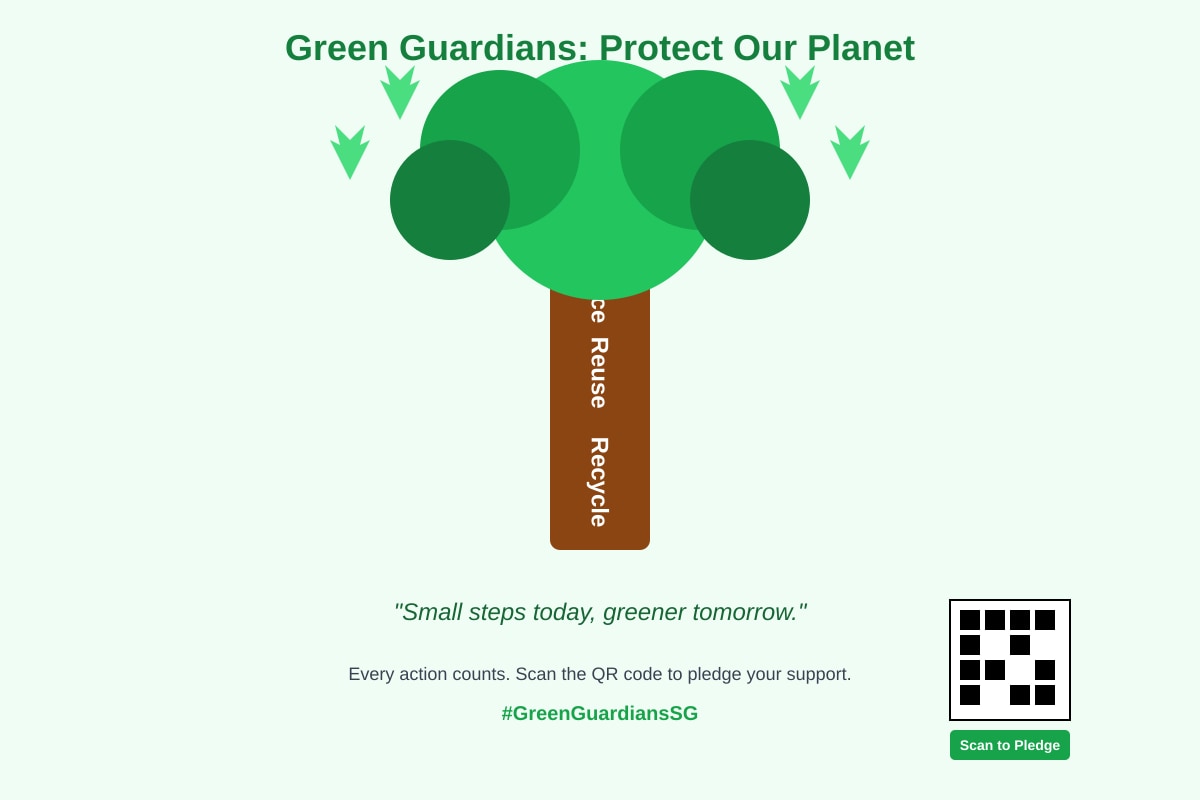
1. What is the main message conveyed by the tagline "Small steps today, greener tomorrow"? [1]
Answer: Individual actions taken now, no matter how small, contribute to a more sustainable and environmentally friendly future.
Marking note: Accept any answer that conveys the idea of present small actions leading to future environmental benefits. Do not accept answers that only explain "small steps" or "greener tomorrow" in isolation.
2. Identify two visual elements in the poster that symbolise collective action. [2]
Answer:
- The tree with leaves shaped like hands (representing many people coming together)
- The tagline "Join the Movement!" / The hashtag #GreenGuardiansSG (representing a community campaign)
Marking note: 1 mark each for any two valid visual elements with explanation of symbolism. Accept: hands as leaves, "Join the Movement", hashtag implying community, QR code for collective pledging.
3. The poster uses the hashtag #GreenGuardiansSG. What is the likely purpose of including this hashtag? [1]
Answer: To create a shared online identity for the campaign and encourage social media engagement / community building around the cause.
Marking note: Accept: to trend the campaign, to allow people to share posts, to build an online community, to track participation.
4. Which phrase in the poster serves as a direct call to action for the reader? [1]
Answer: "Scan the QR code to pledge your support" / "Join the Movement!"
Marking note: Accept either phrase. Must be quoted exactly from the poster.
SECTION B: NARRATIVE TEXT COMPREHENSION [20 marks]
5. From paragraph 1, write down two expressions that suggest the lighthouse is old and weathered. [2]
Answer:
- "whitewashed walls weathered by salt and wind"
- "over a century" / "Each step groaned under his weight" / "thick stone walls" / "spiral staircase" (any two)
Marking note: 1 mark each. Must be quoted as phrases/expressions, not single words. "Weathered" alone = 0 marks. "Whitewashed walls weathered by salt and wind" = 1 mark.
6. In paragraph 2, the writer describes the modern beacon as "efficient but soulless". Explain what this contrast suggests about Elias's feelings towards the change. [2]
Answer: Elias acknowledges the practical superiority of the modern beacon (efficient) but feels a sense of loss or nostalgia because it lacks the human connection, history, and warmth (soulless) that the old lighthouse represented.
Marking note: 1 mark for identifying the contrast (practical vs emotional), 1 mark for explaining Elias's mixed feelings (acceptance of progress but sadness at loss of heritage/connection).
7. Why does the writer describe the sea as a "slate-grey expanse" in paragraph 3? [2]
Answer: The description creates a dull, cold, and vast atmosphere that mirrors Elias's mood — sombre, reflective, and perhaps melancholic — while emphasising the sea's indifference to human history.
Marking note: 1 mark for identifying the mood/atmosphere (bleak, vast, cold), 1 mark for linking to Elias's internal state or the theme of nature's indifference.
8. From paragraph 3, identify one detail that shows the container ship does not rely on the lighthouse. [1]
Answer: "Its navigation lights blinking steadily" / "It did not need the lighthouse anymore."
Marking note: Must be a direct textual detail. Accept either.
9. In paragraph 4, the kestrel is described as hovering "motionless" yet its wings are "beating against the wind". Explain this apparent contradiction. [2]
Answer: The kestrel's body remains stationary in the air ("motionless") relative to the ground because its wing beats exactly counteract the wind's force, allowing it to maintain position while scanning for prey.
Marking note: 1 mark for explaining "motionless" refers to position relative to ground, 1 mark for explaining wing beats counteract wind. Accept: "hovering in place by flying into the wind".
10. Write down two expressions from paragraph 4 that emphasise the speed and precision of the kestrel's dive. [2]
Answer:
- "dropped like a stone"
- "pulled up sharply"
Marking note: 1 mark each. Must be quoted exactly. "Folded its wings" shows preparation but not speed/precision of the dive itself.
11. In paragraph 5, the photograph is described as having "edges frayed" and "colours faded to sepia". What do these details suggest about the photograph and its significance to Elias? [2]
Answer: The photograph is old and has been handled frequently, showing it is a treasured keepsake that Elias has looked at many times over the years, preserving a precious memory of his grandfather.
Marking note: 1 mark for age/condition (old, well-handled), 1 mark for emotional significance (treasured, precious memory).
12. Explain the significance of his grandfather's words: "But it's the keeper who keeps the light." [2]
Answer: The lighthouse beam (the light) is only effective because a dedicated person (the keeper) maintains it; this metaphorically suggests that values, traditions, or care require human commitment to endure, not just systems or technology.
Marking note: 1 mark for literal meaning (human maintenance essential), 1 mark for metaphorical significance (human dedication sustains what matters). Accept: responsibility, duty, human role in preserving heritage.
13. Why does Elias leave the oak door unlocked at the end of the passage? [2]
Answer: He wants the lighthouse to remain accessible, symbolising that its history and memories should not be shut away; it reflects his acceptance that while the lighthouse's function has changed, its significance endures and should be open to others.
Marking note: 1 mark for literal reason (accessibility), 1 mark for symbolic meaning (openness to memory/history/future visitors). Accept: "Some doors should remain open" shows he values connection over closure.
14. The passage explores the theme of change and continuity. Using details from the text, explain how the writer contrasts the old and the new throughout the passage. [4]
Answer:
- Old: Clockwork mechanism with "rhythmic click-click-whirr", Fresnel lens "painting the darkness with sweeping arcs", grandfather's stories and warmth, photograph with "sepia" tones.
- New: "Modern solar-powered beacon", "efficient but soulless", container ship with "navigation lights blinking steadily" that "did not need the lighthouse anymore".
- Continuity: The kestrel follows "ancient rhythms", Elias's memory and the photograph preserve the past, the unlocked door suggests the past remains accessible.
Marking note: 4: At least 3 clear contrasts with textual evidence, covering both technology and human elements.
Mark 3: 2–3 contrasts with some evidence.
Mark 2: 1–2 contrasts, limited evidence.
Mark 1: General statement without specific textual support.
Mark 0: No valid contrast identified.
SECTION C: NON-NARRATIVE TEXT COMPREHENSION [15 marks]
15. From paragraph 1, give two reasons why Singapore's food security is considered vulnerable. [2]
Answer:
- Limited land space for farming
- Heavy reliance on imported food (over 90% from overseas)
Marking note: 1 mark each. Must be from paragraph 1. Accept: "Disruptions caused by climate change, pandemics, and geopolitical tensions" as a third reason (but only 2 required).
16. In paragraph 2, the writer states that a vertical farm can produce "the equivalent yield of a traditional farm many times its size". What does this comparison emphasise about vertical farming? [2]
Answer: It emphasises the space efficiency and high productivity of vertical farming — it maximises output in a minimal footprint, making it ideal for land-scarce urban environments.
Marking note: 1 mark for "space efficiency" or "high yield in small space", 1 mark for linking to urban context/land scarcity.
17. Identify three challenges faced by urban farming mentioned in paragraph 3. [3]
Answer:
- High setup costs
- Energy consumption for artificial lighting
- Need for technical expertise
- Staple crops like rice and wheat not commercially viable indoors (any three)
Marking note: 1 mark each. Must be from paragraph 3.
18. Explain what the phrase "viewing food production as part of urban infrastructure, not a rural activity" (paragraph 4) means in the context of the passage. [2]
Answer: It means integrating farming into city planning and daily urban life (e.g., on rooftops, in schools, offices, housing estates) rather than seeing it as something that only happens in the countryside, so that food production becomes a normal, essential function of the city itself.
Marking note: 1 mark for "integrating farming into cities/urban life", 1 mark for contrast with rural-only mindset / making it essential urban infrastructure.
19. The final paragraph states: "When people grow food together, they grow stronger together." How does the passage support this claim? Use evidence from the text to support your answer. [3]
Answer:
- Urban farming "builds community cohesion" (explicitly stated).
- Schools, offices, and housing estates "integrating farming into daily life" brings people together in shared activity.
- "Reconnecting city dwellers with the source of their food" creates shared awareness and responsibility.
Marking note: 1 mark per point with textual evidence. Maximum 3 marks. Accept paraphrased evidence.
SECTION D: SUMMARY WRITING [10 marks]
20. Using your own words as far as possible, summarise the benefits and challenges of urban farming as described in the passage (Section C).
Write your summary in no more than 80 words, not counting the opening words provided below.
Urban farming offers a sustainable solution for land-scarce cities by using vertical systems and hydroponics to achieve high yields with minimal water and space. It strengthens food security, shortens supply chains, reduces transport emissions, and fosters community bonds. However, high initial costs, significant energy use for lighting, and the need for specialised skills hinder adoption. Staple crops remain unviable indoors, and current output meets only a small fraction of demand. (78 words)
Content points (for marking reference):
Benefits:
- High yield in small space / space-efficient (vertical farming)
- Uses 95% less water / minimal resources (hydroponics/aeroponics)
- Enhances food security / reduces import reliance
- Shortens supply chains
- Reduces carbon emissions from transport
- Builds community cohesion / reconnects people with food
Challenges:
7. High setup costs
8. High energy consumption (artificial lighting)
9. Requires technical expertise
10. Staple crops not commercially viable indoors
11. Currently contributes only a small fraction of food needs
Marking scheme (Content: 6 marks, Language: 4 marks):
- Content (6 marks): 1 mark per valid point (max 6). Must cover both benefits and challenges.
- Language (4 marks):
- 4: Excellent paraphrase, concise, fluent, within word limit
- 3: Good paraphrase, mostly fluent, within word limit
- 2: Some lifting, occasional awkwardness, within word limit
- 1: Heavy lifting, poor expression, may exceed word limit
- 0: Excessive lifting / incoherent / severely exceeds word limit
Word count note: Opening words "Urban farming offers" not counted. Summary above = 78 words. Exceeding 80 words: penalise language mark.
END OF ANSWER KEY