AI Generated Quiz
Secondary 1 Science Scientific Inquiry Quiz
Free Sec 1 Science Scientific Inquiry quiz, Nemo3 AI version, with questions, answers, and syllabus-aligned practice for Singapore students.
These static practice materials are generated from the site's syllabus and paper-generation workflow, with source and model context shown so students and parents can evaluate the material before use.
Questions

Free quiz and exam paper access
Enter your details to view this paper
Your access is remembered on this device.
Answers
Secondary 1 Science Quiz - Scientific Inquiry (Answer Key)
Total Marks: 40
Section A: Multiple Choice Questions (10 marks)
1. Answer: C [1]
Explanation: The readings (12.3, 12.5, 12.4 cm) are close to each other (precise) but far from the true value of 12.0 cm (not accurate). Precision refers to how close repeated measurements are to each other; accuracy refers to how close measurements are to the true value.
2. Answer: B [1]
Explanation: The independent variable is the one deliberately changed by the experimenter. In this investigation, the temperature of water is being changed to see its effect on the rate of dissolving. The dependent variable would be the time taken or rate of dissolving.
3. Answer: B [1]
Explanation: Parallax error occurs when the eye is not positioned perpendicular to the scale reading. Reading the top of the meniscus instead of the bottom is a classic parallax error. For water and most liquids, the correct reading is at the bottom of the meniscus.
4. Answer: C [1]
Explanation: Controlled variables are kept constant to ensure a fair test. The mass of the toy car must stay the same so that any change in speed is due only to the ramp height (independent variable). The height of the ramp is the independent variable, and the speed is the dependent variable.
5. Answer: A [1]
Working: Actual mass = Reading with beaker – Zero error reading = 52.3 g – 0.5 g = 51.8 g Explanation: A zero error means the instrument does not read zero when nothing is on it. This zero error must be subtracted from all subsequent readings.
6. Answer: A [1]
Working: Period = Total time / Number of oscillations = 38.4 s / 20 = 1.92 s Explanation: The period is the time for one complete oscillation. When measuring multiple oscillations, divide the total time by the number of oscillations to reduce reaction time error.
7. Answer: A [1]
Explanation: Set A (9.8, 9.9, 9.8, 9.9) shows values very close to each other (high precision) but consistently below the true value of 10.0 (low accuracy). Set B is both accurate and precise. Set C is neither. Set D is both accurate and precise.
8. Answer: B [1]
Explanation: A fair test requires changing only one variable (independent) at a time while keeping all others constant. This ensures that any observed change in the dependent variable can be attributed to the independent variable alone, establishing cause and effect.
9. Answer: A [1]
Working: Reading = Main scale + Thimble scale – Zero error = 4.5 mm + 0.28 mm – (+0.02 mm) = 4.76 mm Explanation: For a positive zero error, the zero error is subtracted from the observed reading. The micrometer reads 0.02 mm too high, so we subtract 0.02 mm.
10. Answer: C [1]
Explanation: The scientific method involves: observation, question, hypothesis, experiment design, data collection, analysis, conclusion, and communication (typically through scientific journals/reports, not newspapers). Publishing in a newspaper is not a formal step in the scientific method.
Section B: Structured Questions (18 marks)
11. (a) Independent variable: Concentration of salt solution [1]
Explanation: The variable deliberately changed by the experimenter.
(b) Dependent variable: Mass of potato strip (or change in mass) [1] Explanation: The variable measured in response to changes in the independent variable.
(c) Any two of: [2]
- Volume of salt solution
- Temperature of solution
- Time of soaking (30 minutes)
- Size/surface area of potato strips
- Type of potato used
- Initial mass of potato strips (should be similar) Explanation: Controlled variables must be kept constant to ensure a fair test. 1 mark each for any two valid variables.
(d) Suitable presentation: Table with columns for concentration, initial mass, final mass, and change in mass; or a line graph of change in mass against concentration [1] Explanation: Since the independent variable (concentration) is continuous numerical data, a line graph is most appropriate to show the trend. A table is also acceptable for recording raw data.
(e) Explanation: [2]
- Water moves into the potato cells by osmosis [1]
- The potato cells have a higher solute concentration (lower water potential) than the distilled water (0% salt solution) [1] Explanation: Osmosis is the movement of water molecules from a region of higher water potential (dilute solution) to lower water potential (concentrated solution) through a partially permeable membrane. The potato cells gain water and increase in mass.
12. (a) Average time = (0.62 + 0.65 + 0.63 + 0.64 + 0.66) / 5 = 3.20 / 5 = 0.64 s [1]
Explanation: Sum all readings and divide by the number of readings.
(b) Systematic error: An error that causes readings to be consistently shifted in one direction (all too high or all too low) due to a fault in the instrument or method. [1] Explanation: Unlike random errors which scatter readings randomly, systematic errors affect all measurements in the same way. Reaction time consistently makes the measured time longer than the actual time.
(c) Any one of: [1]
- Use a light gate and data logger instead of a stopwatch
- Measure time for more oscillations (e.g., 50 instead of 20) to reduce percentage error
- Use video recording with frame-by-frame analysis
- Have the same person start and stop the stopwatch to keep reaction time consistent Explanation: These methods reduce or eliminate human reaction time error.
(d) Accuracy: The average (0.64 s) matches the theoretical value (0.64 s), so the results are accurate. [1] Precision: The readings range from 0.62 to 0.66 s (range = 0.04 s), showing reasonable consistency, so the results are fairly precise. [1] Explanation: Accuracy refers to closeness to the true value. Precision refers to closeness of repeated measurements to each other. The small spread indicates good precision; the match with theoretical value indicates good accuracy.
13. (a) Hypothesis: As light intensity increases (lamp distance decreases), the rate of photosynthesis increases. [1]
Explanation: A hypothesis is a testable prediction stating the expected relationship between variables.
(b) Independent variable: Distance of lamp from plant (or light intensity) [1] Dependent variable: Number of bubbles per minute (rate of photosynthesis) [1] Explanation: The independent variable is changed; the dependent variable is measured.
(c) Any two of: [2]
- Type/species of water plant
- Mass/length of plant
- Volume of water
- Temperature of water
- Concentration of CO₂ (e.g., add sodium hydrogen carbonate)
- Time of counting bubbles (1 minute) Explanation: These must be kept constant to ensure only light intensity affects the rate.
(d) As the distance of the lamp from the plant increases, the number of bubbles per minute decreases (rate of photosynthesis decreases). [1] Explanation: The data shows a clear decreasing trend: 48 → 32 → 20 → 12 → 6 bubbles/min as distance increases from 10 to 50 cm.
(e) Explanation: [2]
- Light provides energy for photosynthesis; higher light intensity provides more energy [1]
- More energy allows more water molecules to be split (photolysis), producing more oxygen bubbles [1] Explanation: Light intensity is a limiting factor for photosynthesis. At low light intensity, the rate is limited by the amount of light energy available for the light-dependent reactions.
14. (a) Volume of stone = Final reading – Initial reading = 68 cm³ – 50 cm³ = 18 cm³ [1]
Explanation: The displacement method measures volume by the amount of water displaced.
(b) Density = Mass / Volume = 54 g / 18 cm³ = 3.0 g/cm³ [2] Working: 1 mark for correct formula/substitution, 1 mark for correct answer with units. Explanation: Density is mass per unit volume. Units must be consistent (g and cm³ gives g/cm³).
(c) Variation may be due to: [1]
- Parallax error when reading the meniscus
- Water splashing or droplets on the stone affecting the reading
- Stone not fully submerged or touching the sides
- Random fluctuations in reading the measuring cylinder Explanation: Random errors cause scatter in repeated measurements. The displacement method is sensitive to reading technique and water surface effects.
Section C: Data Analysis and Experimental Design (12 marks)
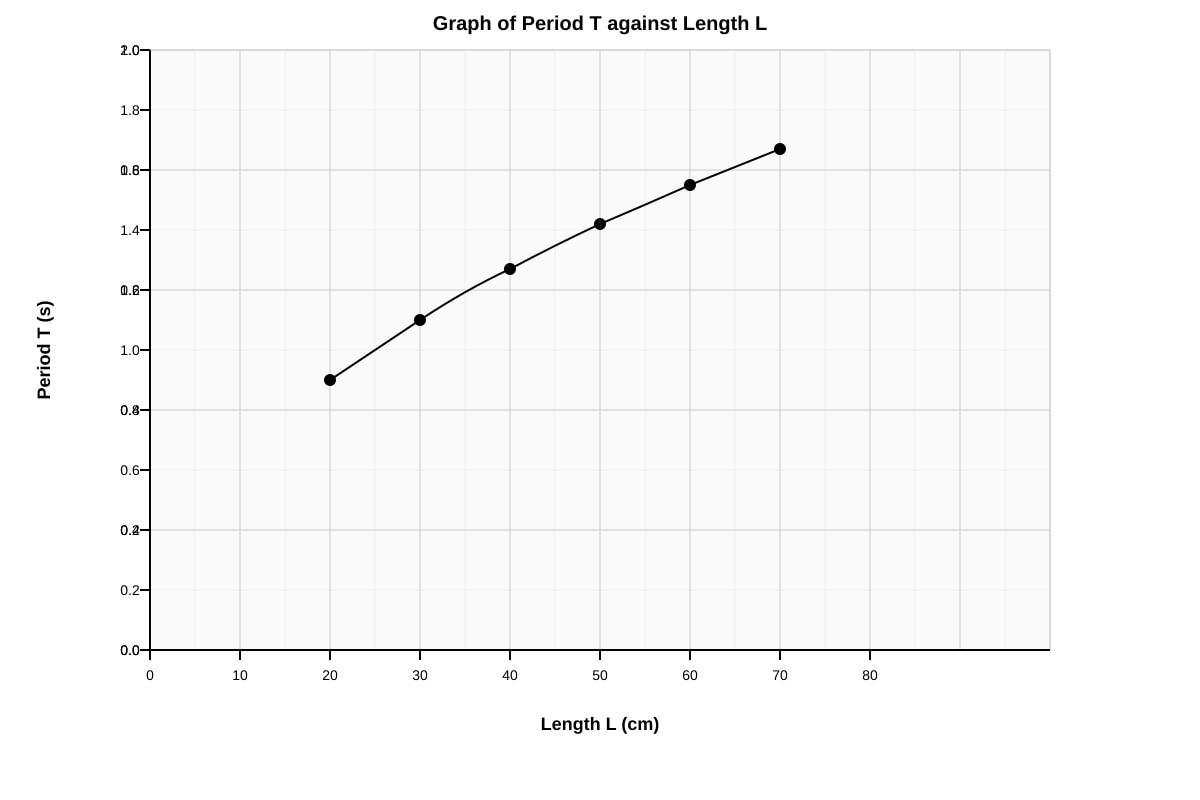
15. (a) Period calculations: [1]
- 40 cm: 25.4 / 20 = 1.27 s ✓
- 50 cm: 28.4 / 20 = 1.42 s ✓
- 60 cm: 31.0 / 20 = 1.55 s ✓
- 70 cm: 33.4 / 20 = 1.67 s ✓ Marking: 1 mark for all four correct (allow 1 error for 0 marks).
(b) Graph requirements: [3]
- Axes labeled with units: x-axis "Length L (cm)", y-axis "Period T (s)" [1]
- Appropriate scales using >50% of grid, points plotted correctly [1]
- Smooth curve of best fit (not straight line) [1] Explanation: The relationship is T ∝ √L, so the graph should be a curve increasing with decreasing gradient.
(c) As the length of the pendulum increases, the period increases. The relationship is not linear; period increases with the square root of length (T ∝ √L). [1] Explanation: The period of a simple pendulum is given by T = 2π√(L/g). The graph curves upward but with decreasing slope.
(d) From graph: At L = 45 cm, T ≈ 1.34 – 1.36 s [1] Explanation: Read from the candidate's graph at 45 cm. Accept values consistent with their plotted curve.
(e) New investigation variables: [3]
- Independent variable: Mass of pendulum bob
- Dependent variable: Period of pendulum (time for one oscillation)
- Controlled variables (any three): Length of pendulum, angle of release (amplitude), number of oscillations timed, gravitational field strength (same location), same string/rod Explanation: To test the effect of mass, only mass should change. Length must be constant because it affects period. Angle should be small and constant.
16. (a) Density calculations: [3]
Liquid A: Mass of liquid = 95.0 – 45.0 = 50.0 g; Density = 50.0 g / 50 cm³ = 1.00 g/cm³ [1] Liquid B: Mass of liquid = 115.0 – 45.0 = 70.0 g; Density = 70.0 g / 50 cm³ = 1.40 g/cm³ [1] Liquid C: Mass of liquid = 80.0 – 45.0 = 35.0 g; Density = 35.0 g / 50 cm³ = 0.70 g/cm³ [1] Marking: 1 mark each for correct mass and density with units.
(b) Order from top to bottom: C (0.70 g/cm³), A (1.00 g/cm³), B (1.40 g/cm³) [1] Explanation: Less dense liquids float on denser liquids. The liquid with the lowest density (C) will be at the top, highest density (B) at the bottom.
(c) Corrected mass of cylinder + liquid B = 115.0 – 2.0 = 113.0 g [1] Corrected mass of liquid B = 113.0 – 45.0 = 68.0 g [1] Corrected density = 68.0 g / 50 cm³ = 1.36 g/cm³ [1] Wait - recheck marks allocation: The question asks for 2 marks. Let's adjust:
- Corrected mass of liquid: 115.0 – 2.0 – 45.0 = 68.0 g [1]
- Corrected density: 68.0 / 50 = 1.36 g/cm³ [1] Total 2 marks. The zero error of +2.0 g means all readings are 2.0 g too high, so subtract 2.0 g.
17. Experimental Design for Parachute Investigation [11 marks total]
Hypothesis: [1]
- As the surface area of the parachute increases, the time taken to fall a fixed distance increases (or: larger surface area → longer fall time / slower descent).
Variables: [2]
- Independent: Surface area of parachute (e.g., 100 cm², 200 cm², 300 cm², 400 cm², 500 cm²)
- Dependent: Time taken to fall a fixed distance (e.g., 2 m)
Controlled variables (any three): [3]
- Mass of parachute + load (use same weight attached)
- Height of drop (fixed distance)
- Shape of parachute (all circular or all square)
- Material of parachute (same type of plastic bag/fabric)
- No wind / still air conditions
- Same method of release
Procedure (4-5 steps): [3]
- Cut parachutes of different surface areas from the same material (e.g., plastic bags).
- Attach identical strings and the same mass (load) to each parachute.
- Hold the parachute at a fixed height (e.g., 2 m) and release it.
- Use a stopwatch to measure the time taken to reach the ground.
- Repeat each surface area 3 times and calculate the average time.
Reliability: [1]
- Repeat each measurement at least 3 times and calculate the average.
- Or: Use a light gate / video analysis for more precise timing.
Presentation of results: [1]
- Table with columns: Surface area (cm²), Time 1 (s), Time 2 (s), Time 3 (s), Average time (s)
- Graph: Line graph of average time (y-axis) against surface area (x-axis)
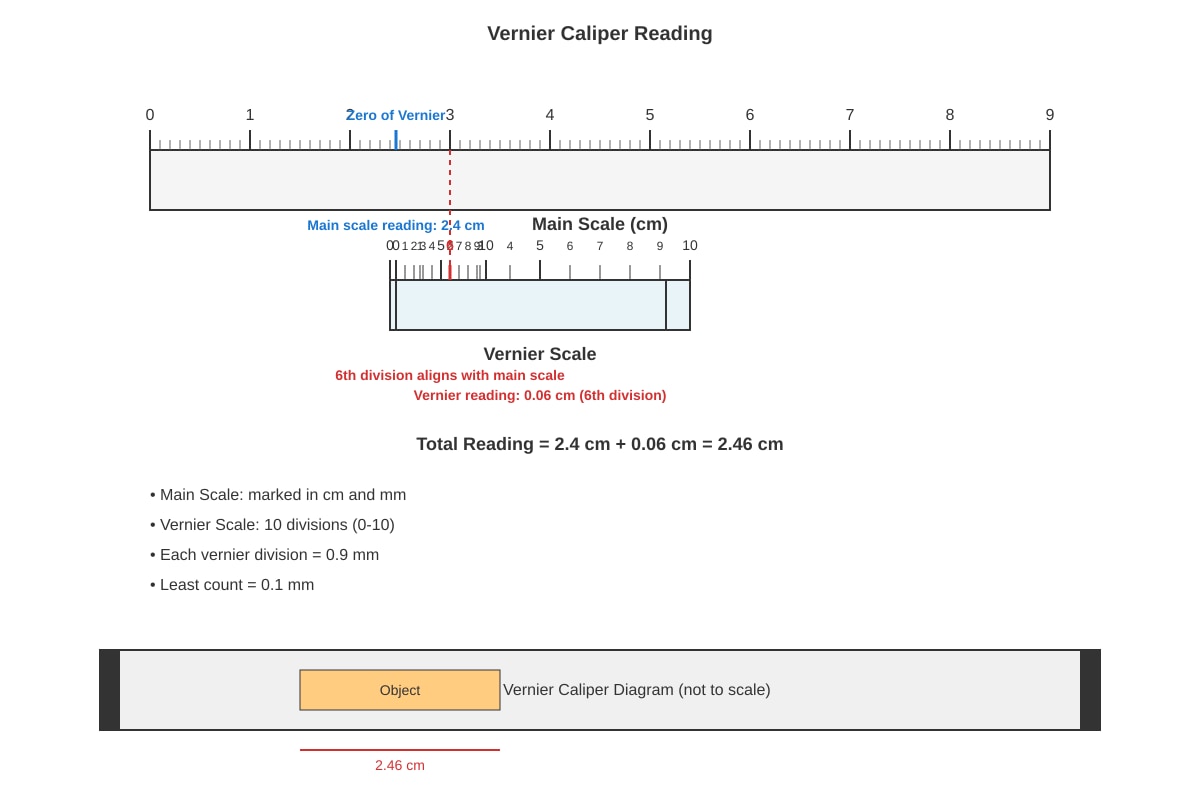
18. (a) Reading = Main scale reading + Vernier scale reading = 2.4 cm + 0.06 cm = 2.46 cm [1]
Explanation: Main scale: zero of vernier is past 2.4 cm but before 2.5 cm → 2.4 cm. Vernier: 6th division aligns → 6 × 0.01 cm = 0.06 cm (assuming 0.01 cm least count).
(b) Corrected reading = Observed reading – Zero error = 2.46 cm – (–0.03 cm) = 2.46 cm + 0.03 cm = 2.49 cm [1] Explanation: Negative zero error means the instrument reads lower than actual. Subtracting a negative error adds the correction.
(c) Positive zero error: When the jaws are closed, the zero of the vernier scale is to the right of the main scale zero. Readings are larger than actual; correction is subtracted. [1] Negative zero error: When the jaws are closed, the zero of the vernier scale is to the left of the main scale zero. Readings are smaller than actual; correction is added. [1] Explanation: Zero error occurs when the instrument does not read zero when the jaws are closed. Positive = reads positive when closed; negative = reads negative when closed.
19. (a) Any two of: [2]
- Volume of water (100 cm³)
- Initial temperature (80°C)
- Room temperature / ambient conditions
- Type/size/shape of beaker (for first experiment)
- No stirring / consistent stirring method
- Same thermometer
(b) The graph shows a steep temperature drop initially, which gradually becomes less steep, approaching room temperature asymptotically (curved line decreasing with decreasing gradient). [1] Explanation: Cooling follows Newton's Law of Cooling: rate of cooling is proportional to temperature difference with surroundings. Largest difference at start → fastest cooling.
(c) Prediction: The cooling curve for the polystyrene cup will be less steep (cooling slower) than for the beaker. [1] Explanation: Polystyrene is a better insulator (traps air) than glass/beaker material, reducing heat loss by conduction and convection. [1]
(d) Source of random error: [1]
- Parallax error reading thermometer
- Slight variations in room temperature / draughts
- Inconsistent stirring
- Reaction time in reading at exact minute intervals
How to minimise: [1]
- Use a digital temperature probe / data logger for continuous recording
- Conduct in a draught-free environment
- Stir gently and consistently / use magnetic stirrer
- Read thermometer at eye level
20. (a) Independent variable: Type of insulating material [1]
Dependent variable: Temperature after 10 minutes (or temperature drop) [1]
(b) Any three of: [3]
- Volume of water (100 cm³)
- Initial temperature (80°C)
- Size/shape/material of beakers
- Thickness/layers of insulation (should be same for all)
- Time of cooling (10 minutes)
- Room temperature / environment
- Same thermometer
(c) Best insulator: Bubble wrap [1] Explanation: Bubble wrap shows the highest temperature after 10 minutes (65°C), meaning it lost the least heat (smallest temperature drop of 15°C). The control (no insulation) dropped to 52°C (drop of 28°C). [1] Marking: 1 mark for correct identification, 1 mark for explanation using data comparison.
(d) The control (no insulation) provides a baseline to compare the effectiveness of each insulating material. It shows how much the temperature would drop without any insulation, allowing the student to determine if a material actually reduces heat loss. [1] Explanation: A control experiment isolates the effect of the independent variable by showing the result when the variable is absent (no insulation).