AI Generated Quiz
Secondary 1 Science Scientific Inquiry Quiz
Free Sec 1 Science Scientific Inquiry quiz, Claude AI version, with questions, answers, and syllabus-aligned practice for Singapore students.
These static practice materials are generated from the site's syllabus and paper-generation workflow, with source and model context shown so students and parents can evaluate the material before use.
Questions
Free quiz and exam paper access
Enter your details to view this paper
Your access is remembered on this device.
Answers
Secondary 1 Science Quiz - Scientific Inquiry (Answer Key)
Total Marks: 40
Section A: Experimental Design and Variables [20 marks]
1. State a suitable hypothesis for investigating how ramp height affects toy car distance. [1 mark]
Answer: If the height of the ramp increases, then the distance the toy car travels will increase. Alternative acceptable answers: Higher ramps will make the car travel further / The greater the ramp height, the greater the distance traveled. Mark scheme: [1] for testable hypothesis linking ramp height to distance traveled
2. Identify variables: [3 marks] (a) Independent variable: Height of the ramp / Ramp height [1] (b) Dependent variable: Distance traveled by the car / Distance the car travels [1] (c) Controlled variable: Type/mass of car, surface material, starting position, ramp material, angle of release [1]
3. Explain importance of controlling variables. [2 marks]
Answer: To ensure that only the independent variable affects the dependent variable [1]. This makes the test fair and allows valid conclusions to be drawn about the relationship being investigated [1]. Mark scheme: [1] for fair test concept, [1] for valid conclusions/reliability
4. Plant growth experiment: [2 marks] (a) Controlled factor: Amount of water, light intensity, temperature, pot size, seed type, amount of soil [1] (b) Improve reliability: Repeat the experiment / Use more plants / Take multiple measurements / Use identical conditions [1]
5. Photosynthesis experiment: [2 marks] (a) Measure rate: Count oxygen bubbles per minute / Measure volume of gas produced per unit time [1] (b) Wait 5 minutes: Allow the plant to adjust to new light conditions / Reach steady state / Equilibrate [1]
6. Paper towel investigation: [3 marks] (a) Measure: Volume/amount of water absorbed, time to absorb set amount, mass of water absorbed [1] (b) Keep same: Size of paper towel, type of water, temperature, method of testing [1] (c) Improve reliability: Repeat tests, use multiple samples of each brand, take average [1]
7. Accuracy vs precision: [2 marks]
Accuracy: How close a measurement is to the true/actual value [1] Precision: How close repeated measurements are to each other / consistency of measurements [1]
8. Measurement error: [3 marks] (a) Error calculation: 5.7 - 5.2 = 0.5 cm [1] (b) Type: Systematic error [1] Reason: The error is consistent in one direction / always overestimating / could be due to incorrect ruler calibration [1]
Section B: Data Analysis and Interpretation [12 marks]
9. Sugar dissolving experiment: [3 marks] (a) Relationship: As temperature increases, dissolving time decreases / Inverse relationship / Higher temperature leads to faster dissolving [1] (b) Prediction: Approximately 25-30 seconds [1] Reasoning: The pattern shows decreasing time with increasing temperature / Following the trend [1]
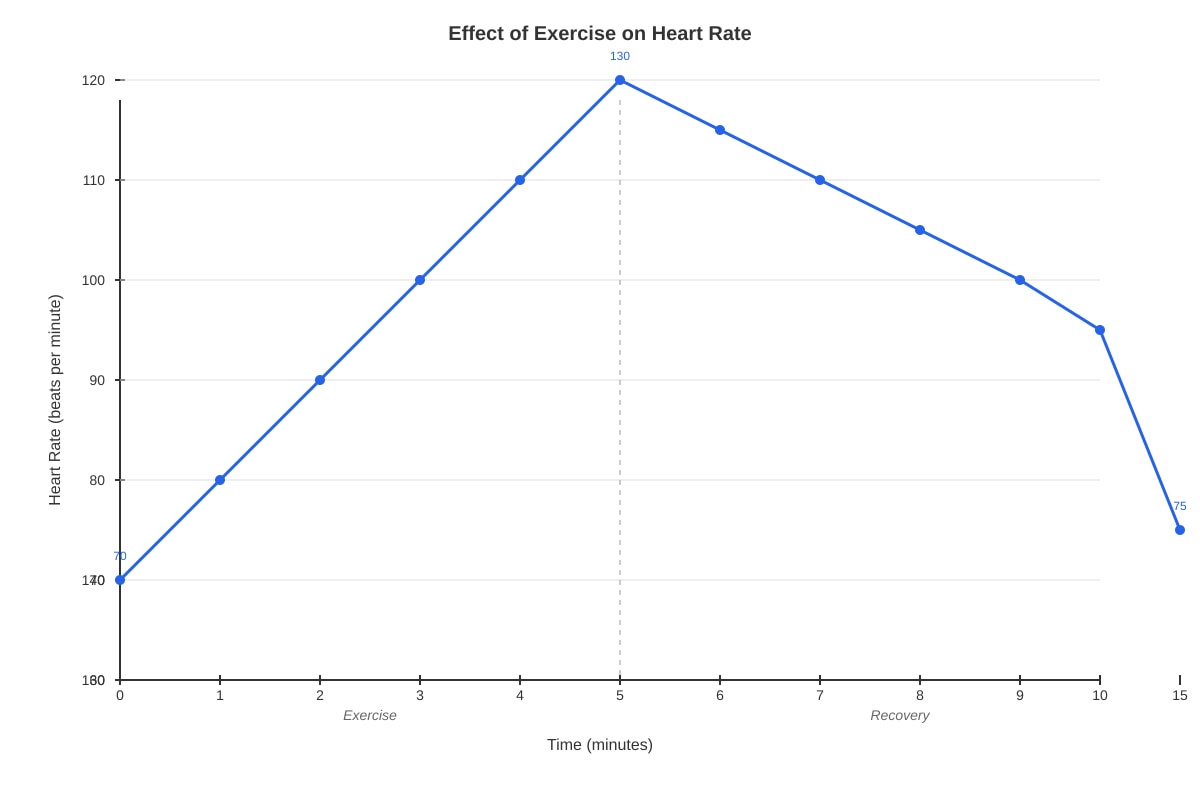
10. Heart rate during exercise: [6 marks] (a) Before exercise: 70 beats per minute [1] (b) Maximum heart rate: 130 beats per minute [1] (c) Return to normal: 10 minutes [1] (d) Explanation: Muscles need more oxygen during exercise [1], so heart pumps faster to deliver oxygen-rich blood to muscles [1]
11. Thermal insulator test - controlled factors: [2 marks]
Possible answers:
- Initial temperature of water [1]
- Volume of water [1]
- Size/type of container [1]
- Thickness of insulating material [1]
- Room temperature [1]
- Time intervals for measurement [1] Mark scheme: Any two appropriate factors [2]
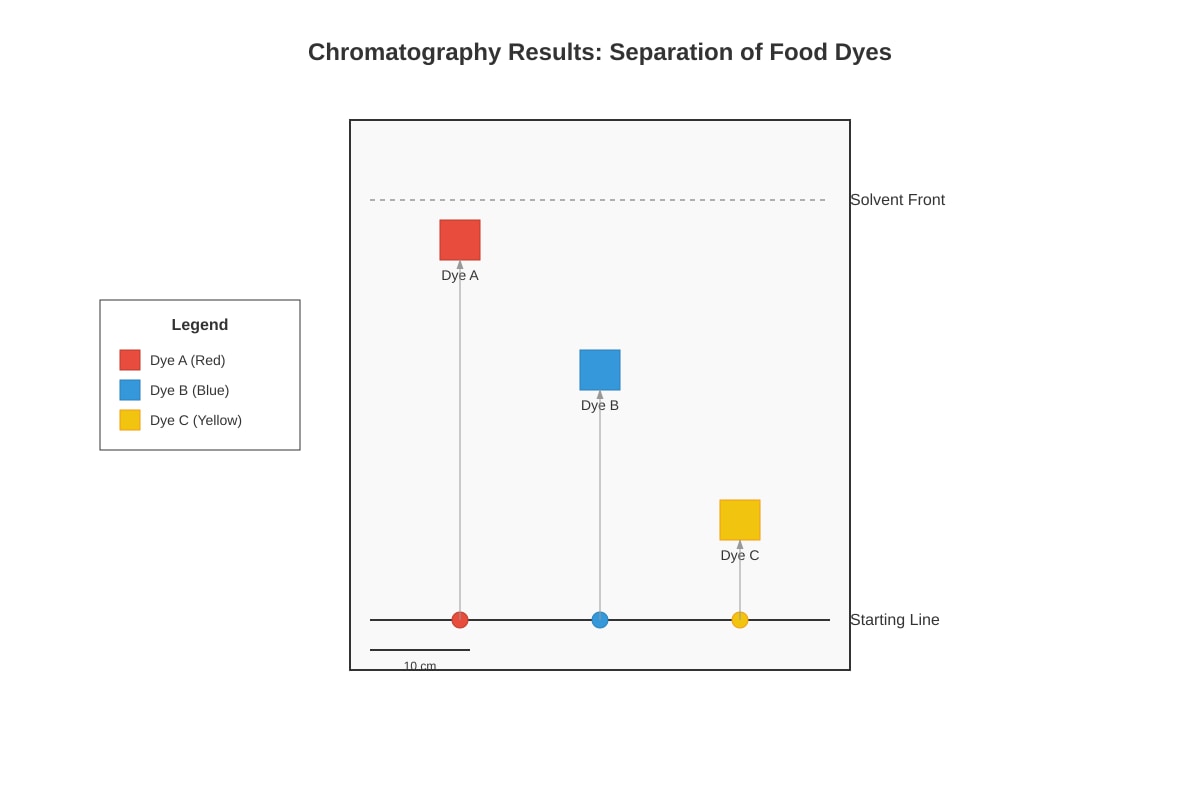
12. Chromatography results: [3 marks] (a) Furthest traveled: Accept identification of the dye that moved highest up the paper [1] (b) Explanation: Different dyes have different solubilities in the solvent [1], so they move at different rates up the paper [1]
Section C: Scientific Method and Evaluation [8 marks]
13. Unreliable plant conclusion: [3 marks] (a) Two reasons:
- Small sample size / Only two plants used [1]
- No repetition / Only one experiment [1]
- No control of other variables [1]
- May have other factors affecting growth [1] Mark scheme: Any two appropriate reasons [2]
(b) Improvement: Use more plants / Repeat the experiment / Control other variables / Use proper controls [1]
14. Observation vs inference: [3 marks]
Observation: Something you can see/detect directly with your senses / factual statement [1] Example: The plant is 10 cm tall / The liquid is blue / Accept any appropriate example [0.5]
Inference: A conclusion based on observations / interpretation of what you observe [1] Example: The plant is healthy / The liquid contains copper sulfate / Accept any appropriate example [0.5]
15. Testing falling objects hypothesis: [3 marks] (a) Experiment: Drop objects of different masses from the same height and measure time taken to fall / Use stopwatch to time different weighted objects [2] (b) Supporting result: Heavier objects would take less time to fall / Heavier objects would fall faster [1]
16. Computer simulation vs real experiment: [2 marks]
Advantage: Safer / Can control all variables perfectly / Faster / Can repeat easily / No equipment needed [1] Disadvantage: May not represent real conditions / Less accurate / Cannot account for all real factors [1]
17. Measuring mass before and after reaction: [1 mark]
Answer: To check if mass is conserved / To see if the reaction follows the law of conservation of mass / To detect if any gas is produced or lost [1]
18. Safety precaution for acid experiment: [1 mark]
Answer: Wear safety goggles / Use gloves / Work in ventilated area / Have water nearby for spills / Wear lab coat [1]
19. Repeated experiment results: [2 marks] (a) Term: Precise / Precision / Consistent [1] (b) Reason: Human error in measurement / Equipment limitations / Environmental changes / Random errors [1]
20. Why scientists publish methods and results: [2 marks]
Answer: So other scientists can check/verify the work [1] and build on the research / allow peer review / share knowledge [1]
Marking Notes:
- Accept equivalent scientific terminology
- Award marks for clear understanding even if wording differs slightly
- For calculation questions, award method marks even if final answer is incorrect
- Encourage use of appropriate units where applicable