AI Generated Quiz
Secondary 1 Science Physical Sciences Quiz
Free Sec 1 Science Physical Sciences quiz, Nemo3 AI version, with questions, answers, and syllabus-aligned practice for Singapore students.
These static practice materials are generated from the site's syllabus and paper-generation workflow, with source and model context shown so students and parents can evaluate the material before use.
Questions


Free quiz and exam paper access
Enter your details to view this paper
Your access is remembered on this device.
Answers
Secondary 1 Science Quiz - Physical Sciences (Answer Key)
Total Marks: 40
Section A: Multiple Choice Questions (10 marks)
1. Answer: B [1]
Explanation: When a student lifts a book, chemical energy stored in the muscles is converted to gravitational potential energy of the book. The book gains height, so its gravitational potential energy increases. The energy comes from the chemical energy in the student's body.
2. Answer: B [1]
Explanation: Work done = Force × Distance moved in the direction of the force. When holding a weight stationary, there is no displacement (distance = 0), so no work is done on the object, even though a force is applied. In all other options, the object moves in the direction of the force (or a component of it).
3. Answer: C [1]
Working: Work done = Force × Distance = 25 N × 4 m = 100 J
4. Answer: D [1]
Working: By conservation of energy, loss in GPE = Gain in KE.
GPE lost = mgh = 2 kg × 10 N/kg × 5 m = 100 J
Therefore, KE just before hitting ground = 100 J
5. Answer: A [1]
Explanation: A compressed spring stores elastic potential energy. When released, this elastic potential energy is converted into kinetic energy of the toy car.
6. Answer: C [1]
Working:
Work output = Load × Load distance = 500 N × 2 m = 1000 J
Work input = Effort × Effort distance = 200 N × 6 m = 1200 J
Efficiency = (Work output / Work input) × 100% = (1000 / 1200) × 100% = 83.3%
7. Answer: C [1]
Explanation: When a car brakes, friction between the brake pads and wheels (and between tyres and road) converts the car's kinetic energy into thermal energy (heat). This is why brakes get hot.
8. Answer: C [1]
Explanation: Work done against gravity = Weight × Vertical height = mgh. It depends on mass (m), gravitational field strength (g), and vertical height (h). Time taken does not affect the work done against gravity (though it affects power).
9. Answer: B [1]
Explanation: At the lowest point (Position B), all gravitational potential energy has been converted to kinetic energy (ignoring air resistance). At the highest points (A and C), the pendulum momentarily stops, so KE = 0 and GPE is maximum.
10. Answer: B [1]
Explanation: Power is defined as the rate of doing work, or work done per unit time. Unit: Watt (W) = Joule per second (J/s).
Section B: Structured Questions (18 marks)
11. Weightlifter Question
(a) Weight = mg = 120 kg × 10 N/kg = 1200 N [1]
(b) Work done = Force × Distance = Weight × Height = 1200 N × 2.0 m = 2400 J [2]
Mark breakdown: 1 mark for correct formula/substitution, 1 mark for correct answer with unit
(c) Power = Work done / Time = 2400 J / 1.5 s = 1600 W [2]
Mark breakdown: 1 mark for correct formula/substitution, 1 mark for correct answer with unit
(d) Work done = 0 J [1]
Explanation: The barbell is stationary (no displacement in the direction of the force). Work done = Force × Distance moved in direction of force. Since distance = 0, work done = 0. [1]
Common mistake: Students often think holding a heavy object involves work because it feels tiring. However, in physics, work requires displacement.
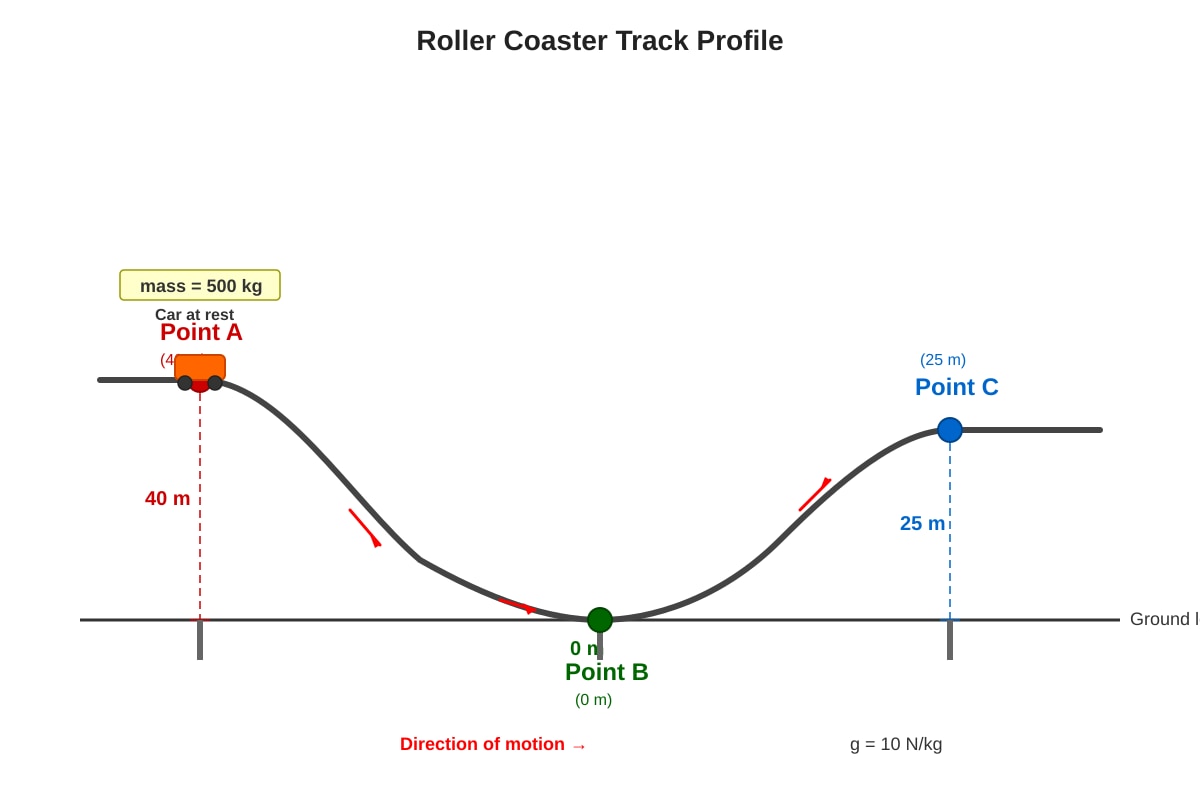
12. Roller Coaster Question
(a) GPE at A = mgh = 500 kg × 10 N/kg × 40 m = 200,000 J (or 200 kJ) [1]
(b) At Point B (ground level), all GPE has been converted to KE (ignoring friction).
KE at B = GPE at A = 200,000 J [1]
(c) KE = ½mv²
200,000 = ½ × 500 × v²
200,000 = 250 × v²
v² = 800
v = √800 = 28.3 m/s (or 20√2 m/s) [2]
Mark breakdown: 1 mark for correct formula and substitution, 1 mark for correct answer with unit
(d) GPE at C = mgh = 500 kg × 10 N/kg × 25 m = 125,000 J (or 125 kJ) [1]
(e) Total energy = 200,000 J (conserved)
KE at C = Total energy - GPE at C = 200,000 - 125,000 = 75,000 J [1]
(f) The total mechanical energy of the car is conserved (ignoring friction/air resistance) and equals the initial GPE at Point A (200,000 J). At any height h, GPE = mgh. For the car to reach a height greater than 40 m, its GPE would need to exceed 200,000 J, which would require more total energy than it started with. Without additional energy input (e.g., a motor/chain lift), this violates the principle of conservation of energy. [2]
Mark breakdown: 1 mark for mentioning conservation of energy, 1 mark for explaining that height > 40 m would require GPE > initial total energy
13. Block on Rough Table Question
(a) Net force = Applied force - Frictional force = 30 N - 10 N = 20 N [1]
(b) F = ma → a = F/m = 20 N / 4 kg = 5 m/s² [1]
(c) Work done by applied force = Force × Distance = 30 N × 5 m = 150 J [1]
(d) Work done against friction = Frictional force × Distance = 10 N × 5 m = 50 J [1]
(e) By work-energy theorem: Net work done = Gain in KE
Net work = Work by applied force - Work against friction = 150 J - 50 J = 100 J
Alternatively: Gain in KE = Net force × Distance = 20 N × 5 m = 100 J [2]
Mark breakdown: 1 mark for correct method (net work or work-energy theorem), 1 mark for correct answer with unit
(f) On a frictionless surface, no work is done against friction. The work done by the applied force (150 J) would all be converted to kinetic energy. The final kinetic energy would be greater (150 J vs 100 J). [1]
Explanation: Without friction, there is no energy dissipated as heat. All work done by the applied force goes into kinetic energy. With friction, some work is "wasted" overcoming friction and converted to thermal energy. [1]
14. Hydroelectric Power Station Question
(a) GPE lost = mgh = 500 kg × 10 N/kg × 80 m = 400,000 J (or 400 kJ) [2]
Mark breakdown: 1 mark for correct formula and substitution, 1 mark for correct answer with unit
(b) Power = Energy per second = 400,000 J/s = 400,000 W (or 400 kW) [1]
(c) Efficiency = (Useful output power / Input power) × 100%
= (320,000 W / 400,000 W) × 100% = 80% [2]
Mark breakdown: 1 mark for correct formula and substitution, 1 mark for correct answer with %
(d) Reason 1: Energy lost as heat due to friction in turbines and generators. [1]
Reason 2: Energy lost as sound and kinetic energy of water exiting turbines / incomplete conversion of water's kinetic energy to electrical energy. [1]
Other acceptable reasons: Electrical resistance in cables, heat in generator coils, turbulence in water flow
(e) Kinetic energy of falling water → Electrical energy (via turbines and generators) [1]
Acceptable: Gravitational potential energy → Kinetic energy → Electrical energy
(f) The power input would double (to 800 kW). [1]
Explanation: Power input = (mass per second) × g × h. Doubling the mass flow rate doubles the energy per second, hence doubles the power.
15. Bouncing Ball Experiment Question
(a) Graph plotting [3]
Mark breakdown:
- 1 mark: Axes labelled correctly with units (Drop Height/cm on x-axis, Bounce Height/cm on y-axis), suitable scales, origin at (0,0)
- 1 mark: All 5 points plotted correctly (± half a small square)
- 1 mark: Best-fit straight line drawn through points (passing through or near origin, balanced points above/below)
Data points: (20,12), (40,24), (60,36), (80,48), (100,60)
Relationship: Bounce height = 0.6 × Drop height (directly proportional)
(b) The bounce height is directly proportional to the drop height. As drop height increases, bounce height increases at a constant rate (ratio of 0.6:1 or 3:5). [1]
(c) When the ball hits the floor, some kinetic energy is converted to thermal energy (heat) and sound energy due to deformation of the ball and floor, and air displacement. This energy is dissipated to the surroundings and is not available to be converted back to gravitational potential energy. [2]
Mark breakdown: 1 mark for identifying energy conversions to heat/sound, 1 mark for explaining energy is dissipated/lost to surroundings
(d) From graph: at drop height 50 cm, bounce height = 30 cm [1]
Accept range 29-31 cm if read from graph
(e) The squash ball is less elastic / has a lower coefficient of restitution than the tennis ball. More kinetic energy is converted to heat/sound on impact, so less is available for the bounce. [1]
Section C: Longer Structured Questions (12 marks)
16. Crane Question
(a) At constant speed, net force = 0. Tension = Weight = mg = 2000 kg × 10 N/kg = 20,000 N [1]
(b) Power = Force × Velocity = Tension × Speed = 20,000 N × 0.5 m/s = 10,000 W (or 10 kW) [2]
Mark breakdown: 1 mark for correct formula (P = Fv), 1 mark for correct answer with unit
(c) Efficiency = (Useful power output / Power input) × 100% = (10,000 W / 15,000 W) × 100% = 66.7% [2]
Mark breakdown: 1 mark for correct formula and substitution, 1 mark for correct answer with %
(d) Work done = Force × Distance = Tension × Height = 20,000 N × 12 m = 240,000 J (or 240 kJ) [2]
Mark breakdown: 1 mark for correct formula and substitution, 1 mark for correct answer with unit
(e) As the block falls: Gravitational potential energy → Kinetic energy. Just before impact, all GPE is converted to KE. Upon hitting the ground, kinetic energy is converted to thermal energy (heat), sound energy, and energy used to deform the ground/block. [2]
Mark breakdown: 1 mark for GPE → KE during fall, 1 mark for KE → heat/sound/deformation on impact
17. Spring-Loaded Toy Gun Question
(a) Elastic PE = ½kx² = ½ × 400 N/m × (0.05 m)² = 200 × 0.0025 = 0.5 J [2]
Mark breakdown: 1 mark for correct formula and substitution, 1 mark for correct answer with unit
(b) At max height, Elastic PE = GPE gained
0.5 J = mgh = 0.02 kg × 10 N/kg × h
0.5 = 0.2 × h
h = 0.5 / 0.2 = 2.5 m [2]
Mark breakdown: 1 mark for equating elastic PE to GPE, 1 mark for correct answer with unit
(c) Air resistance acts on the pellet, converting some kinetic energy to thermal energy. Also, not all elastic PE is transferred to the pellet (some remains as kinetic energy of spring/heat in spring). [1]
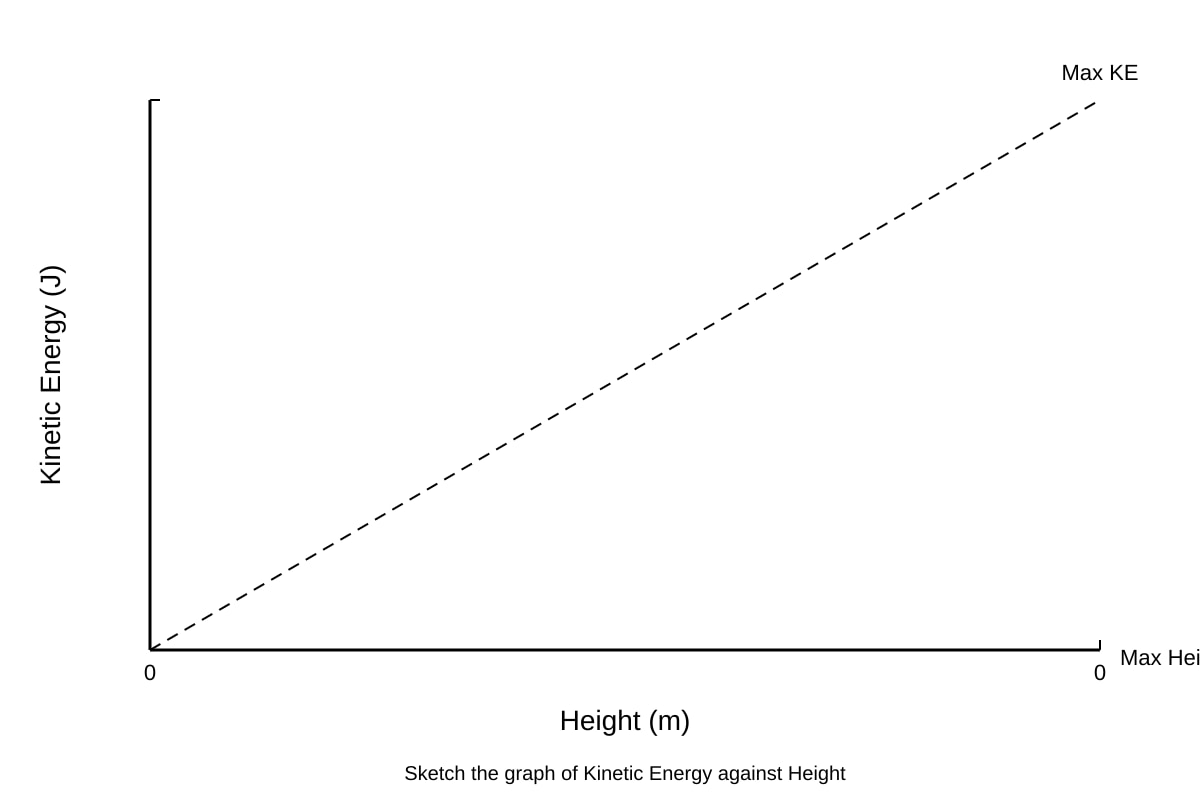
(d) Graph sketch: Straight line starting at (0, 0.5 J) on y-axis (max KE at launch height) and decreasing linearly to (2.5 m, 0 J) on x-axis (zero KE at max height). Axes labelled with units. [2]
Mark breakdown: 1 mark for correct shape (straight line decreasing), 1 mark for correct intercepts labelled (0.5 J at height 0, 0 J at 2.5 m)
18. Student Running Up Stairs Question
(a) Work done against gravity = mgh = 60 kg × 10 N/kg × 3.0 m = 1800 J [2]
Mark breakdown: 1 mark for correct formula and substitution, 1 mark for correct answer with unit
(b) Power = Work done / Time = 1800 J / 4.0 s = 450 W [2]
Mark breakdown: 1 mark for correct formula and substitution, 1 mark for correct answer with unit
(c) Efficiency = Useful power output / Chemical power input
0.25 = 450 W / Chemical power input
Chemical power input = 450 W / 0.25 = 1800 W [2]
Mark breakdown: 1 mark for correct formula rearrangement, 1 mark for correct answer with unit
(d) Work done against gravity remains the same (1800 J) because it depends only on weight and vertical height, not time. [1]
Power developed decreases (to 1800 J / 12 s = 150 W) because the same work is done over a longer time. [1]
19. Simple Pendulum Question
(a) Vertical height = L - L cos θ = 1.0 m - (1.0 m × cos 30°) = 1.0 - 0.866 = 0.134 m (or 1 - √3/2 m) [2]
Mark breakdown: 1 mark for correct method (h = L(1 - cos θ)), 1 mark for correct answer with unit
(b) GPE gained = mgh = 0.5 kg × 10 N/kg × 0.134 m = 0.67 J [1]
(c) Maximum KE = GPE at release point (conservation of energy) = 0.67 J [1]
(d) KE = ½mv² → 0.67 = ½ × 0.5 × v² → 0.67 = 0.25 v² → v² = 2.68 → v = 1.64 m/s [2]
Mark breakdown: 1 mark for correct formula and substitution, 1 mark for correct answer with unit
(e) Air resistance and friction at the pivot convert mechanical energy to thermal energy, causing the total energy to decrease until the pendulum stops. [1]
20. Toy Car and Spring Question
(a) GPE = mgh = 0.1 kg × 10 N/kg × 0.6 m = 0.6 J [1]
(b) At bottom of frictionless ramp, all GPE converted to KE. KE = 0.6 J [1]
(c) At max compression, KE = Elastic PE
0.6 J = ½kx² = ½ × 200 × x² = 100 x²
x² = 0.006 → x = 0.0775 m (or 7.75 cm) [2]
Mark breakdown: 1 mark for equating KE to elastic PE, 1 mark for correct answer with unit
(d) With no energy losses, the car returns to its original height of 0.6 m. [1]
(e) Friction between car and ramp/air resistance converts some mechanical energy to heat, so not all energy is recovered. [1]