AI Generated Quiz

Secondary 1 Science Physical Sciences Quiz

Free AI-Generated Kimi K2 6 Free Secondary 1 Science Physical Sciences quiz with questions and answers for Singapore students. This page is rendered as a direct URL so the questions and answers can be discovered without pressing in-page buttons.

These static practice materials are generated from the site's syllabus and paper-generation workflow, with source and model context shown so students and parents can evaluate the material before use.

Secondary 1 Science AI Generated Generated by Kimi K2 6 Free Updated 2026-06-07

Questions

<!-- TuitionGoWhere generation metadata: stage=5-1; model=moonshotai/kimi-k2.6:free; model_label=Kimi K2.6 Free; generated=2026-06-07; Sources: Stage 4-0 LLM templates, syllabus context, and Stage 2 evidence where available. -->

Secondary 1 Science Quiz - Physical Sciences

Name: _________________________________ Class: __________ Date: __________

Score: ______ / 40 marks

Duration: 40 minutes

Instructions:

  • Answer all questions.
  • Write your answers in the spaces provided.
  • Show all working for calculation questions.
  • Use appropriate units where required.

Section A: Multiple Choice (Questions 1–5)

Choose the correct answer for each question. Each question carries 1 mark.


1. Which of the following is a vector quantity?

Amass
Bspeed
Cdistance
Dforce

Answer: __________


2. A box is pushed 3 m across a floor with a force of 10 N in the direction of motion. The work done is

A3.3 J
B13 J
C30 J
D300 J

Answer: __________


3. A student climbs a staircase to the second floor. Her gravitational potential energy increases because

Aher mass decreases
Bher height above the ground increases
Cshe is moving faster
Dthe staircase does work on her

Answer: __________


4. The efficiency of a machine is defined as

A(useful energy output / total energy input) × 100%
B(total energy input / useful energy output) × 100%
C(work done / force applied) × 100%
D(power output / power input) × 100%

Answer: __________


5. A ball is thrown vertically upward. At the highest point of its motion, the ball has

Amaximum kinetic energy and minimum gravitational potential energy
Bzero kinetic energy and maximum gravitational potential energy
Czero kinetic energy and zero gravitational potential energy
Dmaximum kinetic energy and maximum gravitational potential energy

Answer: __________


Section B: Short Answer and Calculations (Questions 6–14)


6. State the energy conversion that occurs when a student burns food during exercise. [1 mark]


7. Explain why no work is done by a person holding a heavy box stationary at shoulder height. [2 marks]


8. A car of mass 1200 kg travels at a constant speed of 15 m/s.

(a) Calculate the kinetic energy of the car. [2 marks]


(b) Explain what happens to this kinetic energy when the driver applies the brakes and the car comes to rest. [2 marks]


9. A crane lifts a crate of mass 250 kg vertically upwards at a constant speed of 0.5 m/s for a distance of 8 m. Gravitational field strength, g=10 N/kgg = 10 \text{ N/kg}.

(a) Calculate the weight of the crate. [1 mark]


(b) Calculate the work done by the crane on the crate. [2 marks]


(c) Calculate the power delivered by the crane. [2 marks]


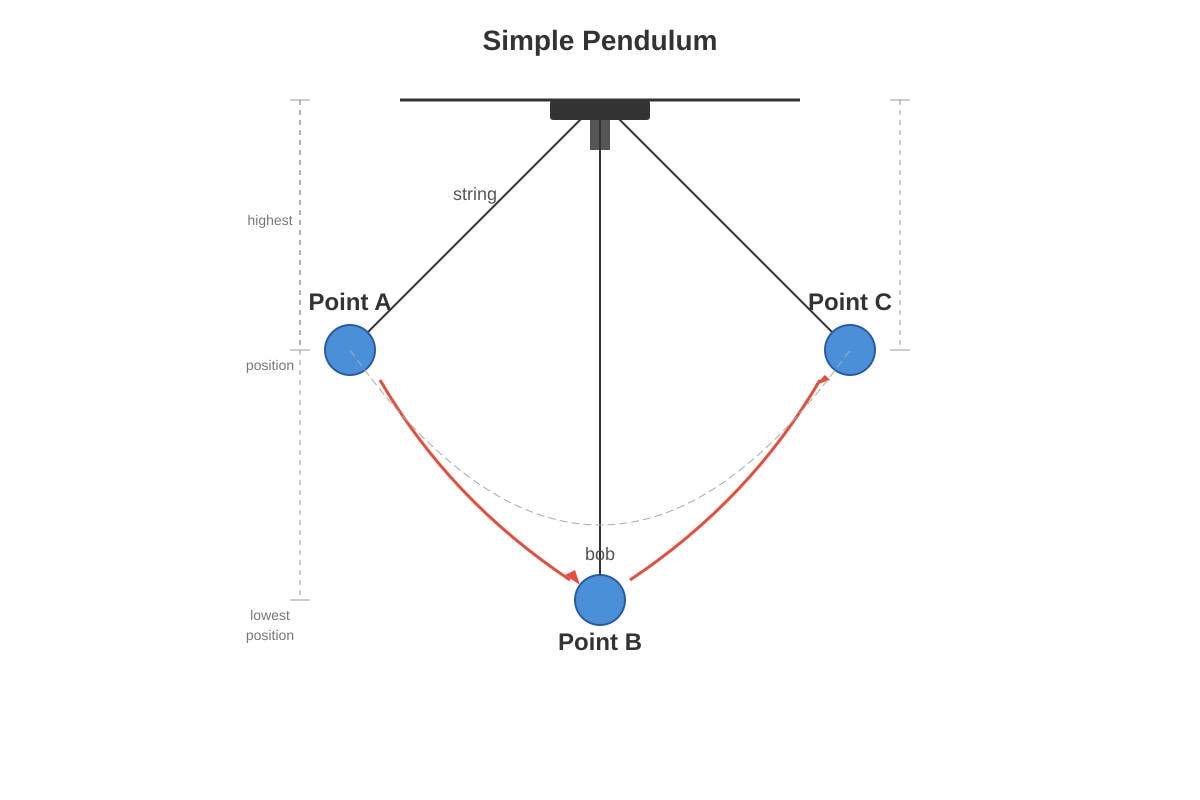
10. The diagram below shows a simple pendulum at different positions.

<image_placeholder> id: Q10-fig1 type: diagram linked_question: Q10 description: Simple pendulum swinging from left to right showing three positions - highest point A on left, lowest point B at bottom, highest point C on right labels: Point A (left highest), Point B (lowest), Point C (right highest), string, bob values: None required must_show: Direction of swing arrow from A to B to C; relative heights of A, B, C; bob positions at each point </image_placeholder>

(a) State the type of energy the bob has at point A. [1 mark]


(b) Describe the energy changes that occur as the bob swings from point A to point B. [2 marks]


(c) Explain why the bob does not reach the same height at point C as it started at point A. [2 marks]


11. A machine has a useful power output of 400 W. The total power input to the machine is 500 W.

(a) Calculate the efficiency of the machine. [2 marks]


(b) Explain why the efficiency of any real machine is always less than 100%. [1 mark]


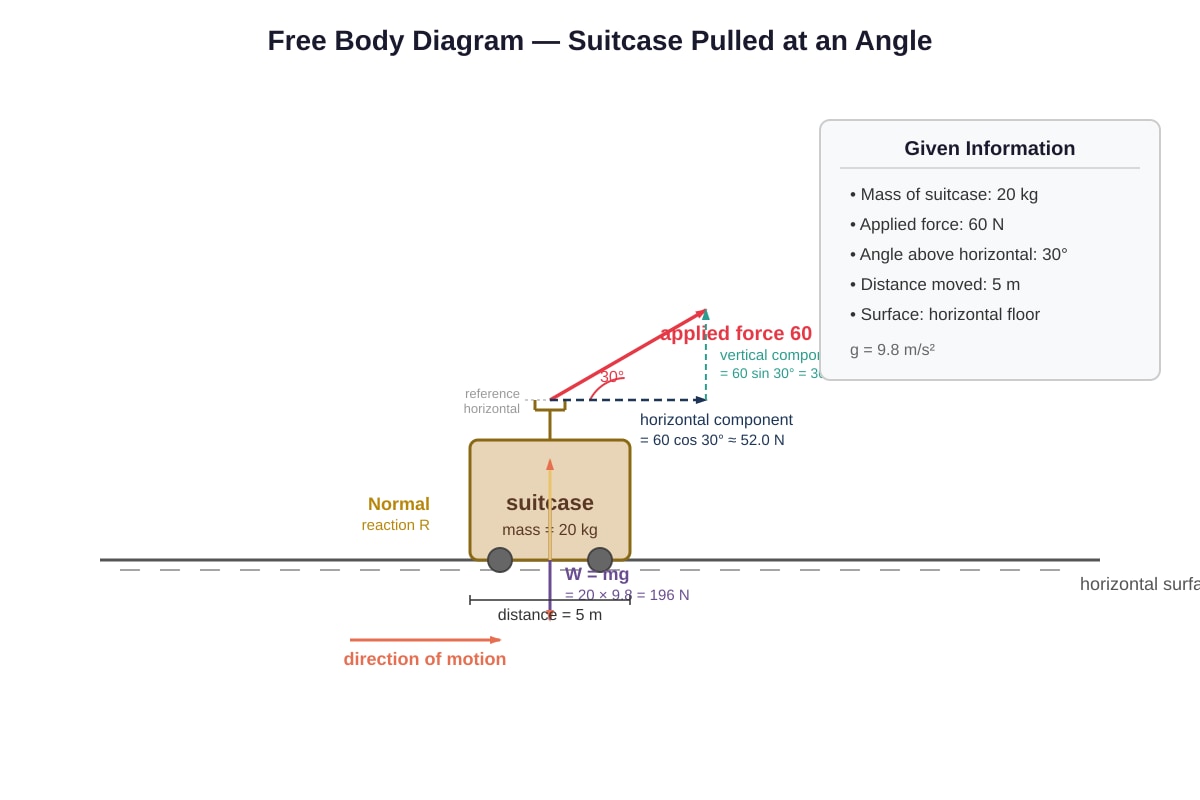
12. A student pulls a 20 kg suitcase along a horizontal floor with a force of 60 N at an angle of 30° to the horizontal. The suitcase moves a distance of 5 m.

<image_placeholder> id: Q12-fig1 type: diagram linked_question: Q12 description: Free body diagram of suitcase being pulled at angle labels: suitcase, applied force 60 N, angle 30°, horizontal surface, direction of motion values: Force = 60 N, angle = 30°, mass = 20 kg, distance = 5 m must_show: The 60 N force vector at 30° above horizontal; horizontal component indicated; direction of motion; horizontal floor surface </image_placeholder>

(a) Calculate the horizontal component of the applied force. [2 marks]


(b) Calculate the work done by the horizontal component of the force. [2 marks]


(c) If the student pulls the suitcase for 10 s, calculate the power developed. [2 marks]


13. An electric motor is used to lift a load. The input electrical energy is 10 000 J. The useful work done lifting the load is 7 500 J.

(a) Calculate the energy wasted by the motor. [1 mark]


(b) Suggest two forms that the wasted energy might take. [2 marks]


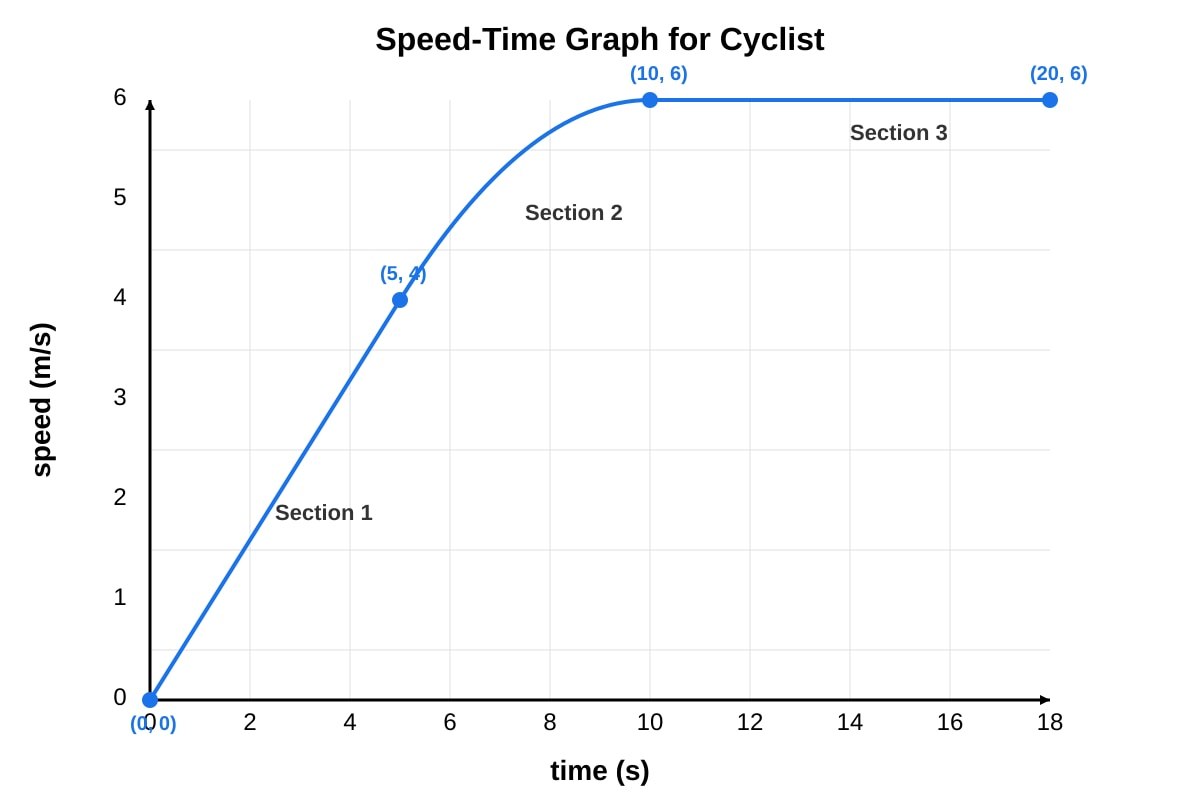
14. The graph shows how the speed of a cyclist changes during the first 20 seconds of a race.

<image_placeholder> id: Q14-fig1 type: graph linked_question: Q14 description: Speed-time graph for cyclist labels: speed (m/s) on y-axis, time (s) on x-axis values: Points: (0,0), (5,4), (10,6), (15,6), (20,6); straight line from 0 to 5s, curve from 5 to 10s, horizontal line from 10 to 20s must_show: Axes with units; labelled points; shape of graph with three distinct sections; speed values marked; time values marked </image_placeholder>

(a) Describe the motion of the cyclist during the first 5 seconds. [1 mark]


(b) State the maximum speed reached by the cyclist. [1 mark]


(c) Calculate the acceleration during the first 5 seconds. [2 marks]


Section C: Structured Response (Questions 15–20)


15. A hydroelectric power station uses water stored in a reservoir to generate electricity.

(a) State the main energy conversion that occurs in a hydroelectric power station. [1 mark]


(b) Explain why the water must be stored at a height above the turbines. [2 marks]


(c) Suggest one advantage and one disadvantage of hydroelectric power compared to fossil fuel power. [2 marks]

Advantage: _________________________________________________________________

Disadvantage: _________________________________________________________________


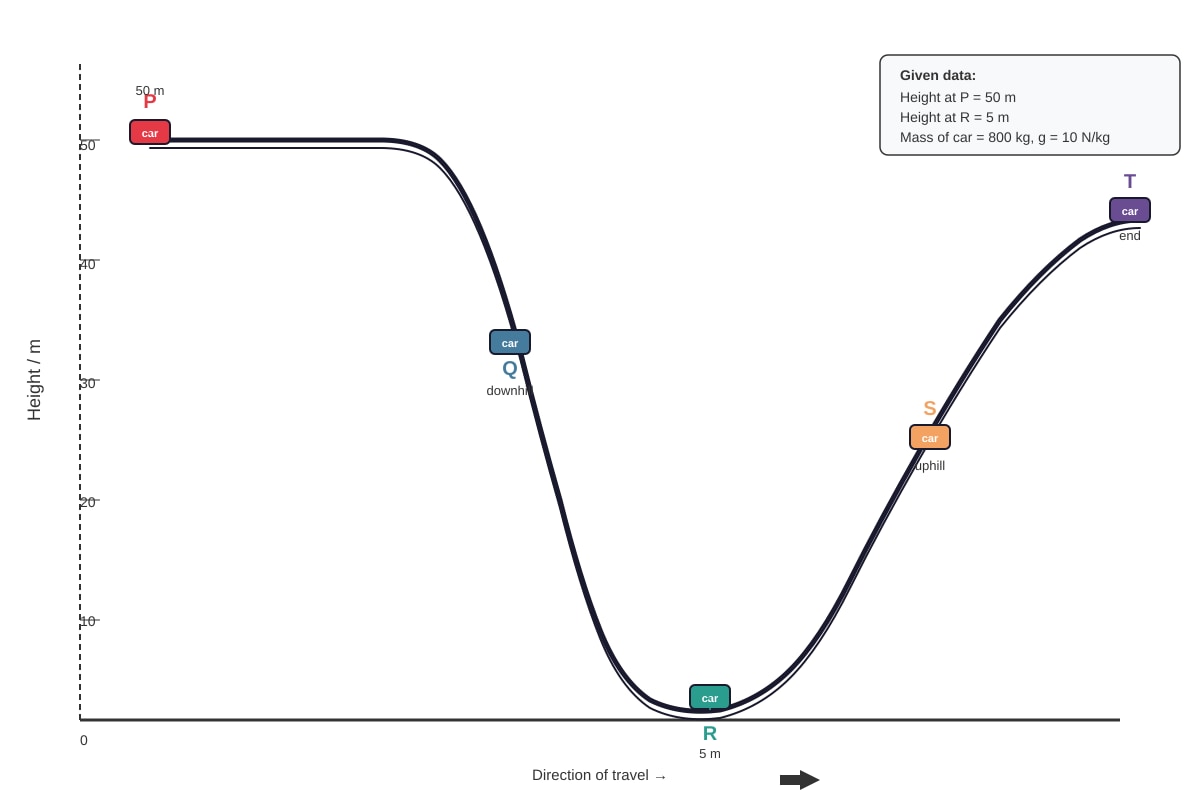
16. The diagram shows a roller coaster car at different points along a track.

<image_placeholder> id: Q16-fig1 type: diagram linked_question: Q16 description: Roller coaster track with labelled points labels: Point P (start, highest, stationary), Point Q (downhill), Point R (lowest point), Point S (uphill, lower than P), Point T (end, higher than R but lower than P) values: Height at P = 50 m, height at R = 5 m, mass of car = 800 kg, g = 10 N/kg must_show: Track shape with five labelled points; relative heights indicated; roller coaster car at each point; height values at P and R </image_placeholder>

(a) Calculate the gravitational potential energy of the car at point P (relative to point R). [2 marks]


(b) Assuming no energy is lost, calculate the maximum speed of the car at point R. [3 marks]


(c) In practice, the speed at point R is less than calculated in part (b). Explain why this happens. [2 marks]


17. A student investigates how the extension of a spring changes with the force applied.

(a) Name the independent variable in this investigation. [1 mark]


(b) The student adds masses gradually and records the extension. The results are shown in the table.

Mass (g)0100200300400500
Force (N)01.02.03.04.05.0
Extension (cm)02.04.15.98.110.0

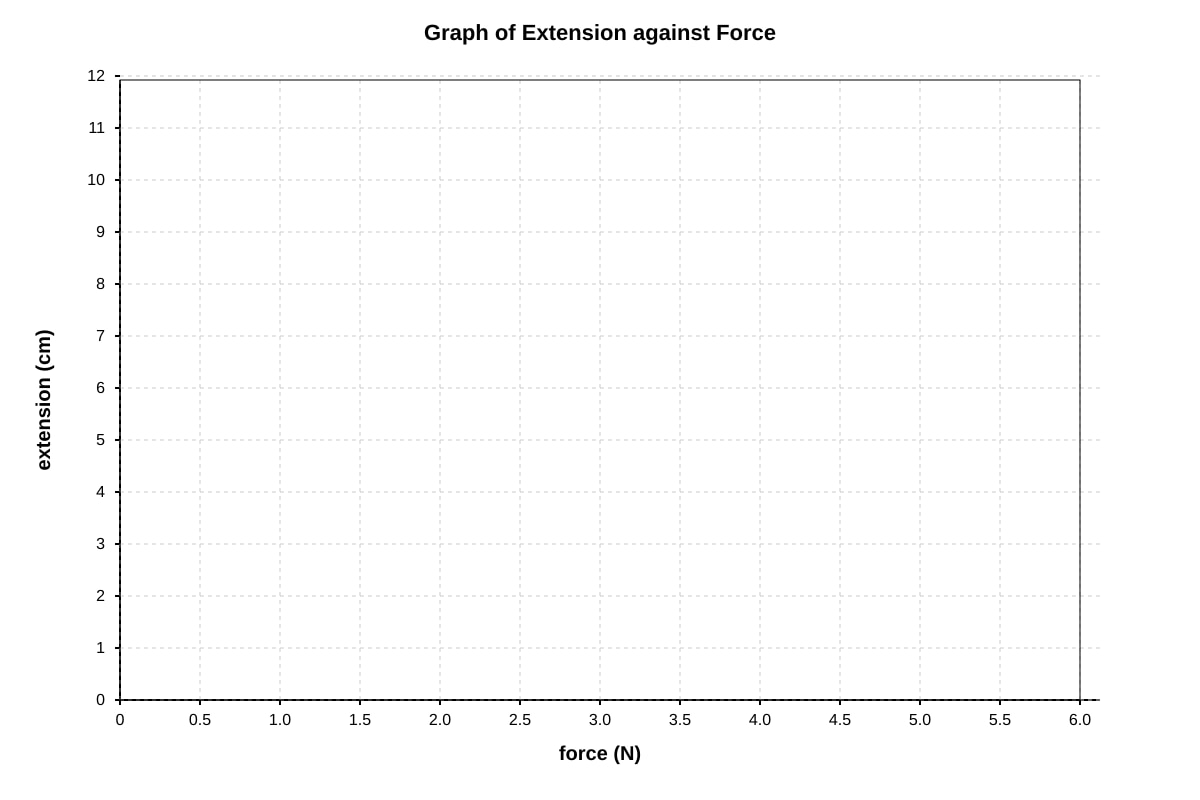
(i) Plot a graph of extension against force on the axes below. [2 marks]

<image_placeholder> id: Q17-fig1 type: graph linked_question: Q17 description: Empty axes for student to plot graph labels: extension (cm) on y-axis, force (N) on x-axis values: x-axis scale 0 to 6 N, y-axis scale 0 to 12 cm must_show: Axes with correct labels and units; appropriate linear scales; grid lines </image_placeholder>

(ii) Use your graph to find the extension when a force of 2.5 N is applied. Show your working. [2 marks]


(iii) The spring constant kk can be found using F=kxF = kx, where xx is the extension in metres. Calculate the spring constant of this spring. [2 marks]


18. A toy car is released from rest at the top of a ramp and rolls down to the bottom.

(a) State the energy conversion that takes place as the car rolls down. [1 mark]


(b) The car has a mass of 0.5 kg. The vertical height of the ramp is 0.8 m. Calculate the gravitational potential energy lost by the car. (g=10 N/kgg = 10 \text{ N/kg}) [2 marks]


(c) If 20% of the energy is lost to friction, calculate the kinetic energy of the car at the bottom of the ramp. [2 marks]


(d) Using your answer to (c), calculate the speed of the car at the bottom of the ramp. [2 marks]


19. A wind turbine has blades with a total swept area of 5000 m². The wind speed is 12 m/s.

(a) Explain how a wind turbine generates electrical energy. [2 marks]


(b) The kinetic energy of the air passing through the blades each second is 432 000 J. The turbine generates 108 000 J of electrical energy each second. Calculate the efficiency of the turbine. [2 marks]


(c) Suggest two reasons why the efficiency is not 100%. [2 marks]


20. A student designs an experiment to compare the energy content of two different foods, A and B.

(a) The student burns each food sample and uses the energy released to heat 50 cm³ of water. Describe how the student can ensure that this is a fair test. [2 marks]


(b) For food sample A, the temperature of the water rises by 24°C. For food sample B, the temperature rises by 18°C. Calculate the energy absorbed by the water for food sample A. The specific heat capacity of water is 4.2 J/(g·°C). The density of water is 1.0 g/cm³. [3 marks]


(c) Explain why the energy calculated in part (b) is less than the actual energy content of the food. [2 marks]


End of Quiz

Answers

<!-- TuitionGoWhere generation metadata: stage=5-1; model=moonshotai/kimi-k2.6:free; model_label=Kimi K2.6 Free; generated=2026-06-07; Sources: Stage 4-0 LLM templates, syllabus context, and Stage 2 evidence where available. -->

Secondary 1 Science Quiz - Physical Sciences: Answer Key

Total Marks: 40


Section A: Multiple Choice

1. Answer: D – force

Explanation: A vector quantity has both magnitude and direction. Force has magnitude (measured in newtons) and direction (the direction of the push or pull). Mass, speed, and distance are scalar quantities—they have magnitude only, with no direction associated.


2. Answer: C – 30 J

Explanation: Work done = force × distance in direction of force. Here, W=10 N×3 m=30 JW = 10 \text{ N} \times 3 \text{ m} = 30 \text{ J}. The units are correct: newton-metres equal joules.


3. Answer: B – her height above the ground increases

Explanation: Gravitational potential energy is calculated as GPE=mghGPE = mgh, where mm = mass, gg = gravitational field strength, and hh = height above a reference point. As the student climbs, her mass stays constant but her height hh increases, so GPE increases.


4. Answer: A – (useful energy output / total energy input) × 100%

Explanation: Efficiency measures how much of the input energy is converted to useful output. It is always expressed as a percentage of useful output over total input. Useful energy output can never exceed total energy input (conservation of energy), so efficiency cannot exceed 100%.


5. Answer: B – zero kinetic energy and maximum gravitational potential energy

Explanation: At the highest point, the ball momentarily stops before falling back down. Speed is zero, so kinetic energy (KE=12mv2KE = \frac{1}{2}mv^2) is zero. Height is maximum, so gravitational potential energy (GPE=mghGPE = mgh) is at its maximum value for this motion.


Section B: Short Answer and Calculations

6. Chemical energy → thermal energy (heat) + kinetic energy [1 mark]

Note: Accept "chemical energy → heat energy" or with mention of movement energy. The key conversion is from stored chemical energy in food to released energy forms.


7. No work is done because there is no displacement [1]. Work done requires both a force and movement in the direction of the force (W=F×dW = F \times d); since d=0d = 0, W=0W = 0 [1].

Teaching note: Students often think holding something heavy is "hard work" in everyday language, but in physics, "work" has a precise meaning. The person does expend chemical energy (muscle tension), but no mechanical work is done on the box.


8. (a) KE=12mv2=12×1200×152KE = \frac{1}{2}mv^2 = \frac{1}{2} \times 1200 \times 15^2 [1]

=12×1200×225=600×225=135000 J=135 kJ= \frac{1}{2} \times 1200 \times 225 = 600 \times 225 = 135\,000 \text{ J} = 135 \text{ kJ} [1]

Marking point: Correct formula with substitution [1], correct final answer with unit [1].

(b) The kinetic energy is converted to thermal energy (heat) [1] through friction in the brakes and between tyres and road [1]. Sound energy is also produced.

Teaching note: Energy is conserved overall. The KE doesn't disappear; it transforms into less useful forms, mainly heat in the brake discs and pads.


9. (a) Weight = mg=250×10=2500 Nmg = 250 \times 10 = 2500 \text{ N} [1]

(b) Work done = force × distance =2500×8=20000 J= 2500 \times 8 = 20\,000 \text{ J} (or 2.0×10⁴ J2.0 \times 10^4 \text{ J}) [2]

Marking: Use of correct force (weight) [1], correct calculation with unit [1].

Teaching note: Crane lifts at constant speed, so upward force equals weight (equilibrium). If speed were changing, Newton's Second Law would apply.

(c) Time taken = distance/speed =8/0.5=16 s= 8 / 0.5 = 16 \text{ s} [1]

Power = work done / time =20000/16=1250 W= 20\,000 / 16 = 1250 \text{ W} [1]

Alternative: Power = force × velocity =2500×0.5=1250 W= 2500 \times 0.5 = 1250 \text{ W} [2]


10. (a) Gravitational potential energy [1]

(b) Gravitational potential energy decreases as height decreases [1]; kinetic energy increases as speed increases [1]. The sum GPE + KE remains constant (ignoring air resistance).

(c) Some energy is lost to air resistance [1], so not all initial GPE converts to KE and back to GPE; some becomes thermal energy in the air and bob [1].

Teaching note: This is why pendulums eventually stop without an external push. In a vacuum with frictionless pivot, the bob would reach exactly the same height.


11. (a) Efficiency =400500×100%=80%= \frac{400}{500} \times 100\% = 80\% [2]

Marking: Correct substitution [1], correct answer [1].

(b) Energy is lost to friction / thermal energy / sound / other non-useful forms [1]. By conservation of energy, useful output must be less than total input.


12. (a) Horizontal component = 60cos30°=60×0.866=51.9652 N60 \cos 30° = 60 \times 0.866 = 51.96 \approx 52 \text{ N} [2]

Marking: Correct trigonometric expression [1], correct evaluation [1].

Teaching note: Only the force component in the direction of motion does work. The vertical component (60sin30°=30 N60 \sin 30° = 30 \text{ N}) acts perpendicular to motion.

(b) Work done = horizontal force × distance =51.96×5=259.8260 J= 51.96 \times 5 = 259.8 \approx 260 \text{ J} [2]

Accept use of exact 60cos30°60 \cos 30° or rounded 52 N52 \text{ N}. With Fh=52 NF_h = 52 \text{ N}: W=52×5=260 JW = 52 \times 5 = 260 \text{ J}.

(c) Power = work done / time =259.8/10=25.9826 W= 259.8 / 10 = 25.98 \approx 26 \text{ W} [2]

Or using P=Fh×vP = F_h \times v where average velocity =5/10=0.5 m/s= 5/10 = 0.5 \text{ m/s}, giving P=51.96×0.526 WP = 51.96 \times 0.5 \approx 26 \text{ W}.


13. (a) Wasted energy =100007500=2500 J= 10\,000 - 7\,500 = 2\,500 \text{ J} [1]

(b) Any two from: thermal energy (heat), sound energy, kinetic energy in moving parts, energy to overcome friction [2]


14. (a) The cyclist is accelerating [1] (uniformly / constant acceleration from 0–5 seconds). Speed increases from 0 to 4 m/s.

(b) 6 m/s [1]

(c) Acceleration = change in velocity / time taken =(40)/5=0.8 m/s2= (4 - 0) / 5 = 0.8 \text{ m/s}^2 [2]

Marking: Correct formula or method [1], correct substitution and answer with unit [1].


Section C: Structured Response

15. (a) Gravitational potential energy → kinetic energy → electrical energy [1]

Accept: GPE → KE → mechanical energy → electrical energy

(b) The water at height has gravitational potential energy (mghmgh) [1]. As it falls, this converts to kinetic energy, which turns turbines to generate electricity [1].

(c) Advantage: renewable / no greenhouse gas emissions during operation / low running costs once built [1]

Disadvantage: high initial construction cost / affects local ecosystem / requires specific geography (valley and river) / dependent on rainfall [1]


16. (a) GPE=mgh=800×10×(505)=800×10×45=360000 JGPE = mgh = 800 \times 10 \times (50 - 5) = 800 \times 10 \times 45 = 360\,000 \text{ J} [2]

Marking: Formula and substitution [1], answer with unit [1]. Note height difference is 45 m (P relative to R).

(b) GPE at P=KE at RGPE \text{ at P} = KE \text{ at R} (energy conservation) [1]

360000=12×800×v2360\,000 = \frac{1}{2} \times 800 \times v^2 [1]

v2=360000×2800=900v^2 = \frac{360\,000 \times 2}{800} = 900

v=900=30 m/sv = \sqrt{900} = 30 \text{ m/s} [1]

Marking: Energy conservation statement or equivalent [1], correct equation [1], correct solution [1].

(c) Energy is lost to air resistance and friction between wheels and track [1]. Some GPE converts to thermal energy and sound, so less kinetic energy is gained at R, resulting in lower speed [1].


17. (a) Force applied / load / mass added [1]

(b) (i) Graph: correct axes with labels and units [1]; all points plotted correctly within ±1 mm, straight line of best fit [1]

Expected visual: Straight line through origin with positive gradient; points approximately (1, 2), (2, 4.1), (3, 5.9), (4, 8.1), (5, 10)

(ii) Reading from graph at F=2.5 NF = 2.5 \text{ N}: approximately 5.0 cm (accept 4.9–5.1 cm) [1]

Method: draw vertical line from 2.5 N on x-axis to line of best fit, then horizontal to y-axis [1]

(iii) From graph, gradient = spring constant (in appropriate units)

Using F=2.0 N,x=0.041 mF = 2.0 \text{ N}, x = 0.041 \text{ m}: k=F/x=2.0/0.041=48.8 N/mk = F/x = 2.0/0.041 = 48.8 \text{ N/m} [1]

Or using any point: k=1.0/0.020=50 N/mk = 1.0/0.020 = 50 \text{ N/m}, k=3.0/0.059=50.8 N/mk = 3.0/0.059 = 50.8 \text{ N/m} [1]

Accept range 48–51 N/m [1]

Teaching note: Hooke's Law states F=kxF = kx where xx must be in metres. The spring obeys Hooke's Law as the graph is a straight line through origin.


18. (a) Gravitational potential energy → kinetic energy [1]

(b) GPE=mgh=0.5×10×0.8=4.0 JGPE = mgh = 0.5 \times 10 \times 0.8 = 4.0 \text{ J} [2]

Marking: Correct formula [1], correct answer with unit [1].

(c) Energy lost to friction = 20% of 4.0 J = 0.8 J [1]

KE at bottom=4.00.8=3.2 JKE \text{ at bottom} = 4.0 - 0.8 = 3.2 \text{ J} [1]

Alternative: KE=80%×4.0=3.2 JKE = 80\% \times 4.0 = 3.2 \text{ J} [2]

(d) KE=12mv2KE = \frac{1}{2}mv^2

3.2=12×0.5×v23.2 = \frac{1}{2} \times 0.5 \times v^2 [1]

v2=3.2×20.5=12.8v^2 = \frac{3.2 \times 2}{0.5} = 12.8

v=12.8=3.583.6 m/sv = \sqrt{12.8} = 3.58 \approx 3.6 \text{ m/s} [1]


19. (a) Wind causes blades to rotate [1]; kinetic energy of blades turns generator, converting kinetic energy to electrical energy [1].

(b) Efficiency =108000432000×100%=25%= \frac{108\,000}{432\,000} \times 100\% = 25\% [2]

Marking: Correct fraction [1], correct percentage [1].

(c) Any two from: kinetic energy in moving air not captured by blades; friction in turbine bearings; electrical resistance in generator; sound energy produced; turbulence and wake effects [2]


20. (a) Any two from: use same volume/mass of water; use same starting temperature; same distance from food to beaker; same apparatus setup; same room temperature/environmental conditions [2]

(b) Mass of water = ρ×V=1.0×50=50 g\rho \times V = 1.0 \times 50 = 50 \text{ g} [1]

Energy = mcΔT=50×4.2×24mc\Delta T = 50 \times 4.2 \times 24 [1]

=5040 J= 5040 \text{ J} [1]

(c) Heat is lost to surroundings (air, beaker, metal stand) [1]; not all energy produced by burning food is transferred to water / incomplete combustion of food [1].


End of Answer Key