AI Generated Quiz
Secondary 1 Science Physical Sciences Quiz
Free Sec 1 Science Physical Sciences quiz, HY3 AI version, with questions, answers, and syllabus-aligned practice for Singapore students.
These static practice materials are generated from the site's syllabus and paper-generation workflow, with source and model context shown so students and parents can evaluate the material before use.
Questions
Free quiz and exam paper access
Enter your details to view this paper
Your access is remembered on this device.
Answers
Secondary 1 Science Quiz - Physical Sciences (Answer Key)
Total Marks: 40
Topic: Physical Sciences (Forces, Energy, Heat, Electricity, Light)
Note: This answer key is syllabus-aligned and generated from AI-inferred templates. It is not based on a specific past-year paper.
Section A: Forces and Motion
Q1. [1 mark]
Answer: Frictional force (or friction).
Teaching note: Friction acts between two surfaces in contact and opposes relative motion. When the book slides, the table exerts friction opposite to the push.
Q2. [1 mark]
Answer: Newton (N).
Teaching note: The SI unit of force is the newton, named after Isaac Newton. A spring balance measures force in newtons.
Q3. [1 mark]
Answer: 5 N.
Teaching note: Weight is the gravitational force acting on an object. If the spring balance reads 5 N, the gravitational force (weight) is 5 N.
Q4. [2 marks]
Answer: Pressure increases when the brick rests on its smallest face. [1] Because pressure = force ÷ area, and the same weight (force) now acts over a smaller contact area. [1]
Teaching note: Weight (force) is unchanged. Smaller area → larger pressure. Common mistake: saying force increases.
Q5. [2 marks]
Answer: Moment = Force × perpendicular distance = 10 N × 0.4 m = 4 N·m. [2 for correct value and unit, or 1 for value only without unit]
Teaching note: Moment measures the turning effect. Use perpendicular distance from pivot to line of force.
Q6. [2 marks]
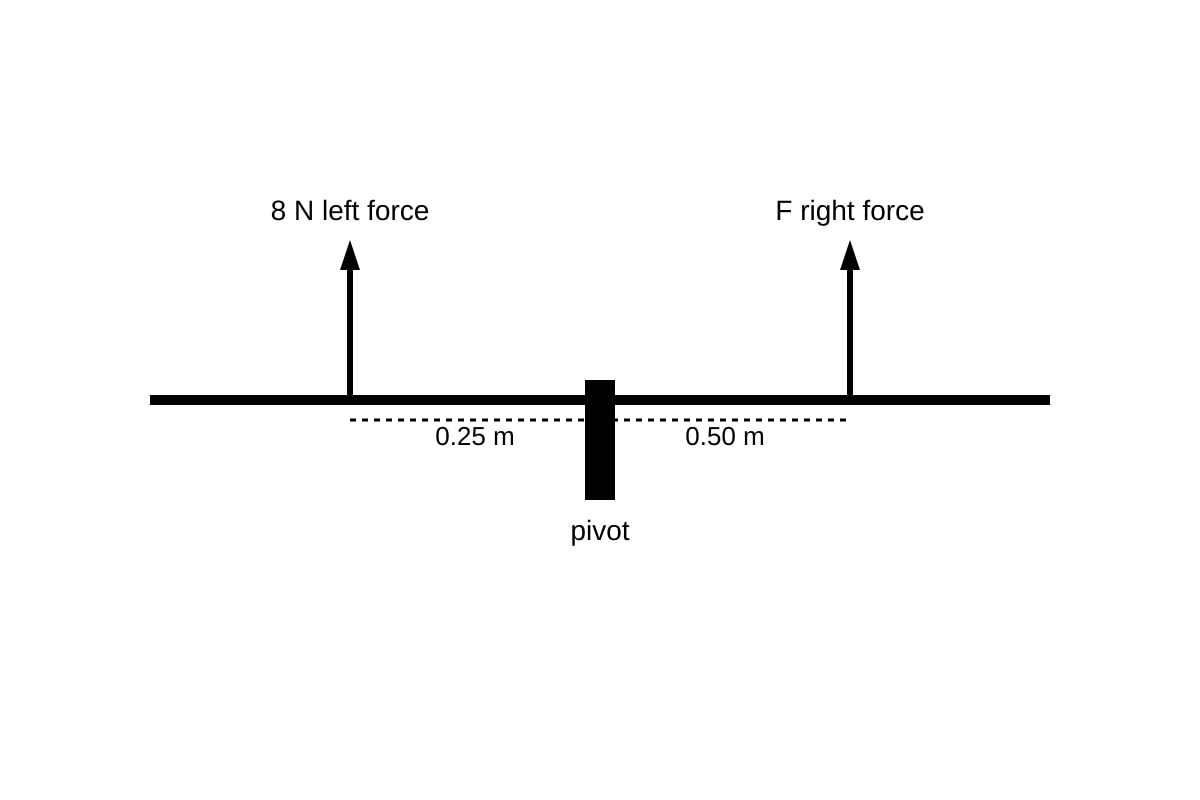
Answer: For balance, clockwise moment = anticlockwise moment.
Anticlockwise = 8 N × 0.25 m = 2 N·m. [1]
Clockwise = F × 0.50 m = 2 N·m → F = 2 ÷ 0.50 = 4 N. [1]
Teaching note: Pivot at centre; both forces downward so moments oppose. F = 4 N.
Q7. [2 marks]
Answer: Any two, e.g., (i) crowbar (ii) scissors / seesaw / bottle opener. [1+1]
Teaching note: A lever is a simple machine with a pivot that reduces effort to lift a load.
Section B: Energy and Heat
Q8. [1 mark]
Answer: Chemical energy → Gravitational potential energy.
Teaching note: Muscles supply chemical energy; lifting increases height so energy stored as GPE.
Q9. [1 mark]
Answer: Work is done against gravity to raise the bag, so chemical energy is stored as GPE.
Teaching note: Energy is conserved; the form changes, not lost.
Q10. [1 mark]
Answer: Gravitational potential energy → Kinetic energy.
Teaching note: As it falls, height decreases, speed increases.
Q11. [2 marks]
Answer: Any two from: sun, wind, hydropower, biomass. [1+1]
Teaching note: Renewable sources replenish naturally; fossil fuels are non-renewable.
Q12. [3 marks]
Answer: Work done = Force × distance [1] = 12 N × 2.5 m [1] = 30 J. [1]
Teaching note: Force and motion same direction. Unit is joule (J).
Q13. [2 marks]
Answer: 0 J. [1] Because work = force × displacement, and displacement = 0 while held stationary. [1]
Teaching note: No movement → no work done, even though force is applied.
Section C: Electricity and Light
Q14. [1 mark]
Answer: 230 V.
Teaching note: Singapore mains voltage is 230 volts.
Q15. [1 mark]
Answer: A long line and a short thick line (cell symbol).
Teaching note: Long line = positive terminal, short thick = negative.
Q16. [1 mark]
Answer: Series circuit.
Teaching note: Components one after another share the same current path.
Q17. [1 mark]
Answer: Fuse (or circuit breaker).
Teaching note: Both break the circuit if current too high; earth wire protects against shock.
Q18. [1 mark]
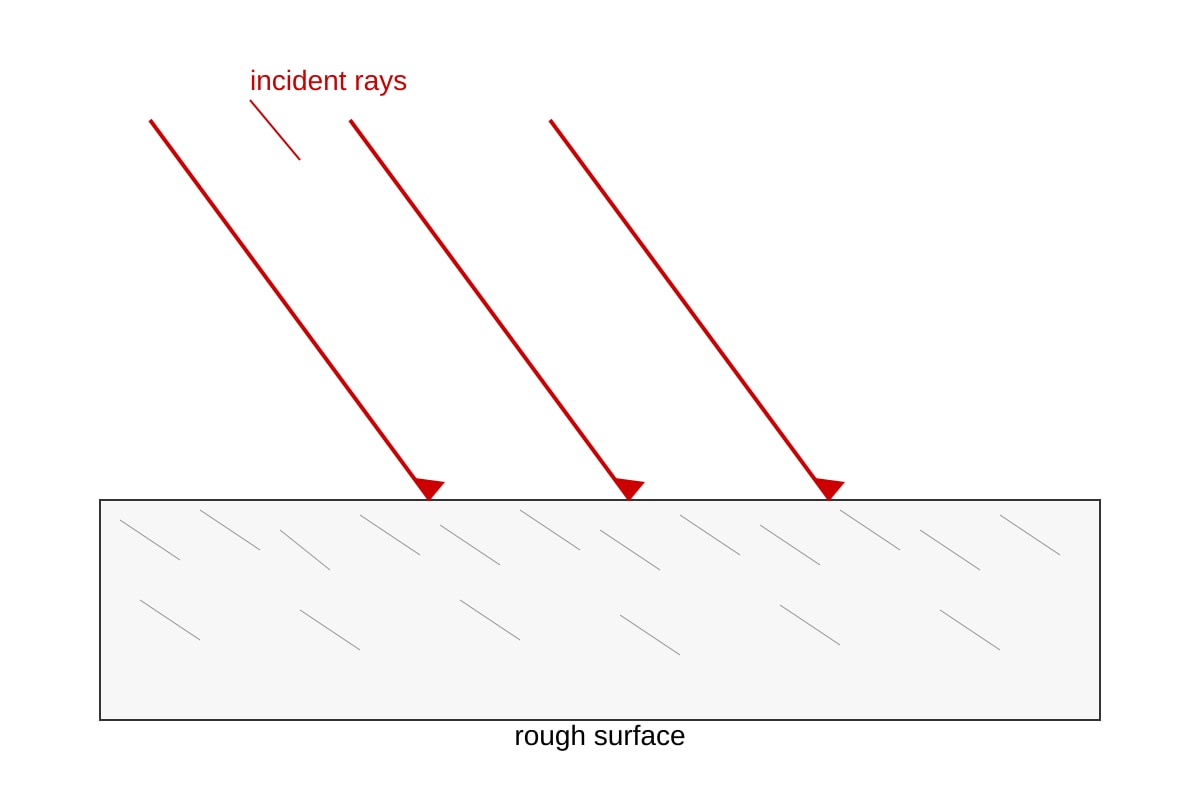
Answer: Reflected rays drawn in many different directions (diffuse reflection).
Teaching note: Rough surface scatters light. Image placeholder must show incident rays and scattered reflected rays.
Q19. [2 marks]
Answer: A closed circuit [1] and a voltage source (cell) [1].
Teaching note: Current needs a complete loop and potential difference.
Q20. [2 marks]
Answer: Heat flowed from hot water (80 °C) to cooler thermometer (20 °C) [1] until both reached same temperature (25 °C) by conduction/convection in air [1].
Teaching note: Heat transfers from higher to lower temperature until thermal equilibrium.