AI Generated Quiz
Secondary 1 Science Physical Sciences Quiz
Free Sec 1 Science Physical Sciences quiz, Claude AI version, with questions, answers, and syllabus-aligned practice for Singapore students.
These static practice materials are generated from the site's syllabus and paper-generation workflow, with source and model context shown so students and parents can evaluate the material before use.
Questions
Free quiz and exam paper access
Enter your details to view this paper
Your access is remembered on this device.
Answers
Secondary 1 Science Quiz - Physical Sciences (Answer Key)
Total Marks: 40
Section A: Forces and Energy (Questions 1-8)
1. A student lifts a 3 kg bag from the floor to a table 0.8 m high at constant speed.
(a) State the energy conversion that takes place during this process. [1] Answer: Chemical energy (in muscles) → Gravitational potential energy (in the bag) Mark: 1 mark for correct energy conversion
(b) Calculate the work done against gravity. (Take g = 10 N/kg) [2] Answer: Work done = mgh = 3 kg × 10 N/kg × 0.8 m = 24 J Marking: 1 mark for correct formula/working, 1 mark for correct answer with unit
2. A brick rests on a table with its largest face in contact with the surface.
(a) State what happens to the force exerted by the brick on the table. [1] Answer: The force remains the same/unchanged Mark: 1 mark for stating force is unchanged
(b) Explain what happens to the pressure exerted by the brick on the table. [2] Answer: The pressure increases because pressure = force ÷ area, and the contact area decreases while force remains constant Marking: 1 mark for stating pressure increases, 1 mark for correct explanation
3. Complete the ray diagram to show reflection on rough paper surface. [2] Answer: Three reflected rays should be drawn in different random directions (diffuse reflection) Marking: 1 mark for showing diffuse reflection, 1 mark for correct ray directions
4. Calculate the moment of the 200 N force at 1.5 m from pivot. [2] Answer: Moment = Force × Distance = 200 N × 1.5 m = 300 N⋅m Marking: 1 mark for correct formula, 1 mark for correct answer with unit
5. State two factors that affect pressure exerted by a solid object. [2] Answer: (a) Force/weight of the object (b) Contact area/surface area Marking: 1 mark each for any two correct factors
Section B: Chemistry and Materials (Questions 6-12)
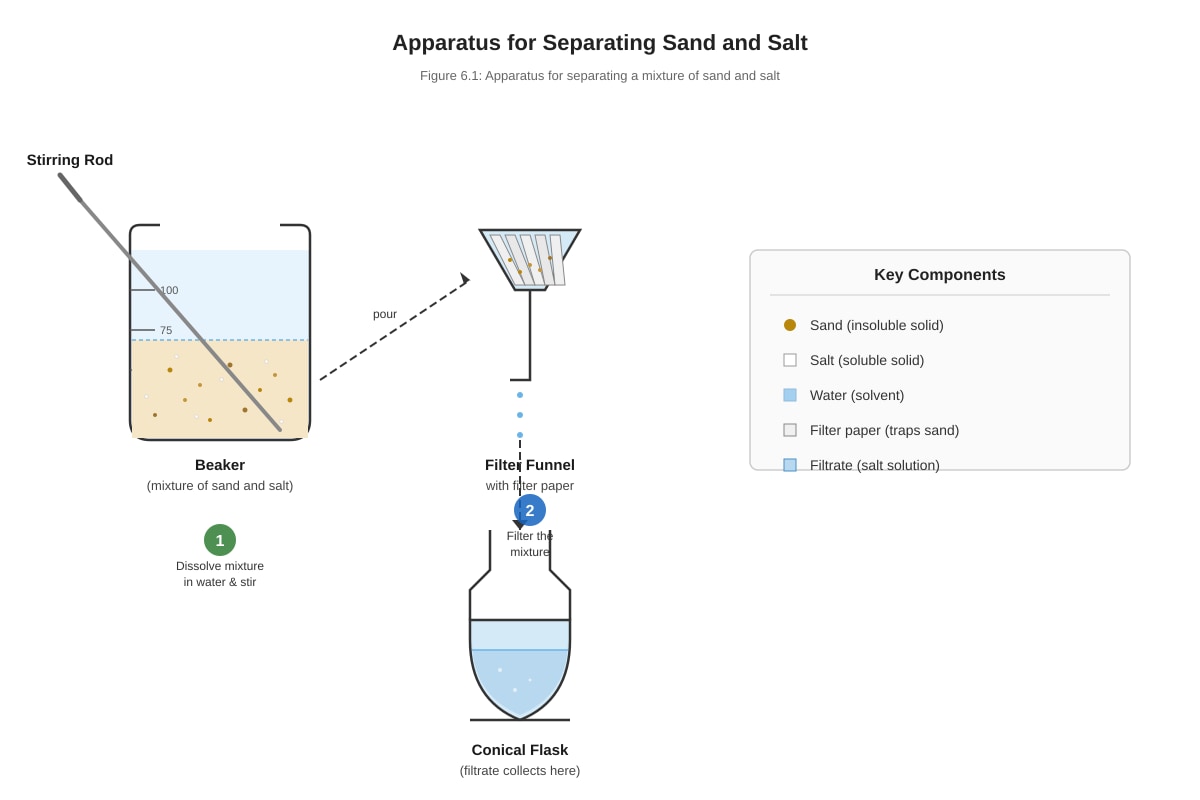
6. Separation of sand and salt mixture.
(a) State the first step in the separation process. [1] Answer: Add water and stir to dissolve the salt Mark: 1 mark for adding water to dissolve salt
(b) Name the separation technique used in the second step. [1] Answer: Filtration Mark: 1 mark for filtration
(c) How would the student obtain pure salt crystals from the filtrate? [1] Answer: Evaporation/heating to evaporate water Mark: 1 mark for evaporation
7. Identify mercury from the data table. [2] Answer: Element: W Reason: It is the only metal that is liquid at room temperature (25°C) Marking: 1 mark for identifying W, 1 mark for correct reason
8. Safety precautions for corrosive chemical. [2] Answer: (a) Wear protective gloves/safety gloves (b) Wear eye protection/safety goggles Marking: 1 mark each for appropriate safety precautions
9. Explain separation differences between oil-water and alcohol-water. [3] Answer: Oil and water are immiscible (do not mix), so they form separate layers that can be separated using a separating funnel. Alcohol and water are miscible (mix completely), so they cannot be separated using a separating funnel. Marking: 1 mark for immiscible, 1 mark for miscible, 1 mark for linking to separation method
10. Hypothesis for sugar solubility investigation. [1] Answer: If temperature increases, then the solubility of sugar in water will increase Mark: 1 mark for testable hypothesis linking temperature and solubility
Section C: Life Sciences and Scientific Inquiry (Questions 11-20)
11. Microscopy calculations.
(a) Calculate total magnification. [1] Answer: 10× × 40× = 400× Mark: 1 mark for correct calculation
(b) Calculate actual length in micrometers. [2] Answer: Actual length = 4.8 mm ÷ 400 = 0.012 mm = 12 μm Marking: 1 mark for correct calculation, 1 mark for unit conversion
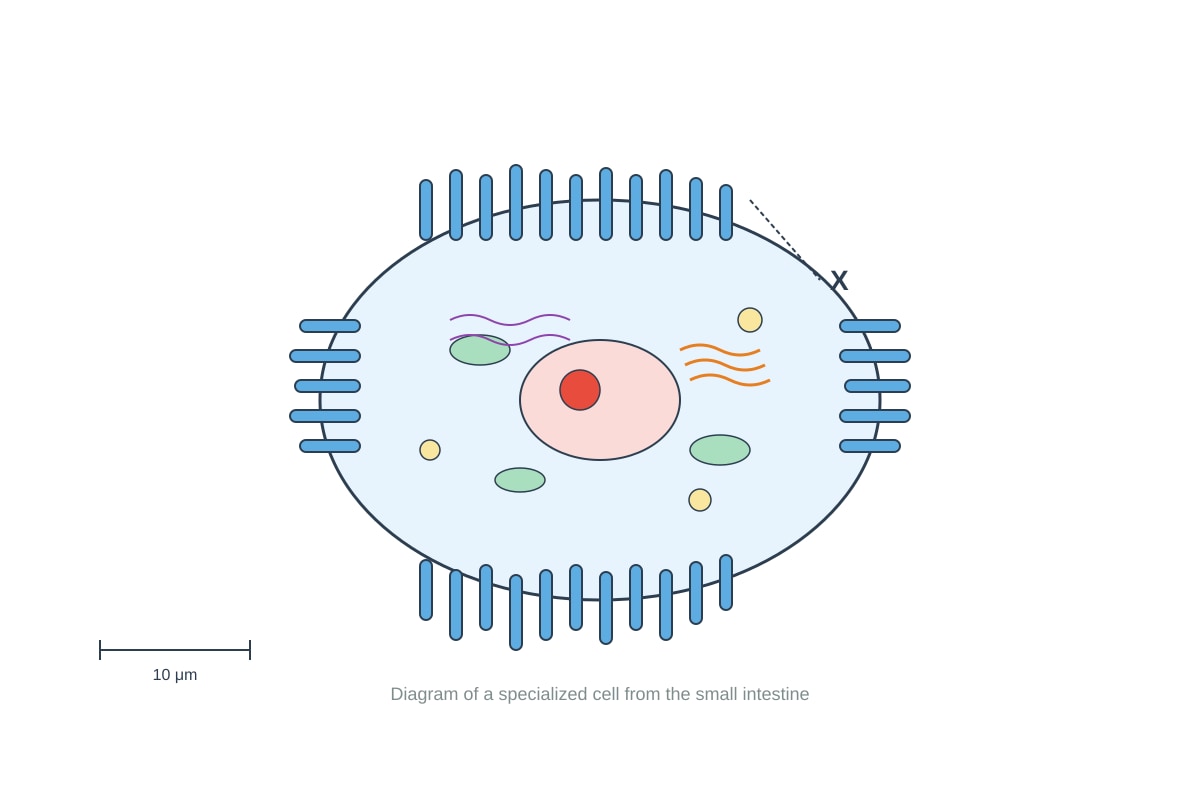
12. Specialized intestinal cell.
(a) Name structure X. [1] Answer: Microvilli/villi Mark: 1 mark for correct identification
(b) Explain how structure X helps the cell function. [2] Answer: It increases the surface area of the cell, allowing more efficient absorption of nutrients Marking: 1 mark for increased surface area, 1 mark for linking to absorption
13. Chromatography analysis.
(a) Explain how chromatography separates dyes. [2] Answer: Different dyes have different solubilities in the solvent, so they travel different distances up the paper Marking: 1 mark for different solubilities, 1 mark for different distances traveled
(b) State one advantage of chromatography. [1] Answer: Can identify multiple components in a small sample/quick analysis/sensitive technique Mark: 1 mark for valid advantage
14. Variables in zinc reaction experiment.
(a) Independent variable: Surface area of zinc [1] (b) Dependent variable: Rate of reaction/volume of gas produced [1] (c) Controlled variable: Temperature/concentration of acid/mass of zinc [1] Marking: 1 mark each for correct variable identification
15. Particle changes when ice melts. [3] Answer: Arrangement: Particles move further apart/become less ordered Movement: Particles move faster/more vigorously Energy: Particles gain kinetic energy Marking: 1 mark each for arrangement, movement, and energy changes
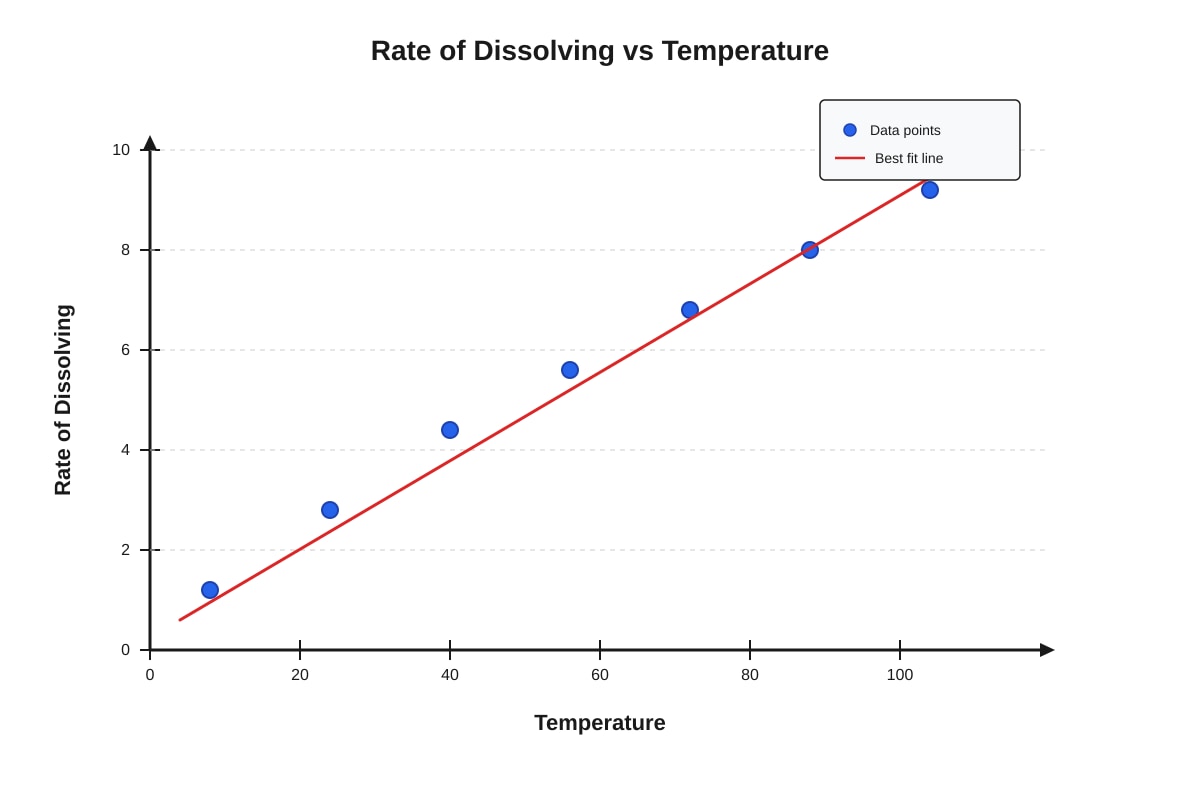
16. Graph conclusion evaluation. [2] Answer: Conclusion supported: Yes Reason: The graph shows a positive relationship between temperature and rate of dissolving Marking: 1 mark for yes, 1 mark for referencing graph evidence
17. Classification table. [3] Answer:
- Oxygen gas (O₂): Element
- Salt water: Mixture
- Carbon dioxide (CO₂): Compound Marking: 1 mark each for correct classification
18. Useful work calculation. [2] Answer: Work = Force × Distance = 30 N × 4 m = 120 J Marking: 1 mark for using 30 N (not 50 N), 1 mark for correct answer
19. Sharp vs blunt knife explanation. [2] Answer: A sharp knife has a smaller contact area, so it exerts greater pressure for the same applied force, making it cut more easily Marking: 1 mark for smaller area, 1 mark for greater pressure
20. Fair test design for plant growth.
(a) Controlled variables: [2] Answer: Same type of plant, same amount of water, same amount of light, same temperature, same pot size Marking: 1 mark each for any two valid controlled variables
(b) Dependent variable: [1] Answer: Height of plant/mass of plant/number of leaves Mark: 1 mark for measurable growth indicator
Common Mistakes to Avoid:
- Energy conversions: Don't forget the source of energy (e.g., chemical energy in muscles)
- Calculations: Always include units and show working
- Variables: Independent variable is what you change, dependent is what you measure
- Pressure: Remember pressure = force ÷ area
- Microscopy: Total magnification = eyepiece × objective
- Separation: Match the technique to the properties of the substances