AI Generated Quiz
Secondary 1 Science Life Sciences Quiz
Free Sec 1 Science Life Sciences quiz, Kimi2.6 AI version, with questions, answers, and syllabus-aligned practice for Singapore students.
These static practice materials are generated from the site's syllabus and paper-generation workflow, with source and model context shown so students and parents can evaluate the material before use.
Questions
Free quiz and exam paper access
Enter your details to view this paper
Your access is remembered on this device.
Answers
Secondary 1 Science Quiz - Life Sciences (Answer Key)
Total Marks: 50
Section A: Multiple Choice Questions (Questions 1–10)
2 marks each
| Question | Answer | Explanation |
|---|---|---|
| 1 | C | The cell is the basic unit of life. All living organisms are made of cells, and cells carry out all the functions of life. Tissues are groups of cells, organs are made of tissues, and organelles are structures within cells. |
| 2 | B | The cell wall is found only in plant cells (and some bacteria and fungi). It provides structural support and protection. Animal cells do not have cell walls; they only have a cell membrane. |
| 3 | C | Chloroplasts contain chlorophyll and are the sites of photosynthesis, where light energy is converted into chemical energy (glucose). Mitochondria carry out cellular respiration, not photosynthesis. |
| 4 | D | The compound microscope produces an inverted image because light passes through two lens systems (eyepiece and objective). Each lens inverts the image, and the combination results in an upside-down, reversed image. |
| 5 | B | All living things can reproduce to produce offspring. Not all living things can fly (e.g., plants), photosynthesise (only plants and some bacteria), or move from place to place (e.g., plants are rooted). |
| 6 | C | The large central vacuole is a distinctive feature of plant cells. It stores water, food, and waste products, and helps maintain turgor pressure to keep the cell rigid. The diagram shows this large fluid-filled space. |
| 7 | A | The nucleus contains chromosomes made of DNA. Mitochondria also contain their own small amount of DNA (mitochondrial DNA), inherited from the mother. Vacuoles and ribosomes do not contain genetic material. |
| 8 | B | Iodine is a biological stain that binds to certain cellular components, making them more visible under the microscope. Onion cells are naturally nearly transparent, so staining is needed to see the nucleus and cell wall clearly. |
| 9 | C | Both animal and plant cells have mitochondria for respiration and nuclei for genetic control. However, plant cells uniquely have large central vacuoles for storage and chloroplasts for photosynthesis. Animal cells lack these structures. |
| 10 | B | Total magnification = Eyepiece magnification × Objective magnification. For example, ×10 eyepiece with ×40 objective gives ×400 total magnification. |
Section B: Short Answer Questions (Questions 11–15)
11. [3 marks]
| Feature | Animal Cell | Plant Cell |
|---|---|---|
| Cell wall | Absent | Present |
| Chloroplasts | Absent | Present |
| Large central vacuole | Absent (small or no vacuoles) | Present |
| Shape | Irregular, round | Regular, fixed shape |
Any three correct differences [1 mark each]
Common acceptable answers:
- Cell wall: plant cells have it, animal cells don't
- Chloroplasts: plant cells have them, animal cells don't
- Vacuole: plant cells have large central vacuole, animal cells have small/no vacuoles
- Shape: plant cells have fixed shape due to cell wall, animal cells have variable shape
- Storage: plant cells store starch, animal cells store glycogen
Teaching note: Students often confuse "cell wall" and "cell membrane." Emphasise that all cells have a cell membrane, but only plant cells have an additional rigid cell wall outside the membrane.
12. [3 marks total]
(a) Prokaryotic and eukaryotic cells [1 mark]
(b) Prokaryotic: Bacteria (e.g., Escherichia coli); Eukaryotic: Animal, plant, fungus, protozoan (any valid example) [1 mark each]
Teaching note: Prokaryotic cells lack a true nucleus and membrane-bound organelles. Their DNA floats in the cytoplasm. Eukaryotic cells have a membrane-bound nucleus and specialised organelles. This fundamental distinction prepares students for upper secondary biology where they study bacterial structure in detail.
13. [3 marks total]
(a) Total magnification = Eyepiece × Objective = 10 × 40 = ×400 [2 marks: 1 for formula, 1 for correct answer]
(b) New magnification = 10 × 10 = ×100 [1 mark]
Teaching note: Total magnification is always a product, never a sum. Students sometimes add (10 + 40 = 50) which is incorrect. Remind them that each lens magnifies the image created by the previous lens, so magnifications multiply.
14. [3 marks total]
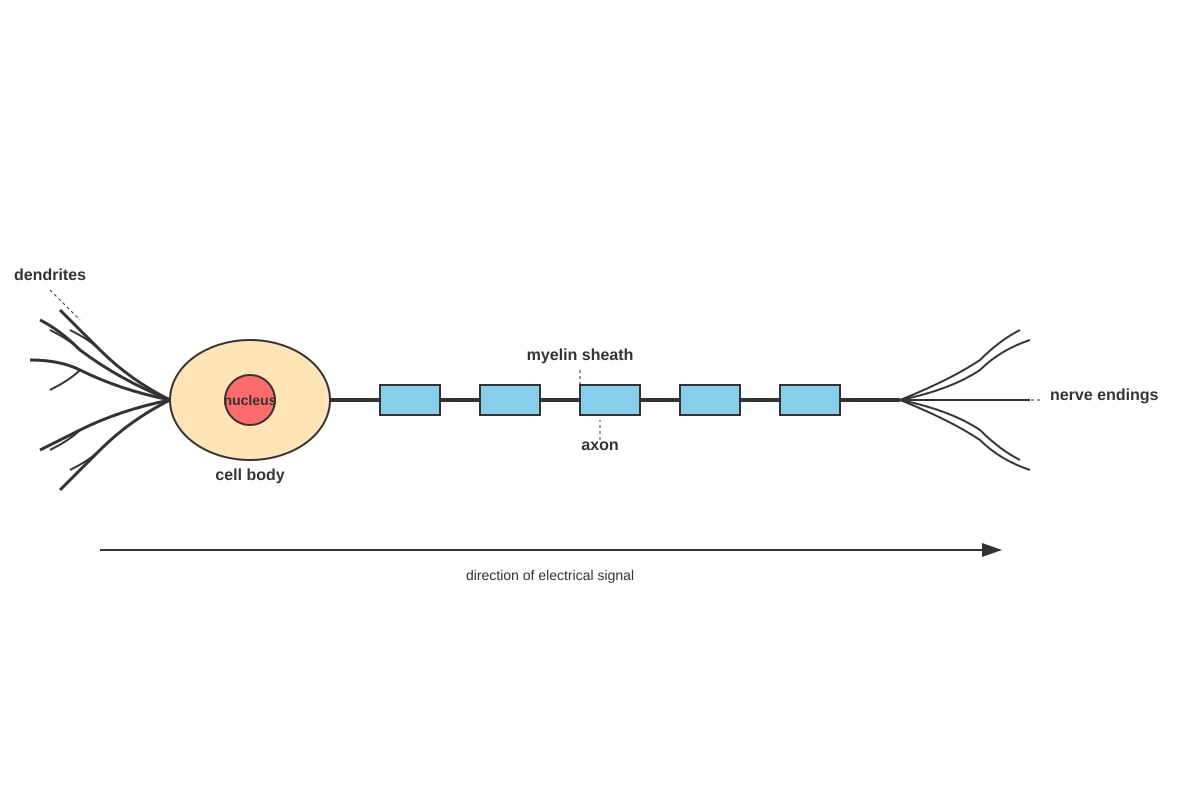
(a) Nerve cell / Neuron [1 mark]
(b) The nerve cell has a long axon that carries electrical signals over long distances [1]. The dendrites branch to receive signals from other nerve cells, and the nerve endings pass signals to the next cell in the circuit [1]. The myelin sheath insulates and speeds up this transmission.
Marking breakdown: [1 mark for identifying long axon/dendrites for signal transmission; 1 mark for explaining how this structure relates to function]
Teaching note: This is an example of structure-function relationship, a key concept in biology. The exaggerated length of the axon (up to 1 metre in humans) is specialized for rapid communication, unlike typical cells which are microscopic.
15. [3 marks]
| Cell Structure | Function |
|---|---|
| Nucleus | Contains genetic material (DNA/chromosomes) and controls cell activities [1] |
| Mitochondrion | Site of aerobic respiration; produces ATP/energy for the cell [1] |
| Cell membrane | Controls what enters and leaves the cell; selectively permeable barrier [1] |
Common mistake: Students often write "cell wall" for plant cell functions in this table. Ensure they match the given structure. For mitochondria, "produces energy" is acceptable but "site of respiration" is more precise.
Section C: Structured Questions (Questions 16–20)
16. [3 marks]
(a) The red colour will spread faster in Beaker B (the beaker at 60°C) [1].
Explanation: At higher temperatures, water particles have more kinetic energy and move faster [1]. The faster-moving particles collide more frequently and with more energy, causing the red dye particles to spread out (diffuse) more rapidly through the water [1]. This process is called diffusion.
Teaching note: This question assesses understanding of the particulate model of matter. The key insight is that temperature affects particle speed, which in turn affects the rate of diffusion. Students should not just state "heat makes it faster" but explain the mechanism through particle theory.
17. [3 marks total]
(a) Safety precaution: Wear gloves / Do not share spatulas / Clean spatula before use / Wash hands after procedure / Wear safety goggles [any valid precaution] [1 mark]
(b) Methylene blue stain binds to acidic components in cells, particularly the nucleus [1]. Human cheek cells are transparent and colourless; without staining, the nucleus and cell membrane boundaries would be nearly invisible under the microscope [1].
Teaching note: This practical is commonly done in Sec 1. The stain is basic and binds to nucleic acids, making the nucleus prominently visible. Emphasise safety with biological specimens—even one's own cells can carry microorganisms.
18. [5 marks total]
(a) The student who says the onion cell is largest is correct [1]. Magnification does not change the actual size of the specimen. The onion cell at 0.25 mm is physically the largest.
Calculation verification:
- Red blood cell actual size: 0.007 mm = 7 µm
- Onion cell actual size: 0.25 mm = 250 µm
- Image size at ×2000: 0.007 × 2000 = 14 mm
- Image size at ×100: 0.25 × 100 = 25 mm
Even viewed at ×2000, the red blood cell image (14 mm) is smaller than the onion cell image at ×100 (25 mm). The onion cell remains largest [2 marks for correct calculation and conclusion].
Alternative approach: Compare actual sizes directly: 0.25 mm > 0.007 mm, so onion cell is larger regardless of magnification.
(b) We need microscopes to see detailed internal structure [1]. Even specimens visible to the naked eye (like pollen grains) require magnification to observe cellular details—cell wall, nucleus, cytoplasm, and other organelles [1].
Teaching note: This question distinguishes between "size" and "magnified image size." Students often confuse these. The actual size is an intrinsic property; magnification only affects how large the image appears.
19. [4 marks total]
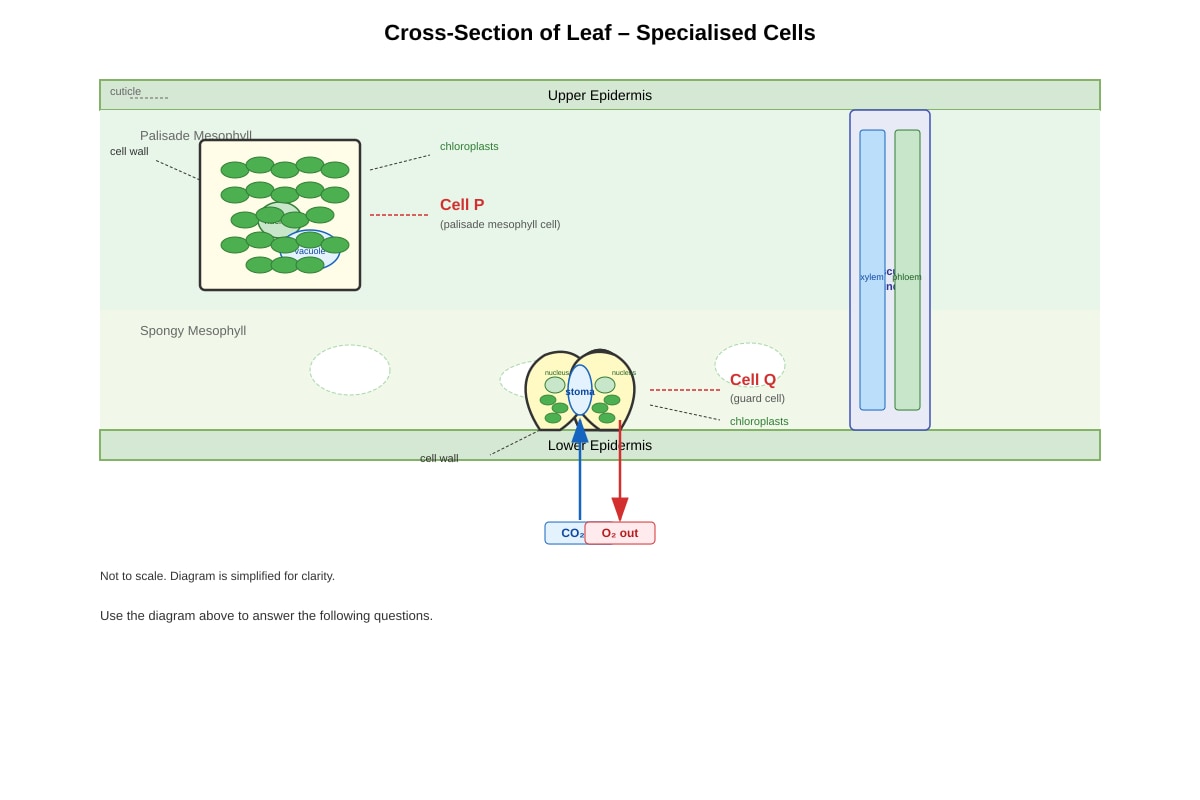
(a) Palisade mesophyll cells are the main site of photosynthesis in leaves [1]. Having many chloroplasts maximises the amount of chlorophyll available to absorb light energy, increasing the rate of photosynthesis and glucose production [1].
(b) The guard cells control the opening and closing of the stoma (pore) between them [1]. When the stoma is open, carbon dioxide enters for photosynthesis, and oxygen/water vapour exit. The kidney shape allows the pore to open when turgid and close when flaccid, regulating gas exchange [1].
Teaching note: Palisade cells are positioned at the top of the leaf to receive maximum light. Their cylindrical shape with minimal air gaps ensures efficient light absorption. Guard cells use osmosis to change shape—this will be covered in more detail in upper secondary.
20. [4 marks total]
(a) Cilia [1 mark]
(b) Paramecium is living because it shows the characteristics of life [1]:
- It moves using cilia to find food and avoid predators
- It feeds by sweeping food particles into its oral groove
- It respires to release energy from food
- It excretes waste through its anal pore
- It reproduces by dividing into two (binary fission)
- It responds to stimuli like light and chemicals
- It maintains water balance using contractile vacuoles
[Any three characteristics with brief explanation: 3 marks—1 mark per valid characteristic with application to Paramecium]
Teaching note: This question connects cell theory to the characteristics of life. Unicellular organisms perform all life functions within one cell, demonstrating that the cell is indeed the fundamental unit of life. The contractile vacuole is particularly interesting as it shows homeostasis at the cellular level.
— END OF ANSWER KEY —