AI Generated Quiz
Secondary 1 Science Chemistry Materials Quiz
Free AI-Generated Qwen3.7 Plus Secondary 1 Science Chemistry Materials quiz with questions and answers for Singapore students. This page is rendered as a direct URL so the questions and answers can be discovered without pressing in-page buttons.
These static practice materials are generated from the site's syllabus and paper-generation workflow, with source and model context shown so students and parents can evaluate the material before use.
Questions
Secondary 1 Science Quiz - Chemistry Materials
Name: __________________________
Class: __________________________
Date: __________________________
Score: _________ / 40
Duration: 45 minutes
Total Marks: 40
Instructions to Candidates:
- Answer all questions.
- Write your answers in the spaces provided.
- For questions requiring calculations, show your working clearly.
- Use proper chemical notation (e.g., , not H2O).
Section A: Multiple Choice Questions (10 marks)
Answer all questions. Each question carries 1 mark.
1. Which of the following is a characteristic property of a mixture? A. It has a fixed boiling point. B. Its components are chemically combined. C. Its components can be separated by physical means. D. It has a fixed composition by mass.
2. Which state of matter has particles that are closely packed in a regular arrangement and vibrate about fixed positions? A. Solid B. Liquid C. Gas D. Plasma
3. The diagram below shows the arrangement of particles in a substance. <image_placeholder> id: Q3-fig1 type: diagram linked_question: Q3 description: A box containing particles arranged in a regular, tightly packed grid pattern. The particles are touching each other. labels: None required inside box. values: None. must_show: Regular lattice structure, particles touching, no large gaps. </image_placeholder> What happens to the particles when the substance melts? A. They move further apart and lose their regular arrangement. B. They move closer together and form a regular arrangement. C. They stop vibrating completely. D. They break down into individual atoms.
4. Which of the following substances is an element? A. Water () B. Carbon dioxide () C. Oxygen () D. Salt ()
5. A student heats a blue solid in a test tube. The solid turns white, and water droplets form at the mouth of the test tube. What type of change has occurred? A. Physical change B. Chemical change C. Change of state only D. Dissolving
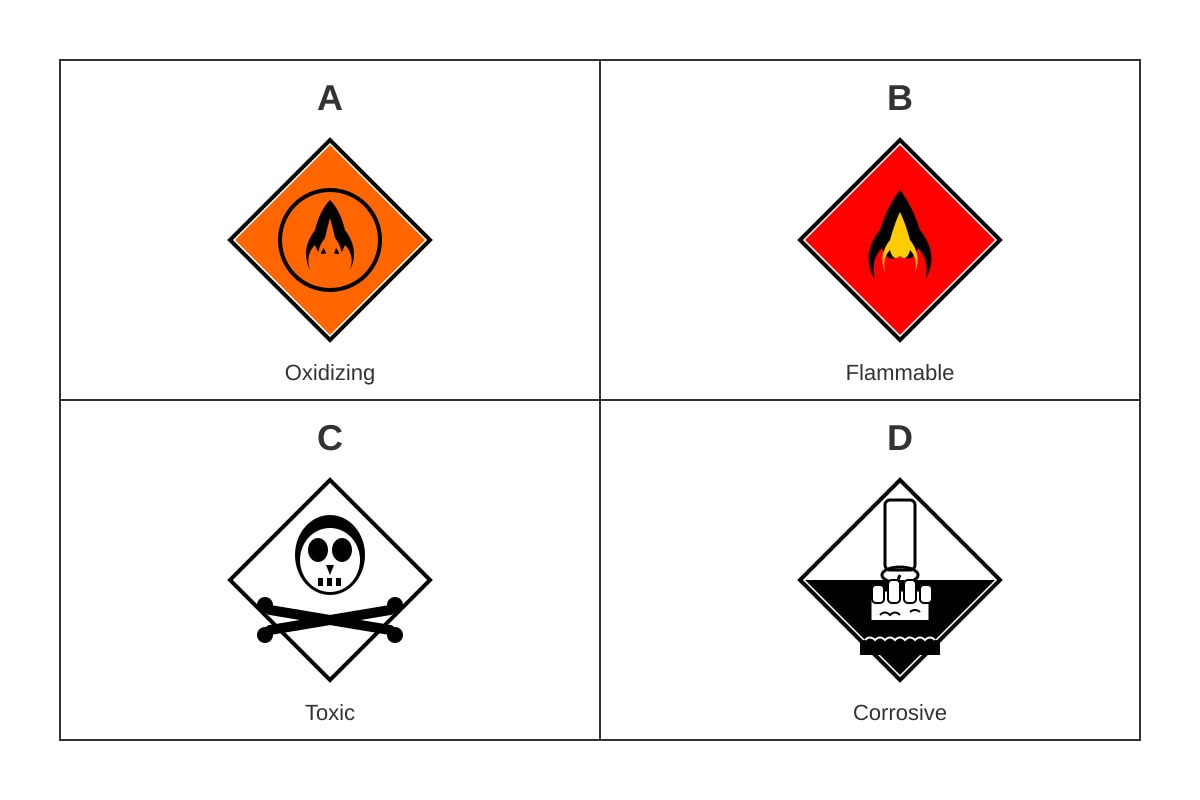
6. Which hazard symbol is used to indicate a substance that can catch fire easily? <image_placeholder> id: Q6-fig1 type: diagram linked_question: Q6 description: Four standard GHS hazard symbols arranged in a 2x2 grid. Top-left: Flame over circle (Oxidizing). Top-right: Flame (Flammable). Bottom-left: Skull and crossbones (Toxic). Bottom-right: Corrosion (Corrosive). labels: A, B, C, D assigned to Top-left, Top-right, Bottom-left, Bottom-right respectively. values: None. must_show: Clear distinction between the flame symbol and the flame-over-circle symbol. </image_placeholder> A. Symbol A B. Symbol B C. Symbol C D. Symbol D
7. What is the correct chemical formula for a molecule containing two hydrogen atoms and one oxygen atom? A. B. C. D.
8. Which process explains why the smell of perfume spreads across a room? A. Evaporation B. Condensation C. Diffusion D. Filtration
9. In the particulate model of matter, what represents the space between gas particles? A. Air B. Vacuum (empty space) C. Water vapour D. Dust particles
10. Which of the following is a compound? A. Iron () B. Air C. Sugar () D. Gold ()
Section B: Structured Questions (10 marks)
Answer all questions in the spaces provided.
11. The table below lists three substances: Iron, Water, and Air.
| Substance | State at Room Temperature |
|---|---|
| Iron | Solid |
| Water | Liquid |
| Air | Gas |
(a) Describe the arrangement and movement of particles in Iron. [2] <br> <br> <br>
(b) Explain why Air can be compressed easily, but Iron cannot. [2] <br> <br> <br>
12. A student performs an experiment to separate a mixture of sand and salt. The steps are listed below but are not in the correct order:
- P: Evaporate the filtrate to dryness.
- Q: Filter the mixture.
- R: Add water to the mixture and stir.
(a) Arrange the steps in the correct order. [1] <br> Answer: ______ ______ ______
(b) Name the residue left on the filter paper. [1] <br> Answer: __________________________
(c) Name the substance found in the filtrate. [1] <br> Answer: __________________________
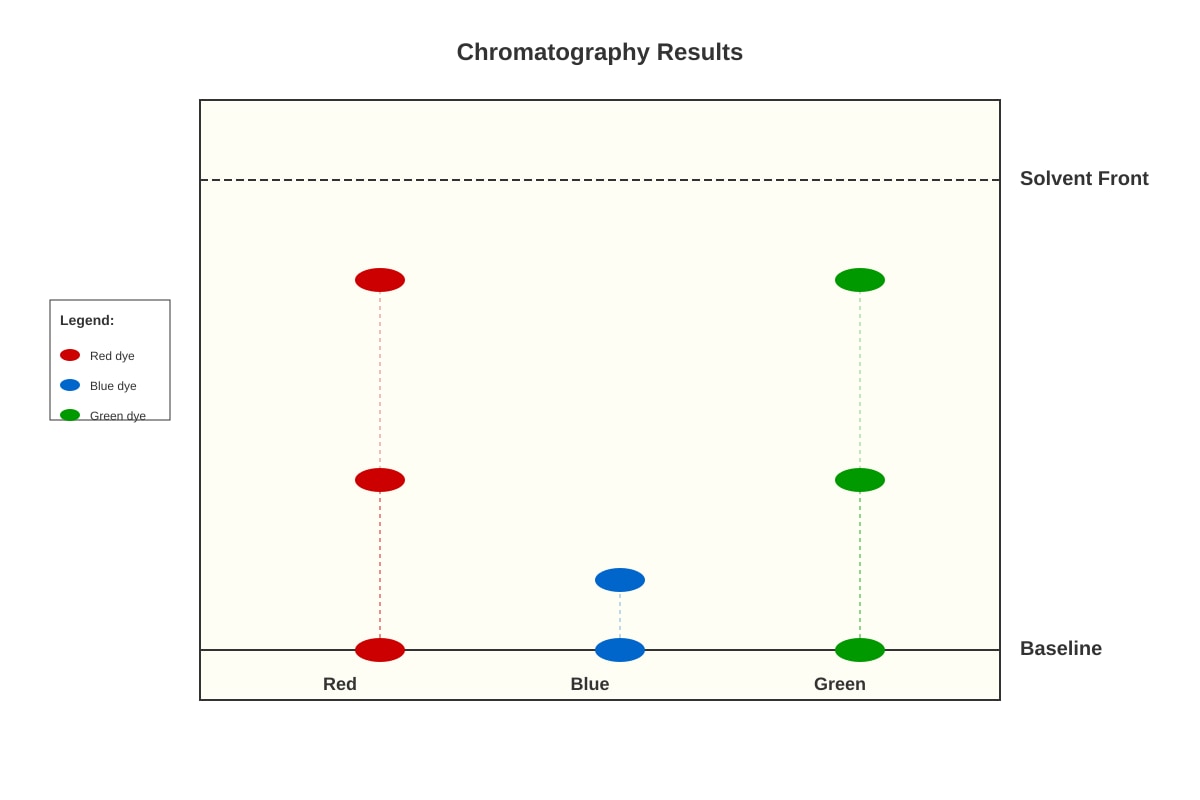
13. The diagram below shows a chromatography experiment performed on three food colourings: Red, Blue, and Green. <image_placeholder> id: Q13-fig1 type: diagram linked_question: Q13 description: A chromatogram on rectangular paper. A baseline is drawn near the bottom. Three spots are on the baseline labeled Red, Blue, Green. Above the baseline, the Red spot has separated into two distinct spots (one high, one low). The Blue spot has remained as a single spot near the baseline. The Green spot has separated into two spots that match the height of the Red spots. A solvent front line is drawn near the top. labels: Baseline, Solvent Front, Red, Blue, Green. values: Distances are not numerical but relative positions must be clear. must_show: Red splits into 2 components. Blue stays as 1 component. Green splits into 2 components matching Red's components. </image_placeholder>
(a) Which food colouring is a pure substance? Explain your answer. [2] <br> <br> <br>
(b) How many different dyes are present in the Green food colouring? [1] <br> Answer: __________________________
(c) Suggest a suitable solvent for this experiment. [1] <br> Answer: __________________________
14. Magnesium ribbon is burned in air. It produces a bright white light and leaves behind a white ash (Magnesium Oxide).
(a) Write the word equation for this reaction. [2] <br> <br> <br>
(b) Is this a physical or chemical change? Give one reason for your answer. [2] <br> <br> <br>
15. The diagram below shows the heating curve of pure water. <image_placeholder> id: Q15-fig1 type: graph linked_question: Q15 description: A line graph with Temperature () on the y-axis and Time (min) on the x-axis. The line starts at 20, rises linearly to 100, stays horizontal at 100 for a period, then rises again. labels: Y-axis: Temperature (), X-axis: Time (min). Points A (start), B (start of plateau at 100), C (end of plateau), D (end). values: Plateau is exactly at 100. must_show: Clear horizontal section at 100 labeled as boiling. </image_placeholder>
(a) What is the boiling point of water according to the graph? [1] <br> Answer: __________________________
(b) What happens to the energy supplied to the water during the section B-C? [1] <br> Answer: __________________________
Section C: Free Response Questions (10 marks)
16. A student is given two white powders: Substance X and Substance Y.
- Substance X melts at exactly .
- Substance Y melts over a range of to .
(a) Identify which substance is a pure substance and which is a mixture. [2] <br> Pure substance: __________________________ <br> Mixture: __________________________
(b) Explain how the melting behaviour helps you identify them. [2] <br> <br> <br> <br>
17. Diffusion is the net movement of particles from a region of higher concentration to a region of lower concentration.
(a) Describe an experiment using potassium manganate(VII) crystals and water to demonstrate diffusion in liquids. Include what you would observe. [3] <br> <br> <br> <br> <br> <br>
(b) Why does diffusion occur faster in gases than in liquids? Refer to the particulate model in your answer. [3] <br> <br> <br> <br> <br> <br>
18. Classify the following substances as an Element, Compound, or Mixture. [3]
(a) Distilled Water () <br> Answer: __________________________
(b) Sea Water <br> Answer: __________________________
(c) Helium Gas () <br> Answer: __________________________
19. A student wants to separate a mixture of ethanol (boiling point ) and water (boiling point ).
(a) Name the most suitable separation technique. [1] <br> Answer: __________________________
(b) Explain why this technique works for this mixture. [2] <br> <br> <br>
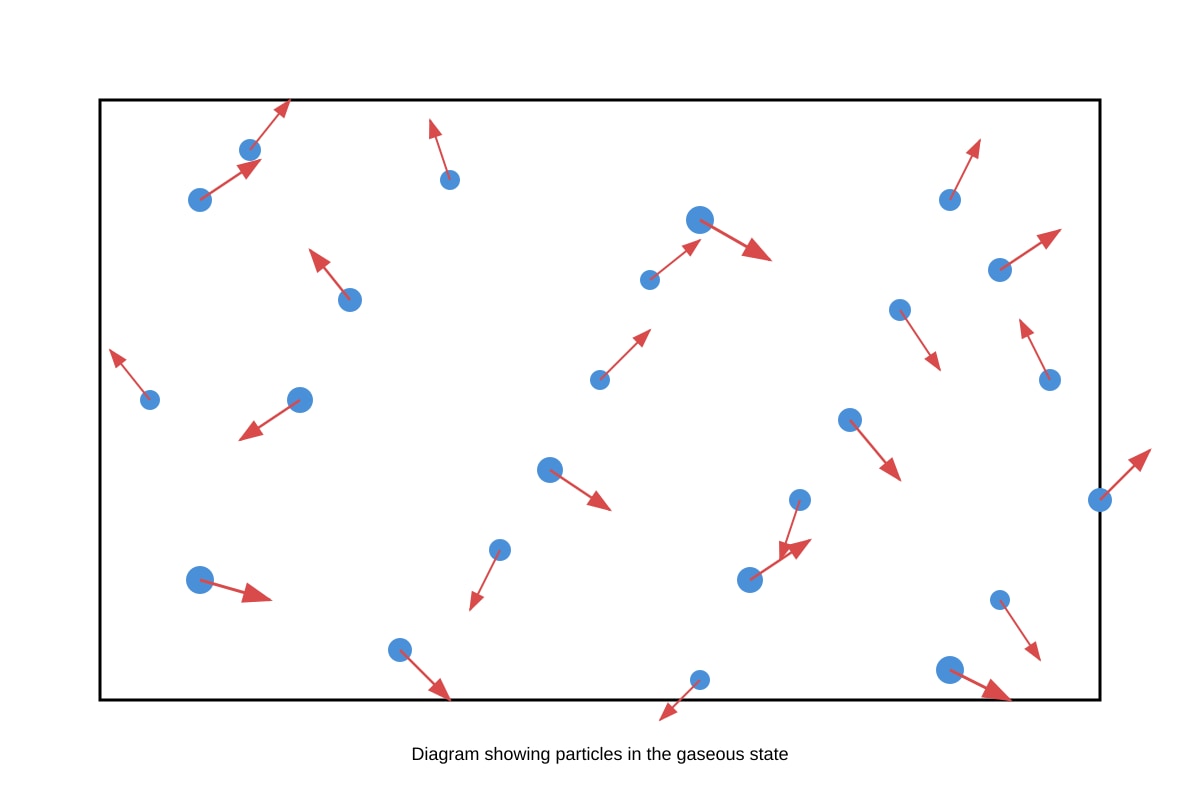
20. Consider the particle diagram below representing a substance in the gaseous state. <image_placeholder> id: Q20-fig1 type: diagram linked_question: Q20 description: A box containing widely spaced particles moving in random directions with arrows indicating velocity vectors of different lengths. labels: None. values: None. must_show: Large gaps between particles, random motion. </image_placeholder>
(a) If the temperature of this gas is increased, describe two changes that occur to the particles. [2] <br>
(b) If the gas is cooled until it becomes a liquid, what happens to the volume of the substance? Explain why. [2] <br> <br> <br>
End of Quiz
Answers
Secondary 1 Science Quiz - Chemistry Materials (Answer Key)
Total Marks: 40
Section A: Multiple Choice Questions
1. C
- Explanation: Mixtures are physically combined, so their components retain their individual properties and can be separated by physical methods (e.g., filtration, distillation). They do not have fixed boiling points or compositions.
2. A
- Explanation: In solids, particles are closely packed in a regular pattern (lattice) and can only vibrate about fixed positions. They have strong forces of attraction holding them together.
3. A
- Explanation: The diagram shows a solid (regular, tight packing). When a solid melts to become a liquid, the particles gain energy, move further apart, and lose their fixed regular arrangement, allowing them to slide past one another.
4. C
- Explanation: An element consists of only one type of atom. Oxygen () contains only oxygen atoms. Water, carbon dioxide, and salt contain more than one type of atom chemically bonded.
5. B
- Explanation: A new substance (white solid) is formed, and water is released. The change is not easily reversible by simple physical means. This indicates a chemical change.
6. B
- Explanation: Symbol B is the standard GHS symbol for "Flammable" (a flame). Symbol A is Oxidizing, C is Toxic, and D is Corrosive.
7. B
- Explanation: The formula indicates 2 hydrogen atoms and 1 oxygen atom. Subscripts indicate the number of atoms of the preceding element.
8. C
- Explanation: Diffusion is the random movement of particles that causes them to spread out from an area of high concentration (the perfume bottle) to low concentration (the rest of the room).
9. B
- Explanation: In the particulate model, gas particles are widely separated. The space between them is empty (vacuum), not filled with air or other matter.
10. C
- Explanation: Sugar () is a compound made of carbon, hydrogen, and oxygen atoms chemically bonded in a fixed ratio. Iron and Gold are elements. Air is a mixture.
Section B: Structured Questions
11. (a) [2 marks]
- Arrangement: Particles are closely packed in a regular arrangement. [1]
- Movement: Particles vibrate about fixed positions. [1]
(b) [2 marks]
- Air (Gas): There are large spaces between the particles, so they can be pushed closer together. [1]
- Iron (Solid): The particles are already closely packed with very little space between them, so they cannot be compressed further. [1]
12. (a) [1 mark]
- R Q P
(b) [1 mark]
- Sand
(c) [1 mark]
- Salt (or Salt solution)
13. (a) [2 marks]
- Substance: Blue. [1]
- Reason: It produces only one spot on the chromatogram, indicating it consists of a single substance. [1]
(b) [1 mark]
- 2 (two)
(c) [1 mark]
- Water (or Ethanol/Alcohol). Note: Water is the most common solvent for food colourings in Sec 1.
14. (a) [2 marks]
- Magnesium + Oxygen Magnesium Oxide [1 for reactants, 1 for product]
- Note: "Air" is acceptable for Oxygen in some contexts, but Oxygen is scientifically precise.
(b) [2 marks]
- Type: Chemical change. [1]
- Reason: A new substance (Magnesium Oxide) is formed which has different properties from the original magnesium. / The change is not easily reversible. [1]
15. (a) [1 mark]
- 100
(b) [1 mark]
- The energy is used to overcome the forces of attraction between particles to change the state from liquid to gas (breaking bonds/intermolecular forces), not to increase temperature.
Section C: Free Response Questions
16. (a) [2 marks]
- Pure substance: Substance X [1]
- Mixture: Substance Y [1]
(b) [2 marks]
- Pure substances have sharp, fixed melting points. [1]
- Mixtures melt over a range of temperatures because the different components interfere with each other's crystal lattice structure. [1]
17. (a) [3 marks]
- Method: Place a crystal of potassium manganate(VII) at the bottom of a beaker of water. Do not stir. [1]
- Observation 1: The purple colour slowly spreads out from the crystal. [1]
- Observation 2: Eventually, the entire solution becomes uniformly purple. [1]
(b) [3 marks]
- Gas Particles: Have more kinetic energy and move faster than liquid particles. [1]
- Spacing: There are larger spaces between gas particles, allowing them to move freely and collide less frequently than in liquids. [1]
- Forces: Forces of attraction between gas particles are negligible, whereas liquid particles have stronger forces holding them closer, restricting movement. [1]
18. (a) [1 mark]
- Compound
(b) [1 mark]
- Mixture
(c) [1 mark]
- Element
19. (a) [1 mark]
- Fractional Distillation (or Simple Distillation is acceptable if fractional is not yet taught, but fractional is more precise for close boiling points. At Sec 1 level, "Distillation" is often accepted). Accept: Distillation.
(b) [2 marks]
- Ethanol and water have different boiling points. [1]
- Ethanol boils at a lower temperature () and vaporizes first, allowing it to be collected separately from the water. [1]
20. (a) [2 marks]
-
- The particles move faster (gain kinetic energy). [1]
-
- The particles collide with the walls of the container more frequently/harder (or move further apart if volume is not fixed). [1]
(b) [2 marks]
- Volume Change: The volume decreases significantly. [1]
- Reason: In the liquid state, particles are much closer together than in the gaseous state, occupying less space. [1]