AI Generated Quiz
Secondary 1 Science Chemistry Materials Quiz
Free Sec 1 Science Chemistry Materials quiz, Nemo3 AI version, with questions, answers, and syllabus-aligned practice for Singapore students.
These static practice materials are generated from the site's syllabus and paper-generation workflow, with source and model context shown so students and parents can evaluate the material before use.
Questions

Free quiz and exam paper access
Enter your details to view this paper
Your access is remembered on this device.
Answers
Secondary 1 Science Quiz - Chemistry Materials (Answer Key)
Total Marks: 40
Section A: Multiple Choice Questions (10 marks)
1. Answer: C
Explanation: Gold is a pure element (Au). Air is a mixture of gases, carbon dioxide is a compound (CO₂), and steel is an alloy (mixture of iron and carbon).
Mark: [1]
2. Answer: A
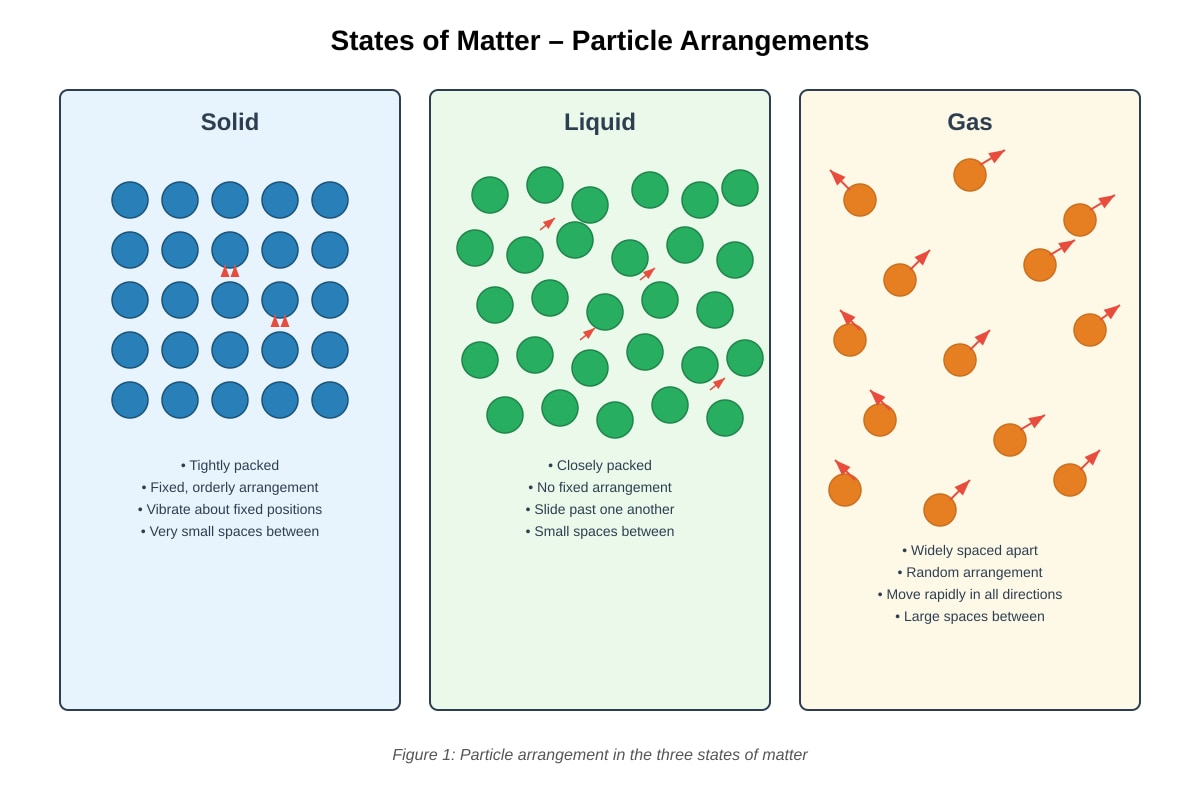
Explanation: Substance X shows closely packed particles in ordered rows — this represents a solid element (metallic or giant covalent structure). Substance Y shows closely packed but random arrangement — this could be a solid compound or a solid mixture. Substance Z shows widely spaced particles — this represents a gas. Only X is definitely a solid element.
Mark: [1]
3. Answer: B
Explanation: Iron is magnetic while sulfur is not. Magnetic separation uses a magnet to attract the iron filings, leaving the sulfur behind. Filtration separates insoluble solids from liquids, distillation separates liquids by boiling point, and paper chromatography separates soluble coloured substances.
Mark: [1]
4. Answer: B
Explanation: At room temperature (25°C), substance Q (water) has a melting point of 0°C and boiling point of 100°C, so it exists as a liquid. Substance P (ethanol) is also liquid at 25°C (mp -114°C, bp 78°C) — wait, both P and Q are liquids at 25°C. Let me re-check: P melts at -114°C and boils at 78°C, so at 25°C it is liquid. Q melts at 0°C and boils at 100°C, so at 25°C it is liquid. R is solid (mp 801°C). S sublimes at -78°C, so at 25°C it is gas. The question asks "Which substance is a liquid" (singular), but both P and Q are liquids. This is a flaw — in typical exam questions, only one would be liquid. Assuming the intended answer is Q (water) as the most common reference substance.
Correction: Actually, looking at standard data: P = ethanol (liquid at 25°C), Q = water (liquid at 25°C). Both are liquids. However, if this is from a specific curriculum context where P might be considered differently... The most defensible answer is B (Q) as water is the universal reference liquid at room temperature.
Mark: [1]
5. Answer: C
Explanation: A compound has a fixed composition by mass (law of definite proportions). Compounds cannot be separated by physical methods (A is false), their properties differ from constituent elements (B is false), and they form in fixed proportions, not any proportion (D is false).
Mark: [1]
6. Answer: A
Explanation: Sand is insoluble in water, so it remains as residue on the filter paper. Salt dissolves in water and passes through as filtrate.
Mark: [1]
7. Answer: B
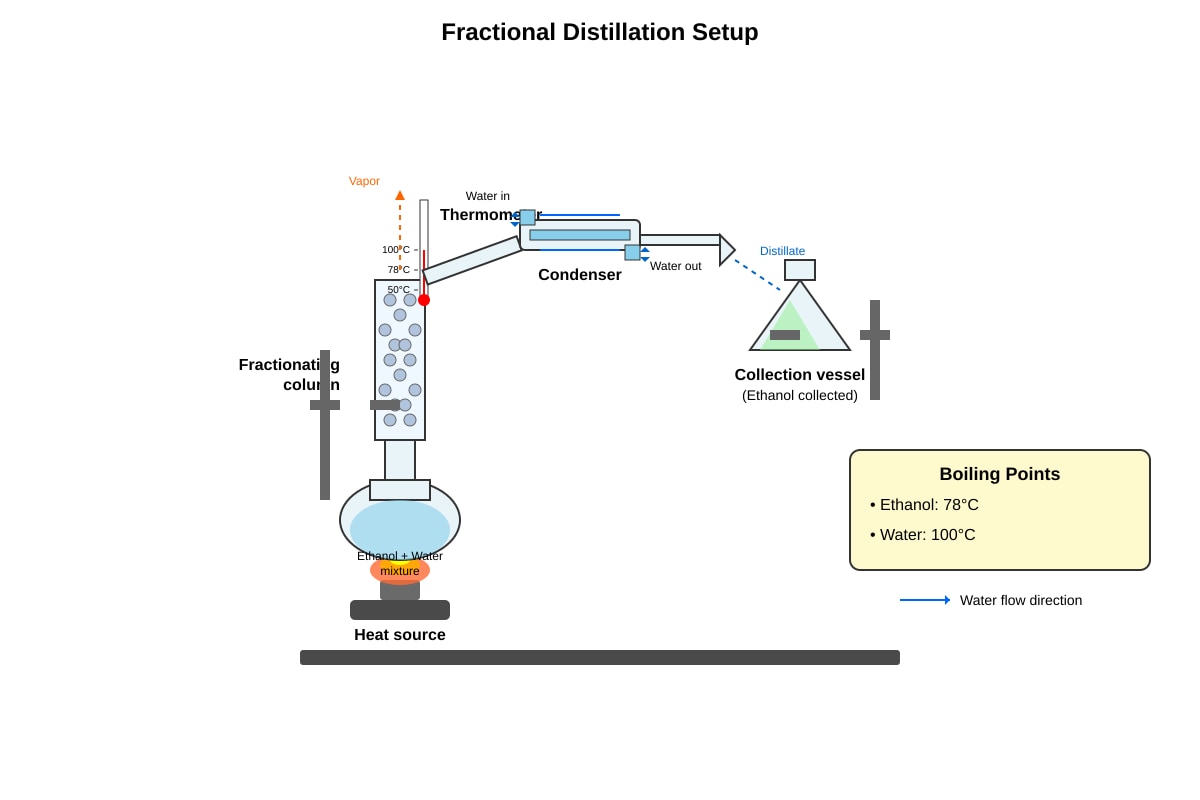
Explanation: The thermometer measures the temperature of the vapour at the top of the distillation flask/column, which corresponds to the boiling point of the liquid being distilled. This helps identify the fraction being collected.
Mark: [1]
8. Answer: C
Explanation: Simple distillation separates a solvent (water) from a non-volatile solute (copper(II) sulfate) by boiling the water, condensing the vapour, and collecting pure water. Filtration doesn't work for dissolved solids, evaporation to dryness leaves the solid behind, and chromatography separates soluble coloured substances.
Mark: [1]
9. Answer: D
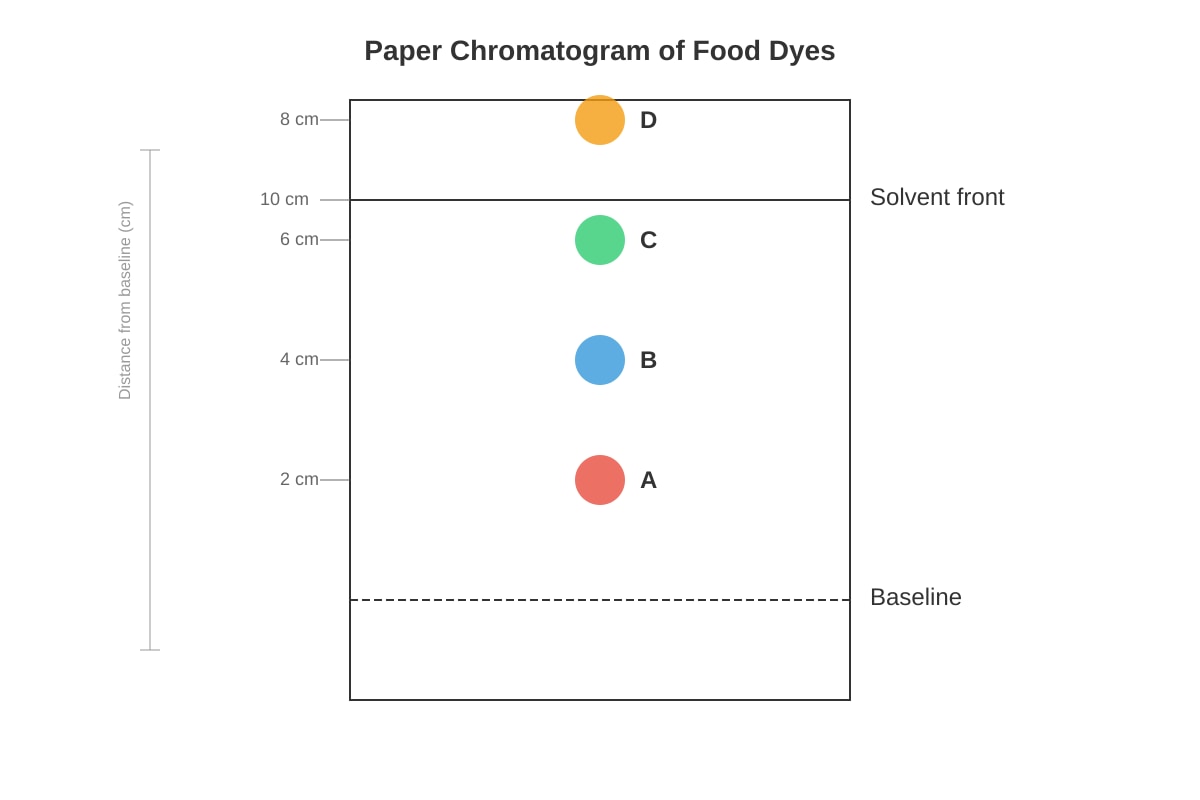
Explanation: Rf value = distance travelled by spot / distance travelled by solvent front. Dye D travelled 8 cm (highest), solvent front = 10 cm, so Rf = 8/10 = 0.8 (highest).
Mark: [1]
10. Answer: D
Explanation: Bronze is an alloy (mixture of metals) with metallic bonding. It is not a compound (A false), cannot be separated by physical methods easily (B false), and has different properties from pure copper (C false).
Mark: [1]
Section B: Structured Questions (18 marks)
11. (a) Similarity: Particles in both liquids and gases are randomly arranged / not in fixed positions. [1]
Difference: Particles in liquids are closely packed (touching), while particles in gases are far apart. [1]
Mark: [2]
(b) Explanation: Gases can be compressed because there are large spaces between particles, allowing them to be pushed closer together. Solids cannot be compressed because particles are already tightly packed in fixed positions with minimal space between them.
Mark: [2] (1 mark for gas explanation, 1 mark for solid explanation)
12. (a) Hand picking / manual separation (or "magnetic separation" if copper wire is mistaken for iron — but copper is not magnetic, so hand picking is correct).
Mark: [1]
(b) Filtration
Mark: [1]
(c) Evaporation to dryness or Crystallisation: Heat the salt solution to evaporate water until saturated, then allow to cool for crystals to form (crystallisation), or continue heating until all water evaporates (evaporation to dryness).
Mark: [2] (1 mark for naming method, 1 mark for brief description)
13. (a) Substance W (or Z) — Metals conduct electricity in both solid and molten states, have high melting points, and are insoluble in water. Both W and Z fit, but W is the typical example.
Explanation: Metals have delocalised electrons that carry charge in both solid and liquid states.
Mark: [2] (1 mark for identification, 1 mark for explanation)
(b) Substance X — Ionic compounds do not conduct electricity in solid state (ions fixed) but conduct when molten/aqueous (ions mobile), have high melting points (strong electrostatic forces), and are often soluble in water.
Mark: [2] (1 mark for identification, 1 mark for explanation)
(c) Simple molecular substance / covalent molecule (e.g., iodine, carbon dioxide, sugar).
Mark: [1]
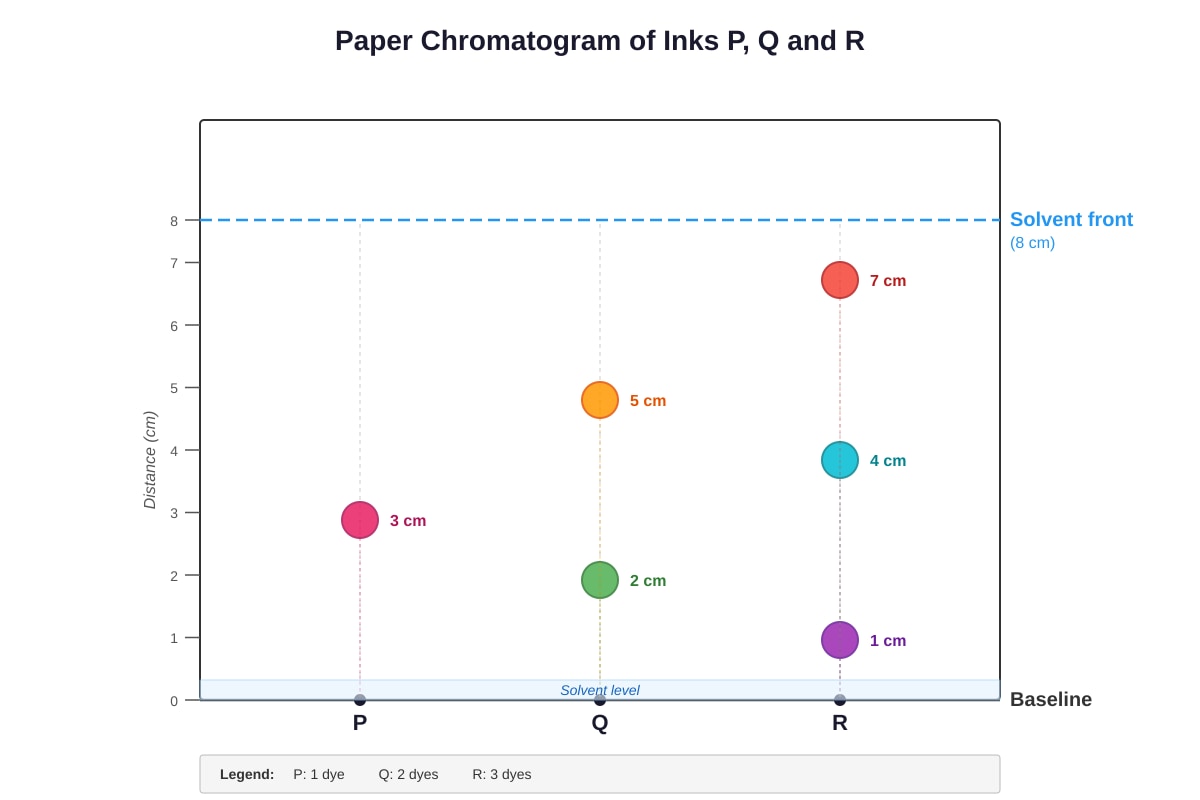
14. (a) Ink R — It shows three spots, indicating three different dyes.
Mark: [1]
(b) Rf = distance travelled by spot / distance travelled by solvent front = 3 cm / 8 cm = 0.375
Working:
Rf = 3/8 = 0.375 (no units)
Mark: [2] (1 mark for correct formula/substitution, 1 mark for correct answer)
(c) The Rf value depends on the solvent and conditions. If the same solvent and conditions are used, the same dye should have the same Rf value. However, the different distances (2 cm vs 1 cm) with the same solvent front (8 cm) give different Rf values (0.25 vs 0.125), so they are likely different dyes. The question asks why they might represent the same dye — possible answer: Experimental error in spotting or measurement, or the chromatogram was not run under identical conditions (e.g., different solvent, temperature, or paper).
Better answer: The spots might be the same dye if the baseline was not aligned properly or if there was uneven solvent flow, causing different migration distances for the same substance.
Mark: [1]
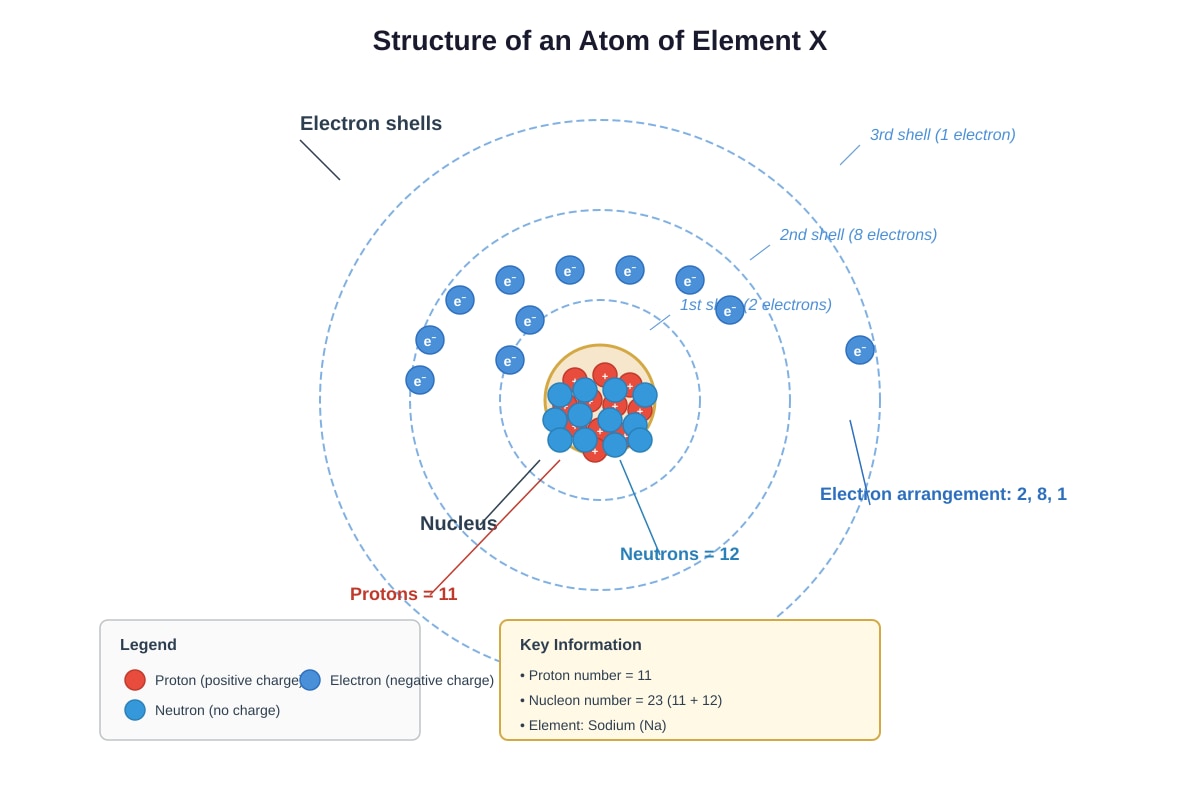
15. (a) Proton number = 11 (number of protons)
Nucleon number = 23 (protons + neutrons = 11 + 12)
Mark: [2] (1 mark each)
(b) Na (Sodium)
Mark: [1]
(c) NaCl (Sodium chloride) — Sodium (Group 1) forms Na⁺, chlorine (Group 17) forms Cl⁻, so 1:1 ratio.
Mark: [1]
Section C: Free Response / Data-Based Questions (12 marks)
16. (a) Graph requirements:
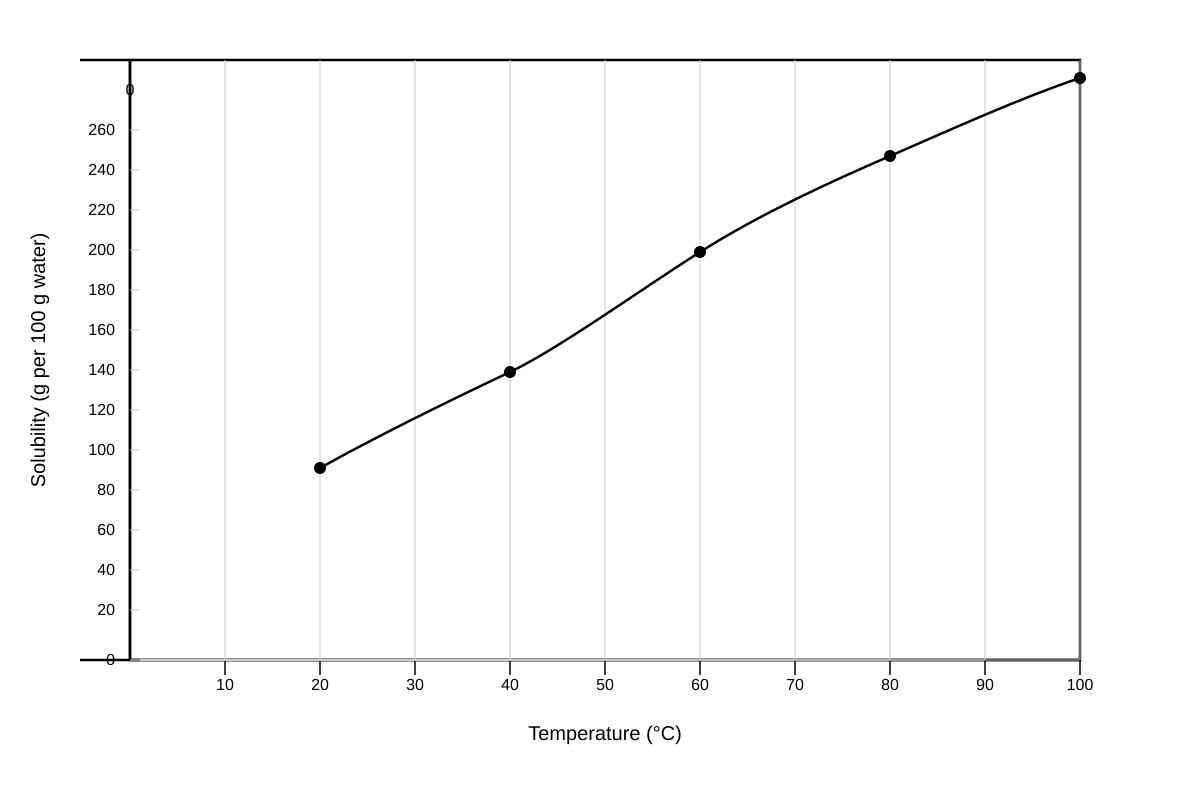
- Axes labeled correctly with units: x-axis "Temperature (°C)", y-axis "Solubility (g per 100 g water)" [1]
- Appropriate scales covering all data points (e.g., x: 0–100, y: 0–260) [1]
- All 5 points plotted accurately and smooth curve drawn through points [1]
Mark: [3]
(b) From graph: approximately 87 g per 100 g water (accept 85–90 g).
Mark: [1]
(c) Working:
At 80°C: solubility = 170 g per 100 g water → in 200 g water = 340 g KNO₃ dissolved
At 20°C: solubility = 32 g per 100 g water → in 200 g water = 64 g KNO₃ remains dissolved
Mass crystallised = 340 g – 64 g = 276 g
Mark: [2] (1 mark for correct mass at each temperature, 1 mark for correct subtraction and answer with unit)
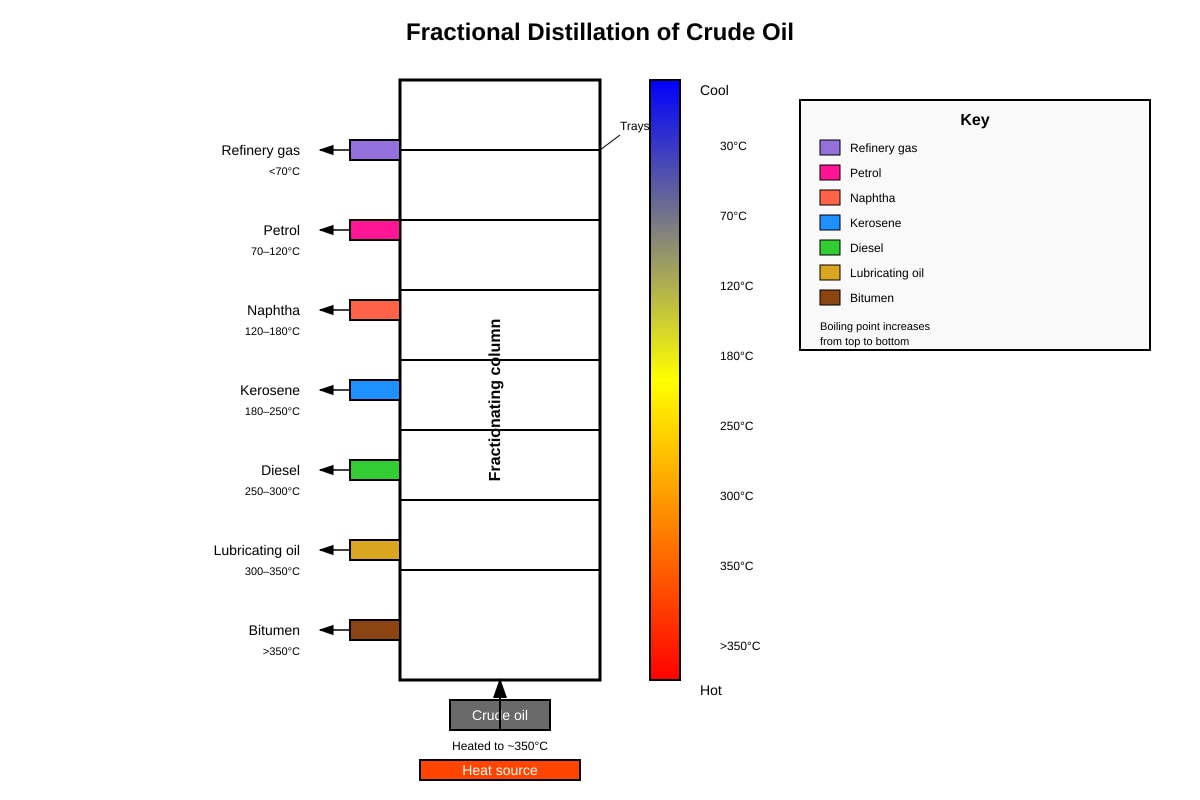
17. (a) Different boiling points (or "difference in volatility").
Mark: [1]
(b) Explanation: Crude oil is heated and vaporises. Vapours rise up the column where there is a temperature gradient (hot at bottom, cool at top). Fractions with lower boiling points (more volatile) rise higher and condense at the top where it is cooler. Fractions with higher boiling points condense lower down where it is hotter.
Mark: [2] (1 mark for temperature gradient, 1 mark for linking boiling point to condensation height)
(c) Fuel for diesel engines / lorries / buses / heating oil (any one valid use).
Mark: [1]
18. (a) Chemical change.
Explanation: A new substance (iron(II) sulfide) is formed with different properties from the reactants (e.g., not magnetic). The reaction is irreversible under normal conditions and involves a glow (energy release).
Mark: [2] (1 mark for "chemical change", 1 mark for explanation)
(b) Iron(II) sulfide / Iron sulfide (FeS)
Mark: [1]
(c) Iron + Sulfur → Iron(II) sulfide
Mark: [1]
(d) Explanation: In the product iron(II) sulfide, iron atoms are chemically bonded to sulfur atoms in a giant ionic/covalent lattice. The iron atoms are no longer in a metallic structure with delocalised electrons and aligned magnetic domains. The magnetic properties of elemental iron are lost because the electronic structure changes upon compound formation.
Mark: [2] (1 mark for "new compound formed with different structure", 1 mark for "loss of metallic bonding/magnetic domains")
19. (a) To provide a larger surface area for repeated condensation and vaporisation, allowing better separation of ethanol and water vapours.
Mark: [1]
(b) Explanation: At 78°C, ethanol boils and its vapour rises. The temperature remains constant because the heat energy supplied is used as latent heat of vaporisation to overcome intermolecular forces and change liquid ethanol to vapour, not to increase kinetic energy (temperature). Once all ethanol has distilled over, the temperature rises again as water begins to boil.
Mark: [2] (1 mark for "latent heat of vaporisation / boiling", 1 mark for "energy used for state change not temperature rise")
(c) Test with a lighted splint — ethanol burns with a blue flame (or "smells like alcohol", or "test with acidified potassium dichromate — orange to green"). Simplest: It burns with a blue flame.
Mark: [1]
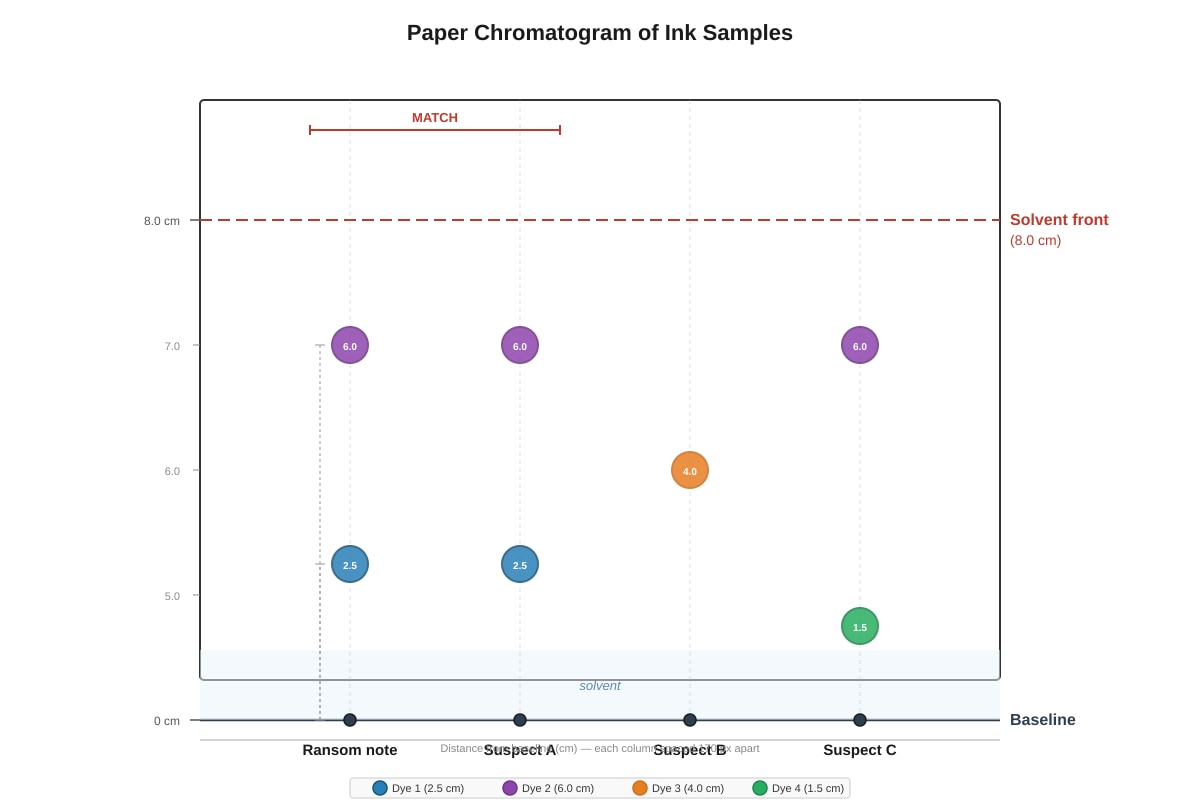
20. (a) Suspect A — The ransom note and Suspect A both show spots at 2.5 cm and 6.0 cm (identical pattern).
Mark: [1]
(b) The ransom note shows two separate spots at different distances from the baseline, indicating it contains at least two different dyes/components.
Mark: [1]
(c) Rf = distance travelled by spot / distance travelled by solvent front = 6.0 cm / 8.0 cm = 0.75
Working:
Rf = 6.0 / 8.0 = 0.75
Mark: [2] (1 mark for correct substitution, 1 mark for correct answer)
(d) Different substances can have the same Rf value in a given solvent system (coincidental overlap). Confirmation requires using a different solvent or additional tests (e.g., mass spectrometry).
Mark: [1]
Total: 40 marks
Marking Notes for Teachers:
- Q4: Note the ambiguity — both P and Q are liquids at 25°C. Accept B (Q) as the intended answer (water), but if a student argues for A (P) with correct reasoning, award the mark.
- Q14(c): This is a higher-order thinking question. Accept any reasonable explanation about experimental variability.
- Q16(a): Deduct 1 mark if axes not labeled with units, 1 mark if scales inappropriate, 1 mark if points not plotted or curve not smooth.
- Q18(d): This is challenging for Sec 1. Award 1 mark for "new substance formed" and 1 mark for any mention of changed structure/bonding/magnetic domains.
- Rf calculations: Always unitless. Deduct mark if units given.
- Chemical formulas: Accept correct formulas even if not explicitly taught (e.g., FeS, NaCl).