AI Generated Quiz
Secondary 1 Science Chemistry Materials Quiz
Free Sec 1 Science Chemistry Materials quiz with questions, answers, and syllabus-aligned practice for Singapore students preparing for school assessments.
These static practice materials are generated from the site's syllabus and paper-generation workflow, with source and model context shown so students and parents can evaluate the material before use.
Questions
Secondary 1 Science Quiz - Chemistry Materials
Name: _________________________________ Class: _________________ Date: _________________
Duration: 40 minutes | Total Marks: 40 | Score: _______ / 40
Instructions:
- Answer all questions.
- Write your answers in the spaces provided.
- For calculation questions, show your working clearly.
- Read each question carefully before answering.
Section A: Multiple Choice (Questions 1–8)
Choose the correct answer. Each question carries 1 mark.
1. Which of the following is a pure substance?
- A) Air
- B) Steel
- C) Distilled water
- D) Seawater
Answer: _________________
2. The chemical formula for sulfuric acid is H₂SO₄. How many different elements are present in this compound?
- A) 3
- B) 4
- C) 5
- D) 7
Answer: _________________
3. Which separation technique would be most suitable for obtaining pure salt from seawater?
- A) Filtration
- B) Evaporation
- C) Chromatography
- D) Magnetic separation
Answer: _________________
4. A student places a small piece of sodium metal into water. The sodium reacts vigorously and produces a gas that burns with a pop sound. What is the gas produced?
- A) Oxygen
- B) Carbon dioxide
- C) Hydrogen
- D) Nitrogen
Answer: _________________
5. Which property best explains why copper is used to make electrical wires?
- A) It is a solid at room temperature
- B) It has a high melting point
- C) It is a good conductor of electricity
- D) It is malleable
Answer: _________________
6. The element symbol "Fe" represents which metal?
- A) Lead
- B) Iron
- C) Copper
- D) Zinc
Answer: _________________
7. A mixture contains iron filings and sulfur powder. Which method can be used to separate them?
- A) Dissolving in water and filtering
- B) Using a magnet
- C) Fractional distillation
- D) Chromatography
Answer: _________________
8. What is the charge of a proton compared to an electron?
- A) Same magnitude, same sign
- B) Same magnitude, opposite sign
- C) Different magnitude, same sign
- D) Different magnitude, opposite sign
Answer: _________________
Section B: Structured Questions (Questions 9–16)
9. (a) State the difference between an element and a compound. [2 marks]
(b) Give one example of an element and one example of a compound. [2 marks]
Element: ___________________________________________________________
Compound: _________________________________________________________
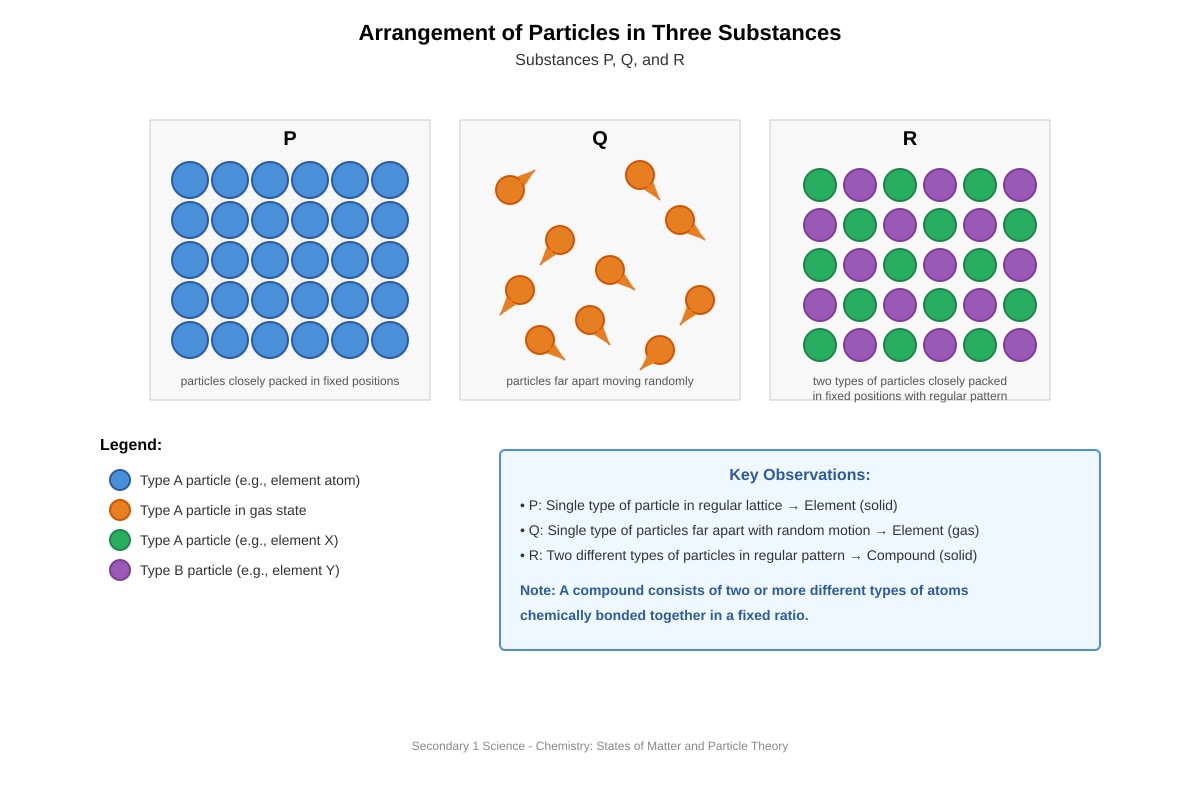
10. The diagram below shows the arrangement of particles in three different substances P, Q, and R.
<image_placeholder> id: Q10-fig1 type: diagram linked_question: Q10 description: Three particle arrangement diagrams showing different states of matter or types of substances labels: P (particles closely packed in fixed positions), Q (particles far apart moving randomly), R (two types of particles closely packed in fixed positions with regular pattern) values: none must_show: Clear distinction between fixed lattice arrangement (P), random gas arrangement (Q), and compound crystal arrangement with two different particle types (R); labels P, Q, R clearly indicated </image_placeholder>
(a) State which substance (P, Q, or R) represents a compound. Explain your answer. [2 marks]
(b) State which substance represents a gas. Give one reason. [2 marks]
11. A student carried out an experiment to separate a mixture of sand and salt.
Step 1: Add water to the mixture and stir. Step 2: Filter the mixture. Step 3: Heat the filtrate until dry.
(a) Explain why salt dissolves in water but sand does not. [2 marks]
(b) What is the purpose of Step 2 (filtration)? [1 mark]
(c) Name the separation techniques used in Steps 2 and 3. [2 marks]
Step 2: ___________________________________________________________
Step 3: ___________________________________________________________
12. The table below shows some properties of four substances.
| Substance | Melting point (°C) | Boiling point (°C) | Solubility in water | Conducts electricity when solid |
|---|---|---|---|---|
| W | 3550 | 4827 | Insoluble | Yes |
| X | -78 | -33 | Soluble | No |
| Y | 114 | 445 | Slightly soluble | No |
| Z | 801 | 1413 | Soluble | No |
(a) Which substance is likely to be a metal? Explain your answer. [2 marks]
(b) Which substance is likely to be a molecular compound? Explain your answer using two pieces of evidence from the table. [3 marks]
13. (a) Write the chemical formula for calcium carbonate. [1 mark]
(b) Calcium carbonate decomposes when heated strongly to form calcium oxide and carbon dioxide. Write a word equation for this reaction. [2 marks]
14. An atom of element X has 11 protons, 12 neutrons, and 11 electrons.
(a) What is the nucleon number (mass number) of element X? [1 mark]
(b) What is the proton number (atomic number) of element X? [1 mark]
(c) Explain why atom X is electrically neutral overall. [2 marks]
15. The pH scale is used to measure how acidic or alkaline a substance is.
(a) State the pH value of pure water. [1 mark]
(b) A student tests three solutions with universal indicator paper. The results are:
- Solution A: red
- Solution B: green
- Solution C: purple
Classify each solution as acidic, neutral, or alkaline. [3 marks]
Solution A: _______________________________________________________
Solution B: _______________________________________________________
Solution C: _______________________________________________________
(c) Hydrochloric acid has a pH of 1. Explain why it is dangerous to touch concentrated hydrochloric acid with bare hands. [2 marks]
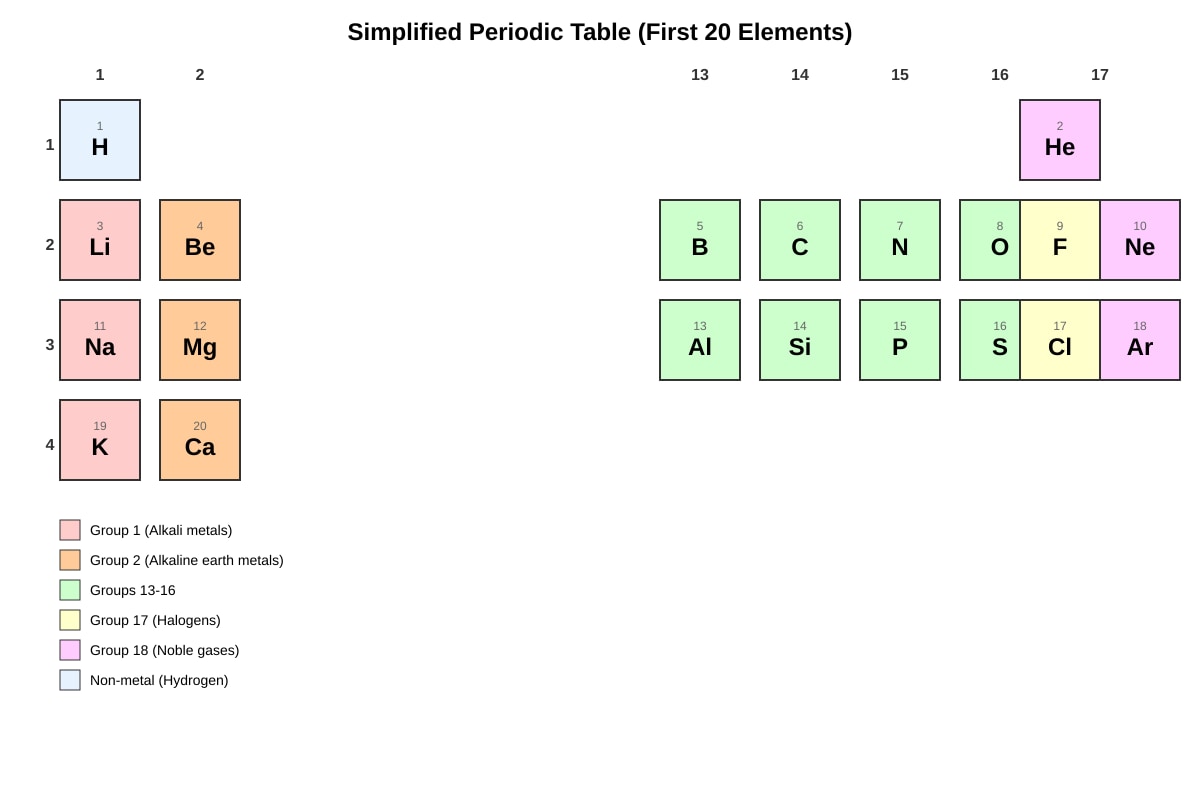
16. Below is a simplified periodic table showing the first 20 elements.
<image_placeholder> id: Q16-fig1 type: table linked_question: Q16 description: Simplified periodic table showing first 20 elements in standard periodic table layout with periods 1-4 and groups 1, 2, 13-18 labels: H, He, Li, Be, B, C, N, O, F, Ne, Na, Mg, Al, Si, P, S, Cl, Ar, K, Ca with their symbols; groups labeled 1, 2, 13, 14, 15, 16, 17, 18; periods labeled 1, 2, 3, 4 values: Atomic numbers 1-20 shown must_show: Standard periodic table arrangement; key group 1 elements (Li, Na, K) clearly in same column; key group 17 elements (F, Cl) clearly in same column; noble gases (He, Ne, Ar) in group 18 </image_placeholder>
(a) Which group contains the noble gases? [1 mark]
(b) Name two elements that belong to the same group and explain what this means about their chemical properties. [3 marks]
(c) Sodium (Na) reacts vigorously with water. Predict how potassium (K) would react with water compared to sodium, and explain your prediction using the periodic table. [2 marks]
Section C: Application and Analysis (Questions 17–20)
17. A student wants to identify an unknown white powder. She carries out the following tests:
Test 1: The powder dissolves completely in water to give a clear, colourless solution. Test 2: When the solution is tested with a flame test, it gives a yellow-orange flame. Test 3: When silver nitrate solution is added, a white precipitate forms.
(a) What can the student conclude from Test 1 about the unknown powder? [1 mark]
(b) The yellow-orange flame in Test 2 suggests the presence of which metal ion? [1 mark]
(c) The white precipitate with silver nitrate in Test 3 suggests the presence of which ion? [1 mark]
(d) Based on all three tests, suggest the identity of the white powder. [2 marks]
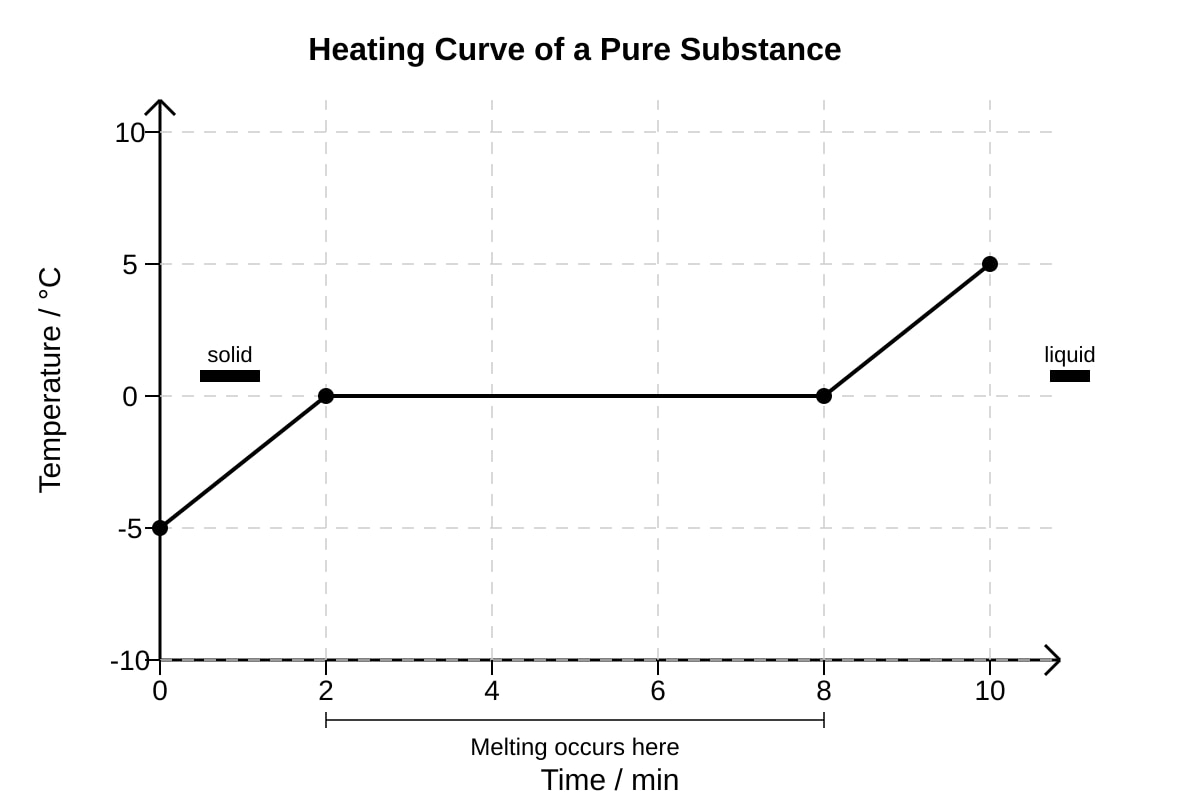
18. The graph below shows how the temperature of a pure substance changes as it is heated steadily from a solid to a liquid.
<image_placeholder> id: Q18-fig1 type: graph linked_question: Q18 description: Heating curve showing temperature against time for a pure substance melting labels: x-axis "Time / min", y-axis "Temperature / °C" values: Initial temperature -10°C, linear rise to 0°C at 3 min, plateau at 0°C from 3 min to 8 min, linear rise after 8 min to 10°C at 10 min must_show: Clear plateau at 0°C lasting 5 minutes; axes labeled with units; two distinct sloped sections separated by horizontal plateau; melting point explicitly at 0°C </image_placeholder>
(a) State the melting point of this substance. [1 mark]
(b) Explain why the temperature remains constant between 3 and 8 minutes even though heating continues. [3 marks]
(c) State whether this substance is likely to be ice or a metal. Explain your answer. [2 marks]
19. Aluminum is a metal with many useful properties. It is used to make aircraft bodies, saucepans, and overhead power cables.
(a) Explain why aluminum is suitable for making aircraft bodies. Consider two properties. [4 marks]
(b) The surface of aluminum reacts with oxygen in the air to form a thin layer of aluminum oxide. Explain why this is beneficial for saucepans despite aluminum being quite reactive. [2 marks]
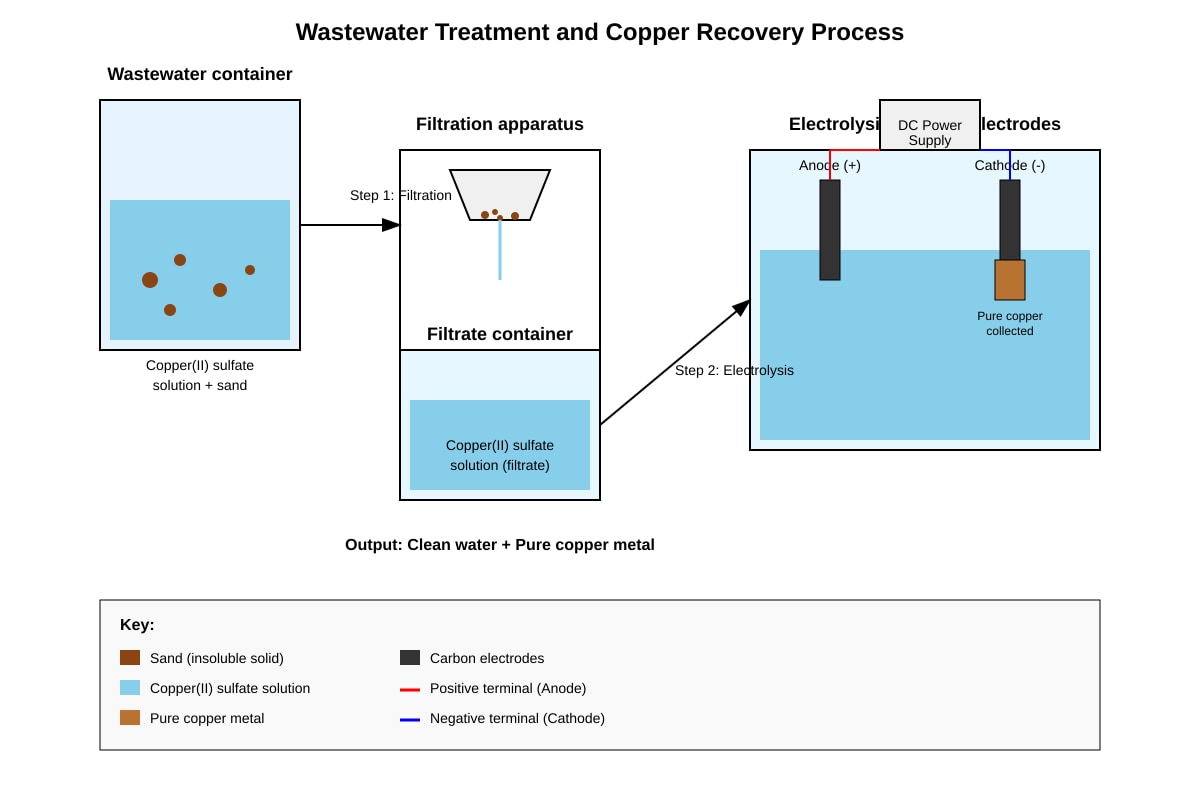
20. A factory produces wastewater containing copper(II) sulfate and sand. The factory wants to recover pure copper metal and clean water from this wastewater.
<image_placeholder> id: Q20-fig1 type: experimental_setup linked_question: Q20 description: Flow chart or experimental setup showing separation process for wastewater treatment labels: Wastewater container, filtration apparatus, filtrate container, electrolysis cell with electrodes, pure copper collected values: None specified must_show: Filtration step separating sand from copper(II) sulfate solution; electrolysis setup with two electrodes in blue copper(II) sulfate solution; pure copper depositing at cathode; clear labeling of input and output materials </image_placeholder>
(a) The factory first filters the wastewater. Explain what is removed by filtration and what passes through. [2 marks]
(b) The filtered solution is then electrolysed using carbon electrodes. Pure copper metal forms at the negative electrode (cathode). Explain why copper is formed at the negative electrode rather than at the positive electrode. [3 marks]
(c) Suggest one other method that could be used to remove copper from the solution, and state a disadvantage of this method compared to electrolysis. [2 marks]
END OF QUIZ
All content in this quiz is syllabus-aligned practice material. It is not derived from official past-year examination papers.
Answers
Secondary 1 Science Quiz - Chemistry Materials: Answer Key
Section A: Multiple Choice
1. C) Distilled water
- Explanation: A pure substance contains only one type of particle. Distilled water is pure H₂O. Air (A) is a mixture of gases, steel (B) is an alloy of iron and carbon, and seawater (D) is water dissolved with many salts. [1 mark]
2. A) 3
- Explanation: H₂SO₄ contains hydrogen (H), sulfur (S), and oxygen (O) — three different elements. The subscript numbers tell us how many atoms of each element, not how many different elements. [1 mark]
3. B) Evaporation
- Explanation: Evaporation removes water from salt solution, leaving pure salt crystals. Filtration (A) removes insoluble solids, not dissolved salt. Chromatography (C) separates dissolved substances but is not practical for obtaining bulk salt. Magnetic separation (D) separates magnetic materials. [1 mark]
4. C) Hydrogen
- Explanation: Active metals like sodium react with water to produce hydrogen gas. The "pop" sound is the characteristic test for hydrogen — it explodes when ignited. This is a standard test: place a burning splint near the gas; hydrogen gives a squeaky pop. [1 mark]
5. C) It is a good conductor of electricity
- Explanation: While copper is solid (A), has a high melting point (B), and is malleable (D), the key property for electrical wiring is electrical conductivity. Materials must allow electrons to flow freely. Most metals conduct electricity due to free-moving electrons in their structure. [1 mark]
6. B) Iron
- Explanation: "Fe" comes from the Latin word "ferrum" meaning iron. This is why iron's chemical symbols don't match its English name — many symbols derive from Latin names (e.g., Na for sodium from "natrium," K for potassium from "kalium"). [1 mark]
7. B) Using a magnet
- Explanation: Iron is magnetic; sulfur is not. A magnet attracts iron filings, leaving sulfur powder behind. Neither iron nor sulfur dissolves in water (A is wrong). Fractional distillation (C) separates liquids by boiling point. Chromatography (D) separates dissolved substances. [1 mark]
8. B) Same magnitude, opposite sign
- Explanation: A proton has charge +1 (positive) and an electron has charge -1 (negative). Both have the same magnitude of charge (one unit of elementary charge) but opposite signs. In a neutral atom, equal numbers of protons and electrons cancel out. [1 mark]
Section B: Structured Questions
9. (a) An element consists of only one type of atom and cannot be broken down into simpler substances by chemical means. [1 mark] A compound consists of two or more different elements chemically bonded together in fixed proportions, and can be broken down only by chemical means. [1 mark]
(b) Element: Any correct example, e.g., oxygen, iron, gold, sulfur [1 mark] Compound: Any correct example, e.g., water (H₂O), carbon dioxide (CO₂), sodium chloride (NaCl) [1 mark]
10. (a) R represents a compound. [1 mark] R shows two different types of particles (atoms) bonded together in a fixed, regular pattern. A compound contains atoms of different elements chemically combined in fixed proportions. [1 mark]
(b) Q represents a gas. [1 mark] The particles are far apart and move randomly, which is characteristic of gas particles — they have high kinetic energy and fill the space available. [1 mark]
11. (a) Salt (sodium chloride) is an ionic compound with strong attractions between ions that can be overcome by water molecules — water is a polar solvent that surrounds and separates the ions. [1 mark] Sand is mainly silicon dioxide (SiO₂), a giant covalent structure with very strong bonds throughout the lattice; water molecules cannot separate these bonds. [1 mark]
(b) To separate the insoluble sand from the salt solution (filtrate). [1 mark]
(c) Step 2: Filtration [1 mark] Step 3: Evaporation (or crystallisation) [1 mark]
12. (a) W is likely to be a metal. [1 mark] Metals conduct electricity when solid due to free-moving electrons in their structure. Also, W has very high melting and boiling points typical of metals with strong metallic bonding. [1 mark]
(b) X is likely to be a molecular compound. [1 mark] Evidence: very low melting point (-78°C) and boiling point (-33°C) [1 mark], and it does not conduct electricity when solid (molecular substances have no free electrons or ions) [1 mark]. These properties suggest weak intermolecular forces between molecules, which is characteristic of molecular compounds.
13. (a) CaCO₃ [1 mark]
(b) calcium carbonate → calcium oxide + carbon dioxide [2 marks: 1 for correct reactants and products, 1 for correct arrow format]
14. (a) Nucleon number = protons + neutrons = 11 + 12 = 23 [1 mark]
(b) Proton number = 11 (same as number of protons) [1 mark]
(c) The atom has 11 positive protons and 11 negative electrons. [1 mark] The positive and negative charges cancel out exactly, giving no overall charge (0). [1 mark]
15. (a) 7 [1 mark]
(b) Solution A (red): acidic [1 mark] Solution B (green): neutral [1 mark] Solution C (purple): alkaline [1 mark] Note: Universal indicator is red in acid, green in neutral, purple/blue in alkali.
(c) Hydrochloric acid is strongly acidic (pH 1 means very high H⁺ ion concentration). [1 mark] It reacts with and damages skin tissue, causing chemical burns. [1 mark]
16. (a) Group 18 (or Group 0, or the rightmost column) [1 mark]
(b) Any valid pair in same group, e.g., lithium (Li) and sodium (Na) in Group 1, or fluorine (F) and chlorine (Cl) in Group 17. [1 mark] Elements in the same group have the same number of outer shell (valence) electrons, so they show similar chemical properties / react in similar ways. [2 marks]
(c) Potassium would react more vigorously with water than sodium. [1 mark] Potassium is below sodium in Group 1; as you go down Group 1, metals become more reactive because the outer electron is further from the nucleus and more easily lost. [1 mark]
Section C: Application and Analysis
17. (a) The powder is soluble in water / forms an aqueous solution. [1 mark]
(b) Sodium ion (Na⁺) [1 mark]
(c) Chloride ion (Cl⁻) [1 mark] Note: Silver nitrate tests for halides; white precipitate with AgNO₃ indicates chloride.
(d) Sodium chloride (NaCl) / common salt. [1 mark] The yellow-orange flame confirms sodium; white precipitate with AgNO₃ confirms chloride; and it is white and soluble in water. [1 mark]
18. (a) 0°C [1 mark]
(b) Between 3 and 8 minutes, the substance is melting. [1 mark] During melting, energy supplied by heating is used to break intermolecular bonds in the solid lattice, not to raise temperature. [1 mark] This energy is called latent heat of fusion. Once all solid has melted, temperature rises again. [1 mark]
(c) Ice (water). [1 mark] The melting point of 0°C matches the known melting point of ice. Metals generally have much higher melting points (e.g., iron melts at 1538°C). [1 mark]
19. (a) Property 1: Low density — aluminum has low density compared to other metals. [1 mark] This makes aircraft lighter, saving fuel and allowing flight. [1 mark]
Property 2: Resistant to corrosion / forms protective oxide layer. [1 mark] This prevents structural weakening over time, ensuring safety and durability at high altitudes. [1 mark]
Alternative valid properties: good strength-to-weight ratio, malleable (can be shaped into aerodynamic forms), good conductor (not relevant for aircraft bodies but acceptable with explanation).
20. (a) Sand (insoluble solid) is removed by filtration. [1 mark] The copper(II) sulfate solution passes through as the filtrate. [1 mark]
(b) In electrolysis, positive copper ions (Cu²⁺) in solution are attracted to the negative electrode (cathode). [1 mark] At the cathode, each Cu²⁺ ion gains two electrons (reduction): Cu²⁺ + 2e⁻ → Cu [1 mark]. This forms neutral copper atoms that deposit as solid metal. Negative sulfate ions are attracted to the positive electrode instead. [1 mark]
(c) Alternative method: Add a more reactive metal (e.g., iron or zinc) to displace copper: Fe + CuSO₄ → FeSO₄ + Cu [1 mark]
Disadvantage: The copper produced is less pure / mixed with excess iron / requires further purification; or iron is consumed and cannot be easily recycled; or electrolysis produces very pure copper directly. [1 mark]
END OF ANSWER KEY
Marking note: Total marks = 8 (Section A) + 21 (Section B) + 11 (Section C) = 40 marks. Check addition carefully when awarding final scores.