AI Generated Quiz
Secondary 1 Science Chemistry Materials Quiz
Free Sec 1 Science Chemistry Materials quiz, HY3 AI version, with questions, answers, and syllabus-aligned practice for Singapore students.
These static practice materials are generated from the site's syllabus and paper-generation workflow, with source and model context shown so students and parents can evaluate the material before use.
Questions
Free quiz and exam paper access
Enter your details to view this paper
Your access is remembered on this device.
Answers
Secondary 1 Science Quiz - Chemistry Materials (Answer Key)
Total Marks: 40
Topic: Chemistry Materials
Level: Secondary 1
Section A
1. [1] Conducts electricity (or: ductile / malleable).
Teaching note: Metals have free electrons that carry current; this is why copper wires are used.
2. [1] Corrosive symbol.
Teaching note: The corrosive symbol (usually showing liquid eating hand/metal) warns it can destroy living tissue or metal.
3. [1] transparent.
Teaching note: Transparent materials allow light through with clear vision (e.g., clear glass). Translucent blurs; opaque blocks.
4. [1] Polyethylene (plastic bag) / PVC / nylon.
Teaching note: Synthetic polymers are human-made long-chain molecules.
5. [1] Physical change.
Teaching note: Sugar molecules stay the same; only spread in water, can be recovered by evaporation.
Section B
6. [2] Keep away from flames [1]; use water bath not direct heat [1].
Marking: 1 mark each correct precaution linked to flammable.
7. [2] Add water to dissolve salt [1]; filter to remove sand, then evaporate water to get salt [1].
Steps: dissolution → filtration → evaporation.
8. [2] Steel is a better conductor of heat [1]; it draws heat from hand faster so feels cold [1].
Concept: Thermal conductivity, not actual lower temperature.
9. [2] High melting point [1]; hard / does not react with food [1].
Accept: withstands heat, rigid.
10. [3] (a) Separating funnel [1]. (b) Oil and water do not mix (immiscible) [1]; different densities let them form layers, tap removes lower layer [1].
Note: Must name immiscible.
11. [2] Corrosive means it can destroy substances on contact [1]; example: hydrochloric acid [1].
Accept: sulphuric acid, bleach.
12. [2] Looks like plastic [1]; flexible / light / made in factory [1].
Note: Not chemical test.
13. [2] Do not pour down sink [1]; dispose in marked hazardous waste bin [1].
Section C
14. [3] (a) P [1]. (b) It is magnetic, conducts electricity, and rusts [2] — iron has all three.
Marking: 1 for P, 2 for correct reason using table.
15. [3] Add water, stir to dissolve salt [1]; filter to remove sand [1]; evaporate filtrate to get salt [1].
Order important.
16. [3] (a) Keep from flames [1]; wear gloves / use fume hood [1]. (b) To know dangers and handle safely [1].
17. [3] Physical: no new substance (boiling water → steam, same H₂O) [1+1]; Chemical: new substance formed (burning paper → ash + CO₂) [1].
Marking: definition + each example.
18. [3] (a) Distillation [1]. (b) Heat to 78 °C, A boils first and is collected [1]; B remains, then raise temp for B [1].
19. [3] Transparent, hard, does not rust [2]; disadvantage: brittle / shatters easily [1].
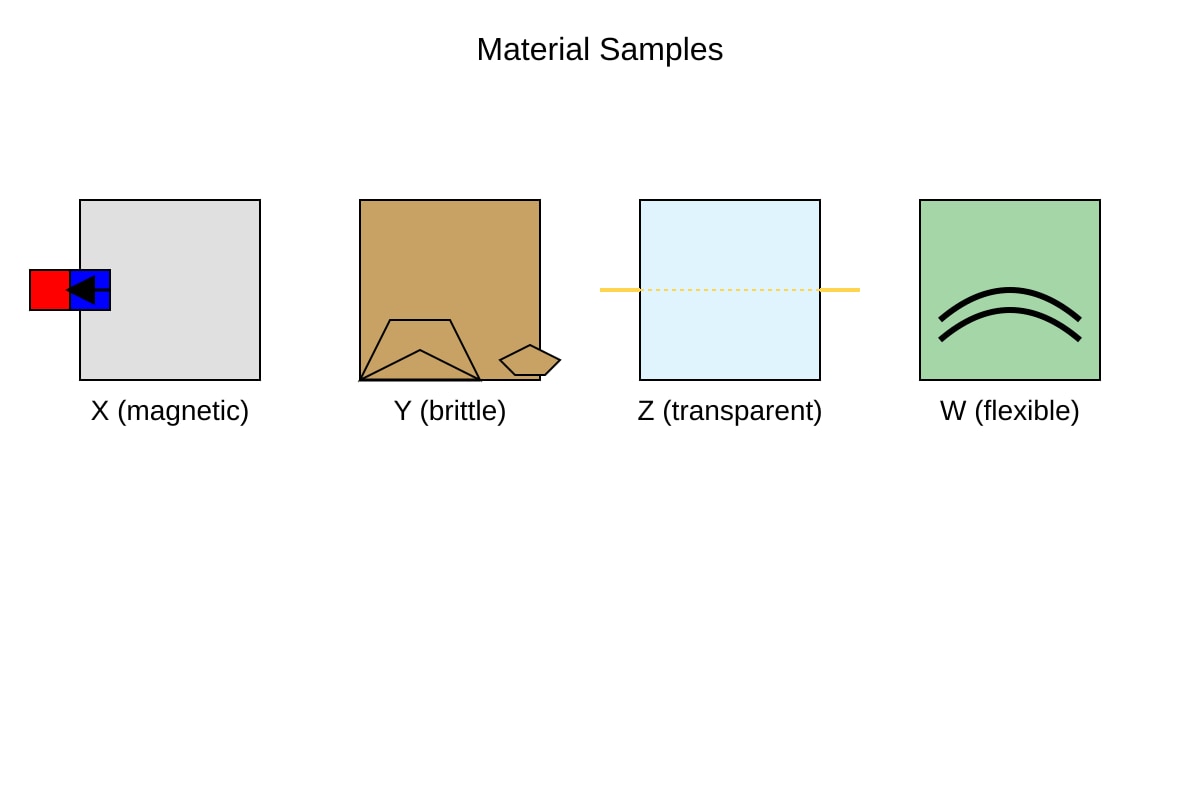
20. [3] X: fridge door (magnetic) [1]; Y: hammer head (brittle but hard) [1]; Z: window pane (transparent) [1].
Image needed: diagram shows X magnetic, Y brittle, Z transparent, W flexible. W not used.