From Real Exams Quiz
Secondary 1 Science Scientific Inquiry Quiz
Free Sec 1 Science Scientific Inquiry quiz, HY3 Exam version, with questions, answers, and syllabus-aligned practice for Singapore students.
These static practice materials are generated from the site's syllabus and paper-generation workflow, with source and model context shown so students and parents can evaluate the material before use.
Questions
Secondary 1 Science Quiz - Scientific Inquiry
Name: ___________________________
Class: ______________
Date: ______________
Score: _______ / 40
Duration: 50 minutes
Total Marks: 40
Instructions:
- This quiz has 20 questions on Scientific Inquiry.
- Section A: Multiple Choice (Questions 1–5)
- Section B: Short Answer (Questions 6–12)
- Section C: Structured Response (Questions 13–20)
- Write your answers in the spaces provided.
- Use appropriate units where needed.
Section A: Multiple Choice (5 × 1 = 5 marks)
1. A student wants to find out if plants grow taller with more sunlight. What is the independent variable?
A. Height of plant
B. Amount of sunlight
C. Type of soil
D. Amount of water
______ [1]
2. Which of the following is a safe laboratory practice?
A. Smelling a chemical directly
B. Wearing open-toed shoes
C. Tying long hair back near a Bunsen burner
D. Pouring unused chemicals back into the bottle
______ [1]
3. A fair test means:
A. All variables are changed at once
B. Only the independent variable is changed, others kept same
C. The experiment is done once
D. No measurements are taken
______ [1]
4. What does a hypothesis state?
A. The result after the experiment
B. A suggested answer to a question, to be tested
C. The list of apparatus
D. The conclusion from data
______ [1]
5. Which instrument measures volume of a liquid?
A. Ruler
B. Thermometer
C. Measuring cylinder
D. Spring balance
______ [1]
Section B: Short Answer (7 × 2 = 14 marks)
6. State one reason why repeating an experiment is important.
________________________________________________________________ [2]
7. A student records the temperature of water as 25 °C, 26 °C, 24 °C, and 25 °C in four trials. Calculate the average temperature. Show your working.
Working: ______________________________________________________
Answer: ________ °C [2]
8. Name the hazard symbol described: "Causes skin burns and destroys materials on contact."
__________ [2]
9. In an experiment to test how sugar affects yeast growth, state one variable that must be kept constant.
________________________________________________________________ [2]
10. Give one example of a quantitative observation.
________________________________________________________________ [2]
11. A pupil uses a ruler with smallest division 1 mm to measure a stick as 12 cm. State the unit and the instrument used.
Unit: ________ Instrument: ________ [2]
12. Explain why a control set-up is used in an investigation.
________________________________________________________________ [2]
Section C: Structured Response (8 questions, 21 marks)
13. A student plans to investigate: "Does the type of fertilizer affect the number of flowers on a rose plant?"
(a) State the independent variable. ________ [1]
(b) State the dependent variable. ________ [1]
(c) State one variable to control. ________ [1]
14. (a) What is the purpose of a Bunsen burner in a laboratory? [1]
(b) State one safety rule when using it. [1]
15. A class measures the time for a toy car to travel 2 m. Results: 4.1 s, 3.9 s, 4.0 s, 4.2 s.
(a) Calculate the average time. Show working. [2]
Working: ______________________________________________________
(b) Why might results vary slightly? [1]
16. Read the hazard labels on a bottle: "Toxic to environment" and "Flammable".
(a) State one precaution when storing this chemical. [1]
(b) State one precaution when using it. [1]
17. A student hypothesises: "If the angle of a ramp is increased, then a ball will roll down faster."
(a) Is this a hypothesis or a prediction? Explain. [2]
(b) How can the student measure the speed? [1]
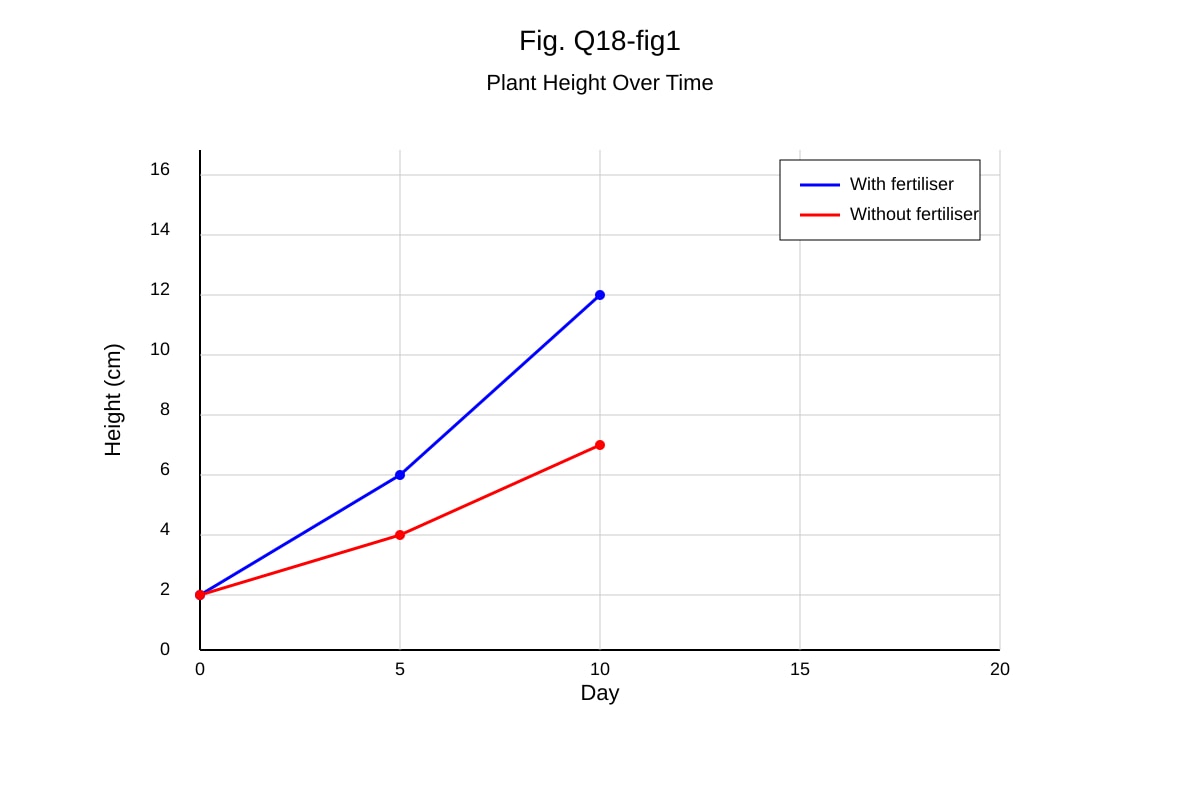
18.

Generated graph for Q18.
Based on Fig. Q18-fig1:
(a) State the height of the plant with fertiliser on Day 10. ________ cm [1]
(b) What conclusion can be drawn about fertiliser effect? [2]
19. An experiment tests if mint leaves keep mosquitoes away. Set-up A: room with mint. Set-up B: room without mint. Same number of mosquitoes released.
(a) Which is the control? [1]
(b) State how to record the dependent variable. [1]
(c) State one improvement to make the test fairer. [1]
20. A pupil writes: "I think ice melts faster in warm water because heat moves from hot to cold."
(a) Identify the part that is a hypothesis. [1]
(b) Describe how to test this with two beakers. [2]
(c) State the expected observation if correct. [1]
Answers
Secondary 1 Science Quiz - Scientific Inquiry (Answer Key)
Total Marks: 40
Topic: Scientific Inquiry
Section A: Multiple Choice
1. B [1]
Independent variable is the factor changed by the student: amount of sunlight. Height is dependent; soil and water should be controlled.
2. C [1]
Tying hair back prevents fire risk near Bunsen burner. Others are unsafe.
3. B [1]
Fair test = change only independent variable, keep others constant.
4. B [1]
Hypothesis = suggested testable answer before experiment.
5. C [1]
Measuring cylinder measures liquid volume. Ruler=length, thermometer=temp, spring balance=force.
Section B: Short Answer
6. [2]
Any one: To check reliability / reduce effect of random error / confirm result is consistent.
Teaching: Repeats increase confidence in data.
7. [2]
Working: (25 + 26 + 24 + 25) ÷ 4 = 100 ÷ 4 = 25
Answer: 25 °C
Mark: 1 for working, 1 for answer.
8. [2]
Corrosive. (Hazard symbol: corrosive causes burns/destroys materials.)
9. [2]
Any one: amount of water / type of yeast / temperature / light. Must be constant.
10. [2]
Example: "The mass was 15 g" or "The temperature was 30 °C". (Numerical observation.)
11. [2]
Unit: cm (or millimetre if justified). Instrument: ruler.
(1 mark each.)
12. [2]
A control is used for comparison to show the effect of the independent variable.
Teaching: Without control, cannot tell if change is due to variable tested.
Section C: Structured Response
13. [3]
(a) Type of fertilizer [1]
(b) Number of flowers [1]
(c) Any: amount of water, sunlight, type of rose plant, soil [1]
14. [2]
(a) To heat substances / provide flame [1]
(b) Tie hair back / wear goggles / keep flammable items away [1]
15. [3]
(a) Working: (4.1 + 3.9 + 4.0 + 4.2) ÷ 4 = 16.2 ÷ 4 = 4.05 s [2]
(b) Human reaction time / slight ramp differences [1]
16. [2]
(a) Store in cool, locked flammable cabinet away from environment [1]
(b) Use in fume hood / keep away from sparks [1]
17. [3]
(a) Prediction (1) because it states expected outcome "will roll faster" (1). Hypothesis suggests relationship; this is an "if-then" prediction. [2]
(b) Measure time with stopwatch over fixed distance, speed = distance/time [1]
18. [3]
(a) 12 cm [1]
(b) Fertiliser increases plant height (1); with fertiliser taller at Day 10 than without (1). [2]
19. [3]
(a) Set-up B (no mint) [1]
(b) Count mosquitoes left after fixed time / bites recorded [1]
(c) Same room size / same temp / same mosquito species [1]
20. [4]
(a) "Ice melts faster in warm water" (or full idea) [1]
(b) Beaker 1: ice + warm water; Beaker 2: ice + cold water; same ice mass, same water vol; time melting. [2]
(c) Ice melts quicker in warm water beaker. [1]
Free quiz and exam paper access
Enter your details to view this paper
Your access is remembered on this device.