From Real Exams Quiz
Secondary 1 Science Scientific Inquiry Quiz
Free Sec 1 Science Scientific Inquiry quiz, Exam version, with questions, answers, and syllabus-aligned practice for Singapore students.
These static practice materials are generated from the site's syllabus and paper-generation workflow, with source and model context shown so students and parents can evaluate the material before use.
Questions
Free quiz and exam paper access
Enter your details to view this paper
Your access is remembered on this device.
Answers
Secondary 1 Science Quiz - Scientific Inquiry (Answer Key)
Total Marks: 40
Section A: Experimental Design and Variables [10 marks]
1. Temperature and dissolving investigation
(a) State a hypothesis for this experiment. [1] Answer: If the temperature of water increases, then sugar will dissolve faster because particles move more quickly at higher temperatures. Mark scheme: Accept any testable hypothesis linking temperature to dissolving rate with scientific reasoning.
(b) Independent variable [1] Answer: Temperature of water Mark scheme: Must identify temperature as the variable being changed.
2. Plant growth experiment
(a) Fair test method [1] Answer: Use the same type/size of plants / Same amount of water / Same amount of light / Same temperature Mark scheme: Accept any valid method to control variables.
(b) Measuring plant growth [1] Answer: Use a ruler to measure height from soil to tip of plant / Measure at the same time each day Mark scheme: Must include measurement tool and method for accuracy.
3. Surface area and dissolving
(a) Prediction [1] Answer: Crushed sugar will dissolve faster Mark scheme: Must identify crushed sugar as faster.
(b) Explanation using particle theory [2] Answer: Crushed sugar has a larger surface area exposed to water [1]. More sugar particles are in contact with water particles, so dissolving happens faster [1]. Mark scheme: 1 mark for surface area concept, 1 mark for particle contact explanation.
4. Material strength testing
(a) Dependent variable [1] Answer: Weight needed to break the material / Breaking strength Mark scheme: Must identify what is being measured as the outcome.
(b) Safety precaution [1] Answer: Wear safety goggles/eye protection / Stand away from the apparatus when weights are added Mark scheme: Accept any appropriate safety measure.
5. Hypothesis, prediction, or observation [1] Answer: Hypothesis Mark scheme: 1 mark - contains if-then format with reasoning.
Section B: Data Analysis and Interpretation [10 marks]
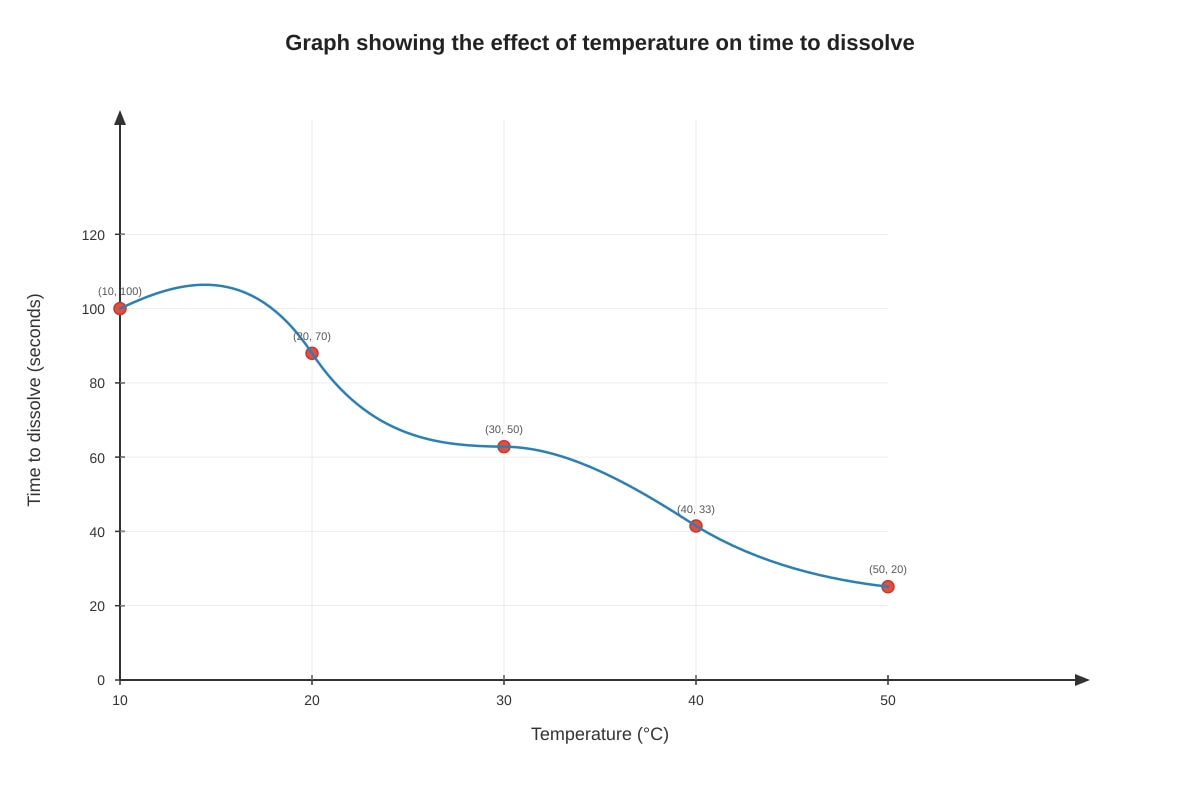
6. Temperature and dissolving graph
(a) Relationship description [2] Answer: As temperature increases, the time taken to dissolve decreases [1]. The relationship is inverse/negative [1]. Mark scheme: 1 mark for trend, 1 mark for relationship type.
(b) Prediction at 30°C [1] Answer: Approximately 50-60 seconds Mark scheme: Accept values between 45-65 seconds from graph interpolation.
7. Light intensity and bubble production
(a) What bubbles represent [1] Answer: Oxygen gas / Product of photosynthesis Mark scheme: Must identify oxygen or photosynthesis product.
(b) Trend in data [1] Answer: As distance from lamp increases, number of bubbles decreases Mark scheme: Must identify inverse relationship.
8. Rf value calculation [2]
Working: Rf = distance travelled by substance ÷ distance travelled by solvent front [1] Rf = 8.0 cm ÷ 10.0 cm = 0.80 [1]
Mark scheme: 1 mark for correct formula/substitution, 1 mark for correct answer.
9. pH measurements
(a) Most acidic liquid [1] Answer: Lemon juice Mark scheme: Must identify lemon juice (lowest pH).
(b) Neutral liquid [1] Answer: Pure water Mark scheme: Must identify pure water (pH 7).
10. Mass and dissolving time relationship [1] Answer: As mass increases, dissolving time increases / Direct/positive relationship Mark scheme: Must identify the direct relationship.
Section C: Scientific Method and Evaluation [10 marks]
11. Plant growth conclusion evaluation
(a) Limitation [1] Answer: Only used one plant of each type / Small sample size / Only tested for one week / No repeats Mark scheme: Accept any valid limitation of the experimental design.
(b) Improving reliability [2] Answer: Use more plants in each condition [1] and repeat the experiment several times [1]. Mark scheme: 1 mark each for larger sample size and repetition.
12. Proper hypothesis [2] Answer: If plants are given fertiliser, then they will grow taller/faster than plants without fertiliser [1] because fertiliser provides nutrients needed for growth [1]. Mark scheme: 1 mark for if-then format, 1 mark for scientific reasoning.
13. Seed germination investigation
(a) Percentage germination calculation [1] Answer: (8 ÷ 10) × 100 = 80% Mark scheme: Must show working and correct percentage.
(b) Controlled factor [1] Answer: Temperature / Amount of water / Type of seeds / Light conditions / Time period Mark scheme: Accept any appropriate variable that should be kept constant.
14. Paper towel absorption experiment
(a) Independent variable [1] Answer: Brand/type of paper towel Mark scheme: Must identify what is being changed.
(b) Measuring water absorption [1] Answer: Measure mass of water absorbed / Use measuring cylinder to measure volume absorbed Mark scheme: Must include quantitative measurement method.
15. Importance of repeating experiments [1] Answer: To check results are reliable / To identify anomalies / To calculate averages Mark scheme: Accept any valid reason for repetition.
Section D: Practical Skills and Applications [10 marks]
16. Exercise and heart rate investigation
(a) Suitable hypothesis [2] Answer: If a person exercises, then their heart rate will increase [1] because the body needs more oxygen during exercise [1]. Mark scheme: 1 mark for if-then format, 1 mark for scientific reasoning.
(b) Controlled variables [2] Answer: (i) Age of participants / Fitness level (ii) Type of exercise / Duration of exercise / Time of day Mark scheme: 1 mark each for any two appropriate controlled variables.
17. Stirring and dissolving
(a) Why stirring increases dissolving rate [2] Answer: Stirring moves dissolved particles away from the surface [1] and brings fresh solvent into contact with the solute [1]. Mark scheme: 1 mark each for particle movement concepts.
(b) Type of variable [1] Answer: Controlled variable Mark scheme: Must identify as controlled variable in temperature experiment.
18. Safety precautions with acid [2] Answer: (i) Wear safety goggles/eye protection (ii) Wear gloves / Use fume cupboard / Have water available for washing Mark scheme: 1 mark each for appropriate safety measures.
19. Ice melting explanation [1] Answer: Higher temperature gives particles more energy to move faster and break bonds / overcome forces holding the ice structure together Mark scheme: Must link temperature to particle energy and state change.
20. Music and plant growth experiment
(a) Measuring plant growth [1] Answer: Measure height with ruler / Measure mass / Count leaves Mark scheme: Accept any quantitative measurement method.
(b) Ethical consideration [1] Answer: Ensure plants are not harmed / All plants receive adequate care / Volume of music not too loud Mark scheme: Accept any appropriate ethical consideration for living organisms.