From Real Exams Quiz
Secondary 1 Science Physical Sciences Quiz
Free Sec 1 Science Physical Sciences quiz with questions, answers, and syllabus-aligned practice for Singapore students preparing for school assessments.
These static practice materials are generated from the site's syllabus and paper-generation workflow, with source and model context shown so students and parents can evaluate the material before use.
Questions
Secondary 1 Science Quiz - Physical Sciences
Name: ___________________________
Class: ___________________________
Date: ___________________________
Score: _____ / 40
Duration: 45 minutes
Total Marks: 40
Instructions:
- Answer all questions.
- Write your answers in the spaces provided.
- For calculation questions, show your working clearly.
- The number of marks is given in brackets [ ] at the end of each question or part question.
Section A: Multiple Choice Questions (10 marks)
Questions 1 to 10 carry 1 mark each. Choose the correct answer and write its letter (A, B, C, or D) in the box provided.
1. A student lifts a 5 N book from the floor to a shelf 1.2 m above the floor at constant velocity. What is the work done by the student on the book? [1]
☐ A. 0 J
☐ B. 4.2 J
☐ C. 6.0 J
☐ D. 7.2 J
2. Which of the following energy conversions takes place when a compressed spring is released and pushes a toy car forward along a horizontal floor? [1]
☐ A. Elastic potential energy → Kinetic energy
☐ B. Chemical energy → Kinetic energy
☐ C. Gravitational potential energy → Kinetic energy
☐ D. Kinetic energy → Elastic potential energy
3. A force of 15 N is used to push a box 4 m across a rough floor. The frictional force acting on the box is 5 N. What is the net work done on the box? [1]
☐ A. 20 J
☐ B. 40 J
☐ C. 60 J
☐ D. 80 J
4. A 2 kg object is dropped from a height of 10 m. Ignoring air resistance, what is its kinetic energy just before it hits the ground? (Take g = 10 N/kg) [1]
☐ A. 20 J
☐ B. 100 J
☐ C. 200 J
☐ D. 400 J
5. Which statement about work is correct? [1]
☐ A. Work is done whenever a force acts on an object.
☐ B. Work is done only when the force and displacement are in the same direction.
☐ C. No work is done when a person holds a heavy box stationary at arm's length.
☐ D. Work done against friction is always zero.
6. A roller coaster car of mass 500 kg is at rest at the top of a hill 20 m high. It rolls down to the bottom and then up a second hill 15 m high. Ignoring friction and air resistance, what is the speed of the car at the top of the second hill? (Take g = 10 N/kg) [1]
☐ A. 0 m/s
☐ B. 10 m/s
☐ C. 14 m/s
☐ D. 20 m/s
7. A machine lifts a load of 800 N through a height of 2 m. The effort applied is 200 N and moves through a distance of 10 m. What is the efficiency of the machine? [1]
☐ A. 40%
☐ B. 50%
☐ C. 80%
☐ D. 100%
8. Which of the following is a vector quantity? [1]
☐ A. Work
☐ B. Energy
☐ C. Power
☐ D. Force
9. A car of mass 1000 kg accelerates from rest to 20 m/s in 10 s. What is the average power developed by the car's engine? (Ignore resistive forces) [1]
☐ A. 2000 W
☐ B. 4000 W
☐ C. 20 000 W
☐ D. 40 000 W
10. A pendulum bob is released from rest at position A, swings through the lowest point B, and rises to position C. Which statement about energy at these positions is correct? (Ignore air resistance) [1]
☐ A. Kinetic energy is maximum at A.
☐ B. Potential energy is minimum at B.
☐ C. Total energy at C is less than total energy at A.
☐ D. Kinetic energy at B is zero.
Section B: Short Answer and Structured Questions (18 marks)
11. A worker pushes a crate of mass 50 kg across a horizontal floor with a constant horizontal force of 200 N. The crate moves 6 m at constant velocity. [3]
(a) State the magnitude and direction of the frictional force acting on the crate.
______________________________________________________________________________ [1]
(b) Calculate the work done by the worker on the crate.
______________________________________________________________________________ [1]
(c) Calculate the work done by friction on the crate.
______________________________________________________________________________ [1]
12. A ball of mass 0.5 kg is thrown vertically upwards with an initial speed of 20 m/s. (Take g = 10 N/kg) [4]
(a) Calculate the initial kinetic energy of the ball.
______________________________________________________________________________ [1]
(b) Calculate the maximum height reached by the ball.
______________________________________________________________________________ [2]
(c) State the energy conversion that takes place as the ball rises from the thrower's hand to its maximum height.
______________________________________________________________________________ [1]
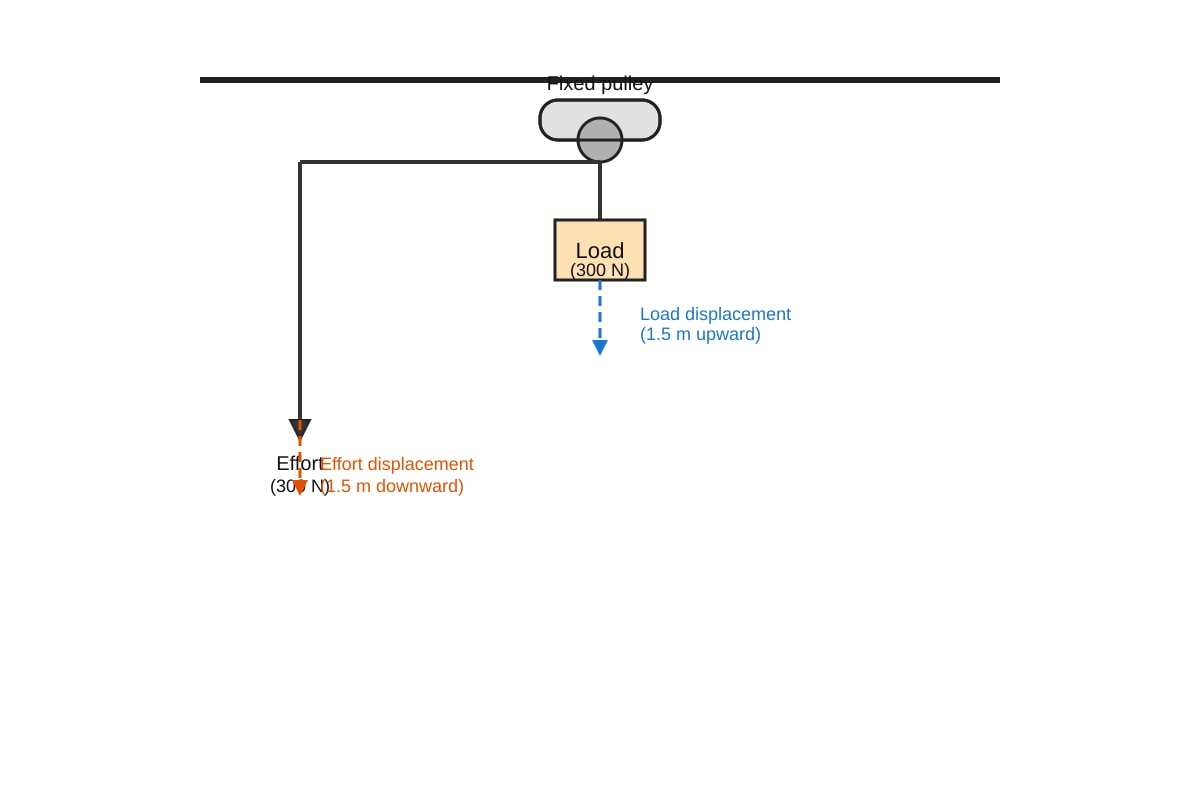
13. <image_placeholder>
id: Q13-fig1 type: diagram linked_question: Q13 description: A simple pulley system with a single fixed pulley. A load of 300 N is attached to one end of the rope. A person pulls down on the other end with an effort of 300 N to lift the load vertically by 1.5 m. The rope is light and inextensible, and the pulley is frictionless. labels: Load (300 N), Effort (300 N), Load displacement (1.5 m upward), Effort displacement (1.5 m downward), Fixed pulley values: Load = 300 N, Effort = 300 N, Load displacement = 1.5 m, Effort displacement = 1.5 m must_show: Single fixed pulley, rope, load, effort direction, displacement arrows </image_placeholder>
The diagram shows a simple pulley system used to lift a load of 300 N. The effort applied is 300 N. The load is raised by 1.5 m. [3]
(a) Calculate the work done by the effort.
______________________________________________________________________________ [1]
(b) Calculate the work done on the load.
______________________________________________________________________________ [1]
(c) State the efficiency of this pulley system.
______________________________________________________________________________ [1]
14. A 4 kg block slides down a frictionless inclined plane of length 5 m and height 3 m. The block starts from rest at the top. (Take g = 10 N/kg) [4]
(a) Calculate the loss in gravitational potential energy of the block.
______________________________________________________________________________ [1]
(b) Calculate the speed of the block at the bottom of the incline.
______________________________________________________________________________ [2]
(c) If the inclined plane has a rough surface and the block reaches the bottom with a speed of 6 m/s, calculate the work done against friction.
______________________________________________________________________________ [1]
15. A student carries a school bag of weight 120 N up a flight of stairs. The vertical height gained is 3 m. The student takes 15 s to climb the stairs. [3]
(a) Calculate the work done by the student against gravity.
______________________________________________________________________________ [1]
(b) Calculate the power developed by the student.
______________________________________________________________________________ [1]
(c) The student walks horizontally along a corridor for 20 m while carrying the same bag. Explain why the work done against gravity in this case is zero.
______________________________________________________________________________ [1]
Section C: Longer Structured and Data-Based Questions (12 marks)
16. A toy car of mass 0.2 kg is launched by a spring along a horizontal track. The spring is compressed by 0.05 m and has a spring constant of 200 N/m. The car then moves up a frictionless ramp inclined at 30° to the horizontal. [5]
(a) Calculate the elastic potential energy stored in the compressed spring.
______________________________________________________________________________ [1]
(b) Assuming no energy losses, calculate the maximum height reached by the car on the ramp. (Take g = 10 N/kg)
______________________________________________________________________________ [2]
(c) Calculate the distance travelled along the ramp before the car stops momentarily.
______________________________________________________________________________ [1]
(d) In reality, the car only reaches a height of 0.10 m. Calculate the average resistive force acting on the car along the ramp.
______________________________________________________________________________ [1]
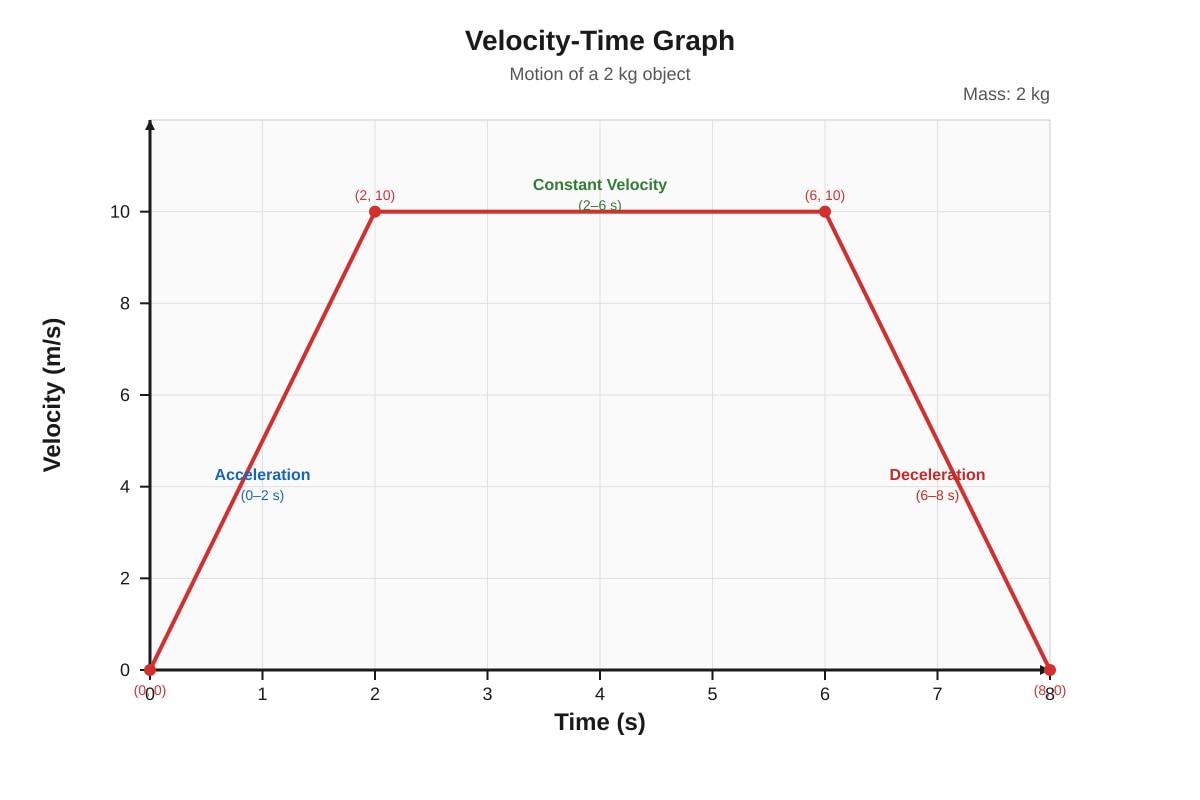
17. <image_placeholder>
id: Q17-fig1 type: graph linked_question: Q17 description: A velocity-time graph for a 2 kg object moving in a straight line. The graph shows: from t=0 to t=2 s, velocity increases uniformly from 0 to 10 m/s; from t=2 to t=6 s, velocity remains constant at 10 m/s; from t=6 to t=8 s, velocity decreases uniformly to 0 m/s. labels: Time (s) on x-axis from 0 to 8, Velocity (m/s) on y-axis from 0 to 10 values: t=0, v=0; t=2, v=10; t=6, v=10; t=8, v=0 must_show: Three distinct segments: acceleration, constant velocity, deceleration; axes labelled with units </image_placeholder>
The velocity-time graph above shows the motion of a 2 kg object. [4]
(a) Describe the motion of the object between t = 0 s and t = 2 s.
______________________________________________________________________________ [1]
(b) Calculate the acceleration of the object between t = 0 s and t = 2 s.
______________________________________________________________________________ [1]
(c) Calculate the resultant force acting on the object between t = 0 s and t = 2 s.
______________________________________________________________________________ [1]
(d) Calculate the total distance travelled by the object in the 8 seconds.
______________________________________________________________________________ [1]
18. A hydroelectric power station uses water falling from a height of 50 m to generate electricity. Water flows at a rate of 200 kg/s. The overall efficiency of the system is 80%. (Take g = 10 N/kg) [3]
(a) Calculate the gravitational potential energy lost by the water per second.
______________________________________________________________________________ [1]
(b) Calculate the electrical power output of the power station.
______________________________________________________________________________ [1]
(c) State one energy loss that occurs in the system, reducing the efficiency to less than 100%.
______________________________________________________________________________ [1]
19. A cyclist and bicycle have a combined mass of 80 kg. The cyclist starts from rest at the top of a hill of vertical height 25 m and freewheels down to the bottom. At the bottom, the speed is 20 m/s. (Take g = 10 N/kg) [4]
(a) Calculate the loss in gravitational potential energy of the cyclist and bicycle.
______________________________________________________________________________ [1]
(b) Calculate the kinetic energy at the bottom of the hill.
______________________________________________________________________________ [1]
(c) Calculate the work done against resistive forces (air resistance and friction) during the descent.
______________________________________________________________________________ [1]
(d) Calculate the average resistive force if the length of the slope is 100 m.
______________________________________________________________________________ [1]
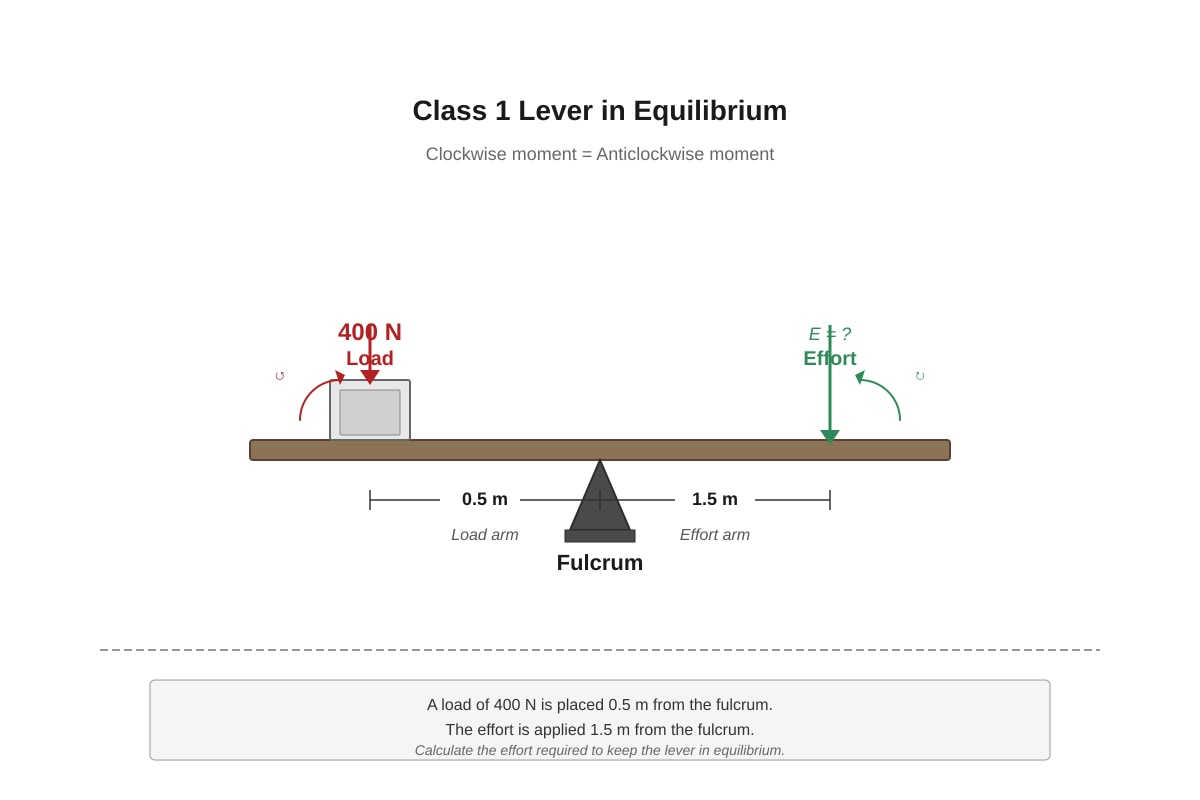
20. <image_placeholder>
id: Q20-fig1 type: diagram linked_question: Q20 description: A lever system (Class 1 lever) with a fulcrum at the centre. A load of 400 N is placed 0.5 m from the fulcrum on the left side. An effort is applied 1.5 m from the fulcrum on the right side. The lever is horizontal and in equilibrium. labels: Fulcrum, Load (400 N) at 0.5 m left, Effort at 1.5 m right, Lever arm lengths values: Load = 400 N, Load arm = 0.5 m, Effort arm = 1.5 m must_show: Fulcrum, load, effort, lever arms with distances labelled, horizontal lever in equilibrium </image_placeholder>
The diagram shows a lever in equilibrium. A load of 400 N is placed 0.5 m from the fulcrum. The effort is applied 1.5 m from the fulcrum. [3]
(a) State the principle of moments.
______________________________________________________________________________ [1]
(b) Calculate the effort required to keep the lever in equilibrium.
______________________________________________________________________________ [1]
(c) If the effort moves down by 0.3 m, calculate the distance moved by the load and the work done by the effort.
______________________________________________________________________________ [1]
End of Quiz
Answers
Secondary 1 Science Quiz - Physical Sciences (Answer Key)
Total Marks: 40
Section A: Multiple Choice Questions (10 marks)
1. C — 6.0 J
Working: Work done = Force × Distance moved in direction of force = 5 N × 1.2 m = 6.0 J.
Concept: Work done against gravity = weight × vertical height. Constant velocity means net force is zero, but the lifting force equals weight.
2. A — Elastic potential energy → Kinetic energy
Concept: A compressed spring stores elastic potential energy. When released, this converts to kinetic energy of the toy car.
3. B — 40 J
Working: Net force = Applied force − Friction = 15 N − 5 N = 10 N. Net work = Net force × Distance = 10 N × 4 m = 40 J.
Alternative: Work by applied force = 15 × 4 = 60 J. Work by friction = −5 × 4 = −20 J. Net work = 60 − 20 = 40 J.
4. C — 200 J
Working: Loss in GPE = Gain in KE = mgh = 2 kg × 10 N/kg × 10 m = 200 J.
Concept: Conservation of energy (ignoring air resistance).
5. C — No work is done when a person holds a heavy box stationary at arm's length.
Explanation: Work = Force × Displacement in direction of force. Displacement is zero, so work done is zero. The person exerts an upward force equal to weight, but there is no movement.
Common mistake: Thinking that exerting a force always means work is done.
6. B — 10 m/s
Working: Loss in GPE = Gain in KE. mg(h₁ − h₂) = ½mv². v = √[2g(h₁ − h₂)] = √[2 × 10 × (20 − 15)] = √100 = 10 m/s.
7. C — 80%
Working: Work output = Load × Load distance = 800 N × 2 m = 1600 J. Work input = Effort × Effort distance = 200 N × 10 m = 2000 J. Efficiency = (1600/2000) × 100% = 80%.
8. D — Force
Concept: Force is a vector (has magnitude and direction). Work, energy, and power are scalar quantities.
9. C — 20 000 W
Working: KE gained = ½mv² = ½ × 1000 × 20² = 200 000 J. Average power = Work/Time = 200 000 J / 10 s = 20 000 W.
10. B — Potential energy is minimum at B.
Explanation: At the lowest point B, height is minimum, so gravitational potential energy is minimum. Kinetic energy is maximum at B. Total energy is conserved (ignoring air resistance), so total energy at C equals total energy at A.
Section B: Short Answer and Structured Questions (18 marks)
11. (a) 200 N, opposite to the direction of motion (or opposite to the applied force) [1]
Reasoning: Constant velocity means zero acceleration, so net force = 0. Friction = Applied force = 200 N, acting opposite to motion.
(b) 1200 J [1]
Working: Work = Force × Distance = 200 N × 6 m = 1200 J.
(c) −1200 J (or 1200 J done against friction) [1]
Working: Work by friction = −Friction × Distance = −200 N × 6 m = −1200 J.
Note: Negative sign indicates energy is dissipated.
12. (a) 100 J [1]
Working: KE = ½mv² = ½ × 0.5 kg × (20 m/s)² = 0.25 × 400 = 100 J.
(b) 20 m [2]
Working: At max height, KE = 0, all initial KE → GPE. mgh = 100 J. h = 100 / (0.5 × 10) = 100 / 5 = 20 m.
Mark breakdown: 1 mark for correct principle (KE → GPE), 1 mark for correct calculation.
(c) Kinetic energy → Gravitational potential energy [1]
Concept: As the ball rises, it slows down (KE decreases) and gains height (GPE increases).
13. (a) 450 J [1]
Working: Work by effort = Effort × Effort displacement = 300 N × 1.5 m = 450 J.
(b) 450 J [1]
Working: Work on load = Load × Load displacement = 300 N × 1.5 m = 450 J.
(c) 100% (or 1) [1]
Working: Efficiency = (Work output / Work input) × 100% = (450 / 450) × 100% = 100%.
Concept: Ideal frictionless pulley with equal effort and load displacements has 100% efficiency.
14. (a) 120 J [1]
Working: Loss in GPE = mgh = 4 kg × 10 N/kg × 3 m = 120 J.
Note: Only vertical height matters, not the length of the incline.
(b) 7.75 m/s (or √60 ≈ 7.7 m/s) [2]
Working: Loss in GPE = Gain in KE. 120 = ½ × 4 × v². v² = 60. v = √60 ≈ 7.75 m/s.
Mark breakdown: 1 mark for equating GPE loss to KE gain, 1 mark for correct calculation.
(c) 48 J [1]
Working: Actual KE at bottom = ½ × 4 × 6² = 72 J. Work against friction = GPE loss − Actual KE = 120 − 72 = 48 J.
15. (a) 360 J [1]
Working: Work against gravity = Weight × Vertical height = 120 N × 3 m = 360 J.
(b) 24 W [1]
Working: Power = Work / Time = 360 J / 15 s = 24 W.
(c) When walking horizontally, the displacement is perpendicular to the gravitational force (weight). Work done against gravity = Force × Displacement × cos 90° = 0. [1]
Key point: Work done by/against a force requires a component of displacement in the direction of the force. Horizontal displacement has no vertical component.
Section C: Longer Structured and Data-Based Questions (12 marks)
16. (a) 0.25 J [1]
Working: Elastic PE = ½kx² = ½ × 200 N/m × (0.05 m)² = 100 × 0.0025 = 0.25 J.
(b) 0.125 m [2]
Working: Elastic PE → GPE. 0.25 = mgh = 0.2 × 10 × h. h = 0.25 / 2 = 0.125 m.
Mark breakdown: 1 mark for energy conservation principle, 1 mark for correct calculation.
(c) 0.25 m [1]
Working: Distance along ramp = h / sin 30° = 0.125 / 0.5 = 0.25 m.
(d) 1.0 N [1]
Working: Actual GPE at max height = mgh = 0.2 × 10 × 0.10 = 0.20 J. Energy lost = 0.25 − 0.20 = 0.05 J. Distance along ramp to 0.10 m height = 0.10 / sin 30° = 0.20 m. Average resistive force = Energy lost / Distance = 0.05 J / 0.20 m = 0.25 N.
Wait — recalc: Distance to 0.10 m height = 0.10 / 0.5 = 0.20 m. Work against friction = 0.05 J. Force = 0.05 / 0.20 = 0.25 N.
Correction: The question asks for average resistive force along the ramp. Energy lost = Initial EPE − Final GPE = 0.25 − (0.2×10×0.10) = 0.25 − 0.20 = 0.05 J. Distance travelled along ramp = 0.10 / sin 30° = 0.20 m. Resistive force = 0.05 J / 0.20 m = 0.25 N.
Mark: 1 mark for correct answer with working.
17. (a) The object accelerates uniformly from rest to 10 m/s in 2 seconds. [1]
Description: Velocity increases at a constant rate (straight line with positive gradient).
(b) 5 m/s² [1]
Working: Acceleration = Gradient = (10 − 0) / (2 − 0) = 5 m/s².
(c) 10 N [1]
Working: F = ma = 2 kg × 5 m/s² = 10 N.
(d) 60 m [1]
Working: Distance = Area under v-t graph.
Area 1 (0–2 s): ½ × 2 × 10 = 10 m.
Area 2 (2–6 s): 4 × 10 = 40 m.
Area 3 (6–8 s): ½ × 2 × 10 = 10 m.
Total = 10 + 40 + 10 = 60 m.
18. (a) 100 000 J/s (or 100 000 W) [1]
Working: GPE lost per second = Mass rate × g × h = 200 kg/s × 10 N/kg × 50 m = 100 000 J/s.
(b) 80 000 W (or 80 kW) [1]
Working: Electrical power output = Efficiency × Input power = 0.80 × 100 000 = 80 000 W.
(c) Energy losses include: heat due to friction in turbines/generators, sound energy, kinetic energy of water leaving the turbines, electrical resistance losses in cables. (Any one) [1]
Concept: Efficiency < 100% because some input energy is converted to unwanted forms (mainly heat).
19. (a) 20 000 J [1]
Working: Loss in GPE = mgh = 80 kg × 10 N/kg × 25 m = 20 000 J.
(b) 16 000 J [1]
Working: KE = ½mv² = ½ × 80 × 20² = 40 × 400 = 16 000 J.
(c) 4000 J [1]
Working: Work against resistive forces = GPE loss − KE gain = 20 000 − 16 000 = 4000 J.
(d) 40 N [1]
Working: Average resistive force = Work / Distance = 4000 J / 100 m = 40 N.
20. (a) For a body in equilibrium, the sum of clockwise moments about any point equals the sum of anticlockwise moments about the same point. [1]
Key phrase: "Sum of clockwise moments = Sum of anticlockwise moments" (about the fulcrum/pivot).
(b) 133.3 N (or 400/3 N) [1]
Working: Clockwise moment = Anticlockwise moment. Effort × 1.5 = 400 × 0.5. Effort = 200 / 1.5 = 133.3 N.
(c) Distance moved by load = 0.1 m. Work done by effort = 40 J. [1]
Working: By similar triangles (or principle of moments geometry), Load distance / Effort distance = Load arm / Effort arm = 0.5 / 1.5 = 1/3. Load moves 0.3 × (1/3) = 0.1 m. Work by effort = Effort × Effort displacement = 133.3 N × 0.3 m = 40 J.
Check: Work on load = 400 N × 0.1 m = 40 J. Consistent with 100% efficiency (ideal lever).
Marking Notes for Teachers:
- Award marks for correct working even if final answer has arithmetic error (follow-through).
- For "state" questions, key terms must be present.
- Units must be included in final answers for calculation questions.
- Significant figures: 2–3 s.f. generally expected unless exact.
- Common errors: forgetting ½ in KE/EPE formulas, confusing mass and weight, omitting negative sign for work done against friction, using slope length instead of vertical height for GPE.