From Real Exams Quiz
Secondary 1 Science Physical Sciences Quiz
Free Sec 1 Science Physical Sciences quiz, Kimi2.6 Exam version, with questions, answers, and syllabus-aligned practice for Singapore students.
These static practice materials are generated from the site's syllabus and paper-generation workflow, with source and model context shown so students and parents can evaluate the material before use.
Questions
Free quiz and exam paper access
Enter your details to view this paper
Your access is remembered on this device.
Answers
Secondary 1 Science Quiz - Physical Sciences: Answer Key
Total Marks: 40 marks
Section A: Multiple Choice and Short Response
1. Answer: B — Gravitational potential energy increases (2 marks)
Working/Explanation:
- The book gains height, so its gravitational potential energy () increases.
- Option A refers to the student's chemical energy, not the book's energy.
- Option C is incorrect because speed is constant (not accelerating), so kinetic energy stays constant (zero if we consider the book is stationary on the shelf, or unchanged during the lift at constant speed).
- Option D is incorrect because there is no stretching or compression.
Key concept: Gravitational potential energy depends on height above a reference level. Lifting an object higher increases its GPE.
Common mistake: Confusing "energy of the book" with energy changes in the person doing the lifting.
2. Chemical energy → Kinetic energy → Gravitational potential energy (2 marks)
Acceptable answers:
- Chemical energy in the cyclist's muscles is converted to kinetic energy of motion, which is converted to gravitational potential energy as height increases (2 marks)
- Chemical energy → gravitational potential energy (1 mark — misses intermediate kinetic energy)
Explanation: Even at constant speed, the cyclist needs kinetic energy to move forward. This kinetic energy comes from chemical energy (food/ATP). As the cyclist rises, kinetic energy is transferred to gravitational potential energy. If the cyclist maintains constant speed, chemical energy continuously replaces energy losses due to friction and air resistance, with the net result being increased gravitational potential energy.
Common mistake: Forgetting that kinetic energy is involved even when speed is constant, or stating only "chemical → potential" without the conversion chain.
3. (a) Height = 1.6 m (2 marks)
Working:
Marking: Formula (1 mark), correct substitution and answer (1 mark)
3. (b) The student's muscles are not 100% efficient. (2 marks)
Explanation points:
- Energy is also transferred as thermal energy (heat) to the surroundings due to muscle inefficiency and friction in joints (1 mark)
- Some chemical energy is converted to kinetic energy of movement (walking/running motion, not just vertical lift) and to sound energy (1 mark)
- The 800 J is only the useful energy transfer to increase gravitational potential energy; the total energy from the body is greater due to wasted energy forms
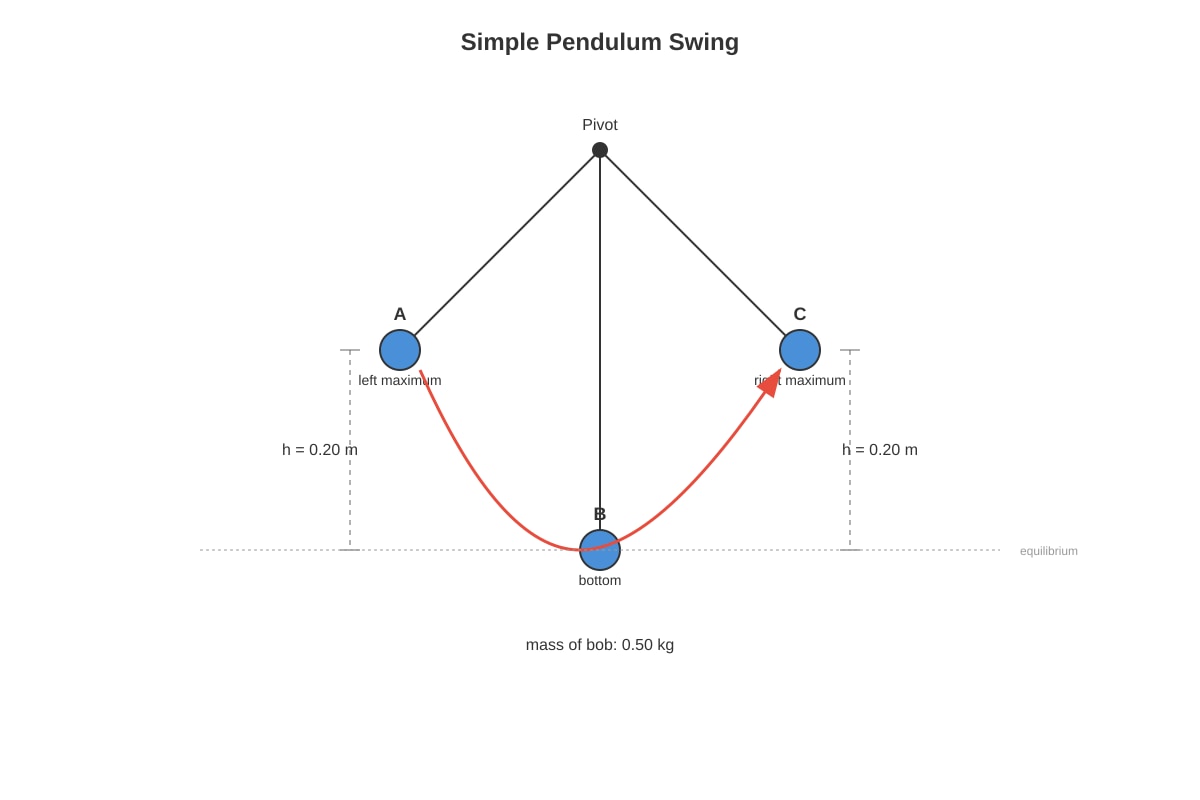
4. (a) Position B (1 mark)
Explanation: At position B (the lowest point), all the gravitational potential energy has been converted to kinetic energy. At positions A and C, the bob is momentarily at rest (maximum GPE, zero KE).
4. (b) Maximum speed = 2.0 m/s (3 marks)
Working: Using conservation of energy: Loss in GPE = Gain in KE
The mass cancels:
Marking: Energy conservation principle stated (1 mark), correct substitution (1 mark), correct answer with unit (1 mark)
Common mistake: Forgetting to take the square root, or including mass unnecessarily and making arithmetic errors.
5. (a) Initial KE = 90 000 J (or 90 kJ) (2 marks)
Working:
Marking: Formula (1 mark), correct calculation (1 mark)
5. (b) The kinetic energy is converted to thermal energy (heat) in the brakes and surrounding air due to friction. (1 mark)
Section B: Structured Response
6. Work done = force × distance moved in direction of force. (2 marks)
Explanation: When holding the box stationary, there is an upward force balancing the weight, but the distance moved in the direction of this force is zero. Therefore, work done = J.
Alternatively: The force is vertical but there is no vertical displacement.
Marking: Definition or formula (1 mark), application to situation (1 mark)
Common mistake: Thinking that because the person gets tired, work must be done. Physical "work" in physics requires displacement in the force direction.
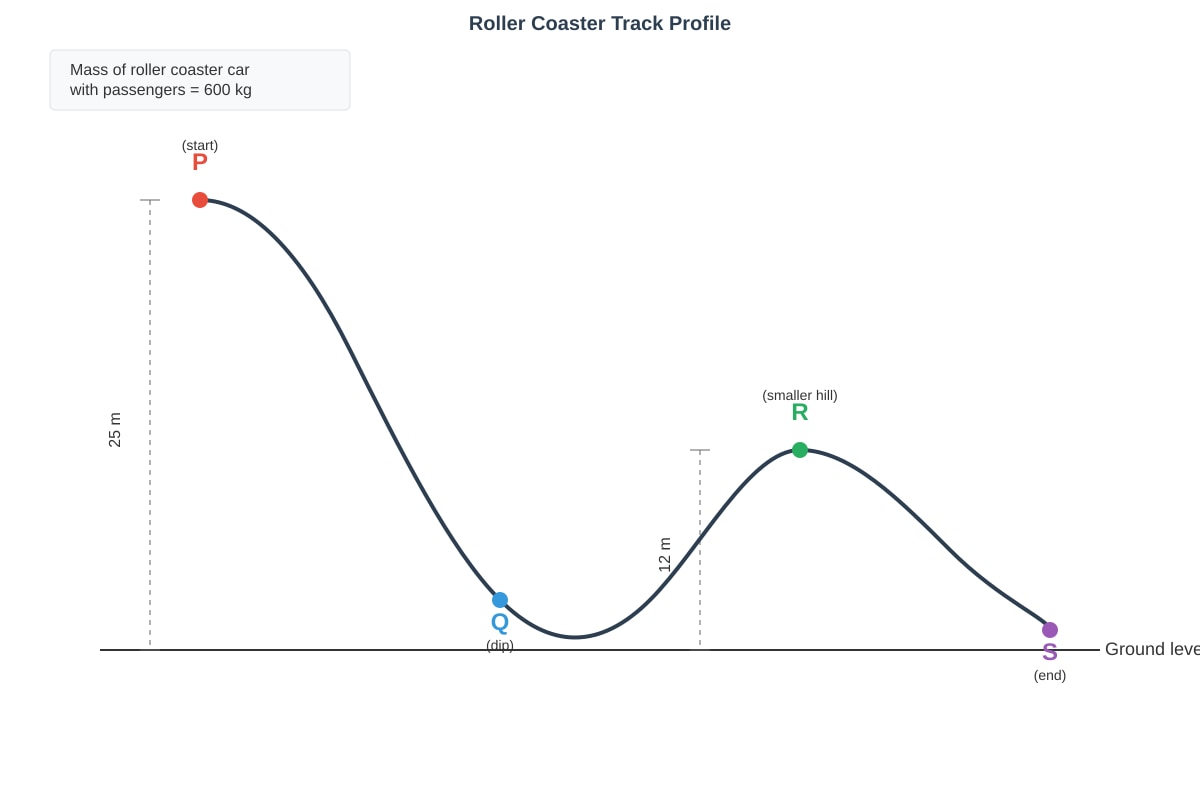
7. (a) GPE at P = 150 000 J (or 150 kJ) (2 marks)
Working:
Marking: Formula (1 mark), correct answer (1 mark)
7. (b) Maximum speed = 22.4 m/s (accept 22 m/s) (3 marks)
Working: Using conservation of energy: GPE at P = KE at Q (lowest point)
Mass cancels:
Marking: Energy conservation stated (1 mark), correct substitution (1 mark), correct answer (1 mark)
Note: The height at R is irrelevant for this calculation — it's a distractor testing whether students identify the correct height difference.
7. (c) Friction and air resistance do negative work, removing mechanical energy from the system. (1 mark) Some GPE is converted to thermal energy (heat) rather than kinetic energy, so the actual speed is less than the theoretical maximum.
8. (a) Work done = 200 J (2 marks)
Working:
Marking: Formula (1 mark), correct answer (1 mark)
8. (b) Work done on the box = force applied to the box × distance the box moves. (2 marks)
With the rough carpet, friction acts against the motion. The box stops after 3 m, so:
- Work done by the student on the box = J (less than before)
- Some of the student's 200 J effort is done against friction (work is dissipated as heat), not as work resulting in box motion
Marking: Recognition that work depends on displacement of the object (1 mark), explanation of energy dissipation/friction (1 mark)
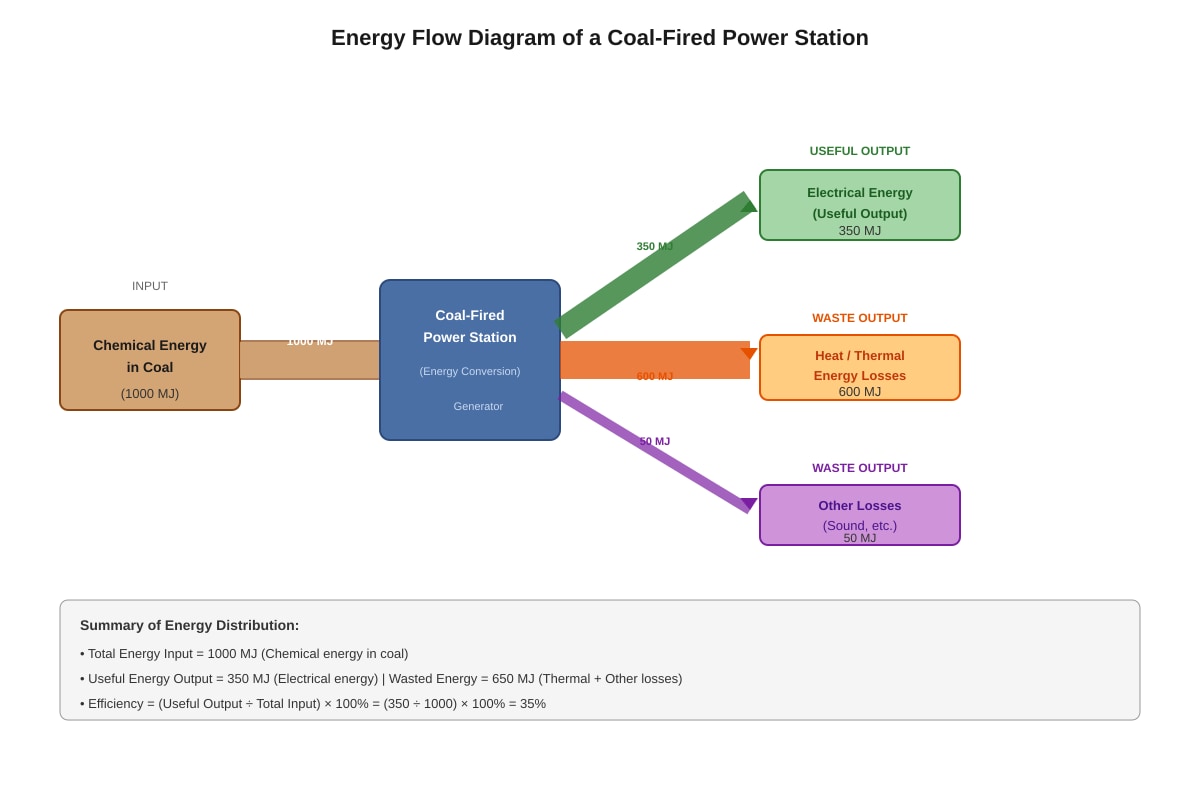
9. (a) Electrical energy (1 mark)
9. (b) Efficiency = 35% (2 marks)
Working:
Marking: Formula or correct identification (1 mark), correct calculation (1 mark)
10. Electrical energy output = J (or 72 MJ) (2 marks)
Working:
Marking: Method (1 mark), correct answer with power of ten (1 mark)
11. (a) 15 N (1 mark)
Explanation: To hold at constant height, the upward force must equal the weight (15 N), by Newton's first law (balanced forces, no acceleration).
11. (b) 0 J (1 mark)
11. (c) The force is vertical (upwards) but the displacement is horizontal. (1 mark) Work done = force × distance × cos(90°) = 0 since cos(90°) = 0. Alternatively: no component of force acts in the direction of motion.
12. (a) Elastic potential energy → Kinetic energy → Gravitational potential energy (+ Kinetic energy) (2 marks)
Marking: First conversion (1 mark), complete chain including GPE gain as ball rises (1 mark)
12. (b) Chemical energy (in battery) → Electrical energy → Kinetic energy (+ Thermal energy due to resistance) (2 marks)
Marking: Battery to electrical (1 mark), electrical to kinetic with waste noted (1 mark)
Section C: Data Analysis and Extended Response
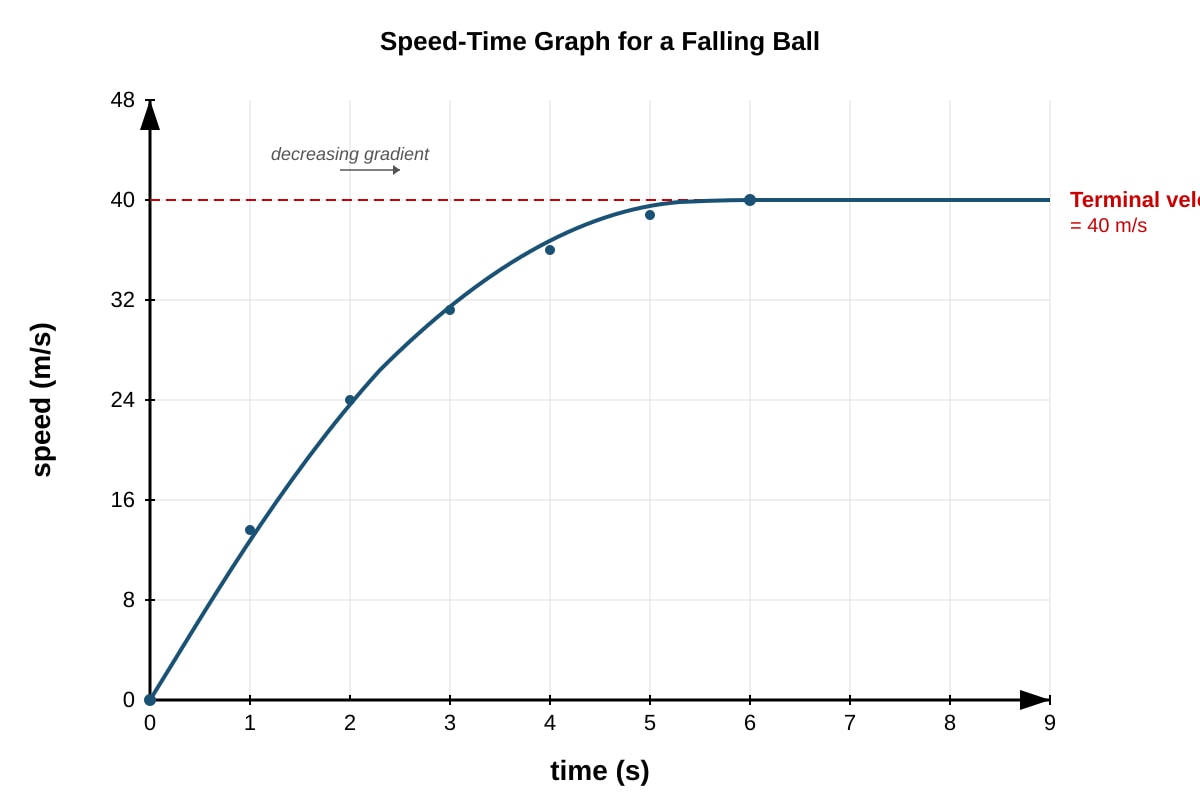
13. (a) 40 m/s (1 mark)
13. (b) The decreasing gradient indicates decreasing acceleration. (2 marks)
Explanation: At the start, the ball accelerates at approximately (10 m/s²) because air resistance is negligible at low speed. As speed increases, air resistance increases, reducing the net force and hence the acceleration. When air resistance equals weight, acceleration becomes zero and terminal velocity is reached.
Marking: Identifies decreasing acceleration (1 mark), explains cause (increasing air resistance with speed) (1 mark)
14. (a) As height increases, speed increases, but not in direct proportion / the increase in speed gets smaller for equal increases in height. (1 mark)
Alternative: Speed increases with height, but the relationship is not linear.
14. (b) Energy is proportional to height (), but speed is not. (2 marks)
Explanation: From , we get . Speed is proportional to the square root of height, not height itself. Doubling the height only increases speed by a factor of , not 2.
Marking: Correct relationship identified (1 mark), mathematical reasoning or correct example from data (1 mark: 1.4 to 2.0 is ×1.4, not ×2)
15. (a) Electrical energy → Gravitational potential energy (of water) (1 mark)
15. (b) Energy losses occur during both processes. (2 marks)
Explanation points:
- Pumping: Some electrical energy is converted to thermal energy (heat) due to friction in pipes and pump inefficiency (1 mark)
- Generation: Turbines and generators are not 100% efficient; friction and electrical resistance cause further thermal energy losses (1 mark)
- Overall efficiency = efficiency of pumping × efficiency of generation, which is always less than 100%
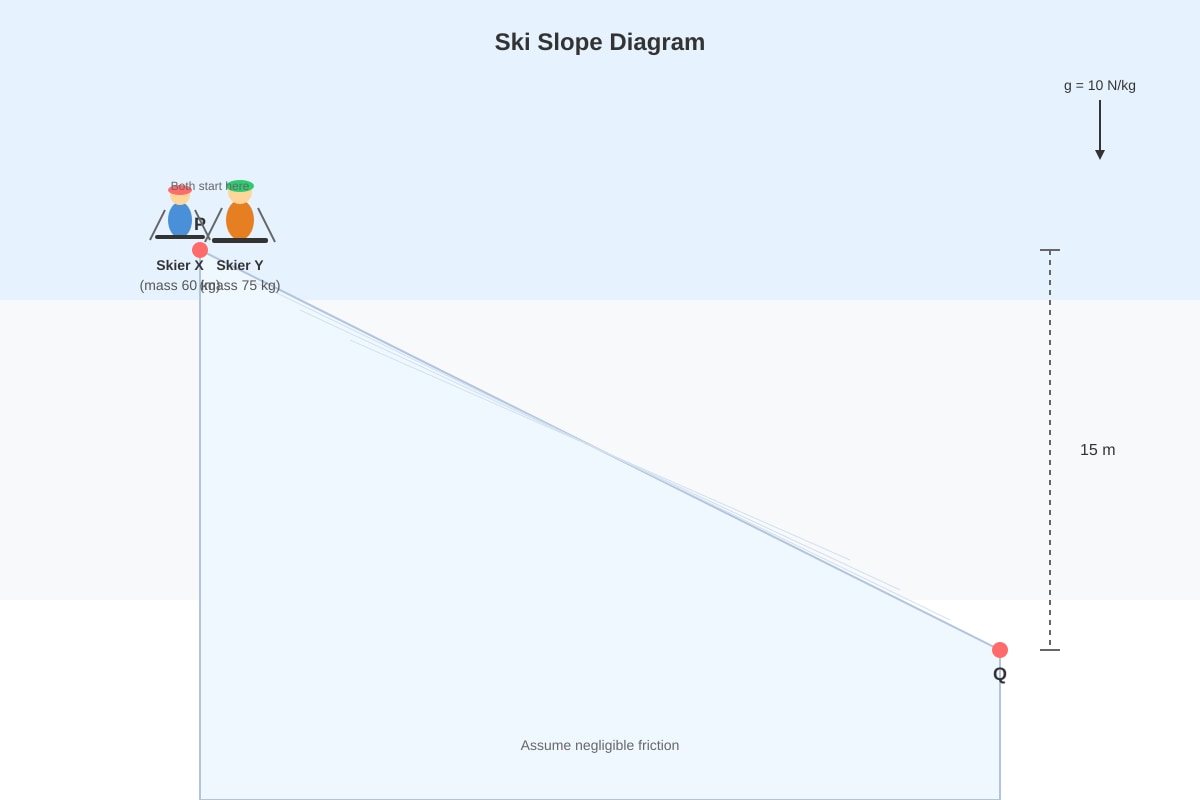
16. (a) Skier Y (75 kg) will have greater kinetic energy. (2 marks)
Explanation: Both skiers start from the same height, so skier Y with greater mass has more initial gravitational potential energy (). With negligible friction, all GPE converts to KE. Since Y has more mass and same height, Y has more initial GPE and therefore more final KE.
Marking: Correct identification (1 mark), correct reasoning using GPE ∝ m (1 mark)
16. (b) Yes, both skiers reach the same speed. (2 marks)
Explanation: From , the mass cancels: . Speed depends only on height and , not on mass. Both skiers fall through the same vertical distance, so they gain the same speed. Skier Y has more kinetic energy because KE also depends on mass, but the speed is identical.
Marking: Correct answer (1 mark), correct reasoning with mass cancellation (1 mark)
Common mistake: Assuming heavier objects fall faster (Galileo's misconception, not Newtonian physics).
17. (a) GPE gained = 600 000 J (or 600 kJ) (2 marks)
Working:
Marking: Formula or method (1 mark), correct answer (1 mark)
17. (b) Electrical energy input = 750 000 J (or 750 kJ) (2 marks)
Working:
Marking: Correct rearrangement (1 mark), correct answer (1 mark)
Common mistake: Multiplying by 0.80 instead of dividing (gives 480 kJ, which is incorrect).
18. (3 marks)
Explanation:
- The same GPE gain requires the same useful work input: is identical for both paths (1 mark)
- On the ramp, the force needed is less because it only needs to overcome a component of weight parallel to the ramp, not the full weight (1 mark)
- However, the distance along the ramp is greater, so the total work done (force × distance) is actually greater when friction is considered, but the force at any instant is less, making it feel easier
- More simply for Sec 1: The ramp allows the force to be smaller but applied over a longer distance; this means less effort/muscle force is needed at any moment, though the same useful work is done against gravity
Alternative accepted answer for full marks: The ramp is a simple machine (inclined plane) that allows the same work to be done with a smaller force over a longer distance, making it less strenuous.
19. (3 marks)
Explanation:
- "Used up" implies energy is destroyed, violating conservation of energy (1 mark)
- The correct description: The car's kinetic energy is converted to thermal energy (heat) due to friction between the wheels and ground, and friction/air resistance in the bearings and surroundings (1 mark)
- The total energy remains constant; it is transformed from one form to another and dissipated to the surroundings (1 mark)
Key concept: Energy cannot be created or destroyed, only converted from one form to another (Law of Conservation of Energy).
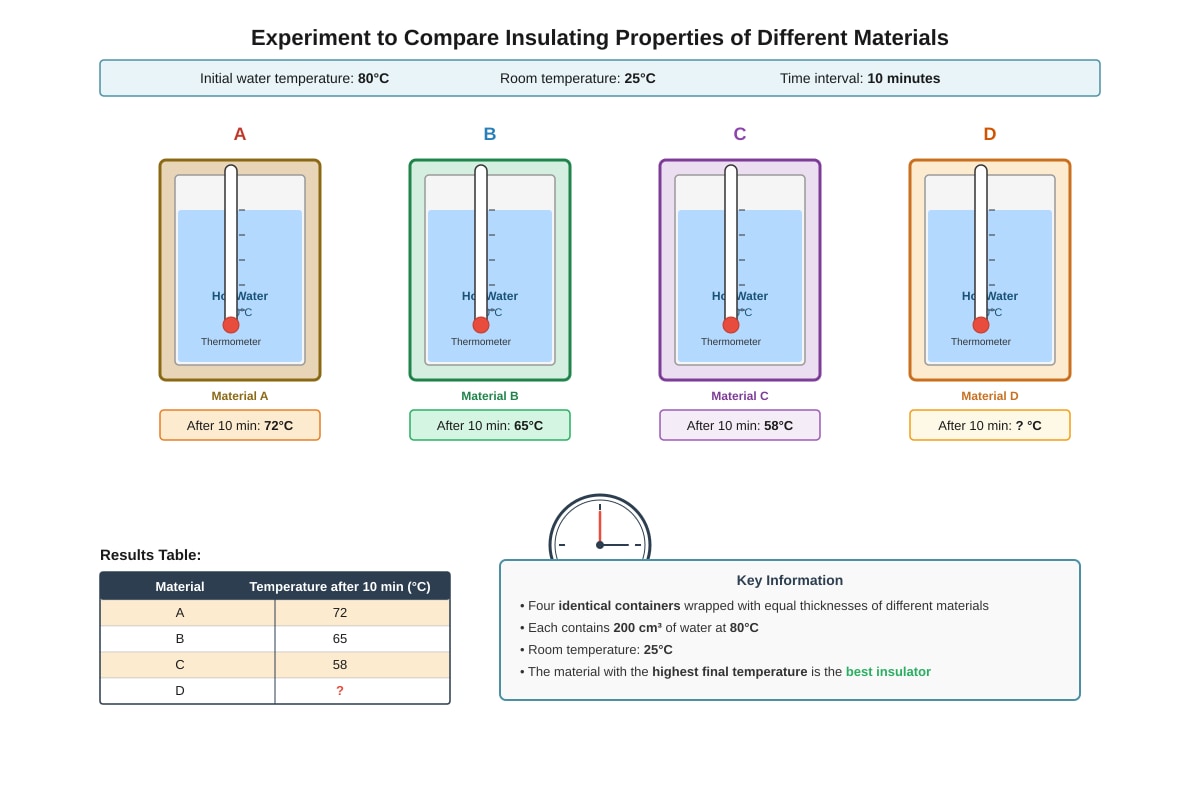
20. (a) Material A is the best insulator. (2 marks)
Reasoning: Material A maintained the highest temperature (72°C), losing only 8°C. This means it slowed down heat transfer from the hot water to the surroundings most effectively. Lower temperature drops indicate poorer insulation.
Marking: Correct identification (1 mark), correct reasoning using data (1 mark)
20. (b) (2 marks)
Explanation:
- Identical containers ensure the same surface area and material properties, so any temperature difference is due to the wrapping material alone (1 mark)
- Same water volume means the same mass of water, so the same heat energy is stored initially at the same temperature. Different volumes would have different thermal capacities and cool at different rates regardless of insulation (1 mark)
Key concept: Controlled variables must be kept constant to test the effect of the independent variable (insulation type) on the dependent variable (temperature change/rate of cooling).