From Real Exams Quiz
Secondary 1 Science Physical Sciences Quiz
Free Sec 1 Science Physical Sciences quiz, HY3 Exam version, with questions, answers, and syllabus-aligned practice for Singapore students.
These static practice materials are generated from the site's syllabus and paper-generation workflow, with source and model context shown so students and parents can evaluate the material before use.
Questions
Free quiz and exam paper access
Enter your details to view this paper
Your access is remembered on this device.
Answers
Secondary 1 Science Quiz - Physical Sciences (Answer Key)
Total Marks: 40
Topic: Physical Sciences
Level: Secondary 1
Section A: Forces and Motion
Q1. [1 mark]
Accepted answer: Any one of: change shape/size; change state of rest or motion (speed and/or direction); lift; press; stretch; twist.
Teaching note: A force is a push or pull. It can deform an object or change how it moves.
Common mistake: Saying "energy" — energy is not an effect of force directly.
Q2. [1 mark]
Answer: Gravitational force (or gravity / weight).
Teaching note: The Earth pulls objects down by gravitational force. Weight is the gravitational force acting on the object.
Q3. [1 mark]
Answer: Newton (N).
Teaching note: The unit of force is the newton, symbol N. A spring balance measures force in newtons.
Q4. [2 marks]
Answer: Pressure increases.
Marking: 1 mark for stating pressure increases; 1 mark for correct reason.
Working:
- Weight (force) of brick = 20 N, stays the same.
- Pressure = Force ÷ Area.
- Smallest face → smaller contact area.
- Smaller area with same force → higher pressure.
Teaching note: Force does not change; only contact area changes.
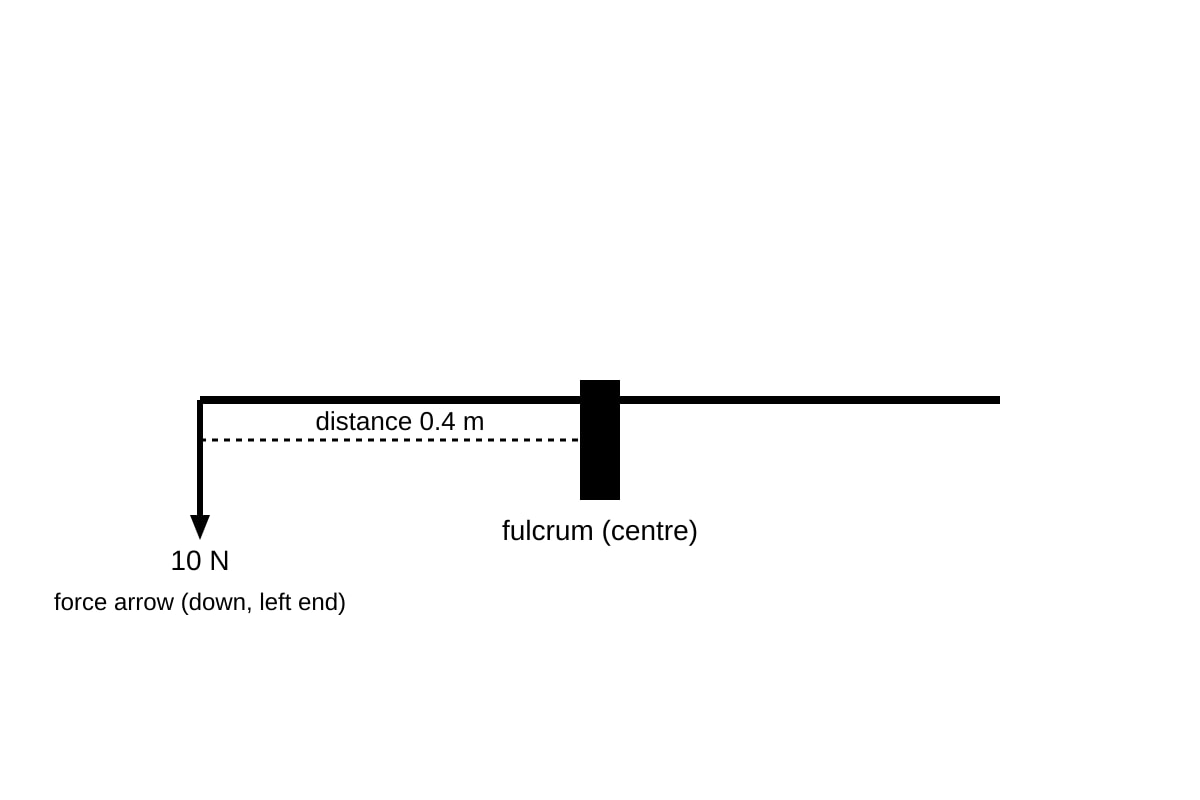
Q5. [2 marks]
Answer: 4 N·m
Working:
Moment = Force × perpendicular distance
= 10 N × 0.4 m
= 4 N·m
Teaching note: Use perpendicular distance from pivot to line of action of force. Unit is N·m.
Common mistake: Using slant distance or forgetting unit.
Section B: Energy and Energy Conversion
Q6. [1 mark]
Answer: Chemical energy → Gravitational potential energy.
Teaching note: Boy uses chemical energy from food/muscles to raise box; box gains GPE.
Q7. [2 marks]
Answer: Any two of: biomass, hydropower, sun (solar), wind. (1 mark each)
Teaching note: Renewable sources can be replenished naturally.
Q8. [2 marks]
Answer: 0 J
Working:
Work done = Force × displacement
Object held stationary → displacement = 0 m
Work = 15 N × 0 m = 0 J
Teaching note: No movement means no work done, even if tired.
Common mistake: Using height 1.2 m wrongly.
Q9. [1 mark]
Answer: Any one: wind not always available (intermittent); can affect birds; noisy; needs large space.
Teaching note: Disadvantages relate to reliability or environment.
Q10. [1 mark]
Answer: Any one: switch off lights when not in use; use energy-saving bulbs; unplug devices.
Teaching note: Reducing wastage saves resources.
Section C: Electricity and Heat
Q11. [1 mark]
Answer: 230 V
Teaching note: Singapore homes use 230 volts.
Q12. [1 mark]
Answer: Circle with letter V inside (ⓥ) — circuit symbol for voltmeter.
Teaching note: Voltmeter connected in parallel; symbol is a circle with V.
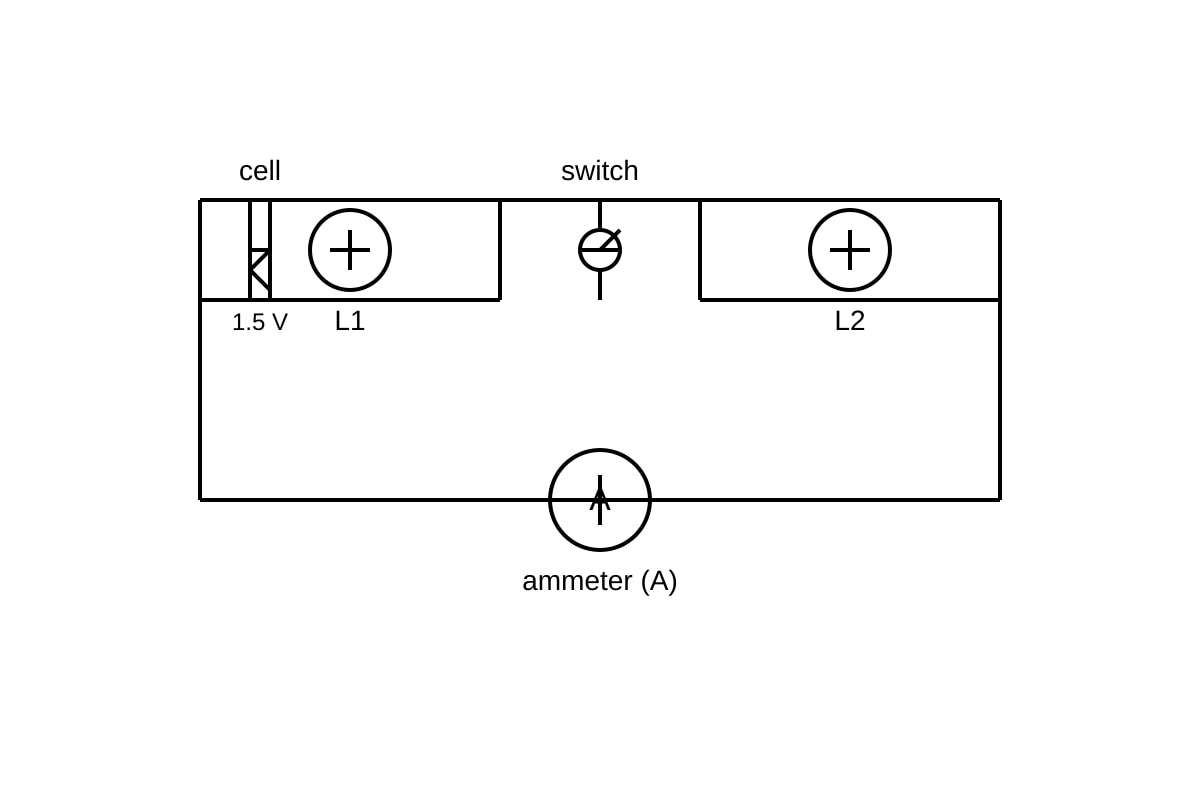
Q13. [1 mark]
Answer: Series
Teaching note: One path, lamps one after another = series.
Q14. [1 mark]
Answer: Same temperature between 20 °C and 80 °C (thermal equilibrium).
Teaching note: Heat flows until both reach same temperature; exact value not needed, just state they equalise.
Q15. [1 mark]
Answer: Maintain temperature (at a set value).
Teaching note: Thermostat keeps temperature steady, e.g., in iron or oven.
Section D: Light, Pressure and Applied Physics
Q16. [1 mark]
Answer: 30°
Teaching note: Law of reflection: angle of incidence = angle of reflection.
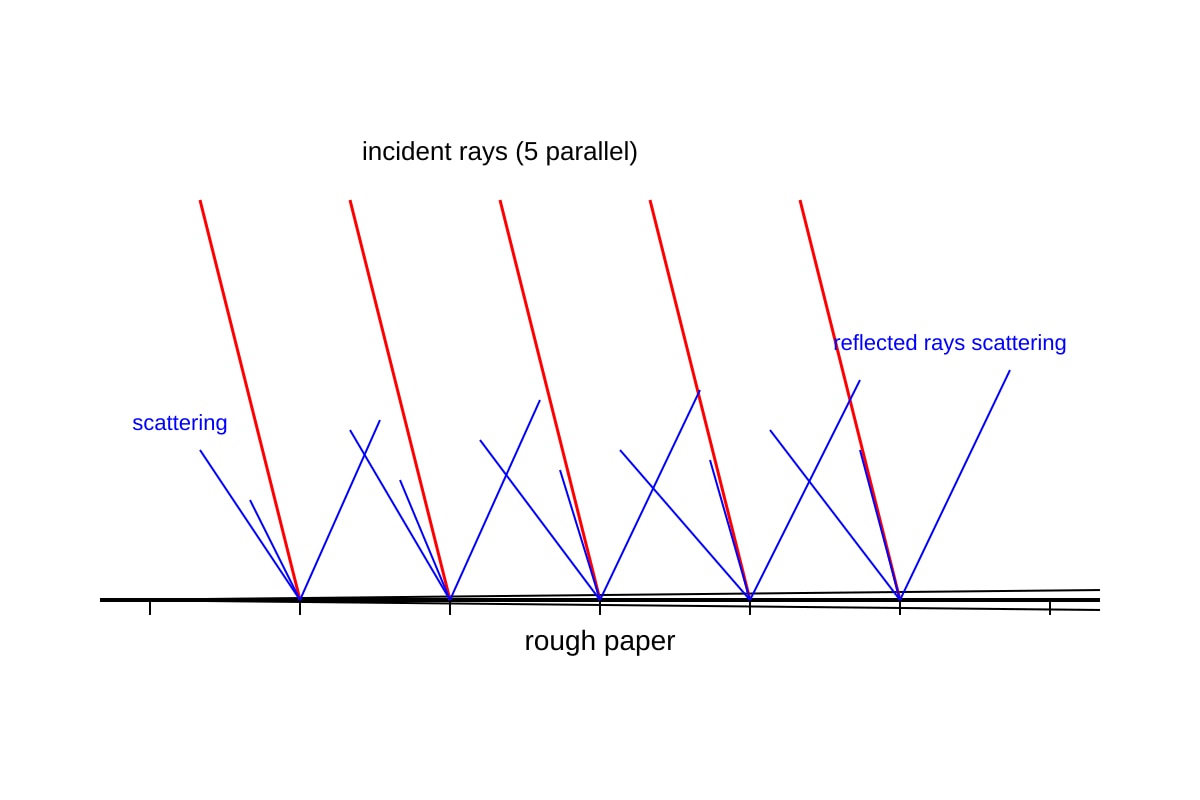
Q17. [1 mark]
Answer: Reflected rays drawn scattering in many directions (diffuse reflection).
Teaching note: Rough surface → diffuse reflection, not parallel rays.
Q18. [2 marks]
Answer: Heels have smaller contact area; same force over smaller area → higher pressure → more damage.
Marking: 1 mark area smaller, 1 mark pressure higher.
Teaching note: Pressure = Force ÷ Area.
Q19. [2 marks]
Answer: 200 J
Working:
Work = Force × distance
= 50 N × 4 m
= 200 J
Teaching note: Force in direction of motion; unit joule (J).
Q20. [1 mark]
Answer: Risk of electric shock / short circuit / electrocution.
Teaching note: Water conducts electricity; danger in damp conditions.