From Real Exams Quiz

Secondary 1 Science Life Sciences Quiz

Free Exam-Derived Kimi K2 6 Free Secondary 1 Science Life Sciences quiz with questions and answers for Singapore students. This page is rendered as a direct URL so the questions and answers can be discovered without pressing in-page buttons.

These static practice materials are generated from the site's syllabus and paper-generation workflow, with source and model context shown so students and parents can evaluate the material before use.

Secondary 1 Science From Real Exams Generated by Kimi K2 6 Free Updated 2026-06-07

Questions

<!-- TuitionGoWhere generation metadata: stage=3-0; model=moonshotai/kimi-k2.6:free; model_label=Kimi K2.6 Free; generated=2026-06-07; Sources: Stage 2-1 real exam-derived templates and Stage 2-2 exam-enriched syllabus. -->

Secondary 1 Science Quiz - Life Sciences

Name: _____________________________ Class: ______________ Date: ______________

Score: ________ / 40

Duration: 40 minutes

Total Marks: 40

Instructions: Answer all questions. Write your answers in the spaces provided. Show all working where required.


Section A: Multiple Choice (Questions 1–5)

Choose the correct answer for each question. Each question carries 1 mark.

Marks for this section: 5


1. Which of the following is NOT a characteristic of living things?

A) Growth B) Reproduction C) Photosynthesis D) Excretion

Answer: ________________


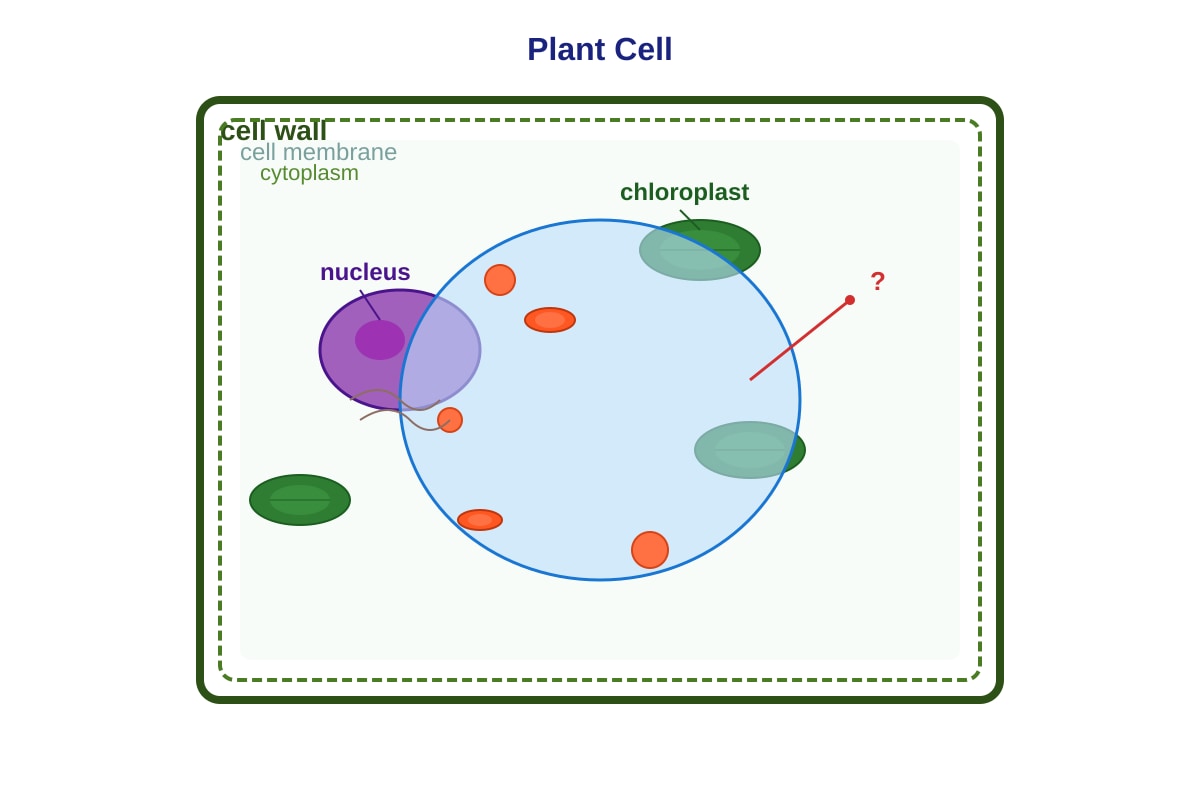
2. The diagram below shows a plant cell.

<image_placeholder> id: Q2-fig1 type: diagram linked_question: Q2 description: Plant cell diagram showing typical organelles with one label missing labels: cell wall, cell membrane, cytoplasm, nucleus, chloroplast, vacuole; one organelle pointed to by leader line is unlabeled values: none must_show: rectangular shape with cell wall, clearly distinguishable organelles, leader line pointing to a large central organelle without a label </image_placeholder>

The structure pointed to by the leader line is responsible for:

A) Controlling what enters and leaves the cell B) Producing energy through respiration C) Containing genetic material D) Storing cell sap and helping maintain cell shape

Answer: ________________


3. In an experiment to test for starch in a leaf, which procedure is essential before adding iodine solution?

A) Crush the leaf with water B) Boil the leaf in ethanol to remove chlorophyll C) Freeze the leaf overnight D) Soak the leaf in sugar solution

Answer: ________________


4. Which part of the digestive system is primarily responsible for absorbing water and mineral salts?

A) Stomach B) Small intestine C) Large intestine D) Oesophagus

Answer: ________________


5. The table below shows the features of three different animal groups.

FeatureGroup XGroup YGroup Z
Body temperature regulationCold-bloodedWarm-bloodedCold-blooded
Body coveringScalesFeathersMoist skin
Embryo developmentLays eggs on landLays eggs with hard shellsLays eggs in water

Which groups are matched correctly to their animal classes?

A) X = Fish, Y = Birds, Z = Amphibians B) X = Reptiles, Y = Birds, Z = Amphibians C) X = Reptiles, Y = Mammals, Z = Fish D) X = Amphibians, Y = Birds, Z = Fish

Answer: ________________


Section B: Short Answer (Questions 6–15)

Answer each question in the space provided. Questions carry 1–3 marks as indicated.

Marks for this section: 22


6. State two ways in which a plant cell differs from an animal cell. ____________________________________________________________________ [2]


7. Name the process by which plants make their own food using sunlight. ____________________________________________________________________ [1]


8. The diagram shows the human heart with chambers labeled W, X, Y, and Z.

<image_placeholder> id: Q8-fig1 type: diagram linked_question: Q8 description: Simple diagram of human heart in sectional view showing four chambers labeled W, X, Y, Z clockwise from top right labels: W (top right), X (bottom right), Y (bottom left), Z (top left); arrows showing blood flow direction; pulmonary artery and aorta indicated values: none must_show: four distinct chambers with clear labels W, X, Y, Z; arrows indicating direction of blood flow; major blood vessels (vena cava, pulmonary artery, pulmonary vein, aorta) should be distinguishable </image_placeholder>

(a) Identify chamber Y. ________________________________________________ [1]

(b) Explain why the wall of chamber W is thicker than the wall of chamber Z.


____________________________________________________________________ [2]


9. Complete the table below by writing the correct digestive enzyme and end product for each food type.

Food TypeEnzymeEnd Product
Starch
ProteinsPepsin / Trypsin
FatsFatty acids and glycerol

[3]


10. Explain why the small intestine is well-adapted for the absorption of digested food. Give two reasons.


____________________________________________________________________ [2]


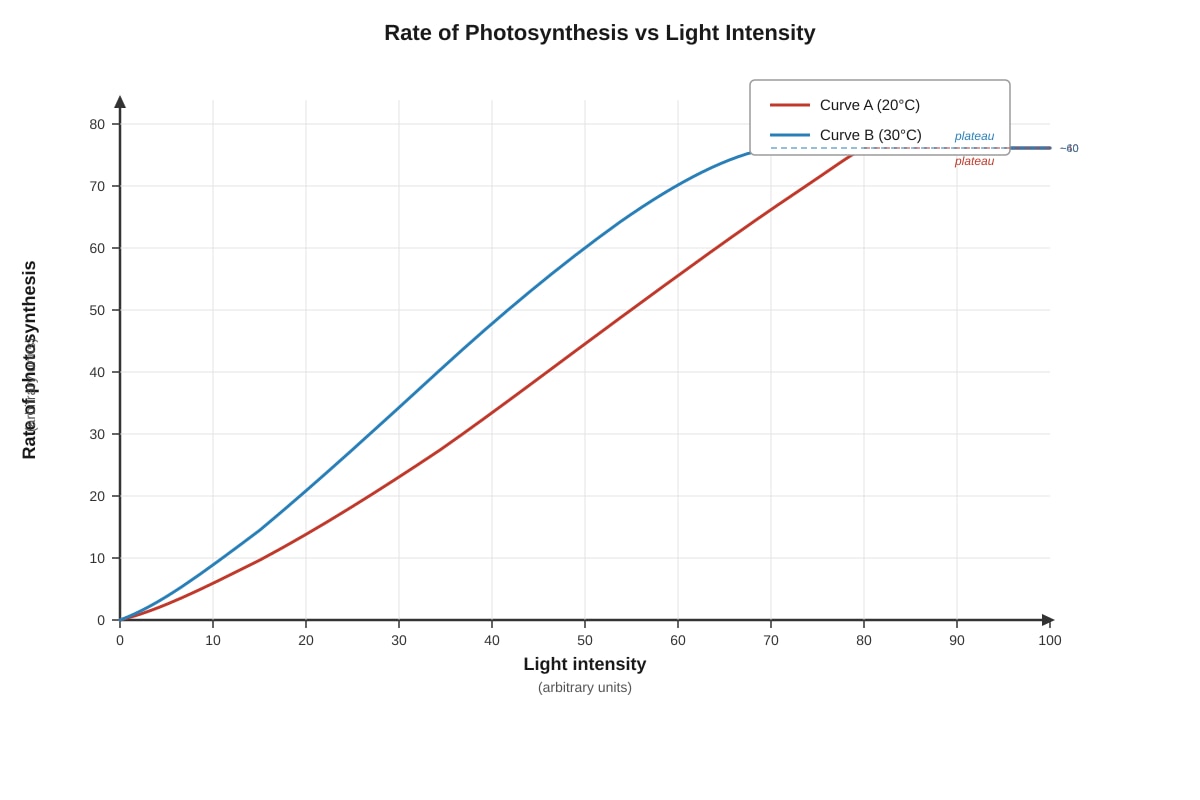
11. The graph below shows how the rate of photosynthesis changes with light intensity at two different temperatures.

<image_placeholder> id: Q11-fig1 type: graph linked_question: Q11 description: Line graph showing rate of photosynthesis (y-axis, arbitrary units) versus light intensity (x-axis, 0-100 arbitrary units) labels: y-axis: Rate of photosynthesis; x-axis: Light intensity; two curves labeled A (20°C) and B (30°C) values: Curve A rises steadily and plateaus at approximately 40 units rate at 80 units light; Curve B rises more steeply, plateaus at approximately 60 units rate at 70 units light must_show: Both curves starting from origin; clear plateau regions; Curve B higher than Curve A at all light intensitudes; axes clearly labeled with units; legend showing 20°C and 30°C </image_placeholder>

(a) State the factor that limits the rate of photosynthesis at point P on Curve B (where the curve has just plateaued). ____________________________________________________________________ [1]

(b) Explain why Curve B reaches a higher maximum rate than Curve A.


____________________________________________________________________ [2]


12. Describe how the breathing system of fish differs from that of mammals.


____________________________________________________________________ [2]


13. In an experiment, a student places a plant in a dark cupboard for 48 hours. She then exposes one leaf to bright light for 4 hours while covering another leaf with aluminium foil. After testing both leaves for starch, explain what results she would expect and why.


____________________________________________________________________ [3]


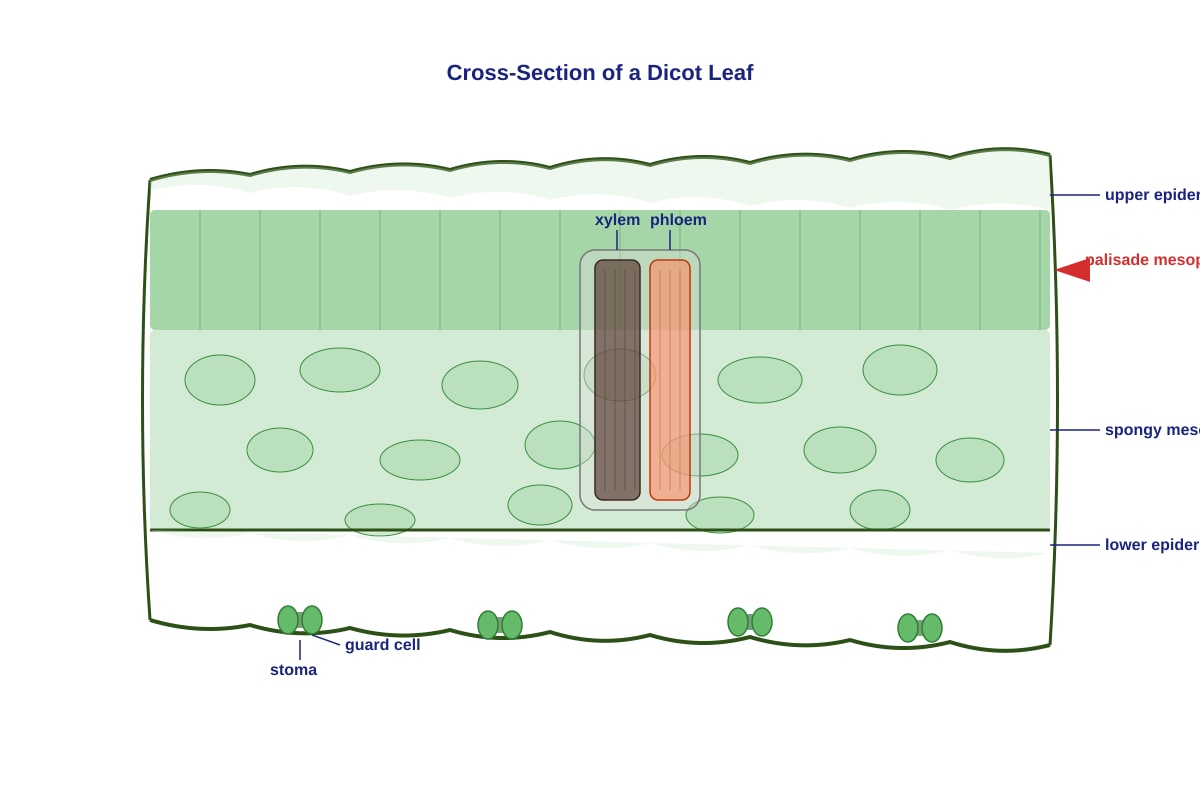
14. The diagram shows a cross-section of a leaf.

<image_placeholder> id: Q14-fig1 type: diagram linked_question: Q14 description: Cross-section of a typical dicot leaf showing upper epidermis, palisade mesophyll, spongy mesophyll, lower epidermis with stomata, and vascular bundle labels: upper epidermis, palisade mesophyll, spongy mesophyll, lower epidermis, stoma, guard cell, xylem, phloem; one arrow pointing to layer between upper epidermis and spongy mesophyll values: none must_show: clear layered structure; distinct palisade and spongy mesophyll layers; stomata with guard cells on lower surface; vascular bundle with xylem and phloem; arrow pointing to palisade mesophyll layer </image_placeholder>

(a) Name the layer pointed to by the arrow. ________________________________ [1]

(b) Explain why this layer contains the most chloroplasts.


____________________________________________________________________ [2]


15. Suggest two ways in which a farmer could increase the yield of crop plants in a greenhouse, based on your knowledge of photosynthesis.


____________________________________________________________________ [2]


Section C: Structured Response (Questions 16–20)

Answer all questions in the spaces provided. Questions carry 2–3 marks.

Marks for this section: 13


16. The diagram shows an experimental setup to investigate the effect of light on gas production in an aquatic plant.

<image_placeholder> id: Q16-fig1 type: experimental_setup linked_question: Q16 description: Two identical test tubes each containing water and an aquatic plant (Elodea), inverted in a beaker of water; one test tube placed in bright light, the other in darkness; bubbles collecting at top of inverted test tube in light condition labels: Tube A (bright light), Tube B (darkness), water, aquatic plant, bubbles/oxygen at top of Tube A, no bubbles in Tube B, beaker values: none must_show: identical setup in both conditions; light source indicated for Tube A; dark cover indicated for Tube B; bubbles visible in Tube A; scale or measurement indication possible; equal starting water levels </image_placeholder>

(a) Suggest why the plant in Tube A produces bubbles but the plant in Tube B does not.


____________________________________________________________________ [2]

(b) Name the gas collected in Tube A and describe how you could test for it.


____________________________________________________________________ [2]


17. The table shows the food substances detected in four different foods.

FoodReducing sugarStarchProteinFat
PPresentAbsentAbsentAbsent
QAbsentPresentPresentAbsent
RPresentPresentAbsentPresent
SAbsentAbsentPresentPresent

(a) Which food would test positive with Benedict's solution but negative with iodine solution? ________________________________ [1]

(b) A student tests an unknown food sample and observes a purple colour with Biuret reagent and a translucent stain on paper. Which food in the table matches this description? ________________________________ [1]

(c) Describe the positive result for each of the following food tests: (i) Benedict's test for reducing sugar: ________________________________ (ii) Ethanol emulsion test for fat: __________________________________ [2]


18. The diagram shows the human alimentary canal.

<image_placeholder> id: Q18-fig1 type: diagram linked_question: Q18 description: Simplified diagram of human alimentary canal showing main parts from mouth to anus with labels W, X, Y, Z pointing to different regions labels: W (pointing to narrow tube after stomach), X (pointing to coiled tube), Y (pointing to wider tube before end), Z (pointing to final opening), mouth, stomach values: none must_show: relative positions correct; W between stomach and X; X as longest coiled section; Y as wider tube leading to Z; arrow labels clearly pointing to correct regions </image_placeholder>

(a) Identify the parts labeled W and Y. W: ________________________________ Y: ________________________________ [2]

(b) Explain how part X is adapted for absorption of digested food.


____________________________________________________________________ [2]


19. A student investigates the effect of temperature on the activity of the enzyme amylase. She sets up five test tubes containing starch suspension and amylase solution at different temperatures. After 10 minutes, she tests each tube for starch using iodine solution.

Temperature (°C)Result of iodine test
0Blue-black
20Blue-black
37Brown
60Blue-black
80Blue-black

(a) Explain the result at 37°C.


____________________________________________________________________ [2]

(b) Explain why the enzyme does not work at 0°C and at 80°C.


____________________________________________________________________ [2]


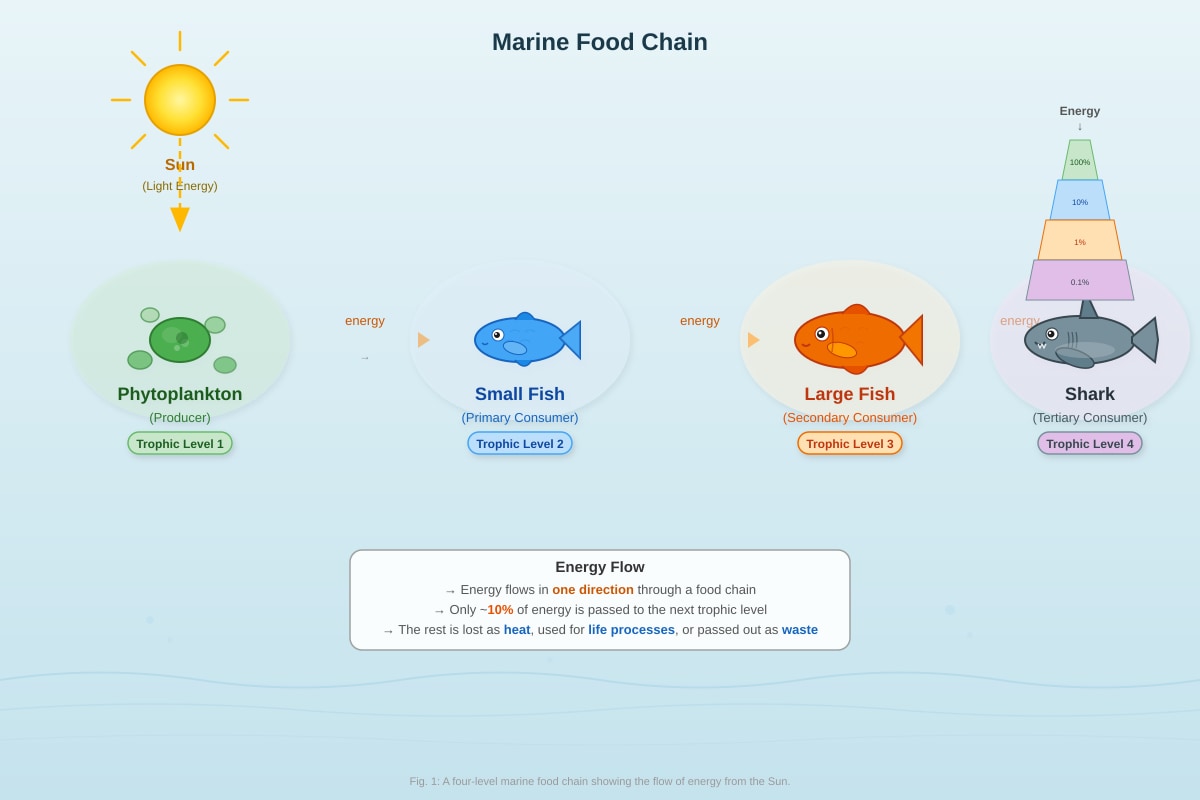
20. The diagram shows a food chain in a marine ecosystem.

<image_placeholder> id: Q20-fig1 type: diagram linked_question: Q20 description: Simple food chain diagram showing arrow flow from left to right through four trophic levels in marine ecosystem labels: phytoplankton → small fish → large fish → shark; arrows between each level; sun symbol above phytoplankton values: none must_show: four distinct trophic levels; correct arrow direction (energy flow); sun indicating energy source for producer; clear labels for each organism; simple marine-themed background or context </image_placeholder>

(a) Write the name of the producer in this food chain. ________________________________ [1]

(b) Explain why energy is lost between each trophic level.


____________________________________________________________________ [2]

(c) If the shark population decreases due to overfishing, predict what would happen to the populations of large fish and small fish in the short term, and explain your answer.


____________________________________________________________________ [2]


END OF QUIZ

Answers

<!-- TuitionGoWhere generation metadata: stage=3-0; model=moonshotai/kimi-k2.6:free; model_label=Kimi K2.6 Free; generated=2026-06-07; Sources: Stage 2-1 real exam-derived templates and Stage 2-2 exam-enriched syllabus. -->

Secondary 1 Science Quiz - Life Sciences: Answer Key

Total Marks: 40


Section A: Multiple Choice (Questions 1–5)

Marks: 5 (1 mark each)


1. C) Photosynthesis [1]

Teaching note: The seven characteristics of living things are: movement, respiration, sensitivity, growth, reproduction, excretion, and nutrition (MRS GREN). Photosynthesis is a process used by plants to achieve nutrition—it is not itself a universal characteristic of all living things. Animals, for example, do not perform photosynthesis but are still living.


2. D) Storing cell sap and helping maintain cell shape [1]

Teaching note: The leader line points to the vacuole, the large central structure in a plant cell. The vacuole contains cell sap (a solution of salts, sugars, and pigments) and maintains turgor pressure against the cell wall, keeping the cell rigid. Option A describes the cell membrane; B describes mitochondria; C describes the nucleus.


3. B) Boil the leaf in ethanol to remove chlorophyll [1]

Teaching note: Chlorophyll is the green pigment that masks the colour change when iodine (yellow-brown) reacts with starch (blue-black). The correct sequence is: boil water → place leaf in boiling water (kills cell and breaks cell walls) → boil leaf in ethanol (removes chlorophyll) → rinse in water → add iodine solution.


4. C) Large intestine [1]

Teaching note: While the small intestine absorbs most digested nutrients (glucose, amino acids, fatty acids, vitamins, minerals), the large intestine primarily absorbs water and mineral salts, converting liquid chyme into solid faeces. The stomach mainly digests; the oesophagus only transports.


5. B) X = Reptiles, Y = Birds, Z = Amphibians [1]

Teaching note:

  • Reptiles (X): cold-blooded, scales, lay eggs on land with leathery or hard shells
  • Birds (Y): warm-blooded, feathers, lay hard-shelled eggs
  • Amphibians (Z): cold-blooded, moist skin, lay eggs in water (no shells, would dry out)

Fish have fins/scales but are fully aquatic; mammals have hair/fur and typically give live birth.


Section B: Short Answer (Questions 6–15)

Marks: 22


6. Any two from: [2]

  • Has a cell wall (animals do not)
  • Has chloroplasts for photosynthesis (animals do not)
  • Has a large central vacuole (animals have small or no vacuoles)
  • Often has a more regular/rectangular shape due to cell wall

Marking: 1 mark per valid difference; must state presence in plant and absence in animal (or vice versa) for full credit.


7. Photosynthesis [1]

Teaching note: From Greek photo- (light) + synthesis (putting together). The word equation: carbon dioxide + water → glucose + oxygen (in the presence of light and chlorophyll).


8. (a) Y = Left ventricle [1]

(b) Chamber W is the right ventricle, which pumps blood to the lungs (pulmonary circulation) only. Chamber Z is the left atrium, which receives oxygenated blood from the lungs and passes it to the left ventricle. The right ventricle has a thicker wall than the left atrium because the atrium only needs to pump blood a short distance into the ventricle (low pressure), while the ventricle must pump blood out of the heart to the lungs or body (higher pressure needed). [2]

Alternative accepted answer: If student identifies W as left ventricle and Z as right atrium (depending on labeling variation), then: W pumps blood to the entire body (systemic circulation) so has the thickest wall of all; Z (right atrium) only receives blood from the vena cava.

Marking note: Accept either interpretation based on standard heart diagrams. The key is explaining wall thickness in relation to pumping distance/pressure required.


9.

Food TypeEnzymeEnd Product
StarchAmylaseMaltose / Glucose
ProteinsPepsin / TrypsinAmino acids
FatsLipaseFatty acids and glycerol

Marking: 1 mark per correct row. For starch, accept "salivary amylase" or "pancreatic amylase"; end product can be maltose (intermediate) or glucose (final after maltase action).


10. Any two from: [2]

  • Long length (approximately 6–7 m in adults) provides large surface area for absorption
  • Villi and microvilli lining the inner surface greatly increase surface area
  • Thin wall (one cell thick/epithelium) allows short diffusion distance for nutrients
  • Rich blood supply (capillaries) maintains concentration gradient by removing absorbed nutrients quickly
  • Lacteals present for fat absorption

Marking: 1 mark per valid adaptation with explanation; "large surface area" alone insufficient without mention of villi/microvilli or length.


11. (a) Carbon dioxide concentration [1] (or "temperature" if interpreted differently, but most likely CO₂ at this stage)

Revised more likely answer: At the point where curve first plateaus, light intensity is no longer limiting—another factor limits rate. Given only light and temperature are variables shown, the limiting factor is most likely carbon dioxide concentration (usually the next limiting factor in standard experiments). Accept "carbon dioxide" or "CO₂ concentration."

(b) Curve B is at 30°C, which is closer to the optimum temperature for enzyme activity in photosynthesis. At 20°C (Curve A), enzyme activity is lower, so the maximum rate of photosynthesis is reduced. Higher temperature increases kinetic energy of molecules and enzyme activity up to optimum. [2]

Marking: Must mention enzymes (or "chemical reactions") and optimum temperature concept for 2 marks.


12. Fish use gills for gas exchange; water flows over the gills and dissolved oxygen is extracted. Mammals use lungs; air is breathed in and oxygen diffuses across alveoli into blood. [2]

Alternative valid points: Fish have a two-way flow system (water enters and exits same path); mammals have a tidal breathing system (air in and out same route) or more efficiently described as airflow through dead-end sacs. Accept any clear structural-functional comparison.


13.

  • Exposed leaf (in light): Tests positive for starch (blue-black with iodine) [1]
  • Covered leaf (in darkness): Tests negative for starch (iodine remains brown/yellow) [1]
  • Explanation: The de-starching period in darkness removes stored starch. Only the exposed leaf can perform photosynthesis using light energy to produce glucose, which is converted to starch for storage. The foil-covered leaf receives no light, so no photosynthesis occurs and no starch is produced. [1]

Marking: 1 mark for each result; 1 mark for explanation linking light to photosynthesis to starch production.


14. (a) Palisade mesophyll (or "palisade layer") [1]

(b) This layer is closest to the upper surface of the leaf where light intensity is greatest. The cells are column-shaped and tightly packed with many chloroplasts to maximise light absorption for photosynthesis. [2]

Marking: 1 mark for position/arrangement; 1 mark for function (maximise light absorption).


15. Any two from: [2]

  • Increase carbon dioxide concentration (add CO₂ generators or ventilate)
  • Increase light intensity (use artificial lighting, especially in winter)
  • Maintain optimum temperature (use heating/cooling systems)
  • Add mineral fertilisers (especially nitrogen, magnesium for chlorophyll; phosphorus, potassium)

Marking: Must relate to factor affecting photosynthesis rate. Generic "add fertiliser" insufficient without linking to photosynthesis (e.g., magnesium for chlorophyll).


Section C: Structured Response (Questions 16–20)

Marks: 13


16. (a) Tube A is in bright light, so the plant can perform photosynthesis. This process produces oxygen gas as a by-product, seen as bubbles. Tube B is in darkness, so no photosynthesis occurs and no oxygen is produced. [2]

Marking: 1 mark for linking light to photosynthesis; 1 mark for oxygen production (not just "bubbles"—must identify process).

(b) The gas is oxygen. [1] Test: Place a glowing splint into the collected gas; it will relights/rekindles in the presence of oxygen. [1]


17. (a) Food P [1] (reducing sugar present, starch absent—Benedict's positive, iodine negative)

(b) Food S [1] (protein → Biuret purple; fat → translucent stain)

(c) (i) Brick red / orange-red precipitate (when heated) [1] (ii) White emulsion forms (or "cloudy white layer"), OR translucent spot on brown paper [1]


18. (a) W = Small intestine (duodenum/ileum region); Y = Large intestine (colon/rectum region) [2]

Note: Based on standard diagram interpretation where W points to the narrow tube immediately after stomach (duodenum start), X is the main coiled small intestine, Y is large intestine, Z is anus.

(b) The small intestine (X) has: [2]

  • Villi that increase surface area enormously
  • Thin walls (one cell thick) for short diffusion distance
  • Rich blood supply in villi to maintain concentration gradient
  • Microvilli on epithelial cells for further surface area increase

Marking: 2 marks for two valid adaptations with explanations; 1 mark for two adaptations without explanation.


19. (a) At 37°C (body temperature), amylase is at or near its optimum temperature. The enzyme works efficiently to break down starch into maltose, so no starch remains and the iodine test stays brown (negative result). [2]

Marking: 1 mark for optimum temperature; 1 mark for starch broken down/no starch detected.

(b) At 0°C: Temperature is too low; enzyme molecules and substrate have insufficient kinetic energy—fewer successful collisions occur, reaction rate very slow/enzyme essentially inactive. Not denatured, just inactive. [1]

At 80°C: Temperature is too high; the enzyme is denatured—the active site changes shape permanently due to breaking of bonds in the protein structure. Substrate can no longer fit. [1]

Marking: Must distinguish between low temperature (slow/inactive, reversible) and high temperature (denatured, permanent damage).


20. (a) Phytoplankton [1]

(b) Energy is lost between trophic levels due to: [2]

  • Respiration (metabolic processes release energy as heat)
  • Movement and other life processes
  • Heat loss to the environment
  • Incomplete digestion (not all organism is eaten or absorbed)
  • Excretion of waste materials

Marking: 1 mark for respiration/heat loss; 1 mark for any other valid reason.

(c) Short-term predictions: [2]

  • Large fish population increases: Fewer sharks to prey on them, so mortality decreases
  • Small fish population decreases: More large fish surviving means more predation pressure on small fish

OR alternative valid prediction with explanation.

Marking: 1 mark for each population trend with correct explanation linked to shark removal. Must show understanding of predator-prey dynamics.


END OF ANSWER KEY