From Real Exams Quiz
Secondary 1 Science Chemistry Materials Quiz
Free Sec 1 Science Chemistry Materials quiz with questions, answers, and syllabus-aligned practice for Singapore students preparing for school assessments.
These static practice materials are generated from the site's syllabus and paper-generation workflow, with source and model context shown so students and parents can evaluate the material before use.
Questions
Secondary 1 Science Quiz - Chemistry Materials
Name: ___________________________
Class: ___________________________
Date: ___________________________
Score: _____ / 40
Duration: 45 minutes
Total Marks: 40
Instructions:
- Answer all questions.
- Write your answers in the spaces provided.
- For multiple-choice questions, write the letter (A, B, C, or D) in the answer space.
- Show all working for calculation questions.
- The number of marks is given in brackets [ ] at the end of each question or part question.
Section A: Multiple Choice Questions (10 marks)
Answer all questions. Write the letter (A, B, C, or D) in the answer space provided.
1. Which of the following is a pure element? [1]
- A. Air
- B. Carbon dioxide
- C. Gold
- D. Steel
Answer: _____
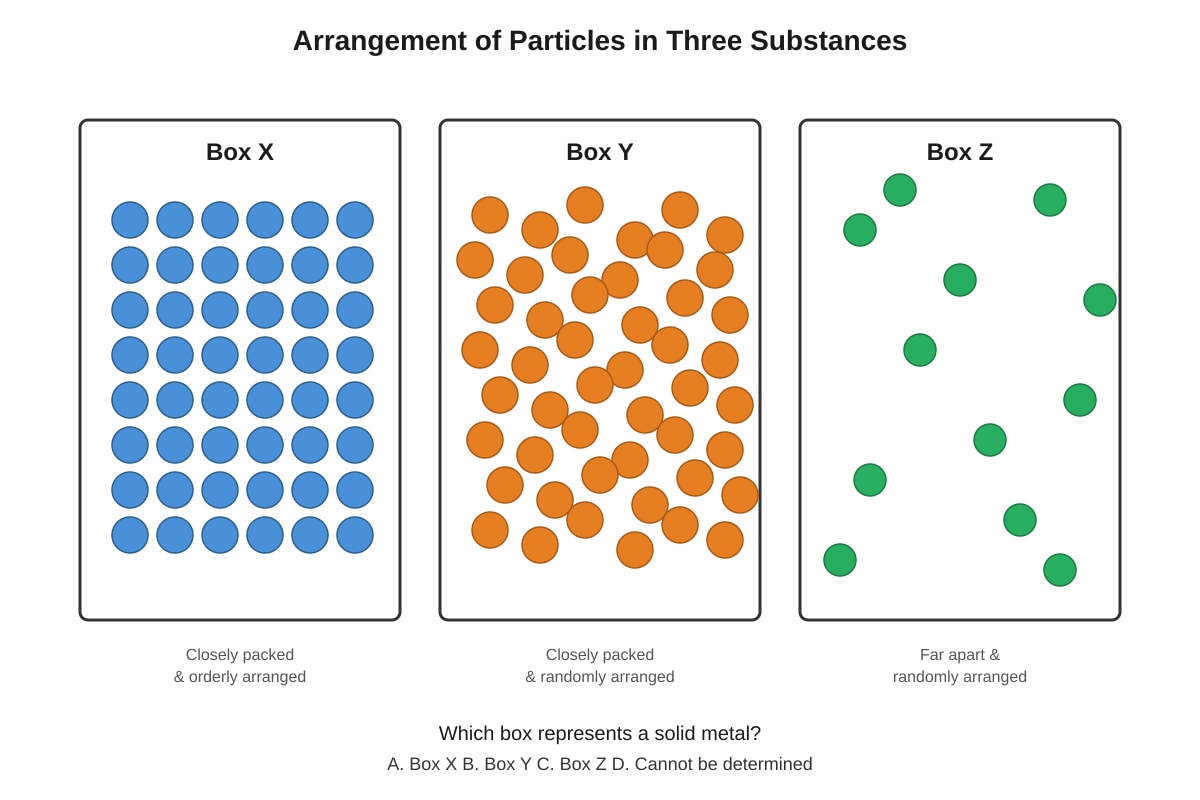
2. The diagram below shows the arrangement of particles in three different substances at room temperature.
<image_placeholder> id: Q2-fig1 type: diagram linked_question: Q2 description: Three boxes showing particle arrangements: Box X shows particles closely packed in ordered rows; Box Y shows particles closely packed but randomly arranged; Box Z shows particles far apart and randomly arranged. labels: Box X, Box Y, Box Z values: None must_show: Ordered arrangement in X, random close packing in Y, wide spacing in Z </image_placeholder>
Which box represents a solid metal? [1]
- A. Box X
- B. Box Y
- C. Box Z
- D. Cannot be determined
Answer: _____
3. A student wants to separate a mixture of iron filings and sulfur powder. Which method is most suitable? [1]
- A. Filtration
- B. Magnetic separation
- C. Distillation
- D. Evaporation
Answer: _____
4. The table below shows the melting and boiling points of four substances.
| Substance | Melting Point (°C) | Boiling Point (°C) |
|---|---|---|
| P | -114 | 78 |
| Q | 0 | 100 |
| R | 801 | 1413 |
| S | -78 | -78 (sublimes) |
Which substance is a gas at room temperature (25°C)? [1]
- A. P
- B. Q
- C. R
- D. S
Answer: _____
5. Which of the following statements about compounds is correct? [1]
- A. Compounds can be separated by physical methods.
- B. Compounds have a fixed composition by mass.
- C. Compounds retain the properties of their constituent elements.
- D. Compounds are formed by physical combination of elements.
Answer: _____
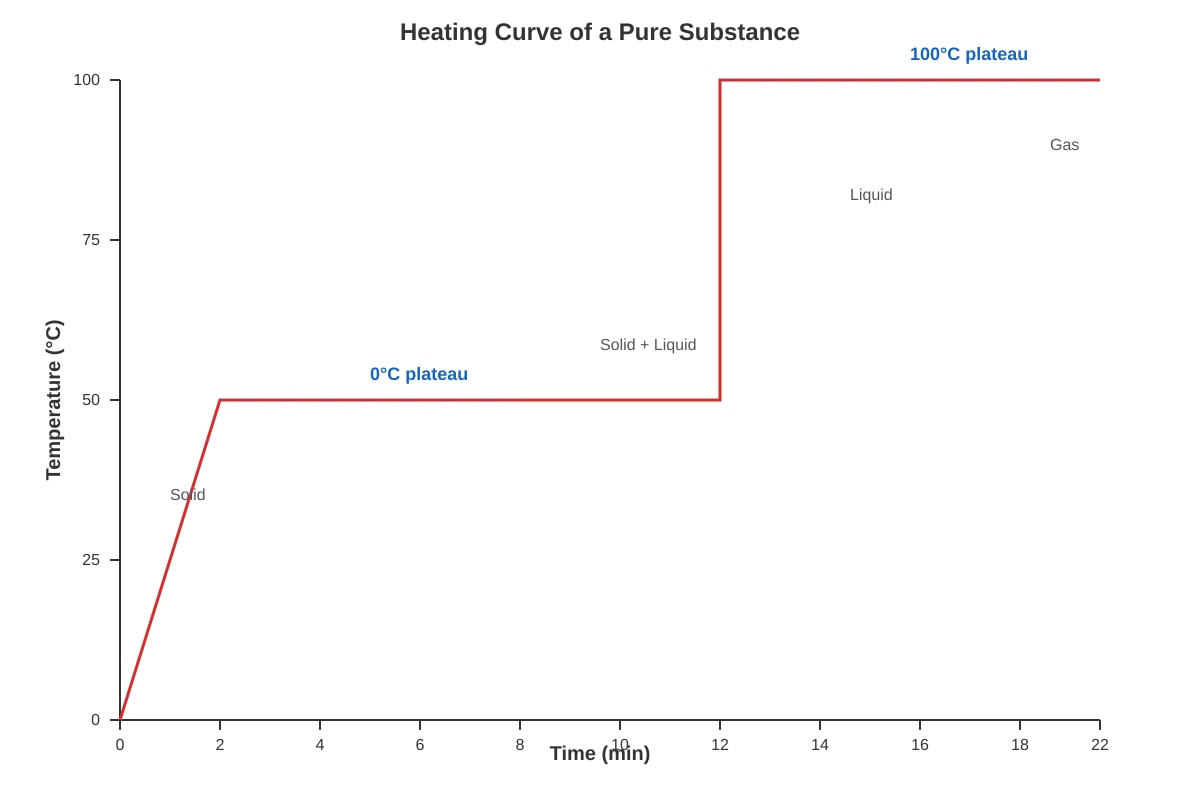
6. The diagram shows the heating curve of a pure substance.
<image_placeholder> id: Q6-fig1 type: graph linked_question: Q6 description: Heating curve graph with temperature on y-axis and time on x-axis. Two horizontal plateaus: first at 0°C from 2 to 8 minutes, second at 100°C from 12 to 22 minutes. Sloped sections before, between, and after plateaus. labels: Temperature (°C), Time (min), 0°C plateau, 100°C plateau values: Plateau 1: 0°C, 2-8 min; Plateau 2: 100°C, 12-22 min must_show: Two distinct plateaus at 0°C and 100°C, sloped heating sections </image_placeholder>
At which temperature does the substance exist as both solid and liquid? [1]
- A. 0°C
- B. 50°C
- C. 100°C
- D. 150°C
Answer: _____
7. A mixture of sand and salt is added to water and stirred. The mixture is then filtered. What is the residue? [1]
- A. Salt only
- B. Sand only
- C. Sand and salt
- D. Water
Answer: _____
8. Which of the following shows the correct order of particle movement from least to greatest? [1]
- A. Solid < Liquid < Gas
- B. Gas < Liquid < Solid
- C. Liquid < Solid < Gas
- D. Solid < Gas < Liquid
Answer: _____
9. Brass is an alloy of copper and zinc. Which statement about brass is true? [1]
- A. Brass is a compound with fixed composition.
- B. Brass can be separated into copper and zinc by filtration.
- C. Brass has properties different from both copper and zinc.
- D. Brass is a pure substance.
Answer: _____
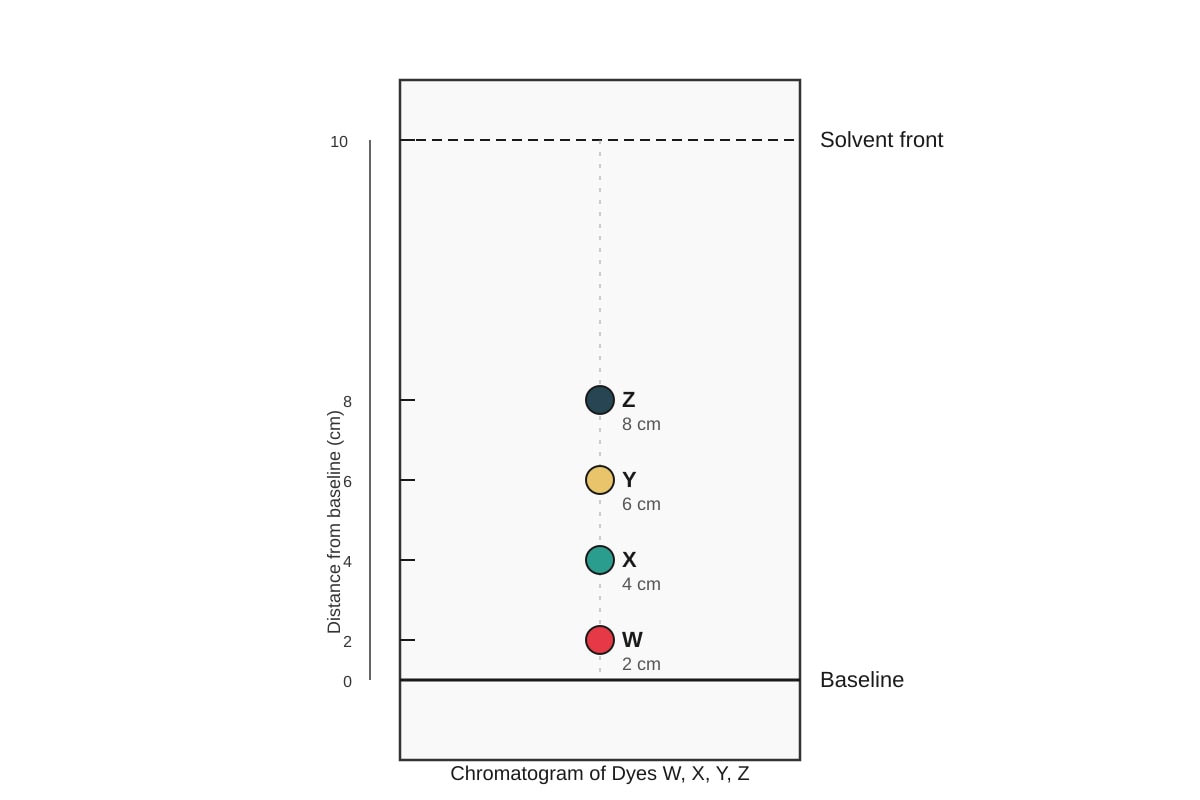
10. The diagram below shows a chromatogram obtained from separating four dyes (W, X, Y, Z).
<image_placeholder> id: Q10-fig1 type: diagram linked_question: Q10 description: Chromatography paper with baseline at bottom, solvent front near top. Four spots: W at 2 cm, X at 4 cm, Y at 6 cm, Z at 8 cm from baseline. Solvent front at 10 cm. labels: Baseline, Solvent front, Spots W, X, Y, Z values: W: 2 cm, X: 4 cm, Y: 6 cm, Z: 8 cm, Solvent front: 10 cm must_show: Baseline, solvent front, four distinct spots at different heights </image_placeholder>
Which dye has the highest Rf value? [1]
- A. W
- B. X
- C. Y
- D. Z
Answer: _____
Section B: Structured Questions (20 marks)
Answer all questions in the spaces provided.
11. The table below shows some properties of four substances A, B, C, and D.
| Substance | Conducts electricity (solid) | Conducts electricity (molten) | Melting point (°C) | Solubility in water |
|---|---|---|---|---|
| A | No | No | -114 | Miscible |
| B | Yes | Yes | 1085 | Insoluble |
| C | No | Yes | 801 | Soluble |
| D | No | No | 3550 | Insoluble |
(a) Which substance is most likely a covalent molecular substance? Explain your answer. [2]
(b) Which substance is most likely an ionic compound? Explain your answer. [2]
(c) Substance B is copper. Explain why copper conducts electricity in both solid and molten states. [2]
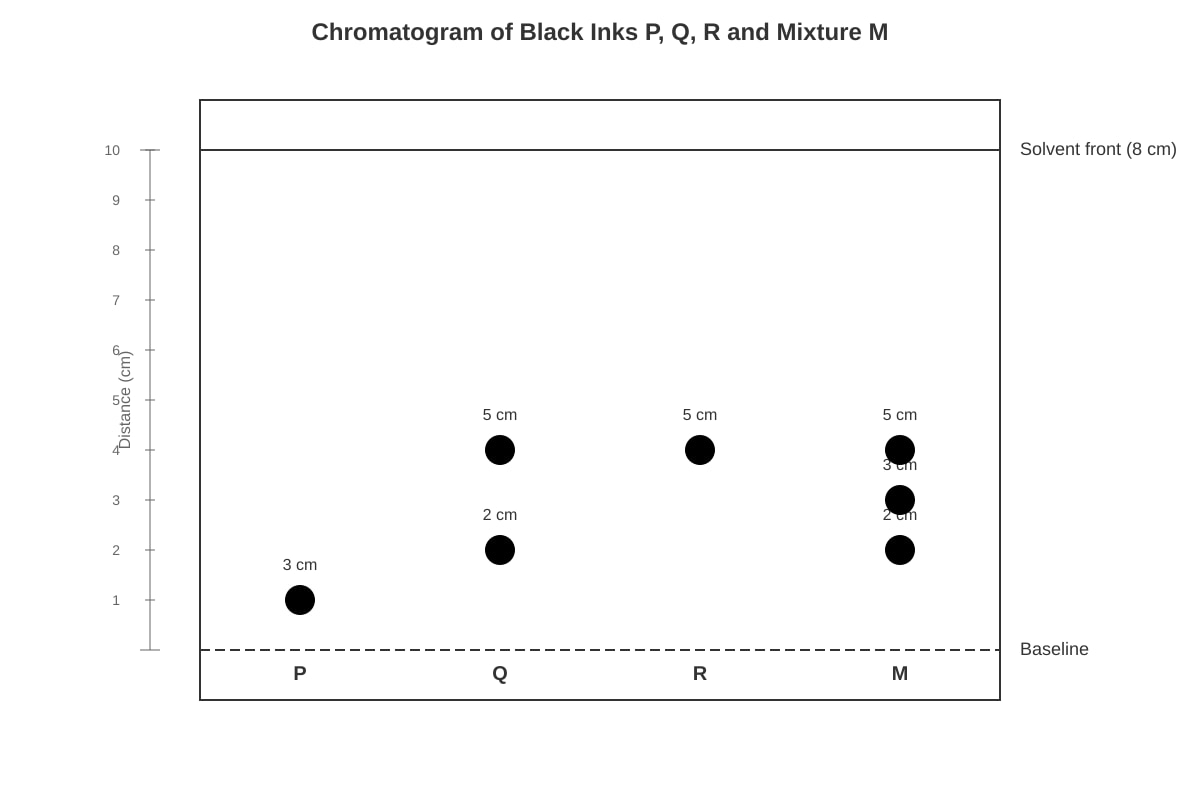
12. A student carries out paper chromatography on three different black inks (P, Q, R) and a mixture M. The chromatogram is shown below.
<image_placeholder> id: Q12-fig1 type: diagram linked_question: Q12 description: Chromatography paper with baseline. Four lanes labeled P, Q, R, M. Lane P: one spot at 3 cm. Lane Q: two spots at 2 cm and 5 cm. Lane R: one spot at 5 cm. Lane M: three spots at 2 cm, 3 cm, and 5 cm. Solvent front at 8 cm. labels: Baseline, Solvent front (8 cm), Lanes P, Q, R, M, Spots with distances values: P: 3 cm; Q: 2 cm, 5 cm; R: 5 cm; M: 2 cm, 3 cm, 5 cm; Solvent front: 8 cm must_show: Four lanes, baseline, solvent front, spots at specified distances </image_placeholder>
(a) Which pure ink(s) are present in mixture M? [1]
(b) Calculate the Rf value of the spot at 5 cm in lane Q. [2]
(c) Explain why the baseline must be drawn in pencil and not in pen. [1]
(d) The solvent used is ethanol. Suggest a safety precaution the student should take. [1]
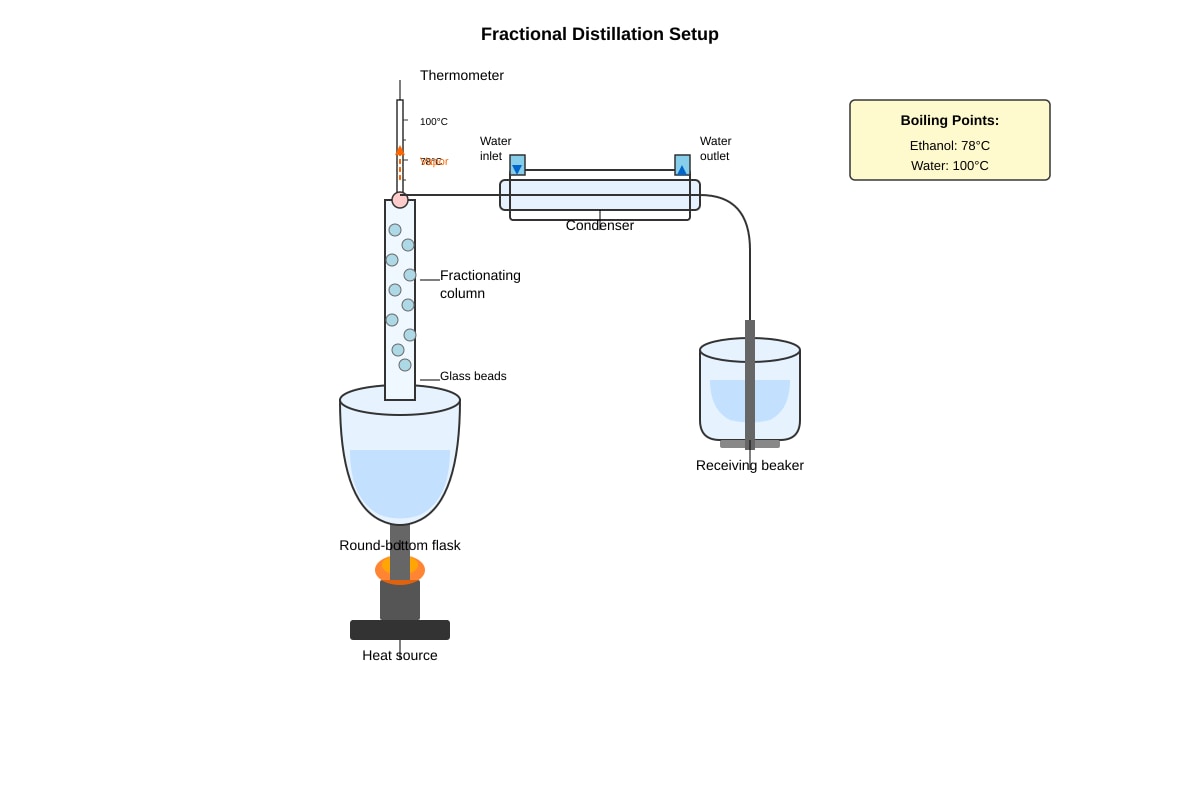
13. The diagram below shows the apparatus used to separate a mixture of ethanol (boiling point 78°C) and water (boiling point 100°C).
<image_placeholder> id: Q13-fig1 type: experimental_setup linked_question: Q13 description: Fractional distillation setup: round-bottom flask with mixture, fractionating column with glass beads, thermometer at top of column, condenser with water in/out, receiving beaker. Heat source under flask. labels: Round-bottom flask, Fractionating column, Glass beads, Thermometer, Condenser, Water inlet/outlet, Receiving beaker, Heat source values: Ethanol BP: 78°C, Water BP: 100°C must_show: All labelled components, thermometer at column top, condenser with water flow direction </image_placeholder>
(a) Name the separation technique shown. [1]
(b) What is the purpose of the glass beads in the fractionating column? [1]
(c) The thermometer reading remains constant at 78°C for several minutes. Explain why. [2]
(d) After collecting the first fraction, the temperature rises to 100°C. What is collected in the receiving beaker now? [1]
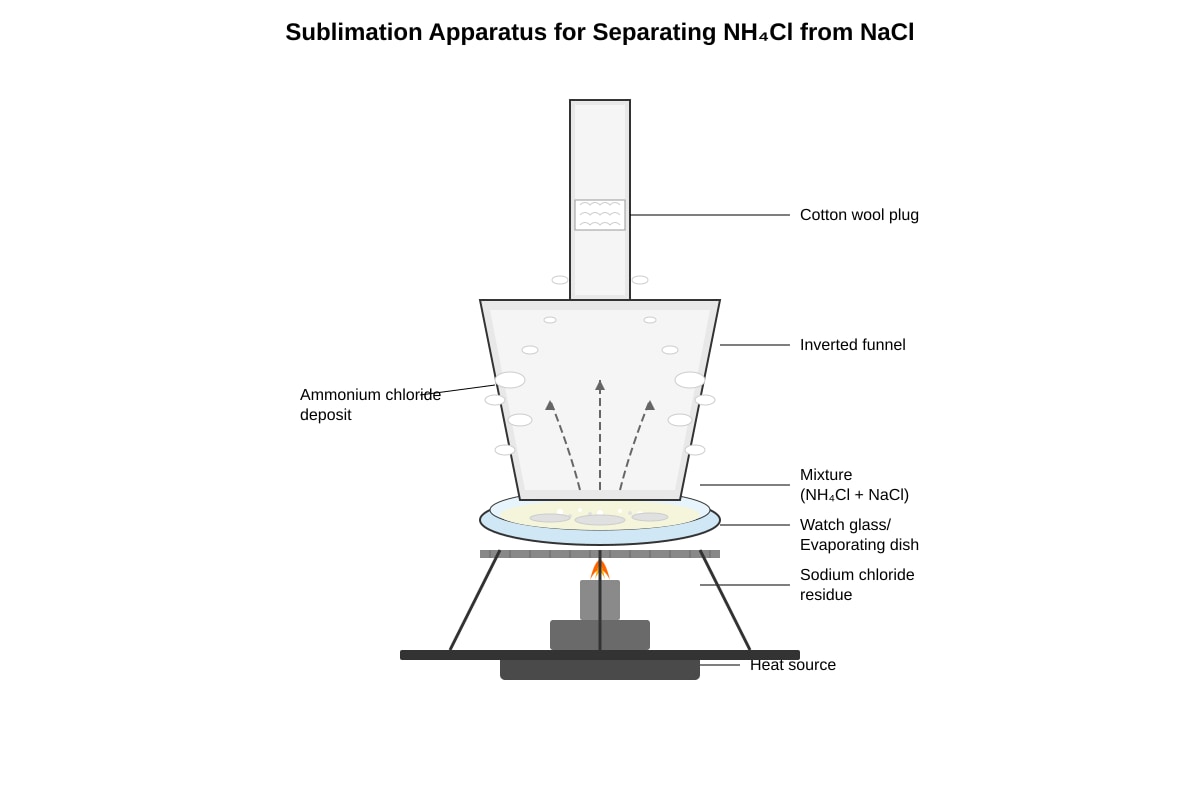
14. A student is given a mixture of ammonium chloride (sublimes at 340°C) and sodium chloride (melting point 801°C).
(a) Name a suitable method to separate this mixture. [1]
(b) Draw a labelled diagram of the apparatus set-up for this separation. [3]
<image_placeholder> id: Q14b-fig1 type: diagram linked_question: Q14 description: Sublimation apparatus: inverted funnel over a watch glass/evaporating dish containing mixture, cotton wool plug in funnel stem, gentle heat source below. Ammonium chloride deposits on cool funnel sides. labels: Mixture (NH4Cl + NaCl), Watch glass/Evaporating dish, Inverted funnel, Cotton wool plug, Heat source, Ammonium chloride deposit, Sodium chloride residue values: None must_show: Inverted funnel over dish, cotton wool in stem, heat source, deposit on funnel, residue in dish </image_placeholder>
(c) Explain how this method separates the two substances. [2]
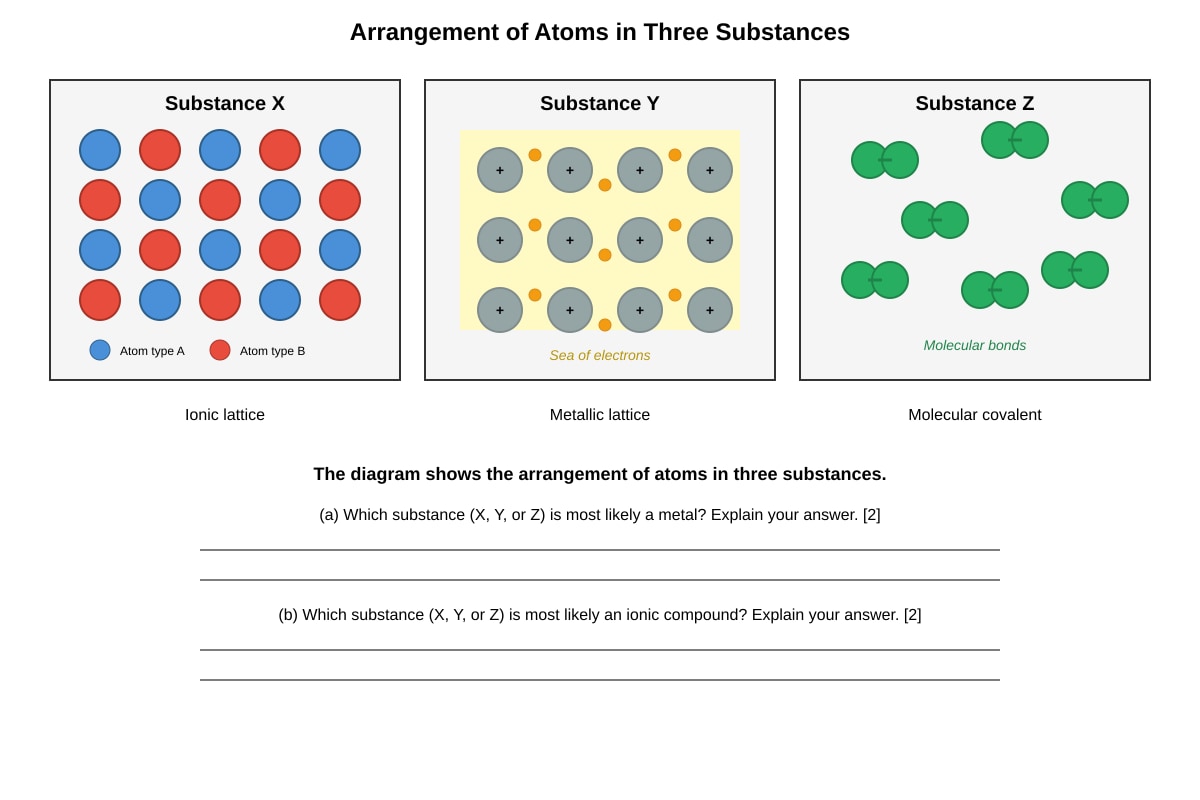
15. The diagram shows the arrangement of atoms in three substances.
<image_placeholder> id: Q15-fig1 type: diagram linked_question: Q15 description: Three particle diagrams: Substance X - two different atoms alternating in a regular lattice. Substance Y - identical atoms in a regular lattice with a 'sea of electrons' shown. Substance Z - diatomic molecules (two atoms bonded) randomly arranged. labels: Substance X, Substance Y, Substance Z, Atom types, Sea of electrons (Y), Molecular bonds (Z) values: None must_show: X: ionic lattice; Y: metallic lattice with delocalised electrons; Z: molecular covalent </image_placeholder>
(a) Which substance (X, Y, or Z) is most likely a metal? Explain your answer. [2]
(b) Which substance (X, Y, or Z) is most likely an ionic compound? Explain your answer. [2]
(c) Substance Z has a low melting point. Explain why in terms of its structure and bonding. [2]
Section C: Data-Based and Application Questions (10 marks)
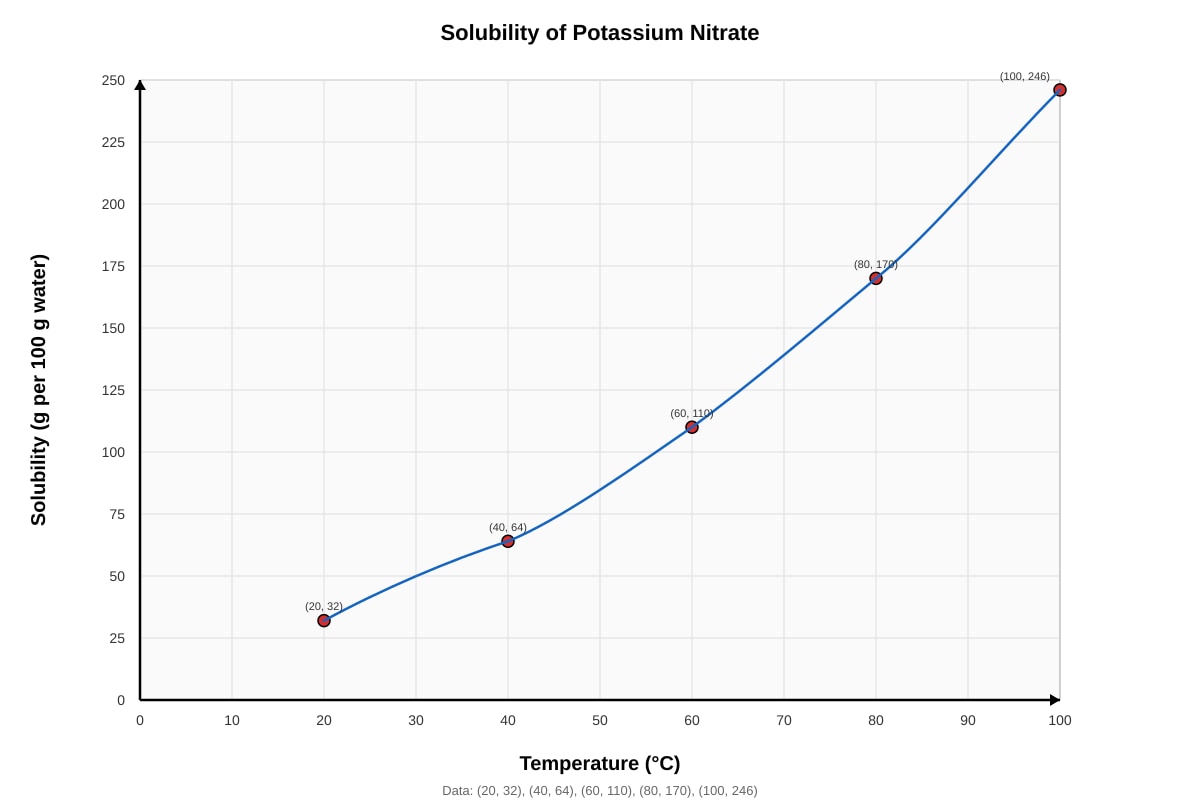
16. A student investigates the solubility of potassium nitrate at different temperatures. The results are shown below.
| Temperature (°C) | Mass of KNO₃ dissolved in 100 g water (g) |
|---|---|
| 20 | 32 |
| 40 | 64 |
| 60 | 110 |
| 80 | 170 |
| 100 | 246 |
(a) Plot a graph of solubility (y-axis) against temperature (x-axis) on the grid below. [3]
<image_placeholder> id: Q16a-fig1 type: graph linked_question: Q16 description: Blank graph grid with axes: x-axis Temperature (°C) from 0 to 100, y-axis Solubility (g/100g water) from 0 to 250. Grid lines at 10°C and 25 g intervals. labels: Temperature (°C), Solubility (g per 100 g water) values: Data points from table must_show: Labeled axes with units, appropriate scale, plotted points, smooth curve </image_placeholder>
(b) Use your graph to estimate the solubility of potassium nitrate at 50°C. [1]
(c) A saturated solution of potassium nitrate at 80°C is cooled to 20°C. Calculate the mass of potassium nitrate that will crystallise out from 200 g of water. [2]
(d) Explain why the solubility of most solids increases with temperature. [1]
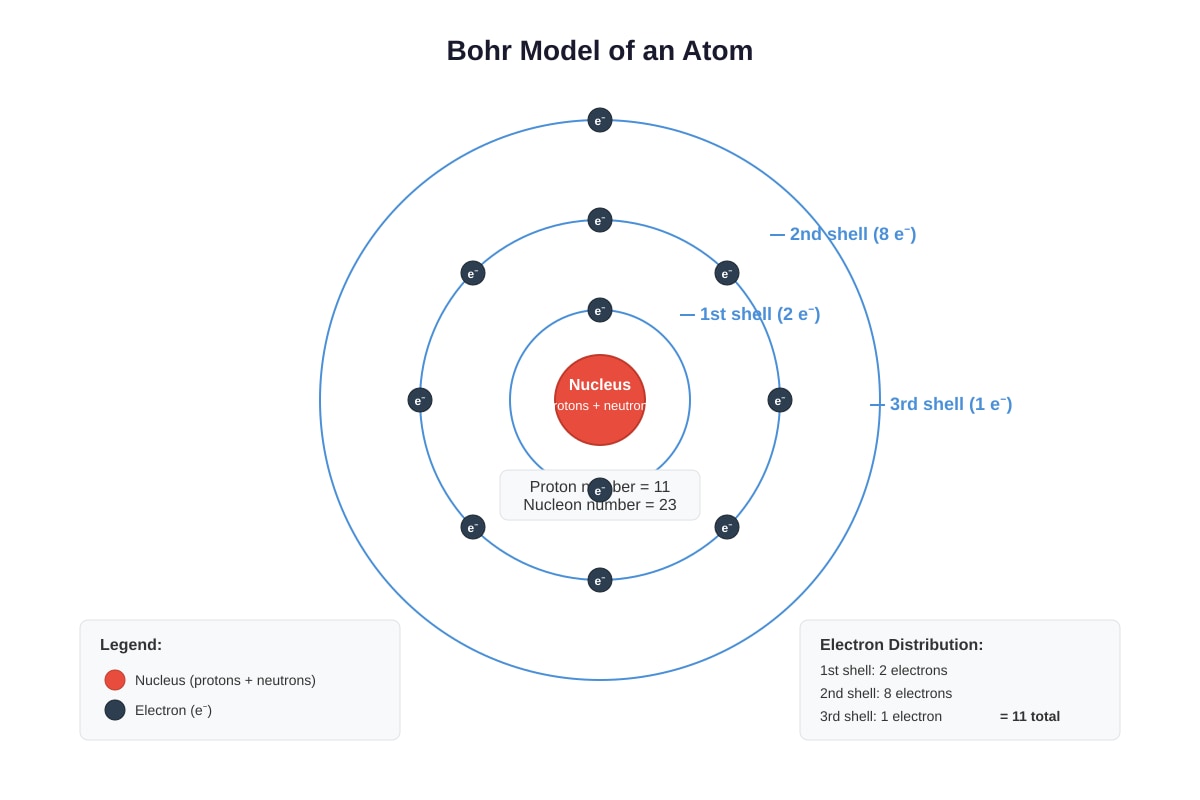
17. The diagram below shows a model of an atom.
<image_placeholder> id: Q17-fig1 type: diagram linked_question: Q17 description: Bohr model of an atom: central nucleus labeled 'Nucleus (protons + neutrons)', three electron shells labeled 1st shell (2 electrons), 2nd shell (8 electrons), 3rd shell (1 electron). labels: Nucleus, 1st shell (2 e⁻), 2nd shell (8 e⁻), 3rd shell (1 e⁻) values: Proton number = 11, Nucleon number = 23 must_show: Three shells with correct electron numbers, nucleus labeled </image_placeholder>
(a) What is the proton number of this atom? [1]
(b) What is the electronic configuration of this atom? [1]
(c) Identify the element. [1]
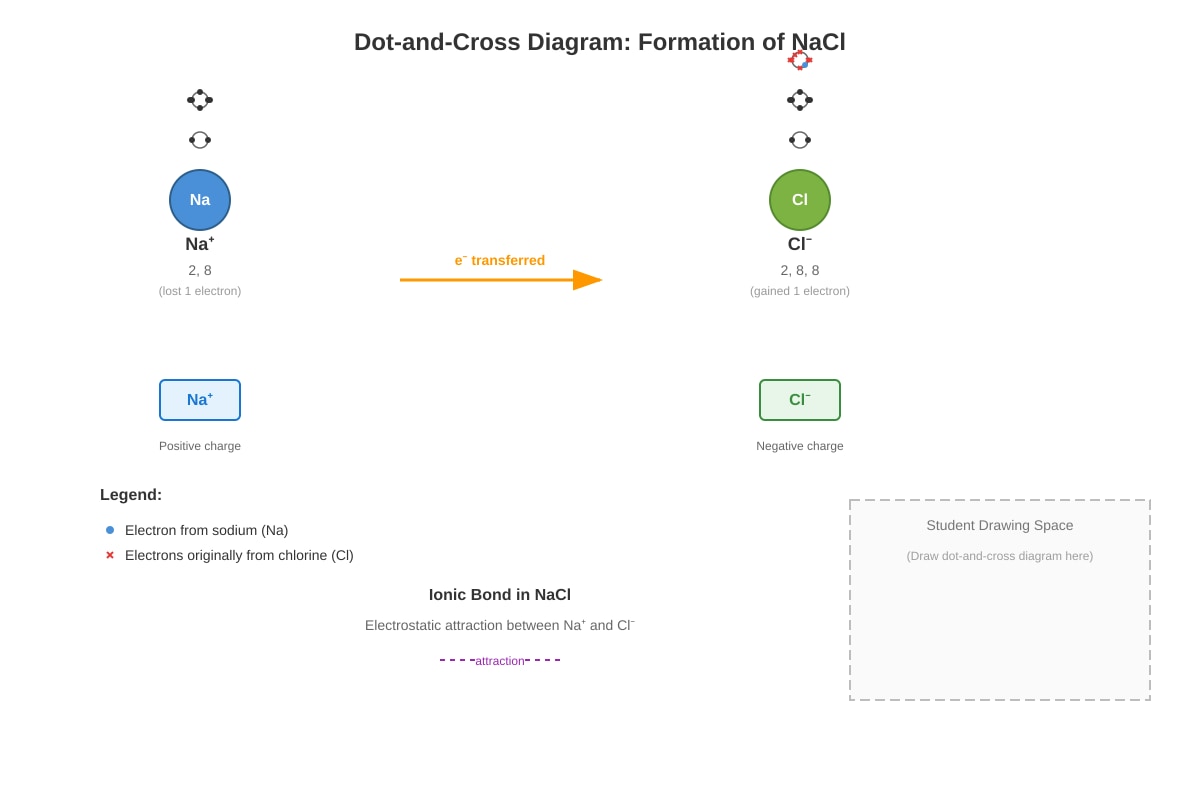
(d) This element reacts with chlorine to form an ionic compound. Draw a dot-and-cross diagram to show the bonding in this compound. Show only outer shell electrons. [3]
<image_placeholder> id: Q17d-fig1 type: diagram linked_question: Q17 description: Blank space for dot-and-cross diagram of NaCl: Na⁺ with empty outer shell (or 2,8), Cl⁻ with 8 outer electrons (7 crosses + 1 dot from Na). Charges shown. labels: Na⁺, Cl⁻, electron dots and crosses, charges values: Na: 2,8,1 → Na⁺: 2,8; Cl: 2,8,7 → Cl⁻: 2,8,8 must_show: Na⁺ with 2,8 configuration, Cl⁻ with 2,8,8 configuration, charges, electron transfer shown </image_placeholder>
18. Read the following passage and answer the questions that follow.
Alloys in Everyday Life
Pure metals are often too soft for many practical uses. For example, pure gold (24 carat) is so soft that it can be scratched with a fingernail. To improve hardness and strength, metals are often mixed with other elements to form alloys. Steel is an alloy of iron and carbon. The carbon atoms, being smaller than iron atoms, disrupt the regular layers of iron atoms, preventing them from sliding over each other easily. This makes steel much harder and stronger than pure iron.
Another common alloy is brass, made from copper and zinc. Bronze, historically important for tools and weapons, is an alloy of copper and tin. Duralumin, an alloy of aluminium, copper, and magnesium, is used in aircraft construction due to its high strength-to-weight ratio.
(a) Explain why pure metals are malleable and ductile in terms of their particle arrangement. [2]
(b) Using the passage, explain how adding carbon to iron makes steel harder. [2]
(c) Duralumin is used in aircraft construction. State two properties of duralumin that make it suitable for this use. [2]
(d) Bronze is an alloy of copper and tin. Suggest why bronze was historically preferred over pure copper for making tools and weapons. [1]
19. A student wants to obtain pure water from a sample of seawater (contains dissolved salts, sand, and microorganisms).
(a) Name the most suitable separation technique to obtain pure water from seawater. [1]
(b) Describe the process, including what happens to the water and the impurities. [3]
(c) The student collects 80 cm³ of pure water from 100 cm³ of seawater. Calculate the percentage yield of pure water. [2]
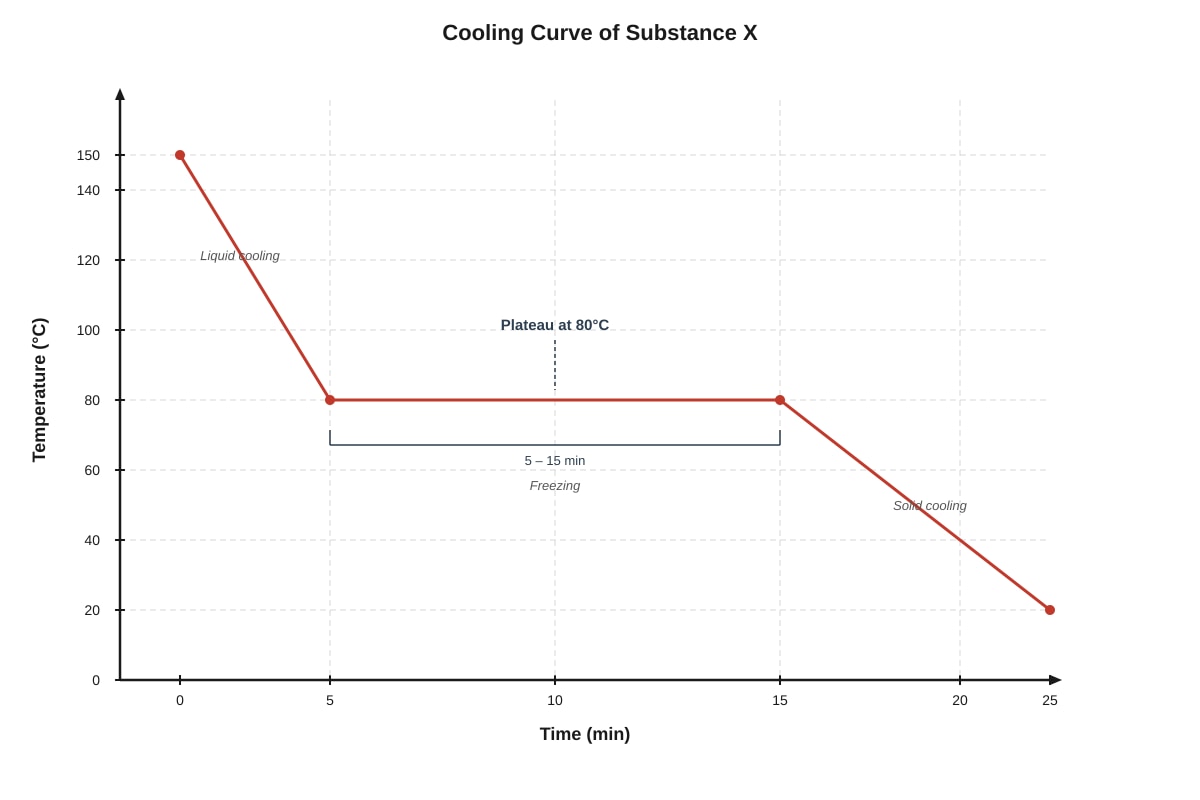
20. The diagram below shows the cooling curve of a pure substance X.
<image_placeholder> id: Q20-fig1 type: graph linked_question: Q20 description: Cooling curve graph: Temperature (°C) vs Time (min). Starts at 150°C, cools to 80°C (sloped), plateau at 80°C from 5 to 15 min, then cools to 20°C (sloped). labels: Temperature (°C), Time (min), Plateau at 80°C values: Plateau: 80°C, 5-15 min; Start: 150°C; End: 20°C must_show: Sloped cooling, distinct plateau at 80°C, sloped cooling after plateau </image_placeholder>
(a) What is the freezing point of substance X? [1]
(b) Describe the arrangement and movement of particles of substance X at the plateau region (80°C). [2]
(c) Explain why the temperature remains constant during the plateau even though heat is being lost to the surroundings. [2]
(d) If substance X is a pure compound, how would its cooling curve differ from that of a mixture? [1]
End of Quiz
Answers
Secondary 1 Science Quiz - Chemistry Materials (Answer Key)
Total Marks: 40
Section A: Multiple Choice Questions (10 marks)
1. Answer: C [1]
- Explanation: Gold (Au) is a pure element found in the Periodic Table. Air is a mixture of gases, carbon dioxide (CO₂) is a compound, and steel is an alloy (mixture of iron and carbon).
2. Answer: A [1]
- Explanation: Box X shows particles closely packed in ordered rows — this represents a solid with a regular structure, typical of metals. Box Y shows closely packed but random arrangement (liquid), and Box Z shows widely spaced particles (gas).
3. Answer: B [1]
- Explanation: Iron is magnetic while sulfur is not. Magnetic separation uses a magnet to attract iron filings, leaving sulfur behind. Filtration separates insoluble solids from liquids, distillation separates liquids by boiling point, and evaporation separates dissolved solids from solution.
4. Answer: D [1]
- Explanation: At room temperature (25°C), a substance is a gas if its boiling point is below 25°C. Substance S sublimes at -78°C (boiling point -78°C), so it is a gas at 25°C. P (ethanol) and Q (water) are liquids; R (NaCl) is a solid.
5. Answer: B [1]
- Explanation: Compounds have a fixed composition by mass (law of definite proportions). They cannot be separated by physical methods (A is false), do not retain properties of constituent elements (C is false), and are formed by chemical combination (D is false).
6. Answer: A [1]
- Explanation: The plateau at 0°C represents melting/freezing where solid and liquid coexist. At 100°C, liquid and gas coexist. The substance is water.
7. Answer: B [1]
- Explanation: Sand is insoluble in water and will be trapped as residue on the filter paper. Salt dissolves in water and passes through as filtrate.
8. Answer: A [1]
- Explanation: In solids, particles vibrate in fixed positions (least movement). In liquids, particles slide past each other. In gases, particles move freely and rapidly (greatest movement).
9. Answer: C [1]
- Explanation: Alloys like brass are mixtures, not compounds (A, D false). They cannot be separated by filtration (B false). Alloys have properties different from their constituent metals (e.g., brass is harder than copper or zinc).
10. Answer: D [1]
- Explanation: Rf = distance moved by spot / distance moved by solvent front. Z travels 8 cm (highest), so it has the highest Rf value (8/10 = 0.8).
Section B: Structured Questions (20 marks)
11. (a) Substance A [1] — It does not conduct electricity in solid or molten state, has a low melting point (-114°C), and is miscible in water. These are properties of a covalent molecular substance (e.g., ethanol). [1]
(b) Substance C [1] — It does not conduct in solid state but conducts when molten, has a high melting point (801°C), and is soluble in water. These are properties of an ionic compound (e.g., NaCl). [1]
(c) Copper has a metallic structure with a lattice of positive ions in a sea of delocalised electrons [1]. These mobile electrons can carry charge in both solid and molten states [1].
12. (a) Inks P and Q [1] — Mixture M shows spots at 2 cm, 3 cm, and 5 cm. These match the spots of Q (2 cm, 5 cm) and P (3 cm). R has a spot at 5 cm only, but M has three spots, so P and Q are present.
(b) Rf = 5/8 = 0.625 [2]
- Distance moved by spot = 5 cm [1]
- Distance moved by solvent front = 8 cm [1]
- Rf = 5/8 = 0.625 (no units) [1 for correct calculation]
- Accept 0.63 or 5/8
(c) Pencil is insoluble in the solvent [1]. Ink from a pen would dissolve and travel up the paper, contaminating the chromatogram.
(d) Ethanol is flammable [1]. Keep away from naked flames / use a water bath for heating / work in a well-ventilated area.
13. (a) Fractional distillation [1]
(b) To provide a large surface area for repeated condensation and vaporisation [1], allowing better separation of components with close boiling points.
(c) At 78°C, ethanol is boiling [1]. The temperature remains constant because the heat energy supplied is used to overcome intermolecular forces during the change of state from liquid to gas (latent heat), not to increase kinetic energy of particles [1].
(d) Water [1] — Water boils at 100°C and distils over after ethanol has been collected.
14. (a) Sublimation [1]
(b) Diagram [3] — Award marks for:
- Inverted funnel over watch glass/evaporating dish containing mixture [1]
- Cotton wool plug in funnel stem [1]
- Gentle heat source below, with ammonium chloride depositing on cool funnel sides and sodium chloride remaining in dish [1]
(c) Ammonium chloride sublimes (changes directly from solid to gas) when heated [1]. The vapour rises and deposits as solid on the cool funnel [1]. Sodium chloride does not sublime (high melting point) and remains in the dish.
15. (a) Substance Y [1] — It shows a metallic lattice with a 'sea of delocalised electrons' [1], which allows metals to conduct electricity and be malleable.
(b) Substance X [1] — It shows two different atoms in a regular alternating lattice [1], characteristic of an ionic compound with oppositely charged ions.
(c) Substance Z has a simple molecular structure [1]. Weak intermolecular forces (van der Waals forces) exist between molecules [1]. Little energy is needed to overcome these forces, so it has a low melting point.
Section C: Data-Based and Application Questions (10 marks)
16. (a) Graph [3] — Award marks for:
- Axes labelled with units: Temperature (°C) and Solubility (g/100g water) [1]
- Appropriate scale covering all data points [1]
- All 5 points plotted correctly and smooth curve drawn [1]
(b) ~87 g/100g water [1] — Accept 85–90 g (read from graph at 50°C).
(c) Mass crystallised = 112 g [2]
- At 80°C: 170 g dissolves in 100 g water → in 200 g water: 170 × 2 = 340 g [1]
- At 20°C: 32 g dissolves in 100 g water → in 200 g water: 32 × 2 = 64 g [1]
- Crystallised = 340 - 64 = 276 g? Wait, let me recalculate.
- Actually: 170 g/100g at 80°C, 32 g/100g at 20°C. For 200 g water:
- At 80°C: 170 × 2 = 340 g dissolved
- At 20°C: 32 × 2 = 64 g remains dissolved
- Crystallised = 340 - 64 = 276 g [2]
- Award 1 mark for correct method if arithmetic error
(d) Higher temperature gives particles more kinetic energy [1], allowing solvent particles to overcome solute-solute forces more effectively and pull more solute into solution.
17. (a) 11 [1] — Proton number = number of electrons = 2 + 8 + 1 = 11.
(b) 2,8,1 [1] — Electrons in shells: 1st shell 2, 2nd shell 8, 3rd shell 1.
(c) Sodium (Na) [1] — Element with proton number 11.
(d) Dot-and-cross diagram [3] — Award marks for:
- Na⁺ ion with 2,8 configuration (empty 3rd shell or 8 crosses in 2nd shell) and + charge [1]
- Cl⁻ ion with 2,8,8 configuration (7 crosses + 1 dot in outer shell) and - charge [1]
- Clear indication of electron transfer (dot from Na to Cl) [1]
18. (a) In pure metals, atoms are arranged in regular layers [1]. These layers can slide over each other when force is applied, making metals malleable and ductile [1].
(b) Carbon atoms are smaller than iron atoms [1]. They disrupt the regular layers of iron atoms, preventing them from sliding easily over each other [1].
(c) High strength-to-weight ratio (strong but light) [1], corrosion resistance / durability [1]. (Accept: high strength, low density, good fatigue resistance)
(d) Bronze is harder and stronger than pure copper [1], making it more suitable for tools and weapons that need to hold an edge and withstand impact.
19. (a) Distillation [1] (or simple distillation)
(b) Seawater is heated in a flask [1]. Water evaporates/boils, leaving salts, sand, and microorganisms behind in the flask [1]. Water vapour enters the condenser, cools, and condenses into pure liquid water collected in a receiver [1].
(c) Percentage yield = 80% [2]
- Yield = (Volume collected / Initial volume) × 100% [1]
- = (80 / 100) × 100% = 80% [1]
20. (a) 80°C [1] — The plateau on a cooling curve represents the freezing point.
(b) At the plateau, particles are arranging into a regular, fixed structure (solid) [1]. Both liquid and solid states coexist; particles in the solid vibrate in fixed positions while liquid particles still move freely [1].
(c) During freezing, heat energy is released as particles form bonds and lose potential energy [1]. This latent heat of fusion released compensates for heat lost to surroundings, keeping temperature constant [1].
(d) A pure compound has a sharp, distinct plateau (constant freezing point) [1]. A mixture freezes over a range of temperatures (sloped cooling without a sharp plateau).