From Real Exams Quiz
Secondary 1 Science Chemistry Materials Quiz
Free Sec 1 Science Chemistry Materials quiz, Kimi2.6 Exam version, with questions, answers, and syllabus-aligned practice for Singapore students.
These static practice materials are generated from the site's syllabus and paper-generation workflow, with source and model context shown so students and parents can evaluate the material before use.
Questions
Free quiz and exam paper access
Enter your details to view this paper
Your access is remembered on this device.
Answers
Secondary 1 Science Quiz - Chemistry Materials: Answer Key
Section A: Multiple Choice
| Question | Answer | Explanation |
|---|---|---|
| 1 | C) Distilled water | Distilled water contains only H₂O molecules, making it a pure substance. Air (A), seawater (B), and steel (D) are all mixtures. |
| 2 | B) Evaporation to dryness | Evaporation removes water, leaving dissolved salt behind. Filtration (A) removes insoluble solids only; distillation (C, D) is for separating liquids with different boiling points. |
| 3 | D) Proton number | Elements are arranged by increasing proton number (atomic number), not mass number, which was Mendeleev's original approach. This arrangement groups elements with similar chemical properties together. |
| 4 | C) Proton | Protons carry a +1 charge. Electrons (A) are negative, neutrons (B) are neutral, and atoms (D) are electrically neutral overall. |
| 5 | C) It contains free-moving electrons | Metals conduct electricity due to delocalised electrons that can move freely through the structure. Other properties listed do not directly explain electrical conductivity. |
Section A Total: 5 marks
Section B: Short Answer
6. State the difference between an element and a compound. [2 marks]
An element consists of only one type of atom and cannot be broken down into simpler substances by chemical means [1 mark].
A compound consists of two or more different elements chemically bonded together in fixed proportions, and can be broken down by chemical methods [1 mark].
Common mistake: "Compound is a mixture" — incorrect; compounds have chemical bonds, mixtures do not.
7. Explain why sugar is a compound but iron is an element. [2 marks]
Sugar () is a compound because its molecules contain carbon, hydrogen, and oxygen atoms chemically bonded together in a fixed ratio [1 mark].
Iron is an element because it contains only iron (Fe) atoms and cannot be broken down into any simpler substance [1 mark].
8. Name the separation technique that would be most suitable for each of the following: [2 marks]
(a) Separating funnel (or decantation) [1 mark]
- Oil and water are immiscible liquids with different densities
(b) Filtration [1 mark]
- Sand is insoluble in water and can be trapped by filter paper
9. Describe the steps to separate copper(II) sulfate and sand. [2 marks]
- Add water to the mixture and stir — copper(II) sulfate dissolves, sand does not [1 mark]
- Filter the mixture — sand remains as residue on filter paper, copper(II) sulfate solution passes through as filtrate [1 mark]
- (Optional extension) Heat the filtrate to evaporate the water and obtain solid copper(II) sulfate crystals
Marking note: Steps 1 and 2 are essential for full marks. Mentioning evaporation/crystallisation is acceptable but not required for 2 marks.
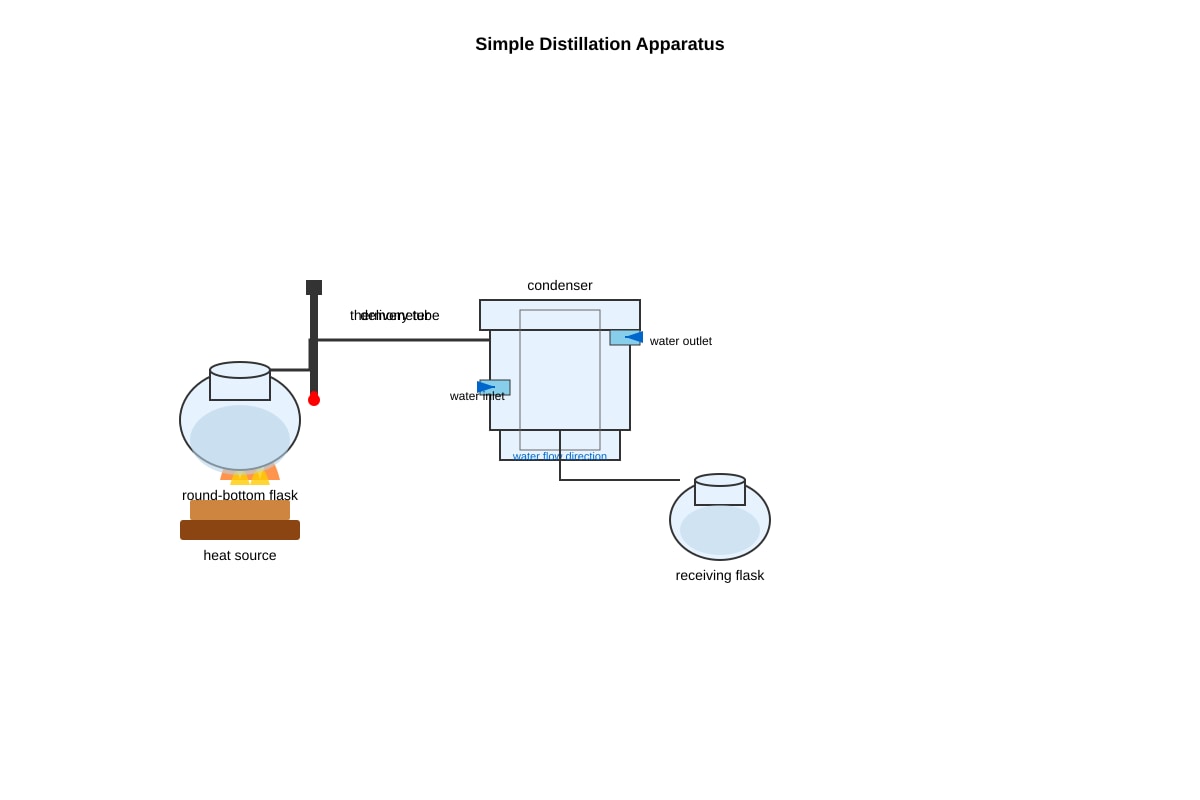
10. Simple distillation apparatus [2 marks]
(a) The thermometer is placed at the opening of the delivery tube to measure the boiling point of the vapour being distilled, ensuring only the desired substance evaporates and passes into the condenser [1 mark].
Teaching point: This confirms that the correct substance is boiling and being collected, as different substances have different boiling points.
(b) The condenser cools the hot vapour, causing it to condense back to liquid so it can be collected [1 mark].
Key detail: Cold water enters at the bottom and exits at the top to ensure the whole condenser jacket stays cold for efficient cooling.
11. Interpreting properties table [2 marks]
(a) Substance Q [0.5 mark]. It conducts electricity in both solid and liquid states, which is characteristic of metals that contain a "sea" of delocalised electrons [0.5 mark].
(b) Substance R [0.5 mark]. It does not conduct when solid (ions are fixed in position) but conducts when liquid (ions are free to move), which is the pattern for ionic compounds [0.5 mark].
12. Test for pure water vs salt solution [2 marks]
- Method: Heat the liquid in an evaporating dish until all liquid has disappeared / use a conductivity meter [1 mark]
- Expected results: If pure water, nothing remains / no conductivity; if salt solution, white solid residue remains / conducts electricity [1 mark]
Alternative: Measure boiling point — pure water boils at exactly 100°C; salt solution boils above 100°C.
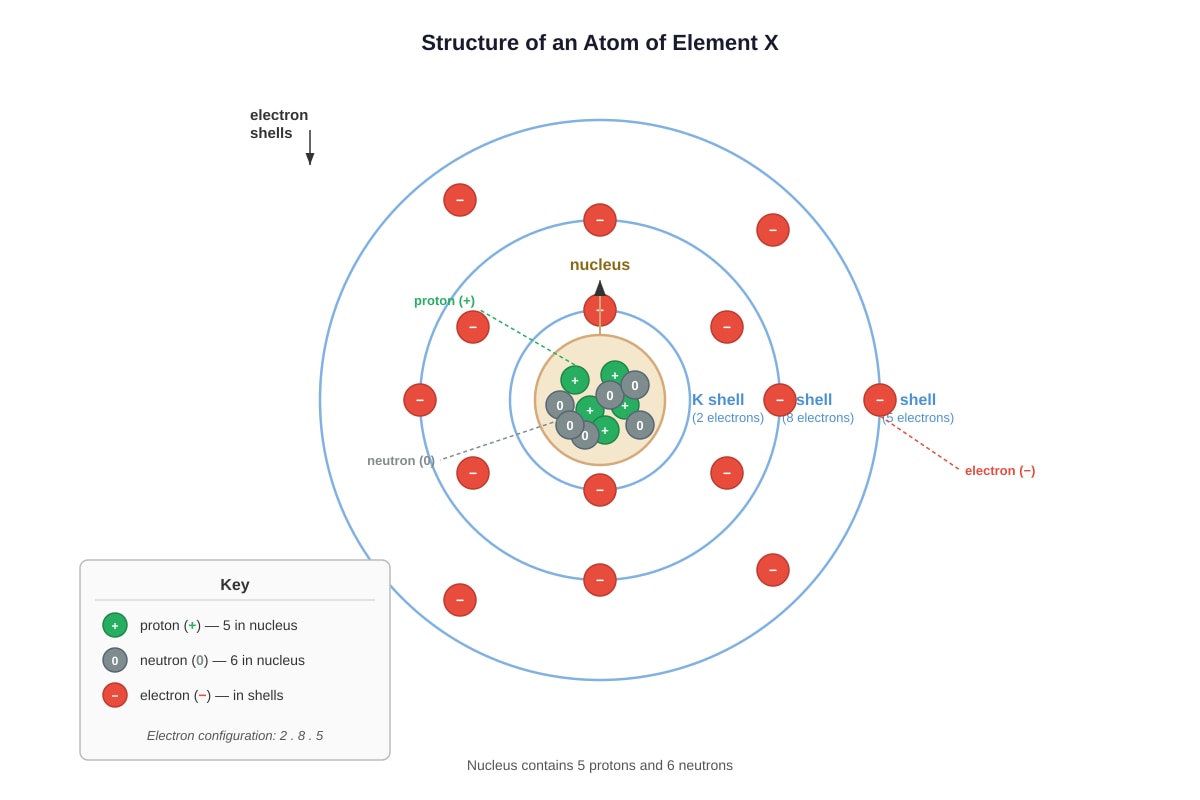
13. Atomic structure of element X [2 marks]
(a) Proton number = 5 [1 mark]
- Count the protons in the nucleus (5 positive charges shown)
(b) Nucleon number = 16 (or 15 if neutrons shown as 5+6=11... wait: diagram shows 5 protons + 6 neutrons, so nucleon number = 11) [1 mark]
- Nucleon number = number of protons + number of neutrons = 5 + 6 = 11
Correction based on diagram values: 5 protons + 6 neutrons = nucleon number 11
14. Subatomic particles table [2 marks]
| Particle | Relative mass | Relative charge | Location in atom |
|---|---|---|---|
| Proton | 1 | +1 | Nucleus |
| Neutron | 1 | 0 | Nucleus |
| Electron | Very small | -1 | Shells / energy levels around nucleus |
Marking: 1 mark for correct relative masses; 1 mark for correct charges and locations (must be substantially correct).
15. Graphite vs diamond [2 marks]
Graphite has layers of carbon atoms held by weak forces between layers, allowing layers to slide over each other [1 mark].
Diamond has each carbon atom covalently bonded to four others in a rigid 3D network, making it extremely hard to deform [1 mark].
Key concept: Both are allotropes of carbon, but their different bonding arrangements lead to very different physical properties.
Section B Total: 21 marks (Q6-Q7: 4, Q8: 2, Q9: 2, Q10: 2, Q11: 2, Q12: 2, Q13: 2, Q14: 2, Q15: 2 = 20... correction: Q9 is 2, recheck: 6(2)+7(2)+8(2)+9(2)+10(2)+11(2)+12(2)+13(2)+14(2)+15(2) = 20 marks)
Recheck marks: Q6=2, Q7=2, Q8=2, Q9=2, Q10=2, Q11=2, Q12=2, Q13=2, Q14=2, Q15=2. Total = 20 marks
Section C: Structured Response
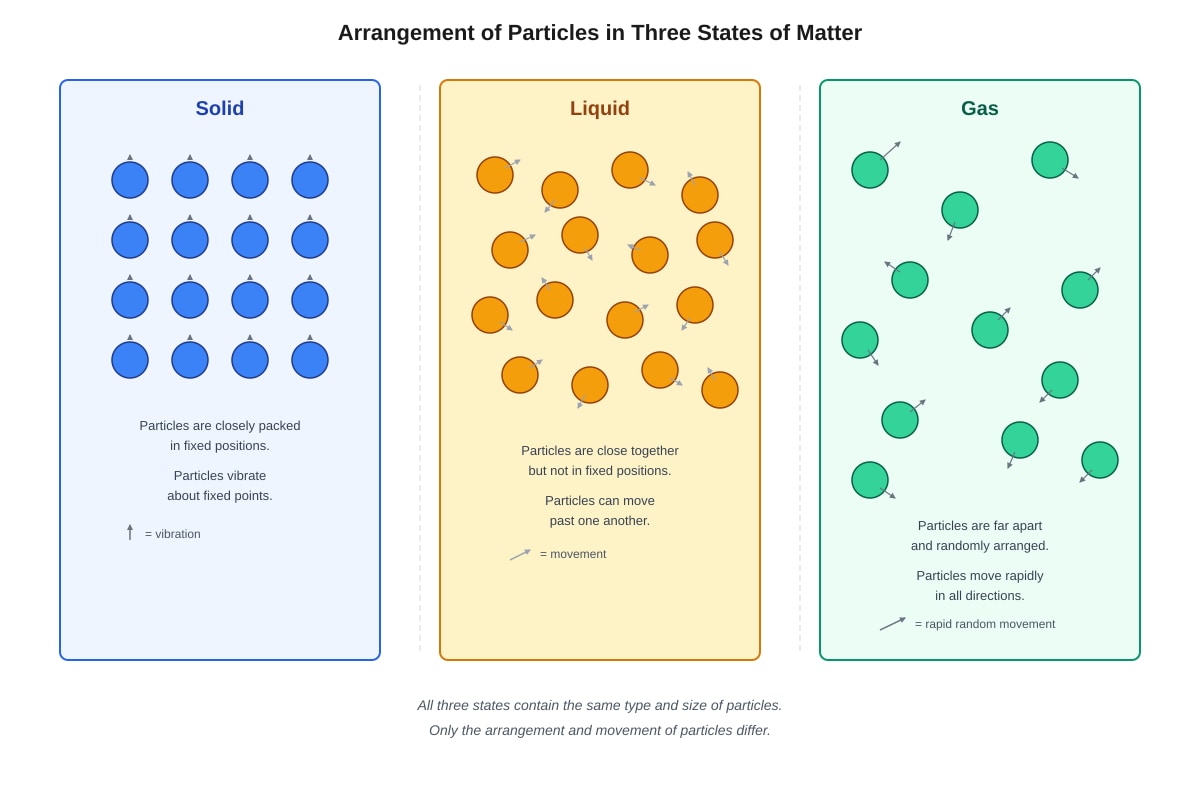
16. States of matter [4 marks]
(a) In a gas, particles are far apart and move randomly at high speeds in all directions [1 mark]. There are no forces holding them in fixed positions, so the gas expands to fill any container and has no fixed shape. However, the mass is fixed because the number and type of particles do not change [1 mark].
(b) When heated, particles gain kinetic energy and vibrate more vigorously [1 mark]. At the melting point, particles have enough energy to break free from their fixed positions and move past each other while remaining close together — the substance becomes a liquid [1 mark].
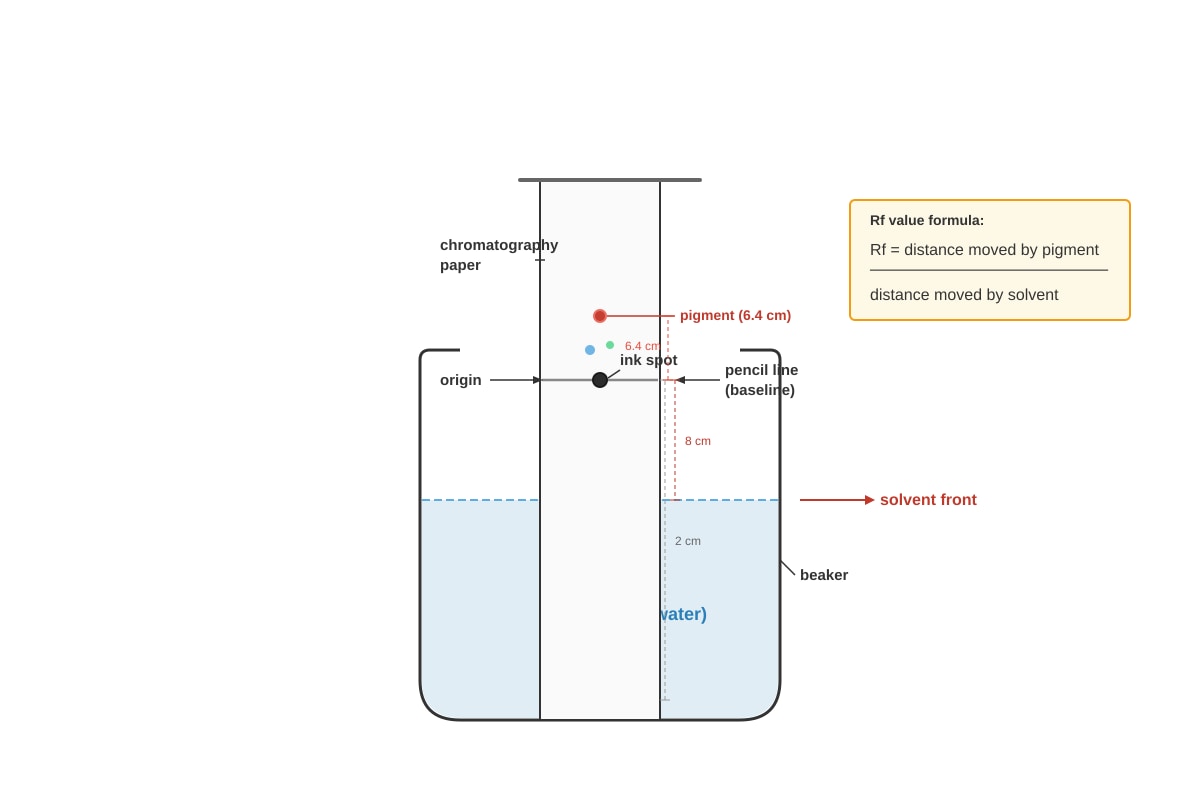
17. Chromatography [4 marks]
(a) Pencil is used because ink would dissolve in the solvent and interfere with the separation, producing misleading results [1 mark]. Pencil contains graphite, which is insoluble in most solvents.
(b) [1 mark]
(or 0.8) [1 mark]
Acceptable range: 0.79–0.81 depending on rounding. Must show working for full marks.
(c) These pigments are insoluble in the solvent (water) used, so they cannot move with the solvent front [1 mark]. Alternatively: they have very strong attraction to the chromatography paper compared to the solvent.
18. Periodic table concepts [5 marks]
(a) Lithium and sodium are in the same group because they both have one electron in their outermost shell (valence electron) [1 mark].
Teaching link: Elements in the same group have the same number of valence electrons, leading to similar chemical properties.
(b) A carbon atom has 6 electrons [1 mark]. In a neutral atom, the number of electrons equals the number of protons, and carbon has proton number 6 [1 mark].
(c) Sodium is more reactive [1 mark]. Although both have one valence electron, sodium's outer electron is in the third shell (n=3), which is further from the nucleus than lithium's in the second shell (n=2) [0.5 mark]. The increased distance and shielding from inner electrons means sodium's valence electron is less strongly attracted to the nucleus and is lost more easily [0.5 mark].
19. Electronic configuration and bonding [5 marks]
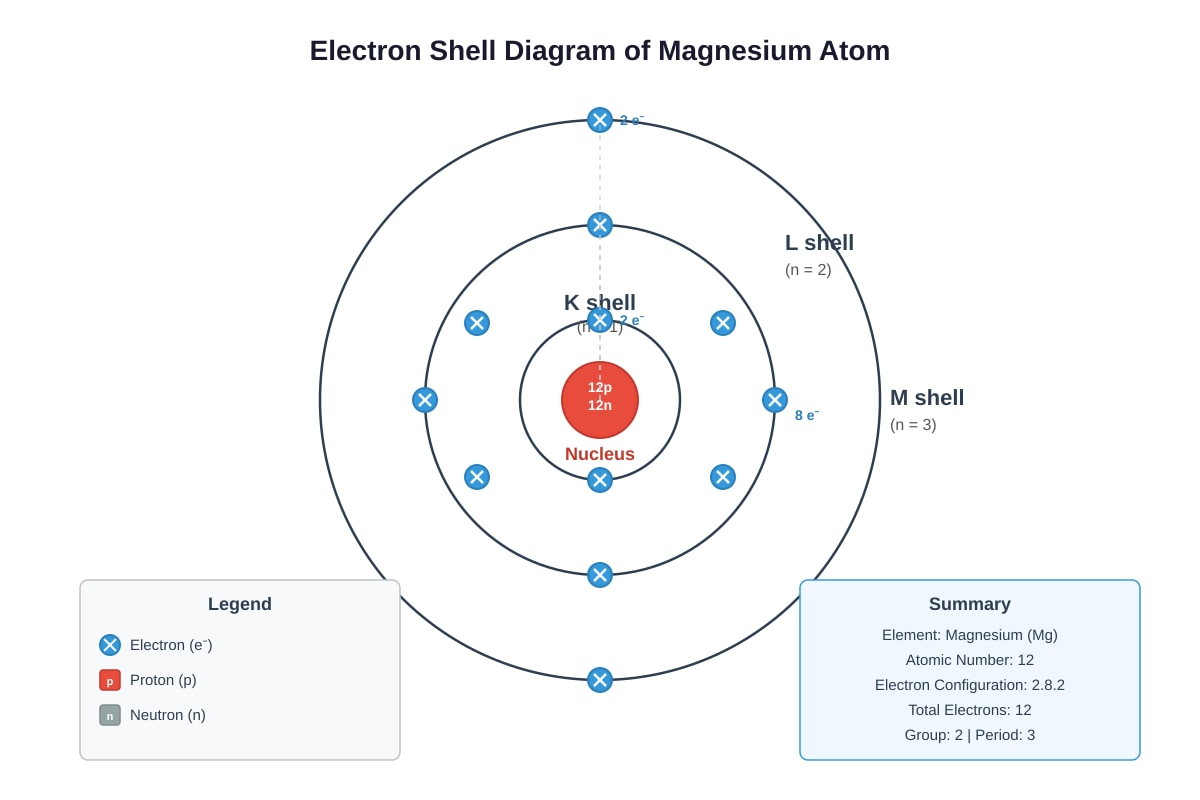
(a) 2.8.2 [1 mark]
(b) Magnesium is in Group 2 because it has two valence electrons (two electrons in its outermost shell) [1 mark].
(c) In the reaction with oxygen:
- Magnesium has 2 valence electrons in its outer shell, which is unstable [1 mark]
- Each magnesium atom loses its 2 valence electrons to form a Mg²⁺ ion with stable octet configuration (2.8) [1 mark]
- The oxygen atom gains these 2 electrons to form O²⁻, also achieving stable octet configuration [1 mark]
Full explanation: The transfer of electrons from magnesium to oxygen forms ionic bonds. Mg²⁺ has configuration 2.8 (like neon); O²⁻ has configuration 2.8 (like neon) — both achieve noble gas stability.
Common mistake: Saying magnesium "shares" electrons — this describes covalent bonding, not ionic bonding.
20. Electroplating calculations [7 marks]
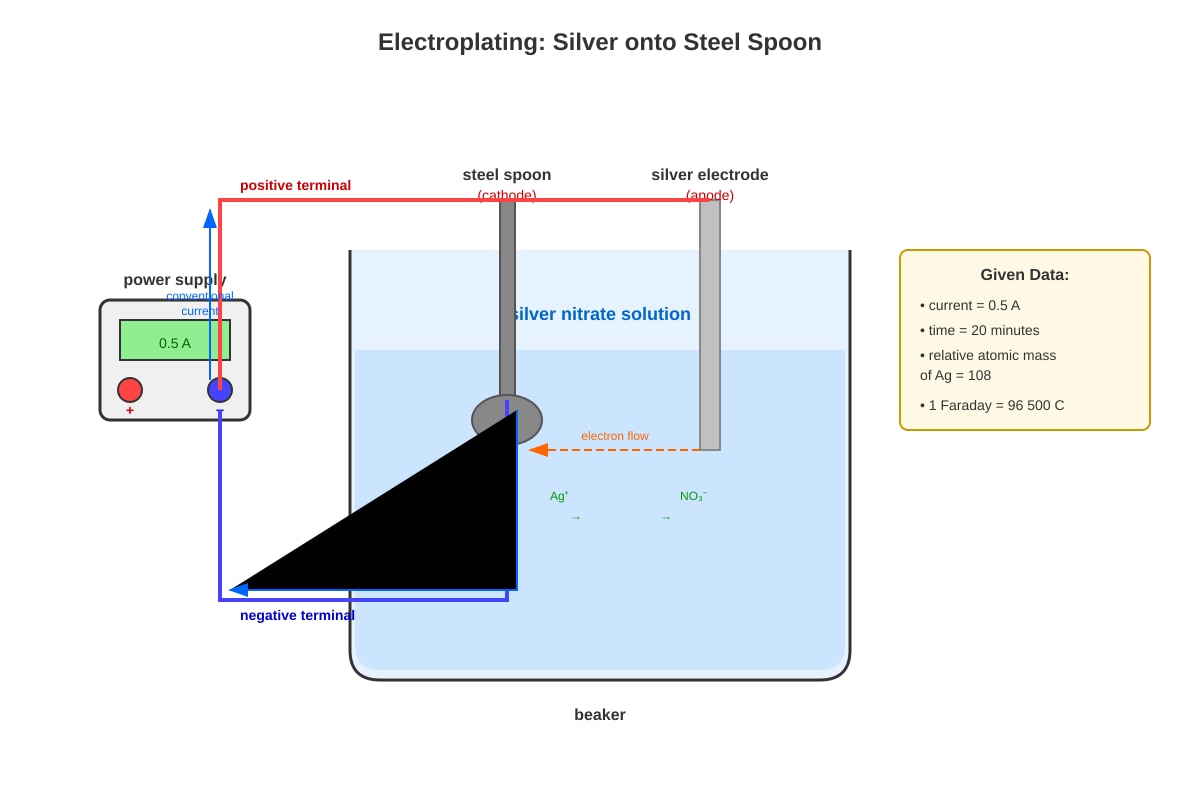
(a) The steel spoon should be connected to the negative terminal (cathode) [1 mark]. This is because positive silver ions () in the solution are attracted to the negative electrode, where they gain electrons and deposit as silver metal on the spoon [1 mark].
(b) The silver electrode (anode) becomes smaller because silver atoms lose electrons to form Ag⁺ ions that enter the solution [1 mark]:
This is oxidation at the anode [0.5 mark]. The silver ions produced maintain the concentration of silver nitrate solution [0.5 mark].
(c) Step 1: Calculate total charge [1 mark]
Step 2: Calculate moles of electrons [0.5 mark]
Step 3: Since , moles of Ag = moles of electrons [0.5 mark]
Step 4: Calculate mass of silver [1 mark]
Acceptable range: 0.67 g – 0.672 g depending on rounding. Full marks for correct method with minor arithmetic errors.
Mark Summary
| Section | Marks |
|---|---|
| Section A (Q1–5) | 5 |
| Section B (Q6–15) | 20 |
| Section C (Q16–20) | 15 |
| Total | 40 |