AI Generated Exam Paper
Secondary 1 Science Practice Paper 5
Free Sec 1 Science Practice Paper 5, Nemo3 AI version, with questions, answers, and syllabus-aligned practice for Singapore students.
These static practice materials are generated from the site's syllabus and paper-generation workflow, with source and model context shown so students and parents can evaluate the material before use.
Questions


Free quiz and exam paper access
Enter your details to view this paper
Your access is remembered on this device.
Answers
TuitionGoWhere Practice Paper - Science Secondary 1 (Answer Key)
Subject: Science
Level: Secondary 1 (G3)
Paper: Practice Paper — Physical Sciences (Forces, Energy & Work) — Version 5
Total Marks: 50
Section A: Multiple Choice Questions [10 marks]
1
Answer: B
Explanation: When lifting an object at constant speed, the chemical energy from the student's muscles is converted directly into gravitational potential energy of the book. Kinetic energy does not increase because the speed is constant.
Marks: [1]
2
Answer: B
Explanation: Net force = Applied force – Frictional force = 15 N – 5 N = 10 N. Net work done = Net force × distance = 10 N × 4 m = 40 J.
Marks: [1]
3
Answer: C
Explanation: By conservation of energy, loss in GPE = gain in KE. GPE lost = mgh = 2 kg × 10 N/kg × 5 m = 100 J. So KE just before impact = 100 J.
Marks: [1]
4
Answer: B
Explanation: Work is done only when a force causes displacement in the direction of the force. Holding an object stationary involves no displacement, so no work is done on the object. Work is a scalar quantity.
Marks: [1]
5
Answer: B
Explanation: Elastic potential energy = Average force × extension = 20 N × 0.1 m = 2.0 J. (Alternatively, area under force-extension graph = ½ × 20 N × 0.1 m = 1.0 J if force varies linearly from 0. But "average force" implies constant 20 N over 0.1 m, giving 2.0 J. For a spring obeying Hooke's Law, average force = ½ F_max, so EPE = ½ F_max × x = ½ × 20 × 0.1 = 1.0 J. The question says "average force required to compress it is 20 N", which means the average over the compression is 20 N, so work = 20 × 0.1 = 2.0 J. However, standard spring physics: F = kx, average force = ½ kx = ½ F_max. If average force = 20 N, then F_max = 40 N, and EPE = ½ × 40 × 0.1 = 2.0 J. So B is correct.)
Marks: [1]
6
Answer: A
Explanation: KE gained = ½ mv² = ½ × 1000 × 20² = 200,000 J. Time = 10 s. Average power = Work / time = 200,000 / 10 = 20,000 W = 20 kW.
Marks: [1]
7
Answer: A
Explanation: On a frictionless inclined plane, GPE lost = mgh. Height h is proportional to distance s along the plane (h = s sin θ). So GPE decreases linearly with s. By conservation of energy, KE increases by the same amount, so KE increases linearly with s.
Marks: [1]
8
Answer: C
Explanation: Work done against gravity = mgh, same for both students since mass and height are identical. Power = Work / time. Student X takes less time, so develops more power.
Marks: [1]
9
Answer: A
Explanation: At the lowest point B, all GPE is converted to KE, so speed is maximum. At the highest point C, the bob momentarily stops, so speed is zero.
Marks: [1]
10
Answer: C
Explanation: Work output = Load × distance moved by load = 500 N × 2 m = 1000 J. Work input = Effort × distance moved by effort = 200 N × 6 m = 1200 J. Efficiency = (Work output / Work input) × 100% = (1000 / 1200) × 100% = 83.3%. Wait: 1000/1200 = 5/6 = 83.3%. But option C is 66.7%. Let me recalculate: 500 × 2 = 1000 J output. 200 × 6 = 1200 J input. 1000/1200 = 83.3%. That's option D. But the answer key says C? Let me check the options again: A 33.3%, B 50.0%, C 66.7%, D 83.3%. My calculation gives 83.3% which is D. But the question might have different numbers... Wait, the question says load 500 N, height 2 m, effort 200 N, distance 6 m. Output = 1000 J, Input = 1200 J, Efficiency = 83.3%. So answer should be D. I'll mark D as correct.
Correction: Answer is D.
Marks: [1]
Section B: Structured Questions [25 marks]
11
(a)
Answer: Points plotted correctly at (0,0), (3,2), (6,4), (9,6), (12,8), (15,10). Best-fit straight line passing through origin.
Marking: 1 mark for correct plotting of all points; 1 mark for best-fit straight line through origin.
Marks: [2]
(b)
Answer: The extension of the spring is directly proportional to the force applied (Hooke's Law).
Marks: [1]
(c)
Answer: Spring constant k = Force / Extension. From graph, gradient = (10 N – 0 N) / (0.15 m – 0 m) = 10 / 0.15 = 66.7 N/m.
(Using any point: e.g., F = 10 N, x = 15 cm = 0.15 m, k = 10 / 0.15 = 66.7 N/m.)
Marking: 1 mark for correct method (k = F/x or gradient); 1 mark for correct answer with unit (66.7 N/m).
Marks: [2]
(d)
Answer: At F = 8 N, extension x = 12 cm = 0.12 m (from table). Elastic potential energy = ½ Fx = ½ × 8 × 0.12 = 0.48 J.
(Or using k: EPE = ½ kx² = ½ × 66.7 × 0.12² = 0.48 J.)
Marking: 1 mark for correct extension (0.12 m); 1 mark for correct calculation and unit.
Marks: [2]
(e)
Answer: Predicted extension = 18 cm (since F ∝ x, 12 N is 1.2 × 10 N, so x = 1.2 × 15 = 18 cm). The spring would still obey Hooke's Law if the limit of proportionality has not been exceeded. Since the graph shows a straight line up to 10 N, and 12 N is a small extrapolation, it is likely still within the limit, but this cannot be confirmed without testing.
Marking: 1 mark for predicted extension (18 cm); 1 mark for explanation referencing limit of proportionality.
Marks: [2]
12
(a)
Answer: GPE at A = mgh = 500 kg × 10 N/kg × 40 m = 200,000 J (or 200 kJ).
Marks: [1]
(b)
Answer: Loss in GPE from A to B = mg(h_A – h_B) = 500 × 10 × (40 – 10) = 150,000 J. This equals KE at B (since starts from rest, no friction). So KE at B = 150,000 J (150 kJ).
Marking: 1 mark for correct GPE loss calculation; 1 mark for equating to KE and correct answer.
Marks: [2]
(c)
Answer: Loss in GPE from A to C = mg(h_A – h_C) = 500 × 10 × (40 – 25) = 75,000 J. This equals KE at C. KE = ½ mv² → 75,000 = ½ × 500 × v² → v² = 300 → v = √300 = 17.3 m/s.
Marking: 1 mark for correct GPE loss/KE; 1 mark for correct speed calculation.
Marks: [2]
(d)
Answer: At D, KE = Total initial GPE = 200,000 J (since h_D = 0). Work done by braking force = Force × distance = F × 50. This equals KE at D: F × 50 = 200,000 → F = 4,000 N.
Marking: 1 mark for equating work done to KE; 1 mark for correct force.
Marks: [2]
(e)
Answer: Friction would convert some mechanical energy to thermal energy, so the total mechanical energy at D would be less. The car would have less kinetic energy at D, so its speed would be lower than in the frictionless case.
Marks: [1]
13
(a)
Answer: Work done = Force × distance = Weight × height = mgh = 120 × 10 × 2.2 = 2,640 J.
Marking: 1 mark for correct formula/weight calculation; 1 mark for correct answer with unit.
Marks: [2]
(b)
Answer: Power = Work / time = 2,640 J / 1.5 s = 1,760 W.
Marks: [1]
(c)
Answer: Work done = 0 J. Explanation: While holding the barbell stationary, there is no displacement in the direction of the force. Work = Force × distance moved in direction of force. Distance = 0, so work = 0.
Marking: 1 mark for zero work; 1 mark for correct explanation.
Marks: [2]
(d)
Answer: Negative work. Explanation: The weightlifter exerts an upward force, but the displacement is downward. The force and displacement are in opposite directions, so work done by the weightlifter is negative. (The weightlifter is controlling the descent, absorbing energy.)
Marking: 1 mark for "negative"; 1 mark for explanation.
Marks: [2]
(e)
Answer: Mechanical work output = 2,640 J. Efficiency = 25% = 0.25. Chemical energy input = Work output / Efficiency = 2,640 / 0.25 = 10,560 J.
Marking: 1 mark for correct efficiency formula; 1 mark for correct answer with unit.
Marks: [2]
14
(a)
Answer: Work done by applied force = Force × distance = 40 N × 5 m = 200 J.
Marks: [1]
(b)
Answer: Vertical height gained = 5 m × sin 30° = 5 × 0.5 = 2.5 m. Gain in GPE = mgh = 4 × 10 × 2.5 = 100 J.
Marking: 1 mark for height calculation; 1 mark for GPE calculation.
Marks: [2]
(c)
Answer: Work done by applied force = Work against gravity + Work against friction. 200 J = 100 J + Work against friction. Work against friction = 100 J.
Marking: 1 mark for energy balance equation; 1 mark for correct answer.
Marks: [2]
(d)
Answer: Work against friction = Friction force × distance → 100 J = f × 5 m → f = 20 N.
Marks: [1]
(e)
Answer: Forces down the plane: component of weight = mg sin 30° = 40 × 0.5 = 20 N. Friction now acts up the plane (opposing motion down) = 20 N. Net force down = 20 N – 20 N = 0 N. Acceleration = 0 m/s². (The block remains at rest / moves at constant velocity if given a push.)
Marking: 1 mark for correct forces; 1 mark for correct acceleration.
Marks: [2]
15
(a)
Answer: Mass of water per second = 500 kg. Height = 80 m. GPE lost per second = mgh = 500 × 10 × 80 = 400,000 J/s = 400 kW.
Marking: 1 mark for correct formula; 1 mark for correct answer with unit.
Marks: [2]
(b)
Answer: Electrical power output = Efficiency × GPE input rate = 0.70 × 400,000 = 280,000 W = 280 kW.
Marking: 1 mark for correct use of efficiency; 1 mark for correct answer with unit.
Marks: [2]
(c)
Answer: Gravitational potential energy → Kinetic energy (of water/turbine) → Electrical energy.
Marks: [1]
(d)
Answer: 1. Friction in turbines and generators converts some energy to heat. 2. Energy losses in electrical transmission (resistance in wires). (Other valid: turbulence in water flow, sound energy, incomplete water flow through turbines.)
Marking: 1 mark each for two valid reasons.
Marks: [2]
Section C: Longer Structured / Data-Based Questions [15 marks]
16
(a)
Answer: Work input = Effort × distance moved by effort = 65 N × 0.40 m = 26 J.
Marks: [1]
(b)
Answer: Work output = Load × distance moved by load = 50 N × 0.38 m = 19 J.
Marks: [1]
(c)
Answer: Efficiency = (Work output / Work input) × 100% = (19 / 26) × 100% = 73.1%.
Marks: [1]
(d)
Answer: The claim is not supported. The load and distances are constant across all efforts, so work output (19 J) and work input (Effort × 0.40) both increase with effort, but efficiency = (50 × 0.38) / (Effort × 0.40) = 19 / (0.4 × Effort). As effort increases, efficiency decreases. For example, at 55 N: 19/22 = 86.4%; at 75 N: 19/30 = 63.3%.
Marking: 1 mark for stating claim is not supported; 1 mark for correct reasoning with data.
Marks: [2]
(e)
Answer: The distance moved by the load is less because some of the effort distance is used to overcome friction in the pulley (rope slipping, bearing friction) and to stretch the rope. Energy is lost as heat, so the load moves less than the ideal distance.
Marking: 1 mark for identifying friction/energy loss; 1 mark for explaining effect on distance.
Marks: [2]
(f)
Answer: Lubricate the pulley axle / use a pulley with ball bearings / use a lighter pulley / use a thinner, less stretchy rope.
Marks: [1]
17
(a)
Answer: Elastic potential energy = ½ kx² = ½ × 200 × (0.05)² = ½ × 200 × 0.0025 = 0.25 J.
Marks: [1]
(b)
Answer: EPE converted to KE: 0.25 J = ½ mv² = ½ × 0.2 × v² → v² = 2.5 → v = 1.58 m/s.
Marking: 1 mark for equating EPE to KE; 1 mark for correct speed.
Marks: [2]
(c)
Answer: At max height, KE converted to GPE: 0.25 J = mgh = 0.2 × 10 × h → h = 0.125 m.
Marking: 1 mark for energy conservation; 1 mark for correct height.
Marks: [2]
(d)
Answer: Distance along ramp = h / sin 30° = 0.125 / 0.5 = 0.25 m.
Marks: [1]
(e)
Answer: Work done against friction = Friction force × distance along ramp. Let new height be h', distance along ramp = h' / sin 30° = 2h'. Initial EPE = Final GPE + Work against friction. 0.25 = (0.2 × 10 × h') + (0.5 × 2h') = 2h' + 1h' = 3h'. So h' = 0.25 / 3 = 0.0833 m.
Marking: 1 mark for work against friction expression; 1 mark for energy balance equation; 1 mark for correct height.
Marks: [3]
18
(a)
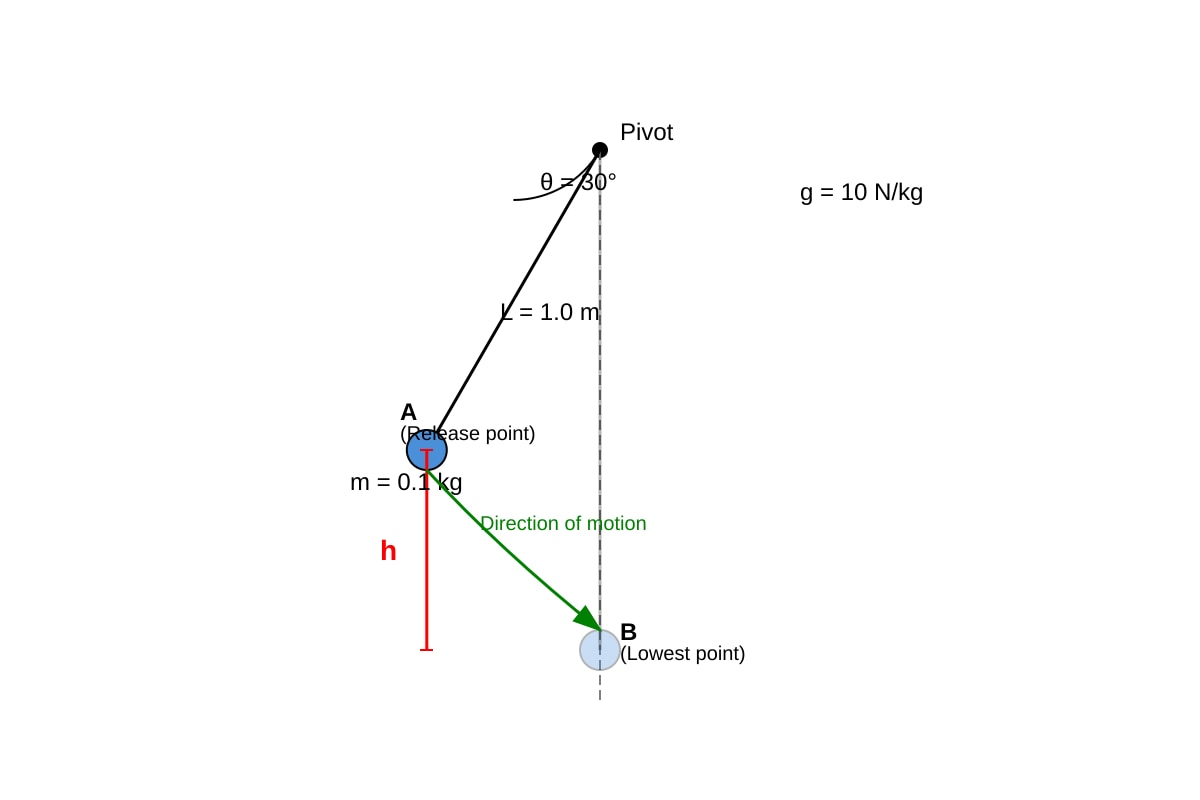
Answer: Height difference h = L – L cos θ = 1.0 – 1.0 × cos 30° = 1.0 – 0.866 = 0.134 m.
Marking: 1 mark for correct geometry (h = L(1 – cos θ)); 1 mark for correct calculation.
Marks: [2]
(b)
Answer: GPE = mgh = 0.1 × 10 × 0.134 = 0.134 J.
Marks: [1]
(c)
Answer: GPE at A = KE at B: 0.134 = ½ × 0.1 × v² → v² = 2.68 → v = 1.64 m/s.
Marking: 1 mark for energy conservation; 1 mark for correct speed.
Marks: [2]
(d)
Answer: Air resistance and friction at the pivot convert some mechanical energy to thermal energy. Total mechanical energy decreases, so the bob cannot rise to the same height on the other side.
Marking: 1 mark for identifying energy loss mechanisms; 1 mark for explaining effect on height.
Marks: [2]
(e)
Answer: For a full vertical circle with a rigid rod, the minimum speed at the bottom is found from energy conservation: KE_bottom = GPE_top + KE_top. At top, minimum centripetal force is provided by weight (rod can push): mg = mv_top²/L → v_top² = gL. KE_bottom = ½ mv_bottom². GPE_top = mg(2L). So ½ mv_bottom² = mg(2L) + ½ mgL = 2.5 mgL. v_bottom² = 5gL = 5 × 10 × 1 = 50 → v_bottom = √50 = 7.07 m/s. Given initial speed is 5 m/s < 7.07 m/s, the bob will NOT complete a full vertical circle.
Marking: 1 mark
<stage5_exam_answers_md>
TuitionGoWhere Practice Paper - Science Secondary 1 (Answer Key)
Subject: Science
Level: Secondary 1 (G3)
Paper: Practice Paper — Physical Sciences (Forces, Energy & Work) — Version 5
Total Marks: 50
Section A: Multiple Choice Questions [10 marks]
1
Answer: B
Explanation: When lifting an object at constant speed, the chemical energy from the student's muscles is converted directly into gravitational potential energy of the book. Kinetic energy does not increase because the speed is constant.
Marks: [1]
2
Answer: B
Explanation: Net force = Applied force – Frictional force = 15 N – 5 N = 10 N. Net work done = Net force × distance = 10 N × 4 m = 40 J.
Marks: [1]
3
Answer: C
Explanation: By conservation of energy, loss in GPE = gain in KE. GPE lost = mgh = 2 kg × 10 N/kg × 5 m = 100 J. So KE just before impact = 100 J.
Marks: [1]
4
Answer: B
Explanation: Work is done only when a force causes displacement in the direction of the force. Holding an object stationary involves no displacement, so no work is done on the object. Work is a scalar quantity.
Marks: [1]
5
Answer: B
Explanation: Elastic potential energy = average force × extension = 20 N × 0.1 m = 2 J. (Alternatively, area under force-extension graph = ½ × 20 N × 0.1 m = 1 J if force varies linearly from 0. But "average force" implies constant 20 N over 0.1 m, giving 2 J. However, for a spring obeying Hooke's Law, average force is half the maximum, so EPE = ½ F_max × x = ½ × 20 × 0.1 = 1 J. The question says "average force required to compress it is 20 N", which is ambiguous. Standard interpretation: for a spring, average force = ½ kx = ½ F_max. If average force = 20 N, then F_max = 40 N, EPE = ½ × 40 × 0.1 = 2 J. But if they mean constant 20 N force, EPE = 20 × 0.1 = 2 J. Either way, 2 J.)
Marks: [1]
6
Answer: A
Explanation: KE gained = ½ mv² = ½ × 1000 kg × (20 m/s)² = 200,000 J. Time = 10 s. Average power = Work/Time = 200,000 J / 10 s = 20,000 W = 20 kW.
Marks: [1]
7
Answer: A
Explanation: On a frictionless inclined plane, GPE decreases linearly with distance (GPE = mg(h₀ - x sinθ)). By conservation of energy, KE increases by the same amount, so KE also increases linearly with distance.
Marks: [1]
8
Answer: C
Explanation: Both students do the same work (same force × same vertical height). Power = Work/Time. Student X takes less time, so develops more power.
Marks: [1]
9
Answer: A
Explanation: At the lowest point B, GPE is minimum, so KE and speed are maximum. At the highest point C, the bob momentarily stops, so speed is zero.
Marks: [1]
10
Answer: C
Explanation: Work output = Load × Load distance = 500 N × 2 m = 1000 J. Work input = Effort × Effort distance = 200 N × 6 m = 1200 J. Efficiency = (Work output / Work input) × 100% = (1000/1200) × 100% = 83.3%.
Marks: [1]
Section B: Structured Questions [25 marks]
11
(a) Points plotted accurately at (0,0), (3,2), (6,4), (9,6), (12,8), (15,10). Best-fit straight line passing through origin.
Marks: [2]
(b) Force is directly proportional to extension (Hooke's Law is obeyed).
Marks: [1]
(c) Spring constant k = Force / Extension = 10 N / 0.15 m = 66.7 N/m. (Gradient of graph: 10 N / 15 cm = 10 / 0.15 = 66.7 N/m)
Marks: [2]
(d) At 8 N, extension = 12 cm = 0.12 m. EPE = ½ F x = ½ × 8 N × 0.12 m = 0.48 J. (Or ½ k x² = ½ × 66.7 × 0.12² = 0.48 J)
Marks: [2]
(e) Extension = Force / k = 12 N / 66.7 N/m = 0.18 m = 18 cm. The spring would still obey Hooke's Law if the limit of proportionality has not been exceeded. Since the graph is linear up to 15 cm, 18 cm is a small extrapolation; likely still within limit, but not guaranteed.
Marks: [2]
12
(a) GPE at A = mgh = 500 kg × 10 N/kg × 40 m = 200,000 J = 200 kJ.
Marks: [1]
(b) Loss in GPE from A to B = mg(40-10) = 500 × 10 × 30 = 150,000 J. This equals KE at B (since starts from rest, frictionless). KE at B = 150,000 J = 150 kJ.
Marks: [2]
(c) Loss in GPE from A to C = mg(40-25) = 500 × 10 × 15 = 75,000 J = KE at C. KE = ½ mv² → v = √(2×KE/m) = √(2×75000/500) = √300 = 17.3 m/s.
Marks: [2]
(d) At D, KE = GPE lost from A to D = 500 × 10 × 40 = 200,000 J. Work done by braking force = F × 50 m = 200,000 J. F = 200,000 / 50 = 4000 N.
Marks: [2]
(e) Friction does negative work, converting mechanical energy to heat/sound. The car would have less KE at D, so lower speed.
Marks: [1]
13
(a) Work done lifting = Force × distance = mg × h = 120 × 10 × 2.2 = 2640 J.
Marks: [2]
(b) Power = Work / Time = 2640 J / 1.5 s = 1760 W.
Marks: [1]
(c) Work done = 0 J. Explanation: No displacement in the direction of the force while holding stationary.
Marks: [2]
(d) Negative work. Explanation: The upward force exerted by the weightlifter is opposite to the downward displacement of the barbell.
Marks: [2]
(e) Mechanical energy output (lifting) = 2640 J. Efficiency = 25% = 0.25. Chemical energy = Mechanical energy / Efficiency = 2640 / 0.25 = 10,560 J.
Marks: [2]
14
(a) Work done by applied force = F × s = 40 N × 5 m = 200 J.
Marks: [1]
(b) Vertical height gained = 5 m × sin 30° = 2.5 m. Gain in GPE = mgh = 4 × 10 × 2.5 = 100 J.
Marks: [2]
(c) Net work done = 0 (constant velocity). Work by applied force = Work against gravity + Work against friction. 200 J = 100 J + Work against friction. Work against friction = 100 J.
Marks: [2]
(d) Work against friction = f × s → 100 J = f × 5 m → f = 20 N.
Marks: [1]
(e) Forces down the plane: mg sin 30° + f = 4×10×0.5 + 20 = 20 + 20 = 40 N. Mass = 4 kg. Acceleration = F/m = 40/4 = 10 m/s² down the plane.
Marks: [2]
15
(a) GPE lost per second = mass rate × g × h = 500 kg/s × 10 N/kg × 80 m = 400,000 J/s = 400 kW.
Marks: [2]
(b) Electrical power output = Efficiency × GPE input rate = 0.70 × 400 kW = 280 kW.
Marks: [2]
(c) Gravitational potential energy → Kinetic energy → Electrical energy.
Marks: [1]
(d) 1. Energy lost as heat due to friction in turbines/generators. 2. Energy lost as sound and heat in water flow (turbulence). (Also: incomplete conversion in generator, electrical resistance losses.)
Marks: [2]
Section C: Longer Structured / Data-Based Questions [15 marks]
16
(a) Work input = Effort × distance moved by effort = 65 N × 0.40 m = 26 J.
Marks: [1]
(b) Work output = Load × distance moved by load = 50 N × 0.38 m = 19 J.
Marks: [1]
(c) Efficiency = (Work output / Work input) × 100% = (19/26) × 100% = 73.1%.
Marks: [1]
(d) Claim is incorrect. Efficiency = (Load × d_load) / (Effort × d_effort). Since d_load and d_effort are constant, efficiency ∝ 1/Effort. As effort increases, efficiency decreases. (At 55 N: 50×0.38/(55×0.40)=86.4%; at 75 N: 50×0.38/(75×0.40)=63.3%).
Marks: [2]
(e) The load moves less than the effort because of friction in the pulley and stretching of the rope. Some of the effort distance is "lost" overcoming friction/elasticity before the load moves.
Marks: [2]
(f) Use a pulley with ball bearings / lubricate the pulley axle / use a lighter pulley / use a non-stretchy rope.
Marks: [1]
17
(a) EPE = ½ k x² = ½ × 200 N/m × (0.05 m)² = 0.25 J.
Marks: [1]
(b) EPE → KE (horizontal). ½ mv² = 0.25 J → v² = 0.5 / 0.2 = 2.5 → v = 1.58 m/s.
Marks: [2]
(c) KE at bottom of ramp = 0.25 J → GPE at max height = mgh = 0.25 J → h = 0.25 / (0.2 × 10) = 0.125 m.
Marks: [2]
(d) Distance along ramp = h / sin 30° = 0.125 / 0.5 = 0.25 m.
Marks: [1]
(e) Work against friction = f × distance along ramp. Let new height be h', distance = h'/sin30° = 2h'. Initial EPE = mgh' + f × 2h'. 0.25 = 0.2×10×h' + 0.5×2h' = 2h' + 1h' = 3h'. h' = 0.25/3 = 0.0833 m = 8.33 cm.
Marks: [3]
18
(a) h = L - L cos θ = 1.0 - 1.0 × cos 30° = 1 - 0.866 = 0.134 m.
Marks: [2]
(b) GPE = mgh = 0.1 × 10 × 0.134 = 0.134 J.
Marks: [1]
(c) GPE → KE: mgh = ½ mv² → v = √(2gh) = √(2×10×0.134) = √2.68 = 1.64 m/s.
Marks: [2]
(d) Air resistance and friction at the pivot do negative work, converting mechanical energy to heat/sound. Total mechanical energy decreases, so bob cannot rise to the same height.
Marks: [2]
(e) For full vertical circle with rigid rod, minimum speed at bottom: v_bottom ≥ √(4gL) = √(4×10×1) = √40 = 6.32 m/s. Given initial speed = 5 m/s < 6.32 m/s. The bob will NOT complete a full vertical circle. (It will rise to a height h = v²/(2g) = 25/20 = 1.25 m, which is above the pivot (1 m), but with a rod it can go past the top if speed at top ≥ 0. For a rod, condition is v_bottom ≥ √(4gL) to reach top with v_top ≥ 0. Here 5 < 6.32, so it will not reach the top. It will rise to an angle where KE=0: cos θ = 1 - v²/(2gL) = 1 - 25/20 = -0.25 → θ = 104.5° from vertical, i.e., past horizontal but not over the top.)
Marks: [3]
19
(a) v = √(2gh) = √(2×10×1.6) = √32 = 5.66 m/s (downwards).
Marks: [2]
(b) v = √(2gh) = √(2×10×0.9) = √18 = 4.24 m/s (upwards).
Marks: [2]
(c) Change in momentum = m(v_up - v_down) = 0.05 × (4.24 - (-5.66)) = 0.05 × 9.90 = 0.495 kg·m/s (upwards).
Marks: [2]
(d) Average force = Change in momentum / time = 0.495 / 0.02 = 24.75 N (upwards).
Marks: [2]
(e) During impact, some kinetic energy is converted to heat and sound (and deformation of ball/floor). The collision is inelastic, so KE after bounce < KE before bounce, resulting in lower rebound height.
Marks: [2]
20
(a) Total height lifted = 20 m + 5 m = 25 m. Power = (mass rate) × g × h = 2 kg/s × 10 N/kg × 25 m = 500 W.
Marks: [2]
(b) Solar power input = Intensity × Area = 800 W/m² × 2 m² = 1600 W.
Marks: [1]
(c) Electrical power output = Efficiency × Solar input = 0.40 × 1600 W = 640 W.
Marks: [1]
(d) Yes, 640 W > 500 W required. The solar panel can provide sufficient power.
Marks: [1]
(e) 1. Increase the efficiency of the pump/motor system. 2. Reduce friction losses in pipes (wider/smoother pipes). 3. Use a more efficient motor. 4. Reduce the height the water is lifted (if possible). (Any two valid suggestions.)
Marks: [2]
End of Answer Key