AI Generated Exam Paper
Secondary 1 Science Practice Paper 5
Free Sec 1 Science Practice Paper 5, HY3 AI version, with questions, answers, and syllabus-aligned practice for Singapore students.
These static practice materials are generated from the site's syllabus and paper-generation workflow, with source and model context shown so students and parents can evaluate the material before use.
Questions
TuitionGoWhere Practice Paper - Science Secondary 1
TuitionGoWhere Practice Paper (AI) — Version 5
Subject: Science
Level: Secondary 1
Paper: Practice Paper (Physical Sciences Focus)
Duration: 45 minutes
Total Marks: 40
Name: ______________________
Class: _________
Date: ____________
Instructions:
- This practice paper has 20 questions across three sections.
- Answer all questions in the spaces provided.
- Use a ruler and pen/pencil for diagrams where needed.
- Show your working clearly for calculation questions.
- Marks for each question are shown in brackets [ ].
Section A: Forces and Motion (Questions 1–7) — Total 14 marks
1. A student pushes a book across a table with a force of 5 N. The book moves 2 m in the direction of the force. Calculate the work done. [2]
2. State one everyday example of a frictional force being useful. [1]
3. A spring balance measures the weight of an object as 10 N. Name the unit of force and state what type of force the spring balance is measuring. [2]
4.
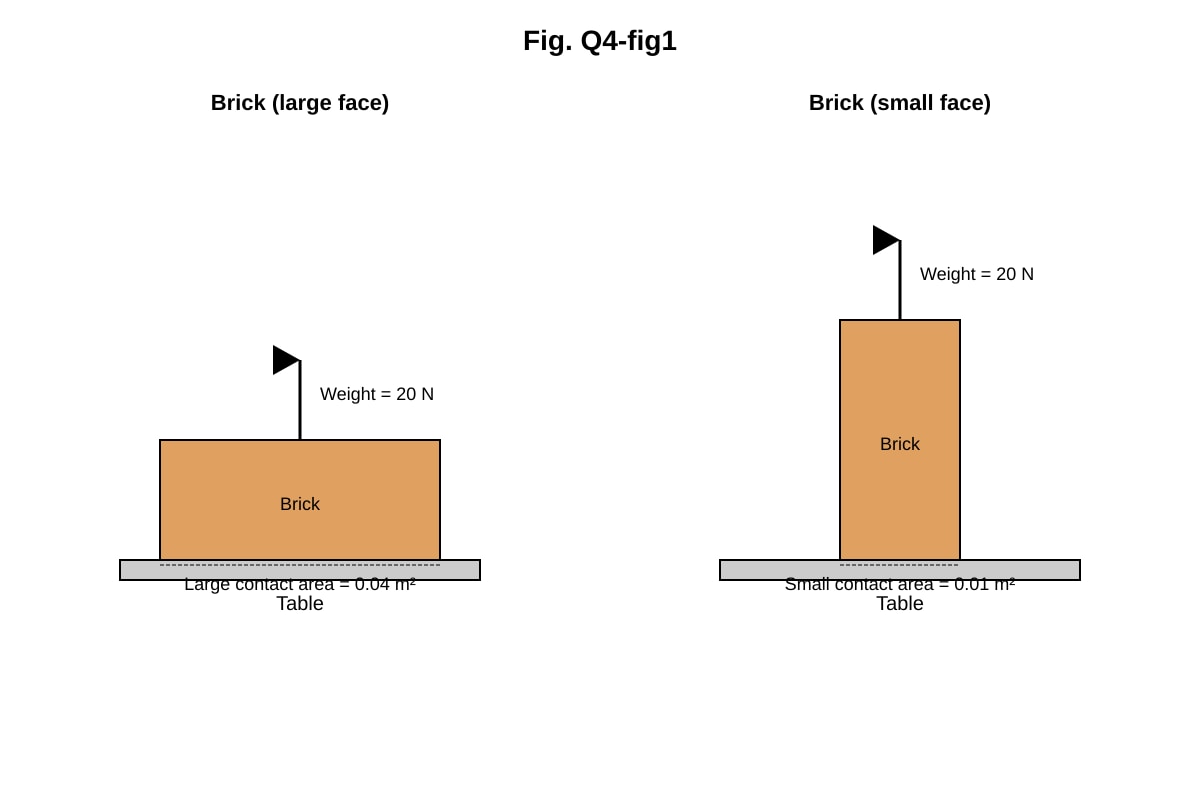
Image pending generation: diagram for Q4.
The brick in Fig. Q4-fig1 has a weight of 20 N. It is placed first on its largest face, then turned to rest on its smallest face. Explain how the pressure on the table changes. [3]
5. Give two effects that a force can have on an object. [2]
6. A person holds a 30 N bag stationary in the air for 10 seconds. Calculate the work done by the person on the bag while holding it. [1]
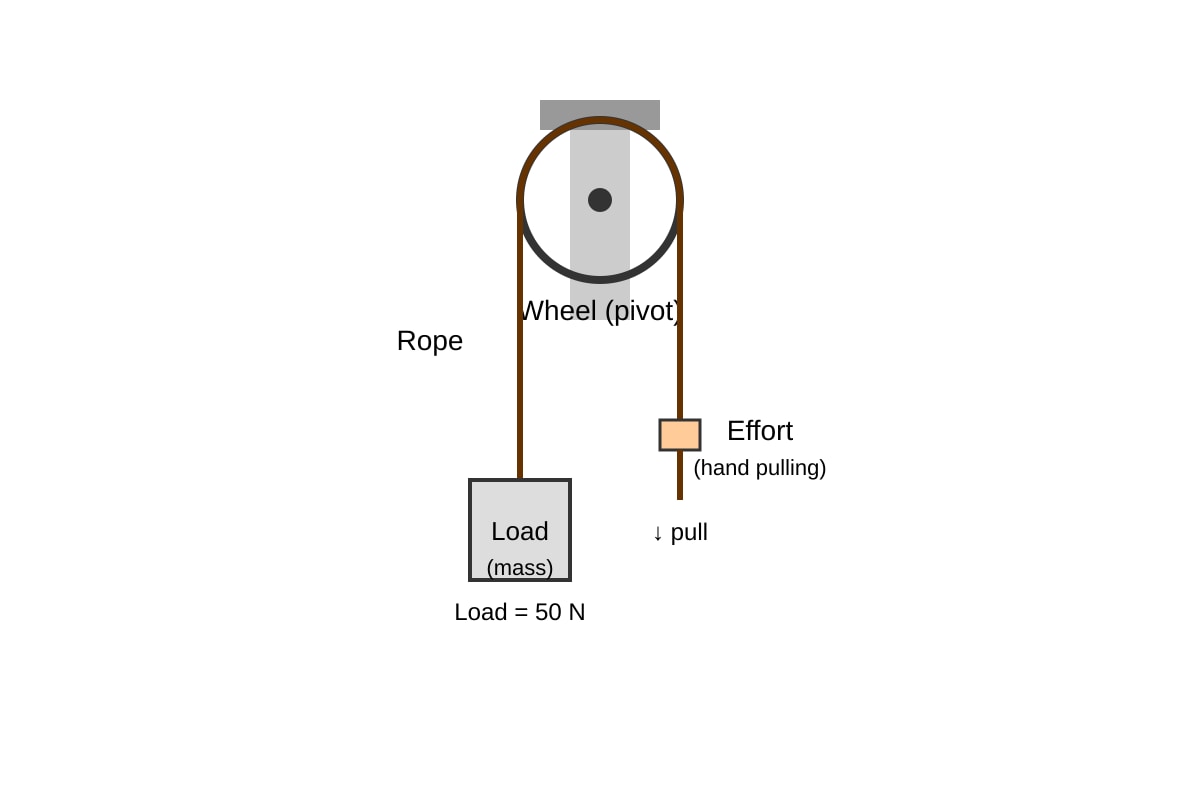
7. Identify the simple machine shown below and state how it helps lift a load. [3]
Image pending generation: diagram for Q7.
Section B: Energy and Heat (Questions 8–14) — Total 14 marks
8. State the energy conversion when a torch is switched on. [1]
9. Name two renewable sources of energy. [2]
10. A ball of mass 0.5 kg is dropped from a height of 4 m. Calculate the gravitational potential energy lost by the ball. (Use g = 10 m/s²) [2]
11. Describe one everyday application of expansion and contraction of materials due to heat. [2]
12. Heat flows from a hot mug of tea to the surrounding air. State the direction of heat flow and explain why it stops. [2]
13. A hairdryer converts electrical energy into two other forms of energy. Name them. [2]
14. Carbon dioxide is released when fossil fuels are burned. State one environmental problem this may cause. [2]
Section C: Electricity and Light (Questions 15–20) — Total 12 marks
15. The voltage supplied to homes in Singapore is 230 V. State the name of the safety device that breaks a circuit when too much current flows. [1]
16. Draw a circuit diagram with one cell, one switch, and two lamps in parallel. [3]
17. An ammeter reads 2 A and a voltmeter across a resistor reads 6 V. Calculate the resistance. [2]
18. State the function of an earth wire in a mains plug. [2]
19.
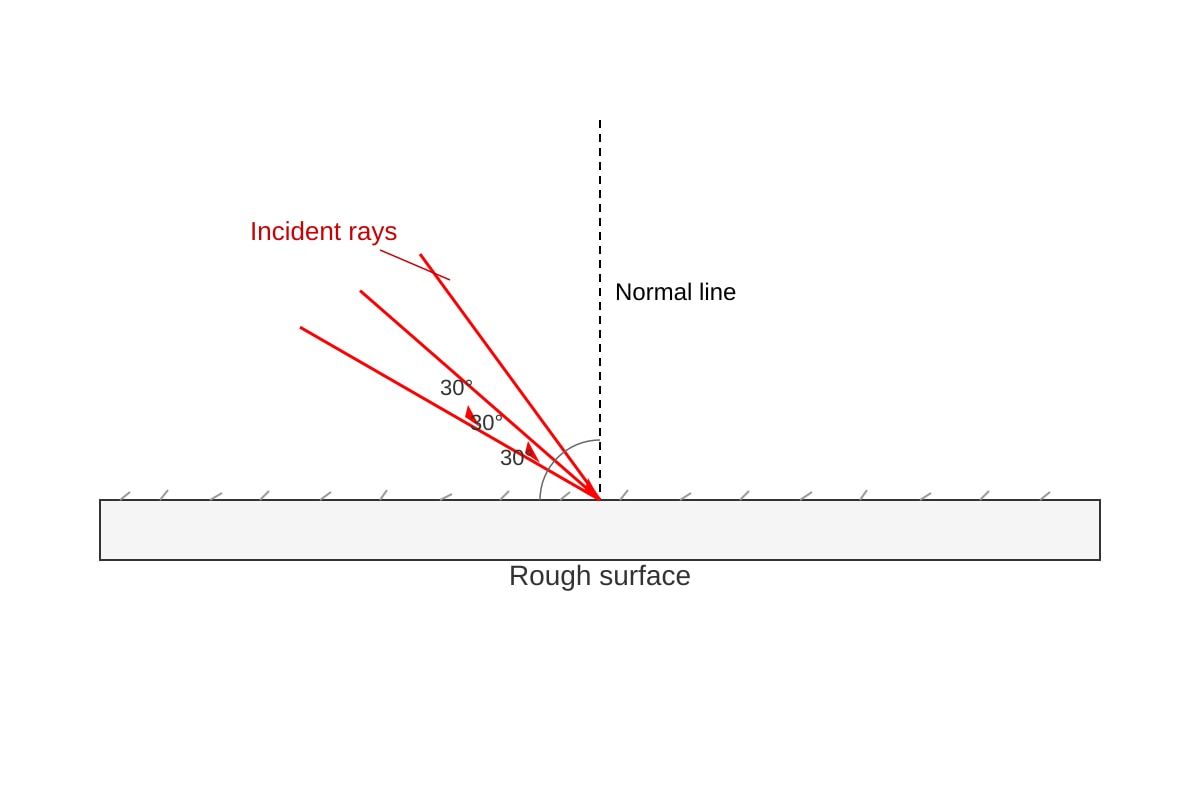
Image pending generation: diagram for Q19.
Complete the diagram in Fig. Q19-fig1 to show what happens to the light rays after they hit the rough paper. [2]
20. A closed circuit has a 3 V cell and a 6 Ω resistor. Calculate the current flowing. [2]
Answers
TuitionGoWhere Practice Paper — Answer Key (Version 5)
Subject: Science
Level: Secondary 1
Total Marks: 40
Section A: Forces and Motion (14 marks)
Q1 [2]
Work done = Force × Distance
= 5 N × 2 m = 10 J
Marks: 1 for formula, 1 for correct answer with unit.
Q2 [1]
Example: Friction between car tyres and road allows the car to move / brakes use friction to stop.
Any one correct everyday example.
Q3 [2]
Unit of force: newton (N) [1]. The spring balance measures gravitational force (weight) [1].
Q4 [3]
Pressure = Force ÷ Area. Weight (force) stays 20 N [1]. On large face: P = 20 ÷ 0.04 = 500 Pa [1]. On small face: P = 20 ÷ 0.01 = 2000 Pa, so pressure is higher on small face [1].
Common mistake: saying force changes.
Q5 [2]
Any two: change shape/size, change state of rest/motion (speed or direction). [1 each]
Q6 [1]
Work done = 0 J (no displacement while held stationary).
Q7 [3]
Simple machine: pulley [1]. It helps lift a load by changing direction of effort / reducing effort needed with multiple pulleys [2].
Section B: Energy and Heat (14 marks)
Q8 [1]
Chemical energy → Light energy (+ heat).
Q9 [2]
Any two: biomass, hydropower, sun, wind. [1 each]
Q10 [2]
GPE lost = mgh = 0.5 × 10 × 4 = 20 J [1 for working, 1 for answer].
Q11 [2]
Example: Bimetallic strip in thermostat bends with heat to break contact [2]. Or railway buckling if not expanded.
Q12 [2]
Heat flows from hot tea to cooler air [1]. Stops when both reach same temperature (thermal equilibrium) [1].
Q13 [2]
Kinetic energy (moving air) and heat energy. [1 each]
Q14 [2]
Global warming / greenhouse effect [2]. (Accept linked explanation.)
Section C: Electricity and Light (12 marks)
Q15 [1]
Circuit breaker (or fuse).
Q16 [3]
Correct parallel circuit: cell + switch in series, two lamps on separate branches [3].
Mark: 1 cell, 1 switch, 2 parallel lamps.
Q17 [2]
R = V ÷ I = 6 ÷ 2 = 3 Ω [1 working, 1 answer].
Q18 [2]
Earth wire carries fault current to ground to prevent shock [2].
Q19 [2]
Reflected rays drawn in many directions (diffuse reflection) [2].
Must show scattered rays, not parallel.
Q20 [2]
I = V ÷ R = 3 ÷ 6 = 0.5 A [1 working, 1 answer].
Free quiz and exam paper access
Enter your details to view this paper
Your access is remembered on this device.