AI Generated Exam Paper
Secondary 1 Science Practice Paper 5
Free AI-Generated Secondary 1 Science Practice Paper 5 practice paper with questions and answers for Singapore students. This page is rendered as a direct URL so the questions and answers can be discovered without pressing in-page buttons.
These static practice materials are generated from the site's syllabus and paper-generation workflow, with source and model context shown so students and parents can evaluate the material before use.
Questions
TuitionGoWhere Practice Paper - Science Secondary 1
TuitionGoWhere Practice Paper (AI) - Version 5
Subject: Science
Level: Secondary 1
Paper: Physical Sciences Practice Paper
Duration: 1 hour 30 minutes
Total Marks: 80 marks
Name: ________________
Class: ________________
Date: ________________
Instructions
- Answer all questions in the spaces provided.
- Show all working clearly for calculation questions.
- Write your answers in blue or black ink.
- Diagrams should be drawn in pencil.
- The use of calculators is allowed.
Section A: Multiple Choice Questions [20 marks]
For each question, choose the best answer and write the letter in the box provided.
1. A student pushes a heavy box across the floor at constant speed. Which energy conversion takes place?
- A. Kinetic energy → Gravitational potential energy
- B. Chemical energy → Kinetic energy → Thermal energy
- C. Gravitational potential energy → Kinetic energy
- D. Thermal energy → Chemical energy
Answer: [ ]
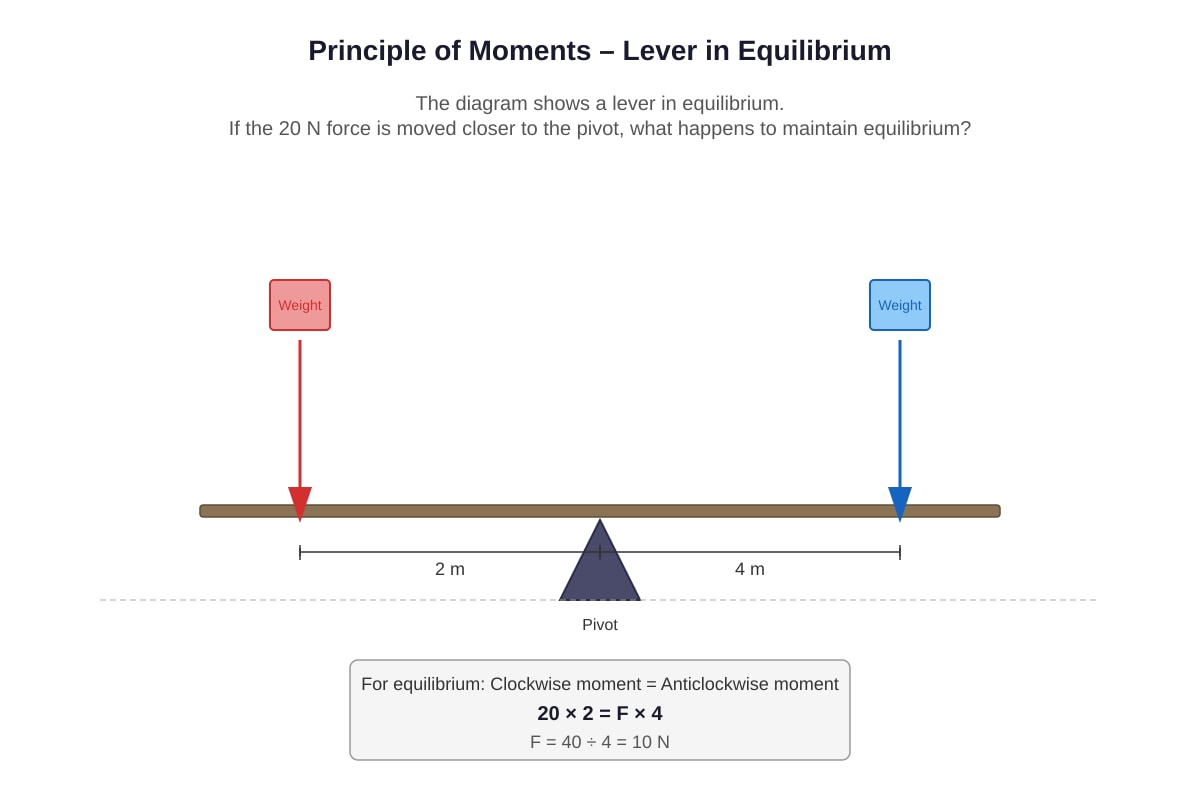
2. The diagram shows a lever in equilibrium. If the 20 N force is moved closer to the pivot, what happens to maintain equilibrium?
[Diagram shows a lever with 20 N force on left side, 2 m from pivot, and unknown force on right side, 4 m from pivot]
- A. The force on the right must increase
- B. The force on the right must decrease
- C. The force on the right remains the same
- D. The lever cannot be balanced
Answer: [ ]
3. Which statement about work done is correct?
- A. Work is done when a force is applied to an object
- B. Work is done only when an object moves in the direction of the force
- C. Work is measured in Newtons
- D. No work is done when lifting an object vertically
Answer: [ ]
4. A ray of light travels from air into glass. What happens to the light ray?
- A. It bends away from the normal
- B. It bends towards the normal
- C. It continues in a straight line
- D. It reflects back into the air
Answer: [ ]
5. Which hazard symbol indicates that a chemical should be kept away from flames?
- A. Skull and crossbones
- B. Flame symbol
- C. Corrosive symbol
- D. Explosive symbol
Answer: [ ]
Section B: Structured Questions [35 marks]
6. A crane lifts a 500 kg steel beam from ground level to the top of a building 30 m high.
(a) Calculate the gravitational potential energy gained by the steel beam. (Take g = 10 m/s²)
Working:
Answer: _________________ J [2]
(b) State the energy conversion that takes place during this process.
Answer: _________________________________ [1]
(c) The crane takes 2 minutes to lift the beam. Calculate the average power output of the crane.
Working:
Answer: _________________ W [2]
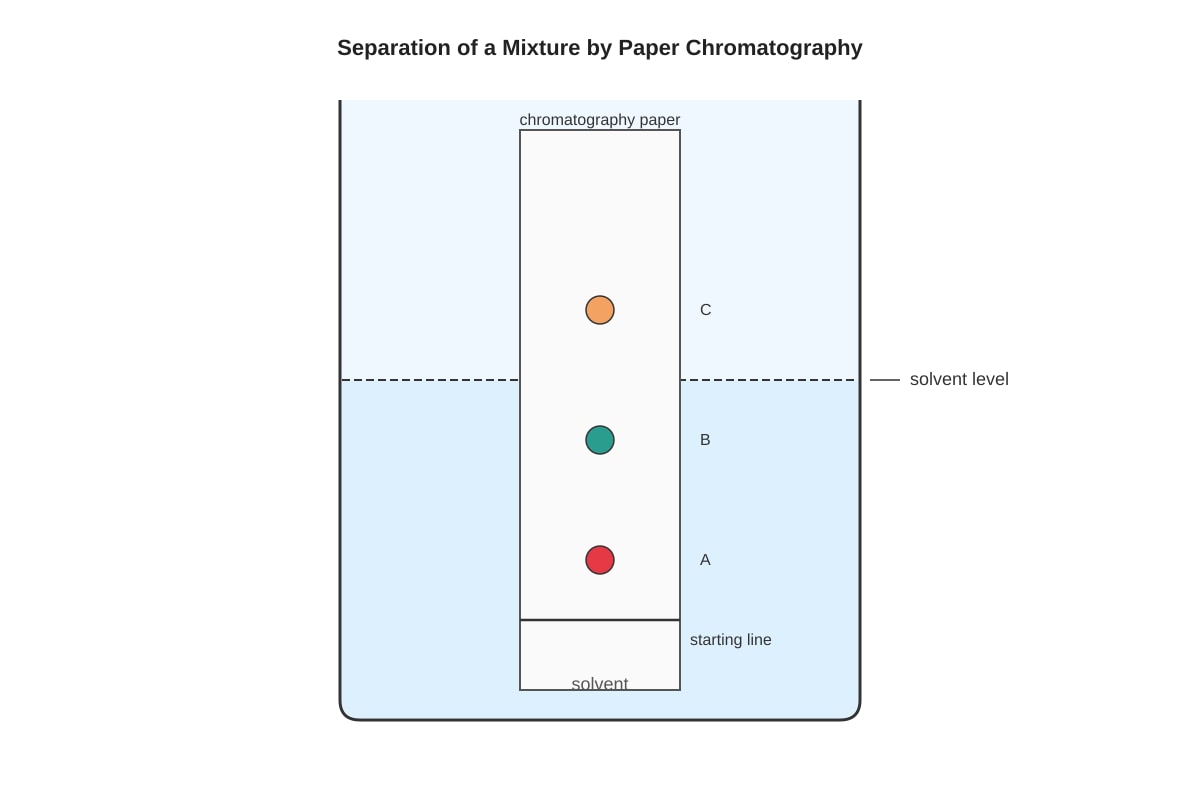
7. The diagram shows the separation of a mixture using paper chromatography.
[Diagram shows chromatography paper with starting line and three separated spots at different heights]
(a) Explain how paper chromatography separates the components of a mixture. [2]
Answer: _________________________________________________________________
(b) State one advantage of using chromatography to analyze mixtures. [1]
Answer: _________________________________________________________________
(c) A student wants to separate a mixture of sand and salt. Explain why chromatography would not be suitable for this separation. [2]
Answer: _________________________________________________________________
8. A student investigates how the surface area of zinc affects the rate of reaction with hydrochloric acid.
(a) State a suitable hypothesis for this investigation. [1]
Answer: _________________________________________________________________
(b) Identify the:
- Independent variable: _________________________________ [1]
- Dependent variable: _________________________________ [1]
- One controlled variable: _________________________________ [1]
(c) Suggest how the student could measure the rate of reaction. [1]
Answer: _________________________________________________________________
Section C: Extended Response Questions [25 marks]
9. The diagram shows a microscope setup used to observe plant cells.
[Diagram shows microscope with 10× eyepiece and 40× objective lens, with a cell image measuring 2.5 mm]
(a) Calculate the total magnification of the microscope. [1]
Working:
Answer: _________________ ×
(b) Calculate the actual length of the cell in micrometers (μm). [2]
Working:
Answer: _________________ μm
(c) The student observes that the plant cell has a thick outer boundary and green structures inside.
(i) Name the thick outer boundary. [1]
Answer: _________________________________
(ii) Name the green structures and state their function. [2]
Name: _________________________________
Function: _________________________________________________________________
(d) Explain why this cell would not be found in animal tissue. [2]
Answer: _________________________________________________________________
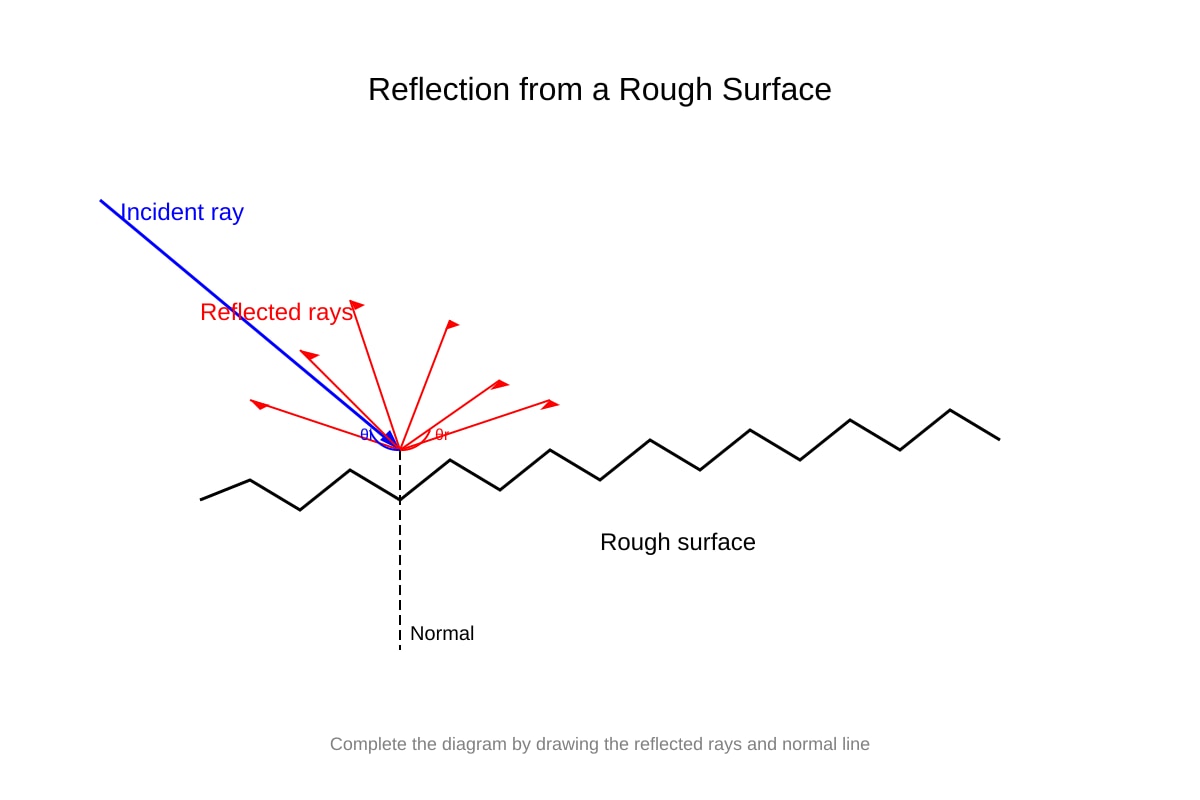
10. A student conducts an experiment to investigate the reflection of light from different surfaces.
(a) Complete the ray diagram below to show what happens when light hits a rough surface. Include the normal line. [2]
[Diagram shows incident ray approaching a rough surface]
(b) Explain the difference between reflection from a smooth surface and reflection from a rough surface. [3]
Answer: _________________________________________________________________
(c) State one practical application of:
(i) Reflection from smooth surfaces: _________________________________ [1]
(ii) Reflection from rough surfaces: _________________________________ [1]
11. A mixture contains iron filings, sand, and salt dissolved in water.
(a) Describe a complete method to separate all three components from this mixture. Include the order of separation steps and the scientific principles involved. [6]
Step 1: _________________________________________________________________
Principle: _________________________________________________________________
Step 2: _________________________________________________________________
Principle: _________________________________________________________________
Step 3: _________________________________________________________________
Principle: _________________________________________________________________
(b) Explain why the order of separation steps is important. [2]
Answer: _________________________________________________________________
12. The table shows data from an experiment investigating how temperature affects the solubility of potassium nitrate in water.
| Temperature (°C) | Mass of KNO₃ dissolved (g) |
|---|---|
| 20 | 32 |
| 40 | 64 |
| 60 | 110 |
| 80 | 169 |
(a) Describe the relationship between temperature and solubility shown in the data. [1]
Answer: _________________________________________________________________
(b) Predict the mass of potassium nitrate that would dissolve at 50°C. Explain your reasoning. [2]
Prediction: _________________ g
Reasoning: _________________________________________________________________
(c) A student dissolves 100 g of potassium nitrate in water at 80°C, then cools the solution to 20°C. Calculate the mass of crystals that would form. [2]
Working:
Answer: _________________ g
END OF PAPER
Answers
TuitionGoWhere Practice Paper - Science Secondary 1 (Answer Key)
Version 5 - Physical Sciences Practice Paper
Section A: Multiple Choice Questions [20 marks]
1. B - Chemical energy → Kinetic energy → Thermal energy The student's muscles convert chemical energy to kinetic energy to move the box, which is then converted to thermal energy due to friction.
2. A - The force on the right must increase When the 20 N force moves closer to the pivot, its moment decreases. To maintain equilibrium, the force on the right must increase to provide the same opposing moment.
3. B - Work is done only when an object moves in the direction of the force Work = Force × Distance moved in the direction of the force. If there's no movement or movement perpendicular to the force, no work is done.
4. B - It bends towards the normal Light slows down when entering a denser medium (glass), causing refraction towards the normal line.
5. B - Flame symbol The flame symbol indicates flammable substances that should be kept away from heat sources and flames.
Section B: Structured Questions [35 marks]
6. (a) [2 marks] GPE = mgh = 500 kg × 10 m/s² × 30 m = 150,000 J (or 1.5 × 10⁵ J) Award 1 mark for correct formula, 1 mark for correct calculation and answer
6. (b) [1 mark] Chemical energy → Gravitational potential energy Accept: Electrical energy → Gravitational potential energy
6. (c) [2 marks] Time = 2 minutes = 120 s Power = Energy/Time = 150,000 J ÷ 120 s = 1,250 W Award 1 mark for time conversion, 1 mark for correct power calculation
7. (a) [2 marks] Different components have different solubilities in the solvent [1], so they travel different distances up the paper [1]. Accept equivalent explanations about component mobility
7. (b) [1 mark] Can separate multiple components simultaneously / Requires only small sample / Quick and simple method Accept any one valid advantage
7. (c) [2 marks] Sand and salt have very different properties [1]. Sand is insoluble while salt is soluble, so they can be separated more easily by filtration and evaporation [1]. Accept explanations about particle size differences or more suitable methods
8. (a) [1 mark] If the surface area of zinc increases, then the rate of reaction will increase. Accept any testable hypothesis linking surface area to reaction rate
8. (b) [3 marks]
- Independent variable: Surface area of zinc / Size of zinc pieces [1]
- Dependent variable: Rate of reaction / Volume of gas produced per minute [1]
- Controlled variable: Temperature / Concentration of acid / Mass of zinc [1]
8. (c) [1 mark] Measure the volume of gas produced per unit time / Time how long it takes for the zinc to disappear Accept any valid method for measuring reaction rate
Section C: Extended Response Questions [25 marks]
9. (a) [1 mark] Total magnification = 10 × 40 = 400×
9. (b) [2 marks] Actual length = Image length ÷ Magnification = 2.5 mm ÷ 400 = 0.00625 mm [1] = 0.00625 × 1000 = 6.25 μm [1]
9. (c) (i) [1 mark] Cell wall
9. (c) (ii) [2 marks] Name: Chloroplasts [1] Function: Photosynthesis / To make food / To capture light energy [1]
9. (d) [2 marks] Animal cells do not have cell walls [1] and do not have chloroplasts [1]. Accept: Animal cells do not carry out photosynthesis
10. (a) [2 marks] Correct ray diagram showing:
- Normal line perpendicular to surface [1]
- Multiple reflected rays in different directions (diffuse reflection) [1]
10. (b) [3 marks] Smooth surface: Light rays reflect at the same angle, following the law of reflection (angle of incidence = angle of reflection) [1]. All rays reflect in the same direction [1]. Rough surface: Light rays hit the surface at different angles and reflect in many different directions (diffuse reflection) [1].
10. (c) [2 marks] (i) Mirrors / Periscopes / Telescopes [1] (ii) Reading paper / Seeing objects around us / Non-glare surfaces [1]
11. (a) [6 marks] Step 1: Use a magnet to remove iron filings [1] Principle: Iron is magnetic while sand and salt are not [1]
Step 2: Add water and stir, then filter [1] Principle: Salt dissolves in water but sand does not [1]
Step 3: Evaporate the filtrate [1] Principle: Water evaporates leaving salt crystals behind [1]
11. (b) [2 marks] The magnetic separation must be done first because once water is added, the iron filings may rust or become harder to separate [1]. Filtration must be done before evaporation to separate the insoluble sand from the salt solution [1].
12. (a) [1 mark] As temperature increases, solubility increases / Positive correlation / Directly proportional
12. (b) [2 marks] Prediction: Approximately 87 g [1] Reasoning: The pattern shows solubility roughly doubles every 20°C, so at 50°C it would be between 64 g and 110 g [1] Accept any reasonable prediction between 80-95 g with valid reasoning
12. (c) [2 marks] At 80°C: 169 g can dissolve At 20°C: 32 g can dissolve [1] Mass of crystals = 169 - 32 = 137 g [1] But student only dissolved 100 g, so crystals formed = 100 - 32 = 68 g
Marking Scheme Summary
Total: 80 marks
- Section A: 20 marks (4 marks each)
- Section B: 35 marks
- Section C: 25 marks
Grade Boundaries (Suggested):
- A: 72-80 marks (90-100%)
- B: 64-71 marks (80-89%)
- C: 56-63 marks (70-79%)
- D: 48-55 marks (60-69%)
- E: 40-47 marks (50-59%)
- F: Below 40 marks (<50%)