AI Generated Exam Paper
Secondary 1 Science Practice Paper 4
Free Sec 1 Science Practice Paper 4, Nemo3 AI version, with questions, answers, and syllabus-aligned practice for Singapore students.
These static practice materials are generated from the site's syllabus and paper-generation workflow, with source and model context shown so students and parents can evaluate the material before use.
Questions

Free quiz and exam paper access
Enter your details to view this paper
Your access is remembered on this device.
Answers
TuitionGoWhere Practice Paper - Science Secondary 1 (Answer Key)
TuitionGoWhere Practice Paper (AI) - Version 4
Subject: Science
Level: Secondary 1 (G3)
Paper: Practice Paper - Physical Sciences
Total Marks: 50
Section A: Multiple Choice Questions [10 marks]
Question 1 [1 mark]
Answer: B
Explanation: When a student lifts a book, the chemical energy stored in the student's muscles (from food) is converted into gravitational potential energy of the book as it gains height. The book moves at constant velocity (implied by "lifts"), so kinetic energy does not increase.
Common mistake: Choosing A (kinetic → potential) - this would apply if the book was thrown upward, not lifted steadily.
Question 2 [1 mark]
Answer: C
Working: Work done = Force × Distance (in direction of force) = 15 N × 4 m = 60 J
Key concept: Work done = F × s when force and displacement are in the same direction.
Question 3 [1 mark]
Answer: C
Working: By conservation of energy (ignoring air resistance): Loss in GPE = Gain in KE mgh = 2 kg × 10 N/kg × 5 m = 100 J So KE just before hitting ground = 100 J
Alternative: v² = u² + 2gh = 0 + 2×10×5 = 100, KE = ½mv² = ½×2×100 = 100 J
Question 4 [1 mark]
Answer: C
Explanation:
- A is incorrect: Work requires displacement in the direction of the force.
- B is incorrect: Work is done when there is a component of force in the direction of displacement (W = Fs cos θ).
- C is correct: When holding an object stationary, there is no displacement, so no work is done on the object (though muscles expend energy internally).
- D is incorrect: Work done against friction is converted to thermal energy, not kinetic energy.
Question 5 [1 mark]
Answer: C
Working: Weight = mg 5 N = 0.5 kg × g g = 5 / 0.5 = 10 N/kg
Key concept: Gravitational field strength g = Weight / Mass. Standard value on Earth is 10 N/kg (or 9.8 N/kg).
Question 6 [1 mark]
Answer: B
Explanation: At the highest point of vertical motion, the ball momentarily stops (velocity = 0), so kinetic energy = 0. It is at maximum height, so gravitational potential energy is maximum.
Question 7 [1 mark]
Answer: C
Working: Efficiency = Useful work output / Work input × 100% 80% = Useful work output / 250 J × 100% Useful work output = 0.80 × 250 = 200 J
Question 8 [1 mark]
Answer: B
Explanation: Work done = Force × Distance moved in direction of force. If the wall does not move, distance = 0, so work done = 0. In all other options, the object moves in the direction of the applied force (or opposite for braking).
Question 9 [1 mark]
Answer: C
Working: KE = ½mv² = ½ × 4 kg × (3 m/s)² = 2 × 9 = 18 J
Question 10 [1 mark]
Answer: C
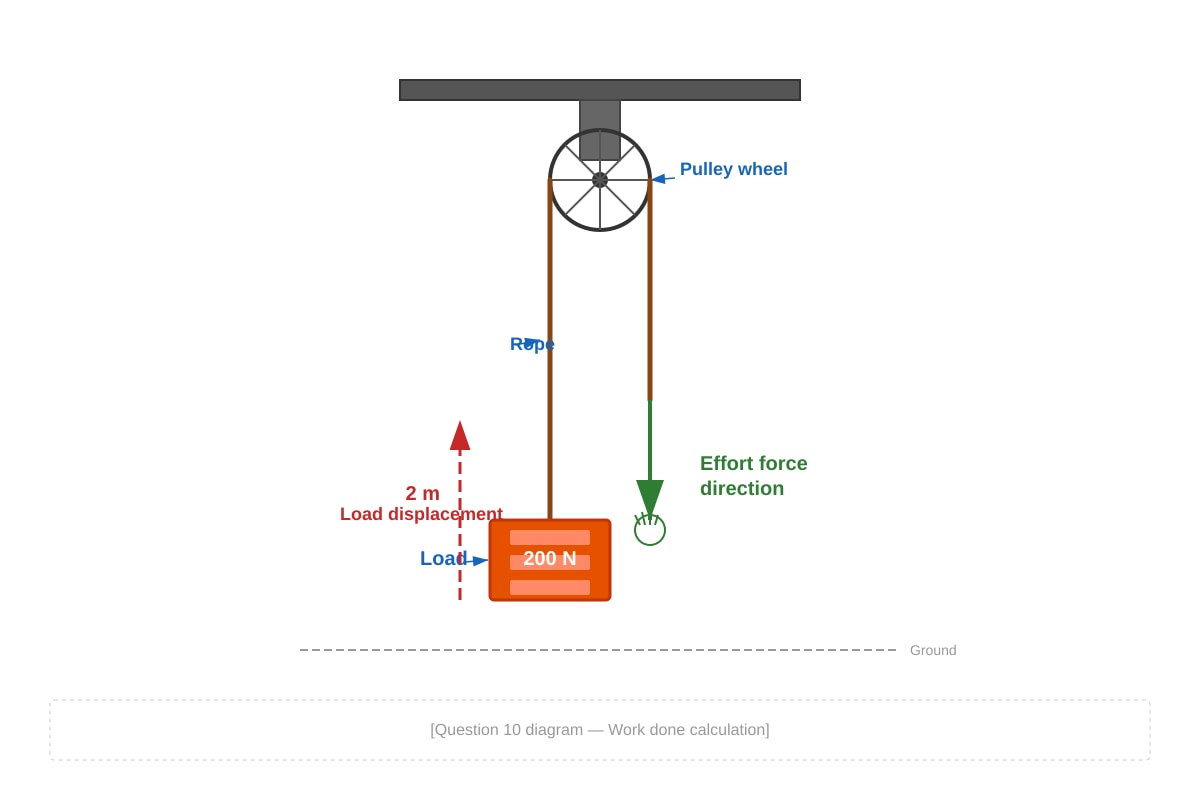
Working: Work done on load = Force on load × Distance moved by load = Weight of load × Vertical distance lifted = 200 N × 2 m = 400 J
Note: In a fixed pulley, the effort moves the same distance as the load, but the question asks for work done on the load.
Section B: Structured Questions [25 marks]
Question 11 [4 marks]
(a) [1 mark] Answer: Gravitational potential energy → Kinetic energy
Explanation: As the ball falls, its height decreases so GPE decreases, and its speed increases so KE increases.
(b) [2 marks] Working: GPE = mgh = 0.050 kg × 10 N/kg × 1.0 m = 0.5 J
Mark breakdown: 1 mark for correct substitution (including unit conversion 50 g = 0.050 kg), 1 mark for correct answer with unit.
(c) [1 mark] Answer: Some of the ball's kinetic energy is converted to thermal energy and sound energy upon impact with the ground, so less energy is available to convert back to gravitational potential energy during the rebound.
Alternative acceptable answers: Energy lost to air resistance during fall; energy lost as heat/sound during collision; inelastic collision with ground.
Question 12 [5 marks]
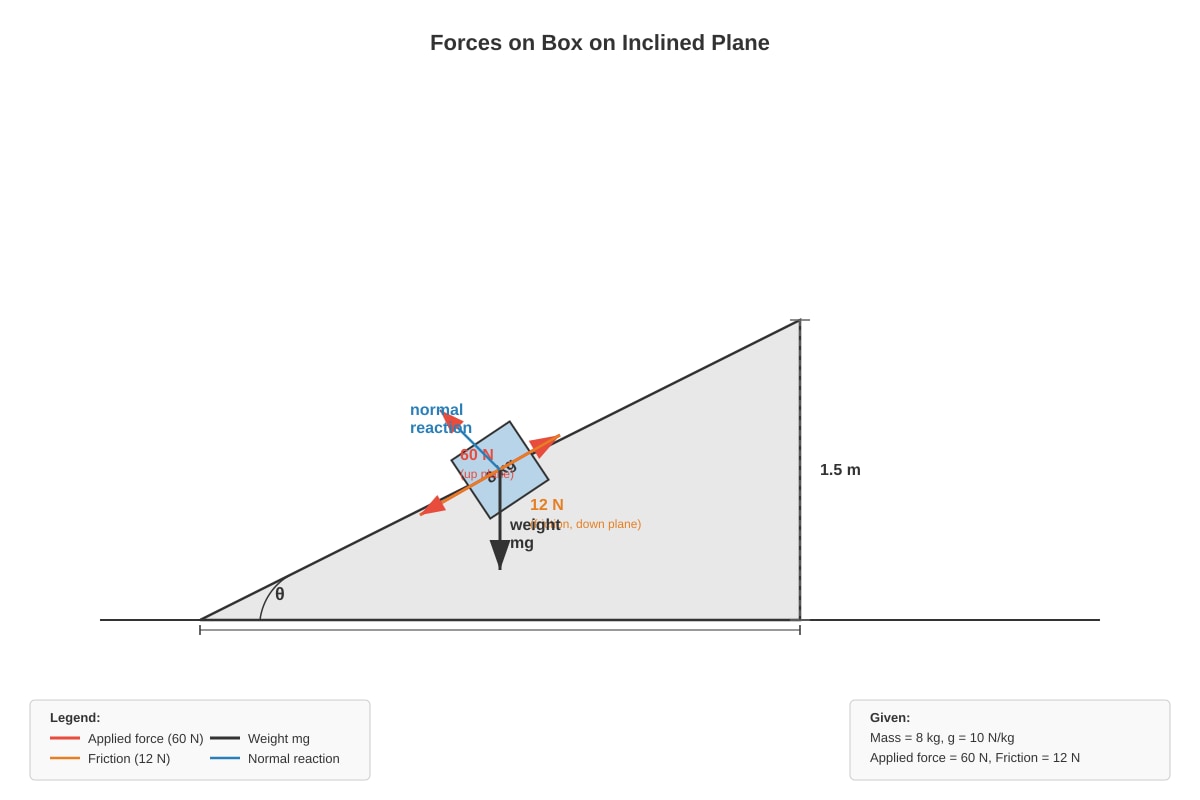
(a) [1 mark] Working: Work done by applied force = Force × Distance along plane = 60 N × 3 m = 180 J
(b) [1 mark] Working: Work done against friction = Frictional force × Distance = 12 N × 3 m = 36 J
(c) [1 mark] Working: Gain in GPE = mgh = 8 kg × 10 N/kg × 1.5 m = 120 J
(d) [2 marks] Working: By conservation of energy: Work input = Gain in GPE + Work against friction + Gain in KE 180 J = 120 J + 36 J + Gain in KE Gain in KE = 180 - 120 - 36 = 24 J
Mark breakdown: 1 mark for correct energy equation/concept, 1 mark for correct calculation.
Alternative method: Net force = 60 - 12 - (component of weight parallel to plane). But component of weight parallel = mg sin θ = 80 × (1.5/3) = 40 N. Net force = 60 - 12 - 40 = 8 N. Work by net force = 8 × 3 = 24 J = Gain in KE. (This also yields 24 J.)
Question 13 [4 marks]
(a) [2 marks] Working: At top: GPE = mgh = 0.2 kg × 10 N/kg × 0.8 m = 1.6 J At bottom (frictionless): All GPE → KE KE = ½mv² = 1.6 J v² = 2 × 1.6 / 0.2 = 16 v = 4 m/s
Mark breakdown: 1 mark for correct energy conservation equation, 1 mark for correct answer with unit.
(b) [2 marks] Working: On horizontal rough surface: Initial KE = Work done against friction 1.6 J = Friction × Distance Friction = 1.6 J / 2.5 m = 0.64 N
Mark breakdown: 1 mark for correct concept (KE lost = work against friction), 1 mark for correct calculation with unit.
Question 14 [6 marks]
(a) [1 mark] Working: Weight = mg = 500 kg × 10 N/kg = 5000 N
(b) [2 marks] Working: Work done = Force × Distance = Weight × Height (since constant speed, force = weight) = 5000 N × 12 m = 60,000 J (or 60 kJ)
Mark breakdown: 1 mark for recognising force = weight at constant speed, 1 mark for correct calculation.
(c) [1 mark] Working: Time = Distance / Speed = 12 m / 0.4 m/s = 30 s
(d) [1 mark] Working: Power output = Work done / Time = 60,000 J / 30 s = 2000 W (or 2 kW)
(e) [1 mark] Working: Efficiency = Power output / Power input × 100% = 2000 W / 15,000 W × 100% = 13.3%
Note: Low efficiency is realistic for a crane motor lifting at constant speed - much energy goes to overcoming internal friction, heat, etc.
Question 15 [6 marks]
(a) [2 marks] Working: Vertical height difference h = L - L cos θ = 1.2 - 1.2 cos 30° = 1.2 - 1.2 × 0.866 = 1.2 - 1.0392 = 0.1608 m ≈ 0.161 m
Mark breakdown: 1 mark for correct geometry/trigonometry (h = L(1 - cos θ)), 1 mark for correct calculation.
(b) [2 marks] Working: Loss in GPE = Gain in KE (no energy losses) mgh = ½mv² v² = 2gh = 2 × 10 × 0.1608 = 3.216 v = √3.216 ≈ 1.79 m/s
Mark breakdown: 1 mark for correct energy conservation equation, 1 mark for correct calculation with unit.
(c) [1 mark] Answer: Air resistance acts on the bob / Friction at the pivot / The string has mass and stretches.
Any one valid reason for energy loss during swing.
(d) [1 mark] Answer: Thermal energy (heat) and sound energy.
Explanation: The initial GPE is eventually dissipated as thermal energy due to air resistance and friction at the pivot, and some sound energy from the swinging motion.
Section C: Free Response / Data-Based Questions [15 marks]
Question 16 [5 marks]
(a) [2 marks] Working: Electrical energy = Power × Time = VI × t = 6.0 V × 0.8 A × 4.0 s = 19.2 J
Mark breakdown: 1 mark for correct formula (E = VIt), 1 mark for correct calculation with unit.
(b) [1 mark] Working: Gain in GPE = mgh = 0.2 kg × 10 N/kg × 1.5 m = 3.0 J
(c) [1 mark] Working: Efficiency = Useful output / Input × 100% = 3.0 J / 19.2 J × 100% = 15.6%
(d) [1 mark] Answer: Energy is lost as thermal energy (heat) in the motor coils due to electrical resistance / Friction in moving parts of the motor / Sound energy from motor vibration.
Any one valid reason for energy loss in an electric motor.
Question 17 [5 marks]
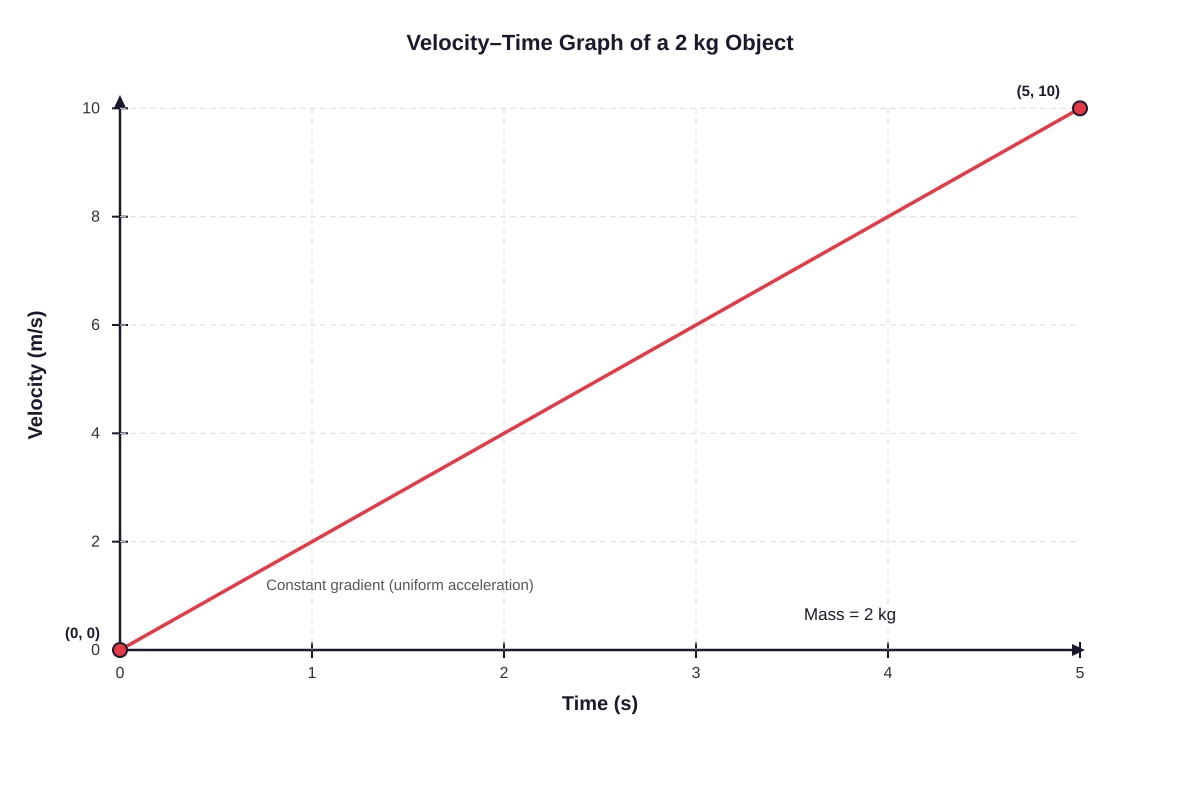
(a) [1 mark] Working: Acceleration = Gradient of v-t graph = (10 - 0) / (5 - 0) = 2 m/s²
(b) [1 mark] Working: Net force = ma = 2 kg × 2 m/s² = 4 N
(c) [2 marks] Working: Method 1: Work done by net force = Net force × Displacement Displacement = Area under v-t graph = ½ × 5 s × 10 m/s = 25 m Work = 4 N × 25 m = 100 J
Method 2: Work done = Gain in KE = ½mv² - ½mu² = ½ × 2 × 10² - 0 = 100 J
Mark breakdown: 1 mark for correct method (either displacement or KE change), 1 mark for correct answer with unit.
(d) [1 mark] Working: Net force = Applied force - Friction 4 N = Applied force - 4 N Applied force = 8 N
Question 18 [5 marks]
(a) [1 mark] Working: Total mechanical energy at A = GPE at A (since starts from rest, KE = 0) = mgh = 500 kg × 10 N/kg × 40 m = 200,000 J (or 200 kJ)
(b) [2 marks] Working: At B: Total energy = GPE + KE (frictionless track) 200,000 = (500 × 10 × 15) + KE 200,000 = 75,000 + KE KE = 125,000 J ½mv² = 125,000 v² = 250,000 / 500 = 500 v = √500 ≈ 22.4 m/s
Mark breakdown: 1 mark for correct energy conservation equation, 1 mark for correct calculation with unit.
(c) [1 mark] Working: At C: GPE = 500 × 10 × 25 = 125,000 J Total energy = 200,000 J (conserved on frictionless track) KE at C = 200,000 - 125,000 = 75,000 J
(d) [1 mark] Working: At D: GPE = 0, KE = ½ × 500 × 20² = 100,000 J Total energy at D = 100,000 J Work done against friction (C to D) = Energy at C - Energy at D = 200,000 - 100,000 = 100,000 J
Alternative: Work against friction = Loss in mechanical energy = 200,000 - 100,000 = 100,000 J
End of Answer Key
Total Marks: 50