AI Generated Exam Paper
Secondary 1 Science Practice Paper 4
Free Sec 1 Science Practice Paper 4, Kimi2.6 AI version, with questions, answers, and syllabus-aligned practice for Singapore students.
These static practice materials are generated from the site's syllabus and paper-generation workflow, with source and model context shown so students and parents can evaluate the material before use.
Questions
Free quiz and exam paper access
Enter your details to view this paper
Your access is remembered on this device.
Answers
TuitionGoWhere Practice Paper - Science Secondary 1
Answer Key and Marking Scheme
Version 4 of 5
Section A: Multiple Choice and Short Answer
Total: 20 marks
1. C — Speed
Explanation: Speed is a scalar quantity because it has magnitude only, with no direction. Force, velocity, and acceleration are all vector quantities because they have both magnitude and direction. A scalar is completely described by a number and unit, while vectors require direction to be specified.
(1 mark)
2. C — Exactly 5 N
Explanation: When an object moves at constant velocity, the resultant force on it is zero (Newton's First Law). This means the applied forward force must be exactly balanced by the backward frictional force. Since the applied force is 5 N, friction must also be 5 N. Common error: Students sometimes think that because the book is moving, friction must be less than the applied force. This confuses static friction with kinetic (sliding) friction — at constant velocity, forces are balanced.
(1 mark)
3. Chemical energy → Electrical energy → Light energy (+ thermal energy)
Acceptable answers: Chemical → Electrical → Light; or Chemical → Light (with mention of intermediate electrical)
Explanation: In a battery-powered torch, chemical energy stored in the battery is converted to electrical energy. This electrical energy flows through the circuit and is converted to light energy (and some thermal energy as waste) in the bulb. The key insight is that energy conversions often involve intermediate steps, and some energy is always "lost" as heat due to resistance in the circuit and the bulb.
(1 mark)
4. Gravitational potential energy =
J
Marking breakdown: [1] Correct formula stated or implied; [1] Correct substitution and calculation; [1] Unit (J/Joules). Note: If g = 9.8 N/kg is used, answer = 58.8 J — accept if clearly stated.
Explanation: Gravitational potential energy () depends on three factors: mass (), gravitational field strength (), and vertical height (). When lifting an object, work done against gravity becomes stored as GPE. The unit is joules (J), which equals newton-metres (N·m).
(2 marks)
5. No work is done because there is no displacement in the direction of the force.
Explanation: Work is defined as , where is displacement in the direction of force . When holding a box stationary, the distance moved , so mathematically regardless of how large the force is or how tired the person feels. The person does expend chemical energy (muscles are contracting), but this is internal biological work, not mechanical work on the box. In physics, "work done on an object" requires the object's position to change.
Marking points: [1] Mention of zero displacement/no movement; [1] Link to work formula or definition of work involving distance moved.
(2 marks)
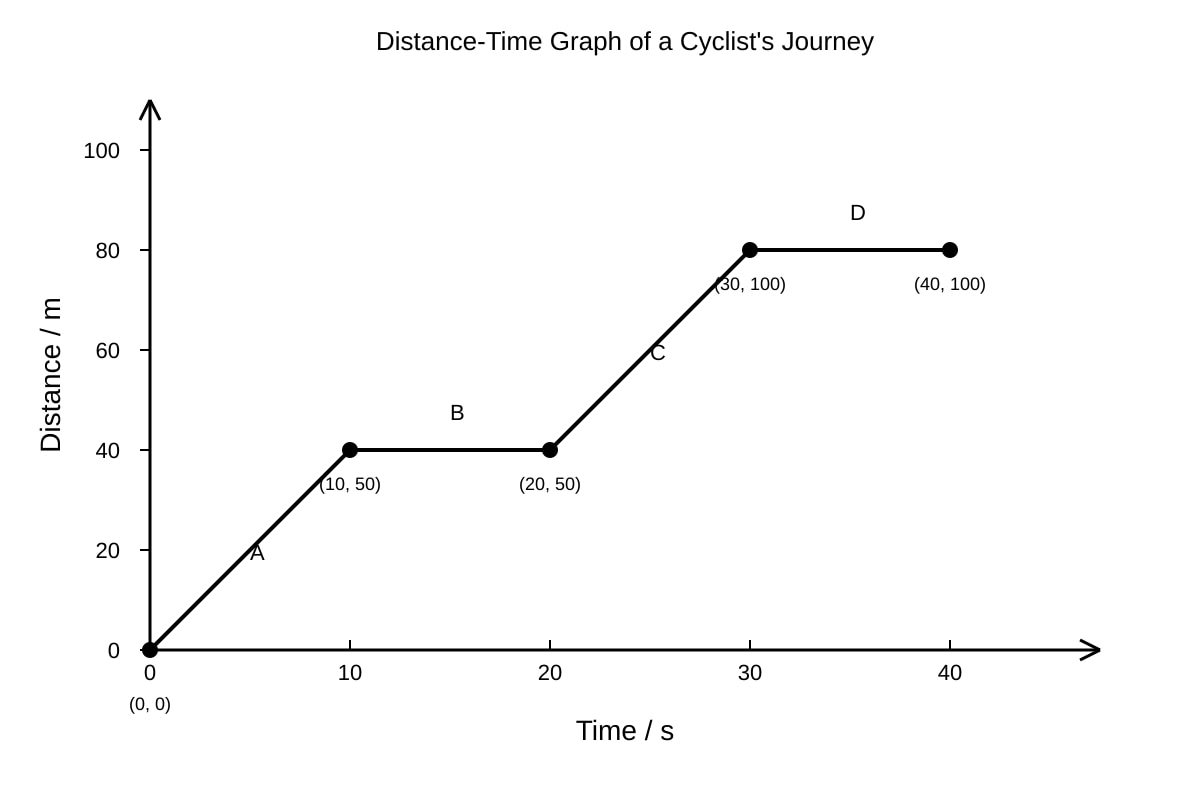
6. During segment B, the cyclist is stationary (at rest).
Reason: The distance does not change (remains at 50 m) while time increases, meaning the cyclist stopped for 10 seconds.
Marking points: [1] State "stationary" or "at rest" or "stopped"; [1] Reference to constant distance/horizontal line on graph/zero gradient.
Explanation: On a distance-time graph, the gradient (slope) represents speed. A horizontal line (zero gradient) means speed = 0. The cyclist may have stopped to rest, wait for traffic, or make a delivery. Segment A has positive slope → moving away; Segment C has positive slope → moving again; Segment D has zero slope → stopped again.
(2 marks)
7. Energy cannot be created or destroyed, but can only be converted from one form to another, with the total energy remaining constant.
Alternative acceptable wording: The total energy in a closed/system isolated from external influences remains constant.
Explanation: This fundamental principle means that whenever energy appears to "disappear," it has actually changed to another form — often heat/sound that dissipates into the surroundings. In practice, we distinguish between "useful" energy and "wasted" energy, but the total is always conserved. This principle underlies all energy calculations and explains why perpetual motion machines are impossible.
(1 mark)
8. Kinetic energy =
J (or J)
Marking breakdown: [1] Correct formula; [1] Correct substitution; [1] Final answer with unit.
Explanation: Kinetic energy depends on mass and the square of velocity. This means doubling speed quadruples kinetic energy — an important safety consideration for vehicles. The unit is joules (J). Note: , not . Common error: Forgetting to square the velocity or using instead of .
(2 marks)
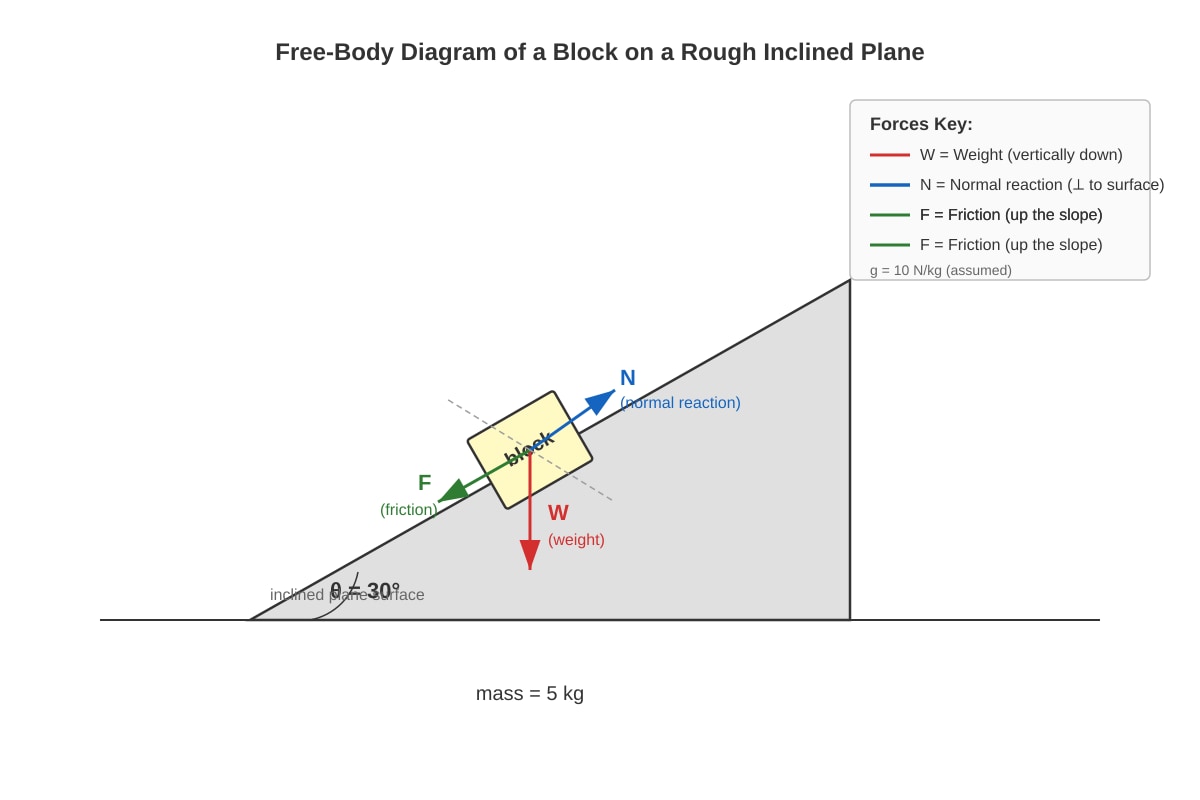
9. Normal reaction (force) or Normal contact force
Alternative: Reaction force
Not acceptable: "Reaction" alone (ambiguous), "Air resistance," "Gravity"
Explanation: When two surfaces are in contact, they exert equal and opposite forces perpendicular to the contact surface. This is Newton's Third Law pair with the component of weight pressing the block into the plane. The "normal" means perpendicular — not "ordinary." The normal force prevents the block from sinking into the surface.
(1 mark)
10. The block remains stationary because the forces are balanced (resultant force = 0).
Explanation: For an object to remain at rest, the resultant force must be zero (Newton's First Law). The component of weight acting down the slope is opposed by static friction acting up the slope. If weight component < maximum static friction, the actual static friction adjusts to exactly equal the weight component, maintaining equilibrium. Static friction is a self-adjusting force up to a maximum value.
Marking points: [1] State forces are balanced/resultant force is zero; [1] Identify that static friction equals/opposes weight component; [1] Explain that static friction adjusts to match applied force up to its maximum. Common error: Confusing static friction with kinetic friction — static friction is variable, not fixed.
(3 marks)
Section B: Structured Questions
Total: 24 marks
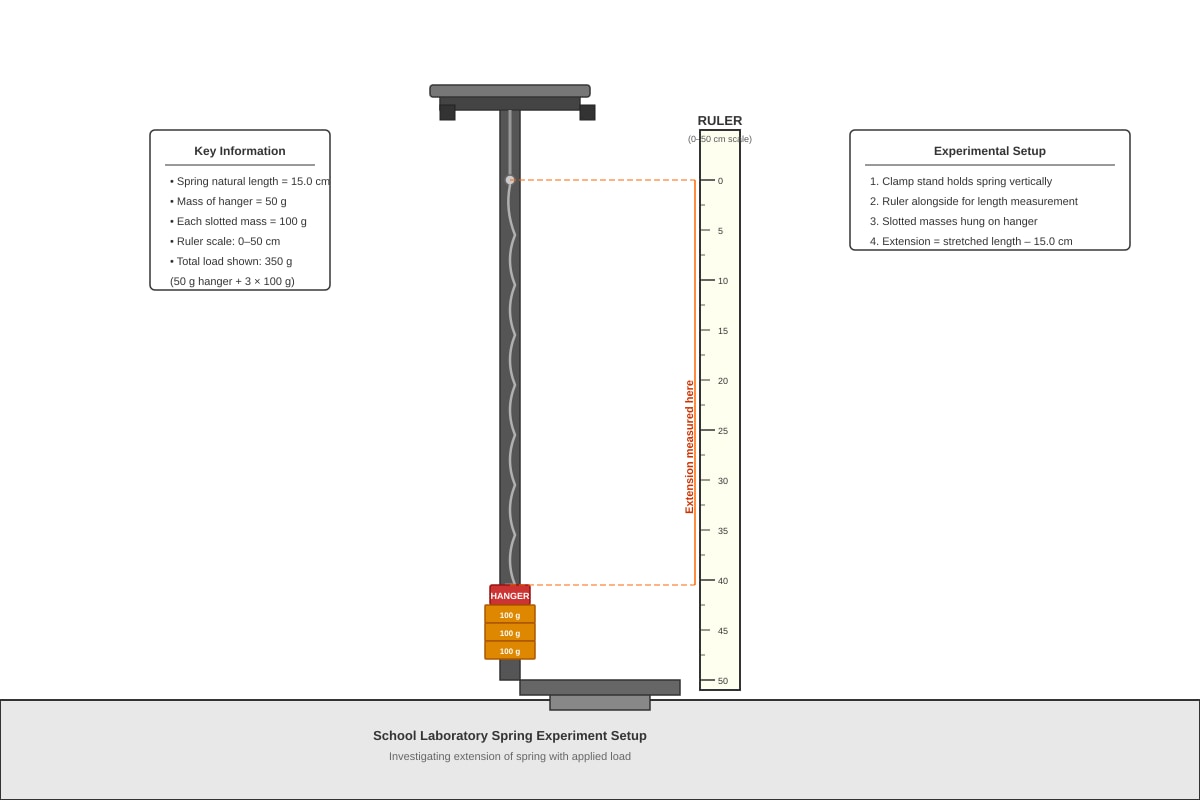
11(a) Independent variable: Load (or mass/weight added)
Explanation: The independent variable is the one deliberately changed by the experimenter. Here, the student decides how much mass to add, making load the independent variable. The dependent variable is the extension (what is measured). Control variables include the same spring, same temperature, same method of adding masses gradually, etc.
(1 mark)
11(b) Extension = Total length − Natural length
cm (or 0.040 m)
Marking: [1] Correct method (subtraction); [1] Correct answer with unit.
Explanation: Extension is the extra length caused by the load, not the total length. This is a common source of error — students sometimes give the total length as the answer. Standard practice: Always subtract the original/natural length from the loaded length to find extension.
(2 marks)
11(c) The graph of extension against load would show a straight line passing through the origin up to about 2.0 N, then the line curves/bends (non-linear) beyond that point.
Explanation: This tells us that the spring obeys Hooke's Law () in the linear region — the extension is directly proportional to the load. The constant of proportionality is the spring constant . Beyond the elastic limit (around 2.0 N here), the spring undergoes plastic deformation and does not return to its original length. The data shows non-linearity setting in between 2.0 N and 2.5 N.
Marking points: [1] Straight line/linear portion identified; [1] Passes through origin/direct proportionality mentioned; [1] Curves/non-linear at higher loads/elastic limit exceeded. Common error: Describing the graph as "proportional" without mentioning the straight line through origin requirement.
(3 marks)
12(a) GPE = J
Marking: [1] Formula and substitution; [1] Final answer with unit.
Explanation: The gravitational potential energy depends on the vertical height above the reference level (ground). At 5 m, all energy is GPE (assuming starting from rest, though not explicitly stated, the question says "dropped" implying initial velocity is zero). The mass must be in kg and height in m for the unit to come out as joules.
(2 marks)
12(b) By conservation of energy (no air resistance), all GPE converts to KE:
KE at ground = GPE at start = 20 J
Alternative calculation: , so m/s
KE = J
Marking: [1] Correct reasoning (conservation of energy or kinematic method); [1] Correct answer with unit.
Explanation: With no air resistance, mechanical energy is conserved. The gravitational potential energy at height becomes entirely kinetic energy at ground level. This is a powerful problem-solving approach — when friction/drag is negligible, total mechanical energy (GPE + KE) stays constant throughout the motion.
(2 marks)
12(c) Energy is "lost" (converted to other forms) during the bounce, mainly:
- Some kinetic energy → thermal energy in the ball and ground
- Some kinetic energy → sound energy on impact
- Some energy causes permanent deformation of the ball
Explanation: The ball does not return to 5 m because the total mechanical energy after the bounce is less than before. This "energy loss" is actually energy conversion to non-mechanical forms. The coefficient of restitution for real balls is less than 1, meaning the bounce is imperfect. The ball reaches 3 m, so it retains 60% of its original energy. The missing 8 J (20 J − 12 J = 8 J) went to heat and sound.
Marking points: [1] Energy converted to thermal/heat; [1] Energy converted to sound; [1] Mention of inelastic collision/permanent deformation OR overall energy is less after bounce. Any two detailed points for full marks.
(3 marks)
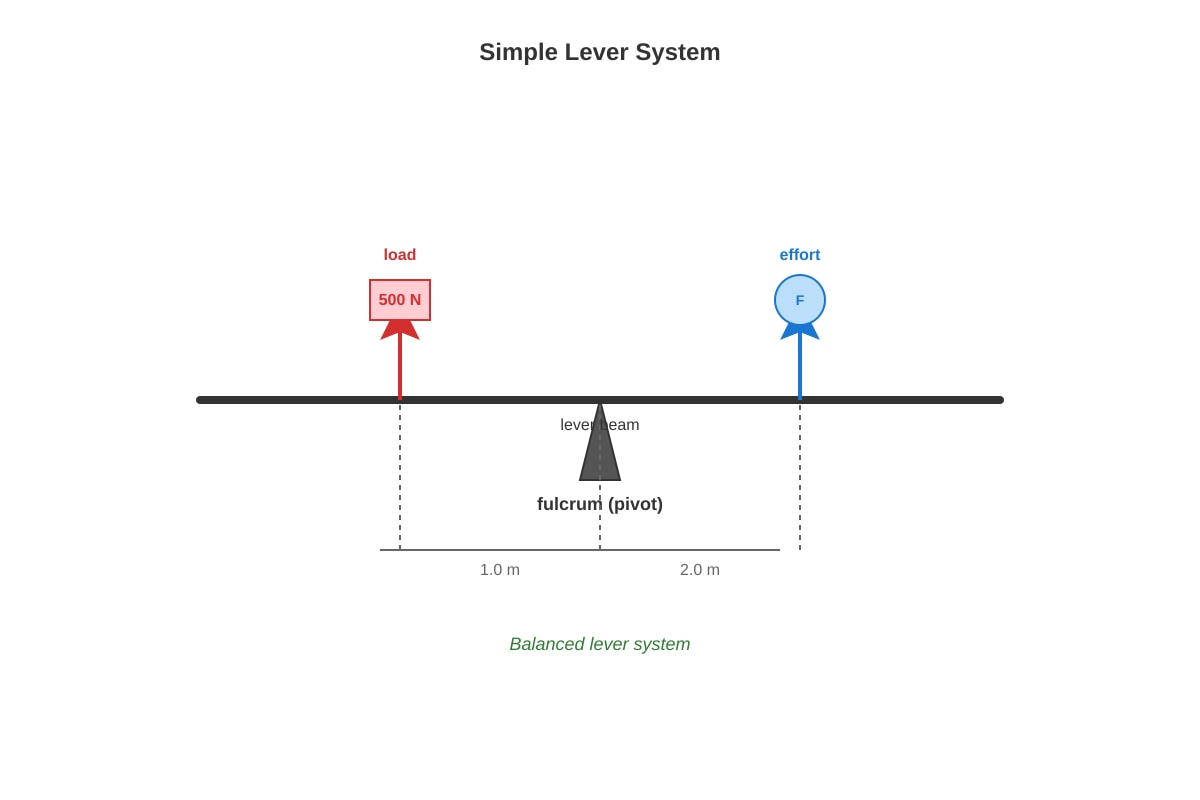
13(a) Moment = Force × perpendicular distance from pivot
Moment of load = Nm (or 500 N·m)
Marking: [1] Correct formula or substitution; [1] Correct answer with unit.
Explanation: The moment (or torque) measures the turning effect of a force. It depends on both the force magnitude and how far from the pivot it acts (perpendicular distance). A larger force or greater distance creates greater turning effect. The unit is newton-metre (Nm), which is not called "joule" even though N×m = J — moments and energy are different physical quantities and should not be confused.
(2 marks)
13(b) For equilibrium: clockwise moment = anticlockwise moment
N
Marking: [1] Principle of moments stated or applied; [1] Correct calculation with unit.
Explanation: The principle of moments states that for a balanced lever, total clockwise moment equals total anticlockwise moment. The effort force needed is half the load because the effort acts twice as far from the pivot. This is the mechanical advantage of levers — trading force for distance. The longer the effort arm relative to the load arm, the smaller the effort needed.
(2 marks)
13(c) Move the fulcrum closer to the load (increase effort arm, decrease load arm) OR use a longer lever arm on the effort side.
Explanation: From the principle of moments (), reducing the load distance or increasing the effort distance reduces the required effort force. Practical examples: wheelbarrow (load near wheel, effort at handles), crowbar (pivot near load).
(1 mark)
14(a) Total height = cm cm = 3.0 m
Marking: [1] Correct multiplication; [1] Correct conversion to metres (or answer in cm with clear unit).
Explanation: Each step contributes 15 cm vertically. Even though the student travels diagonally along the stairs, the work against gravity depends only on vertical displacement, not path taken. This is a key feature of gravitational potential energy. 300 cm = 3.0 m (always convert to consistent units for energy calculations).
(2 marks)
14(b) Work done = Force × distance = Weight × vertical height
J (or 1.5 kJ)
Marking: [1] Correct weight calculation; [1] Correct final answer with unit.
Explanation: The force needed to climb at constant speed equals the student's weight (). Work is done against gravity, stored as increased GPE. The calculation J gives the same result, confirming consistency between approaches.
(2 marks)
14(c) Power = Work done / Time taken
W (watts)
Marking: [1] Correct formula and substitution; [1] Correct answer with unit.
Explanation: Power measures the rate of doing work. A more powerful student could climb faster (less time) or climb with more mass. 150 W is a reasonable human power output for climbing stairs — comparable to the power of a bright incandescent bulb. Elite cyclists can sustain 400-500 W; resting human metabolism is about 100 W.
(2 marks)
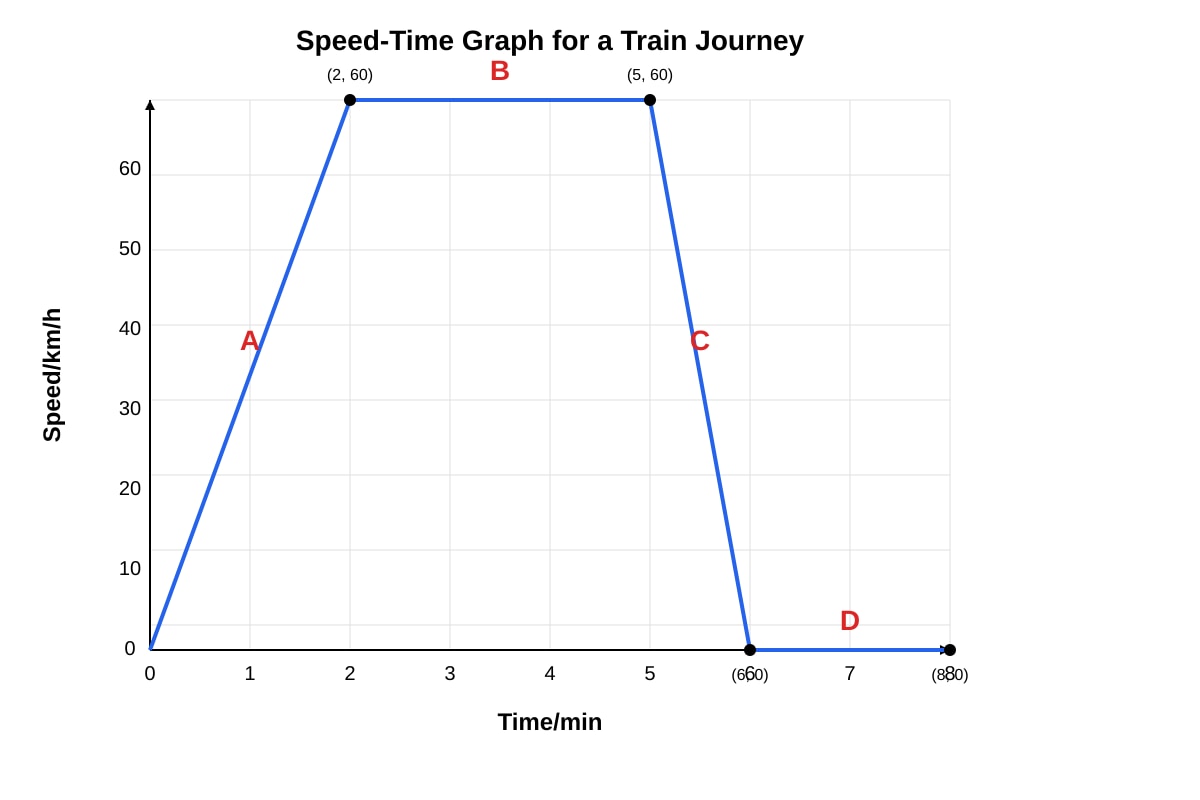
15(a) The train is moving at constant speed / uniform speed (cruising at steady 60 km/h).
Explanation: On a speed-time graph, a horizontal line indicates constant (unchanging) speed. The gradient of a speed-time graph represents acceleration, so zero gradient means zero acceleration — no speeding up or slowing down.
(1 mark)
15(b) During segment C, the train is decelerating / slowing down at a constant rate (uniform deceleration).
Explanation: The speed decreases uniformly from 60 km/h to 0 km/h in 1 minute. The negative gradient (downward slope) of the speed-time graph represents constant negative acceleration (deceleration). The train is braking to stop at the station. Note: "Deceleration" is preferred over "negative acceleration" at this level; either is acceptable if clearly used.
Marking: [1] Decelerating/slowing down; [1] Constant rate/uniform deceleration.
(2 marks)
15(c) The area under the graph gives the distance travelled.
Explanation: For a speed-time graph, distance = speed × time, which geometrically corresponds to the area between the graph line and the time axis. This area can be calculated using geometry (rectangle + triangles for simple shapes) or approximate methods for curved graphs. For this trapezium-shaped graph, the area equals: rectangle (segment B) + two triangles (segments A and C). Note: The horizontal segment D contributes zero area because speed = 0.
Marking points: [1] Mention of "area under graph"; [1] Link to "distance travelled" or "area = speed × time"; [1] Clear explanation of how to apply this (counting squares, using geometry, etc.).
(2 marks)
16(a) Efficiency of 25% means that 25% of the total input energy is converted to useful output energy (mechanical work/kinetic energy of car), while 75% is wasted (mainly as thermal energy in the engine and surroundings).
Explanation: No real engine is 100% efficient due to: friction between moving parts, heat loss to coolant and exhaust gases, incomplete combustion of fuel, and air resistance. The 25% figure represents the fraction of chemical energy in petrol that actually moves the car; the rest heats the environment.
Marking points: [1] 25% useful / 75% wasted; [1] Examples of where energy is wasted (heat, friction, sound, exhaust).
(2 marks)
16(b) Input power = 40 000 J/s = 40 000 W = 40 kW
Useful power output = Efficiency × Input power
W
kW
Marking: [1] Correct identification of input power; [1] Correct formula application; [1] Correct answer with unit.
Alternative check: 25% = 1/4, so useful power = 40 000 ÷ 4 = 10 000 W.
Explanation: Efficiency is always output/input as a fraction or percentage. Here 25% = 0.25 = 1/4. The useful power is what actually propels the car — overcoming air resistance, rolling resistance, and enabling acceleration. A typical car needs about 10-20 kW to maintain highway speeds.
(3 marks)
Section C: Data Analysis and Extended Response
Total: 16 marks
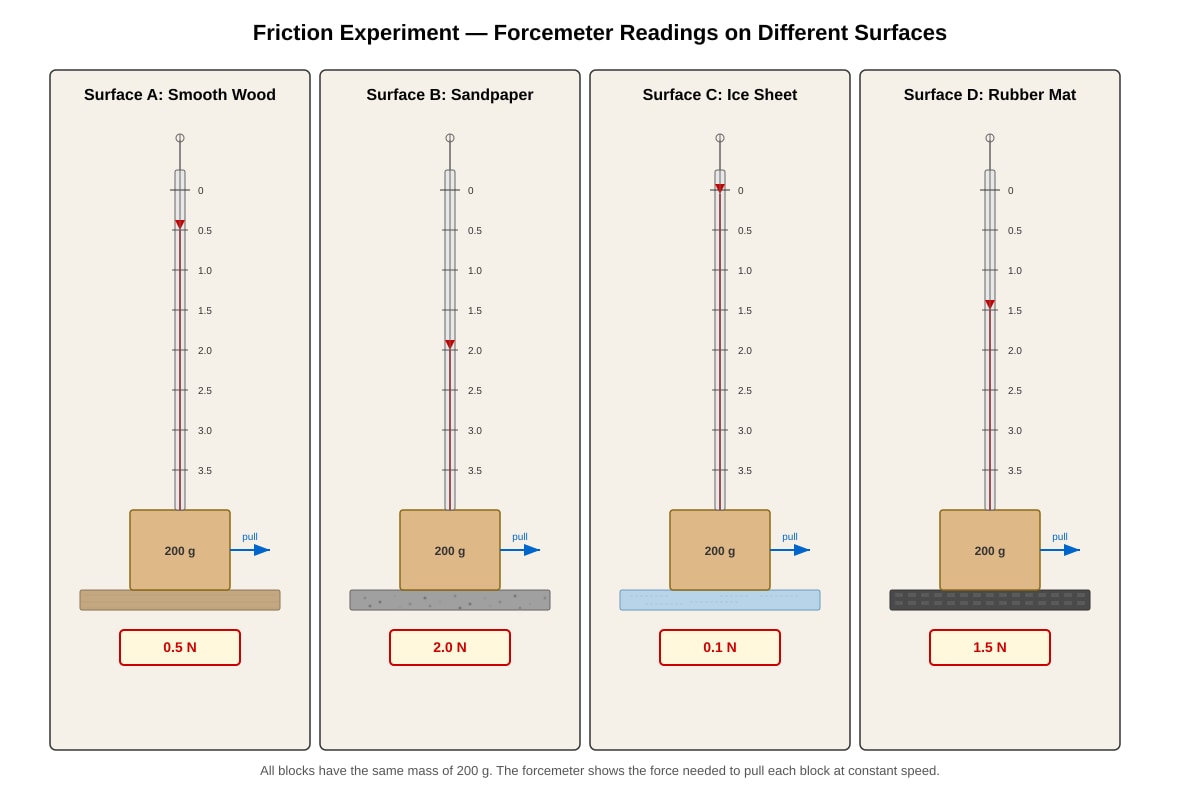
17(a) C, A, D, B (increasing friction)
Explanation: The forcemeter reading equals the kinetic friction when pulled at constant velocity. Lower force = lower friction. Surface C (ice, 0.1 N) has least friction; B (sandpaper, 2.0 N) has most.
(1 mark)
17(b) At constant speed, the resultant force is zero, so the pulling force equals the frictional force.
Explanation: If the block accelerates, the forcemeter shows more than friction (need extra force to accelerate). If it decelerates, the reading is less. Only at constant velocity does the spring scale reading exactly equal the kinetic friction. This is applying Newton's First Law: balanced forces mean constant velocity (including zero velocity).
Marking points: [1] Constant velocity means resultant force = 0/balanced forces; [1] Therefore pulling force = friction; [1] If speeding up or slowing down, reading would not equal friction. Common error: Thinking that moving at all means friction is overcome — the key is the constancy of velocity, not its non-zero value.
(3 marks)
17(c) Two ways to reduce friction:
- Use lubrication (oil, grease, graphite) between surfaces — reduces contact between surface irregularities
- Use rollers/wheels/ball bearings — converts sliding friction to rolling friction, which is smaller
Alternative valid answers: Make surfaces smoother; use air cushions (hovercraft principle); reduce normal force (less weight pressing surfaces together)
Marking: [1] Each valid method with brief explanation (2 × 2 marks). No explanation = half mark per point.
(2 marks)
18(a) Energy conversions in hydroelectric power:
| Step | Energy Form | Conversion |
|---|---|---|
| Water in reservoir (high up) | Gravitational potential energy | — |
| Water flows down | GPE → KE | As height decreases, speed increases |
| Water hits turbines | KE of water → KE of turbine blades | Turbines rotate |
| Turbine spins generator | KE of turbine → Electrical energy | Electromagnetic induction in generator |
| Electricity transmission | Electrical energy → Electrical energy (with some losses) | Sent to homes/industry |
Explanation: The overall chain is: GPE → KE → Electrical energy
The water's elevated position gives it stored GPE. As it descends through pipes, this converts to kinetic energy. Fast-moving water strikes turbine blades, transferring kinetic energy to rotational motion. The spinning turbine drives a generator, where electromagnetic induction converts mechanical energy to electrical energy. Some energy is lost to heat due to: turbulence in water flow, friction in turbine bearings, electrical resistance in generator coils, and transformer losses in transmission.
Marking points (up to 4): [1] GPE of water identified; [1] Conversion to KE as water falls; [1] Turbine converts KE to rotational mechanical energy; [1] Generator converts to electrical energy via electromagnetic induction; [1] Mention of transmission/heat losses. Award best 4 points.
(4 marks)
18(b) Not all GPE converts to electrical energy because of energy losses:
- Friction in pipes and turbine bearings → thermal energy
- Turbulence and sound in flowing water → thermal and sound energy
- Electrical resistance in wires → thermal energy
- The generator is not 100% efficient
Explanation: The Second Law of Thermodynamics implies that no energy conversion is 100% efficient — some useful energy always becomes dissipated as heat. Modern hydroelectric plants achieve 80-90% efficiency, which is excellent compared to coal plants (~35%) or car engines (~25%). The "lost" energy warms the water slightly and heats the machinery.
Marking: [1] Friction/resistance losses mentioned; [1] Energy becomes heat/thermal energy (not "lost" — converted).
(2 marks)
19(a) At point A:
GPE = J
KE = J
Total energy = J = 101 kJ
Assumption: Negligible friction/air resistance; total mechanical energy is conserved throughout.
Marking: [1] Correct GPE calculation; [1] Correct KE calculation; [1] Correct total with unit; [1] Valid assumption stated.
Explanation: The initial speed of 2 m/s is small but not negligible — it contributes 1 kJ. The total mechanical energy (assuming conservation) stays at 101 kJ throughout the ride. At point D (lowest point), all this is kinetic energy. At each height, GPE + KE = 101 kJ, allowing speed calculations at any point. This is a powerful verification tool for roller coaster physics.
(3 marks)
19(b) Maximum possible energy at point D = 101 kJ (from part a)
To reach 25 m height, needed GPE = J = 125 kJ
But the car only has 101 kJ maximum total energy.
Since J, insufficient energy to reach 25 m.
Even with maximum speed at D (all energy as KE), the total is only 101 kJ, which could raise the car to maximum height m.
Explanation: This demonstrates the limiting nature of energy conservation. The roller coaster cannot exceed its initial total energy without an external energy input. Real roller coasters use a motor-driven chain lift for the first hill to "charge" the system with energy. Subsequent hills must be lower (or same height with speed) for the ride to complete without external power.
Marking points: [1] Calculate required energy for 25 m OR state needed GPE; [1] Compare with available total energy; [1] Conclude insufficient energy / maximum possible height is less than 25 m.
(3 marks)
20. Experimental design for investigating ramp angle and toy car speed:
Equipment needed: Toy car, ramp (adjustable or set of different ramps), protractor or ruler for angle measurement, stopwatch or light gates/ticker tape timer, metre rule, flat smooth surface at bottom
Variables:
- Independent: Angle of ramp (measured with protractor)
- Dependent: Speed of car at bottom (or time to travel down, or distance travelled on flat surface)
- Controlled: Same car (same mass/wheels), same starting point (measured from top), same ramp surface material, same conditions (no wind, same temperature — affects bearing friction)
Measurements:
- Measure angle with protractor for each trial
- Time the car from release to bottom using stopwatch (repeat 3 times for reliability, take average to reduce random error)
- OR measure distance travelled on flat surface after ramp (mark stopping point, measure with metre rule)
- OR use light gates at bottom to measure speed directly
Processing results:
- Calculate speed = distance of ramp / time (if using timing method), or use light gate direct reading
- Plot graph of speed (y-axis) against angle (x-axis)
- Describe expected trend: speed increases with angle initially, may plateau at very steep angles if air resistance becomes significant or if car jumps/rattles
Or for distance on flat surface: Plot stopping distance against angle — greater initial speed means greater stopping distance (work against friction over longer distance)
Safety: Keep feet and hands clear of car path; ensure ramp does not slip.
Marking descriptors (up to 6):
- [1-2] Basic list with some equipment, one variable identified
- [3-4] Most equipment, variables identified, basic measurement method
- [5-6] Complete design with correct variables, detailed measurement with repeats/reliability, clear processing including graph type and prediction, awareness of control variables and safety
(6 marks)
Total marks verification:
- Section A: 20 marks ✓
- Section B: 24 marks ✓
- Section C: 16 marks ✓
- Total: 60 marks ✓