AI Generated Exam Paper
Secondary 1 Science Practice Paper 4
Free Sec 1 Science Practice Paper 4, HY3 AI version, with questions, answers, and syllabus-aligned practice for Singapore students.
These static practice materials are generated from the site's syllabus and paper-generation workflow, with source and model context shown so students and parents can evaluate the material before use.
Questions
Free quiz and exam paper access
Enter your details to view this paper
Your access is remembered on this device.
Answers
TuitionGoWhere Practice Paper - Science Secondary 1 (Version 4) — Answer Key
Subject: Science
Level: Secondary 1
Topic: Physical Sciences
Total Marks: 40
Section A: Forces and Energy (16 marks)
Q1. [1 mark]
Answer: Chemical energy → Gravitational potential energy.
Teaching note: The boy uses muscles (chemical energy) to raise the car, increasing its height, so energy is stored as gravitational potential energy. Common mistake: stating only "potential energy" without naming the source.
Q2. [1 mark]
Answer: Work is done against gravity to lift the car, so chemical energy in muscles is converted to gravitational potential energy.
Teaching note: Link cause (lifting against gravity) to effect (energy stored). Mark for mentioning "work done against gravity".
Q3. [2 marks]
Working:
Work done = Force × Distance
= 5 N × 1.2 m
= 6 J
Marking: 1 mark for correct formula and substitution, 1 mark for correct answer with unit.
Teaching note: Force is weight (5 N) because lifted at steady speed; distance is vertical height (1.2 m).
Q4. [2 marks]
Answer: 0 J. Explanation: Work = Force × Displacement; displacement = 0 because book is stationary, so work done = 0.
Marking: 1 mark for 0 J, 1 mark for correct reason (no displacement).
Teaching note: Common trap: multiplying 10 N × 1.0 m = 10 J wrongly. Holding stationary means no movement.
Q5. [2 marks]
Answer: Pressure increases when on smallest face. Reason: Pressure = Force ÷ Area; force (weight) constant at 20 N, area decreases, so pressure increases.
Marking: 1 mark for stating pressure increases, 1 mark for correct use of P = F/A with constant force.
Teaching note: Force does not change, only contact area changes.
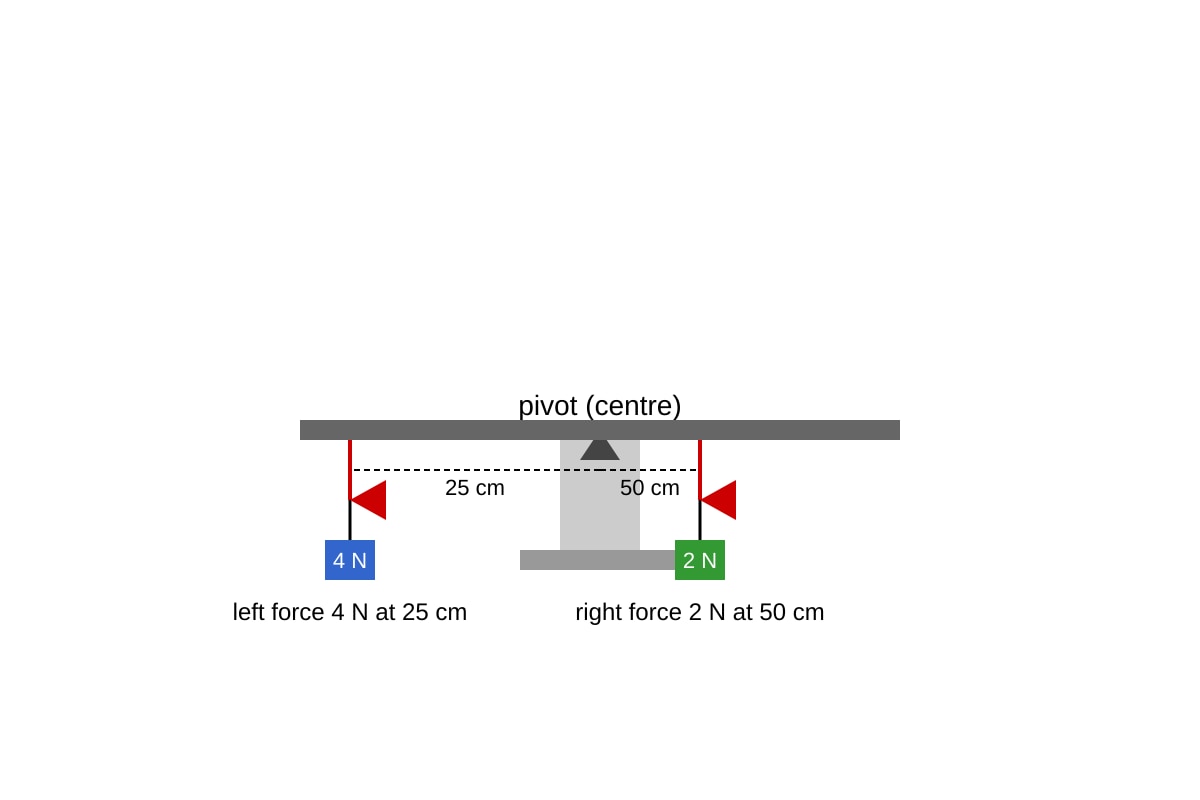
Q6. [2 marks]
Working:
Moment = Force × Perpendicular distance
= 4 N × 25 cm
= 100 N·cm
Marking: 1 mark formula/substitution, 1 mark answer with unit.
Teaching note: Use perpendicular distance from pivot (25 cm), not slant. From image: left side 4 N at 25 cm.
Q7. [2 marks]
Working:
Work done = Force × Distance
= 12 N × 4 m
= 48 J
Marking: 1 mark working, 1 mark answer.
Teaching note: Force and motion same direction, so direct multiply.
Q8. [2 marks]
Answer: Example: crowbar / seesaw. It makes work easier by increasing the distance from pivot for effort, reducing needed force (or by shifting load closer).
Marking: 1 mark example, 1 mark explanation.
Teaching note: Simple machine reduces effort via lever principle.
Section B: Heat and Light (12 marks)
Q9. [1 mark]
Answer: Temperature (degree of hotness).
Teaching note: Not "heat" — thermometer measures temperature.
Q10. [1 mark]
Answer: higher; lower.
Teaching note: Heat flows from hot to cold until equal.
Q11. [2 marks]
Answer: Different metals expand by different amounts when heated, so the strip bends.
Marking: 1 mark different expansion, 1 mark bending result.
Teaching note: Bimetallic = two metals; unequal expansion causes curvature.
Q12. [1 mark]
Answer: To maintain a set temperature.
Teaching note: Used in irons, ovens.
Q13. [1 mark]
Answer: Rays scatter in many directions (diffuse reflection).
Teaching note: From image, rough surface → diffuse. Draw reflected rays randomly.
Q14. [3 marks]
Answer: Specular reflection is on smooth surfaces, reflected rays parallel (angle in = angle out). Diffuse reflection is on rough surfaces, rays scatter.
Marking: 1 mark specular def, 1 mark diffuse def, 1 mark comparison.
Teaching note: Use law of reflection for specular; rough breaks parallel.
Section C: Electricity (12 marks)
Q15. [1 mark]
Answer: Ampere (A).
Teaching note: Symbol A.
Q16. [1 mark]
Answer: 230 V.
Teaching note: Singapore standard.
Q17. [2 marks]
Answer: Circuit with cell symbol (two lines, long/short), switch (open/closed), lamp (circle with X), all in one loop.
Marking: 1 mark correct symbols, 1 mark series connection.
Teaching note: Series = single path.
Q18. [2 marks]
Answer: Hazard: overloaded circuit / damp conditions. Safety: circuit breaker / fuse.
Marking: 1 mark hazard, 1 mark feature.
Teaching note: Match feature to hazard (e.g., fuse stops overload).
Q19. [2 marks]
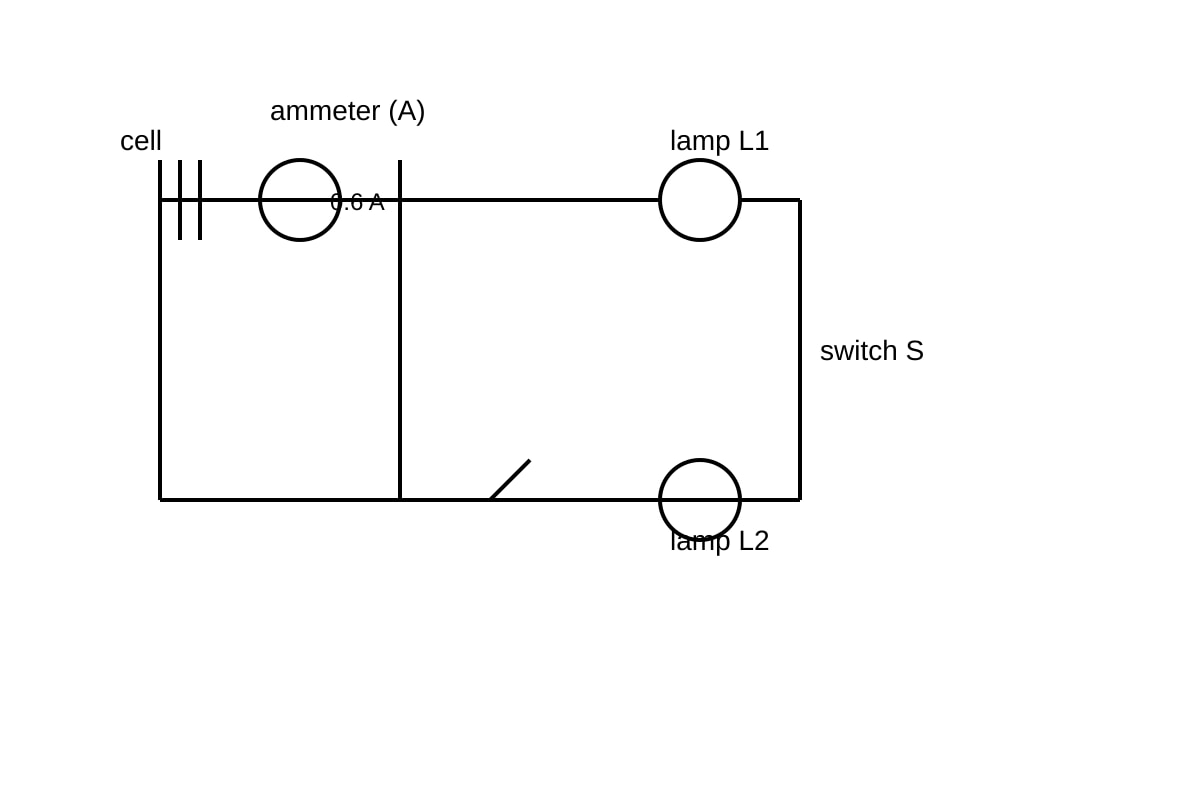
Answer: Parallel. Explanation: Lamps in separate branches, same voltage, independent.
Marking: 1 mark parallel, 1 mark reason.
Teaching note: From image, two branches from cell.
Q20. [3 marks]
Answer: Live (brown), Neutral (blue), Earth (green/yellow). Earth wire colour: green and yellow.
Marking: 1 mark three wires, 1 mark colours, 1 mark earth colour.
Teaching note: Earth protects from shock.
Total Marks: 40 — End of Answer Key