AI Generated Exam Paper

Secondary 1 Science Practice Paper 3

Free Kimi AI-generated Sec 1 Science Practice Paper 3 with questions, answers, and syllabus-aligned practice for Singapore students preparing for exams.

These static practice materials are generated from the site's syllabus and paper-generation workflow, with source and model context shown so students and parents can evaluate the material before use.

Secondary 1 Science AI Generated Generated by Kimi K2.6 Free Updated 2026-06-10

Questions

<!-- TuitionGoWhere generation metadata: stage=5-2; model=moonshotai/kimi-k2.6:free; model_label=Kimi K2.6 Free; generated=2026-06-09; Sources: Stage 4-0 LLM templates, syllabus context, and Stage 2 evidence where available. -->

TuitionGoWhere Practice Paper - Science Secondary 1

TuitionGoWhere Practice Paper (AI)
Subject: Science
Level: Secondary 1 (G3)
Paper: Practice Paper - Physical Sciences
Version: 3 of 5
Duration: 1 hour 15 minutes
Total Marks: 60 marks

Name: _________________________ Class: __________ Date: __________

Instructions to Candidates

  • Answer ALL questions.
  • Write your answers in the spaces provided.
  • Show all working clearly for calculation questions.
  • Marks are awarded for correct units and appropriate significant figures.
  • Use a pencil for diagrams and a pen for all other work.

Section A: Multiple Choice (Questions 1-10)

10 marks (1 mark each)

Choose the correct answer for each question. Write your answer (A, B, C, or D) in the box provided.


1. A student pushes a stationary book across a table. The book moves at constant velocity. Which statement about the forces is correct?

A. The push force is greater than friction.
B. The push force equals friction, and the resultant force is zero.
C. There is no friction acting on the book.
D. The book accelerates because of the push force.

Answer: _______


2. A ball is thrown vertically upward. At the highest point of its path, which energy conversion is occurring?

A. Kinetic energy → Gravitational potential energy
B. Gravitational potential energy → Kinetic energy
C. Kinetic energy → Thermal energy
D. No energy conversion is occurring at that instant

Answer: _______


3. The density of a substance is calculated using which formula?

A. Mass × Volume
B. Mass ÷ Volume
C. Volume ÷ Mass
D. Mass + Volume

Answer: _______


4. A 50 kg student climbs a staircase to a height of 4 m. What is the increase in gravitational potential energy? (Take g = 10 N/kg)

A. 20 J
B. 125 J
C. 200 J
D. 2000 J

Answer: _______


5. Which of the following is a vector quantity?

A. Mass
B. Speed
C. Distance
D. Velocity

Answer: _______


6. A car travels 120 km in 2 hours, then returns 80 km in 1.5 hours. What is the average speed for the whole journey?

A. 34.3 km/h
B. 57.1 km/h
C. 66.7 km/h
D. 100 km/h

Answer: _______


7. In an experiment to measure the volume of an irregular stone, which method is most appropriate?

A. Measure the length, width, and height with a ruler
B. Use a measuring cylinder and water displacement method
C. Weigh the stone on a balance
D. Use a string to measure around the stone

Answer: _______


8. A lever is in equilibrium when:

A. The effort force is always greater than the load
B. The moment of the effort equals the moment of the load
C. The effort distance is always less than the load distance
D. The lever is always straight and horizontal

Answer: _______


9. Which statement about pressure is correct?

A. Pressure = Force × Area
B. Pressure increases when the same force is applied over a smaller area
C. Pressure is measured in newtons
D. Liquids exert no pressure on the sides of their container

Answer: _______


10. A pulley system has a velocity ratio of 4. If the effort distance moved is 8 m, what distance does the load rise?

A. 0.5 m
B. 2 m
C. 4 m
D. 32 m

Answer: _______


Section B: Structured Response (Questions 11-16)

30 marks


Question 11 (5 marks)

A student measures the density of a metal cube. The measurements are recorded below:

MeasurementValue
Mass of cube216 g
Length of one side3.0 cm

(a) Calculate the volume of the cube. Show your working.

_________________________________________________________________ [1]

(b) Calculate the density of the metal in g/cm³. Show your working.

_________________________________________________________________ [2]

(c) The student is told the metal is likely to be aluminium (density = 2.7 g/cm³) or iron (density = 7.9 g/cm³). Use your answer to (b) to identify the metal, explaining your reasoning.

_________________________________________________________________ [2]


Question 12 (5 marks)

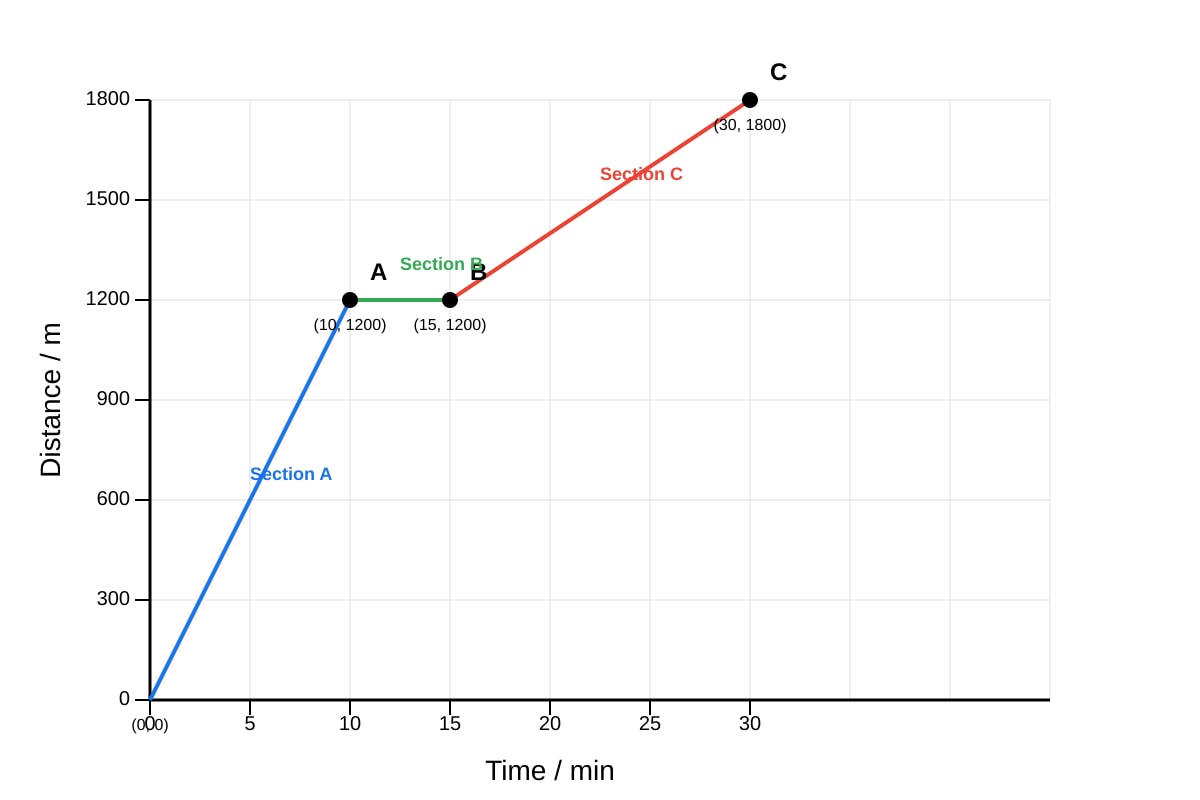
<image_placeholder> id: Q12-fig1 type: diagram linked_question: Q12 description: A distance-time graph showing a cyclist's journey in three stages labels: A (0-10 min, straight line rising), B (10-15 min, horizontal line), C (15-30 min, straight line rising less steeply than A); axes labelled "Distance / m" (vertical) and "Time / min" (horizontal) values: Point A starts at origin, ends at (10, 1200); Point B at (15, 1200); Point C ends at (30, 1800) must_show: Three distinct sections with different gradients; labels for points A, B, and C; clear axis labels with units; numerical values at key points; steeper gradient in A than in C </image_placeholder>

The diagram above shows a distance-time graph for a cyclist's journey.

(a) Determine the speed of the cyclist during section A of the journey. Show your working and give the correct unit.

_________________________________________________________________ [2]

(b) Describe the motion of the cyclist during section B. Explain what this means in terms of distance travelled.

_________________________________________________________________ [1]

(c) Compare the speed of the cyclist in section A with the speed in section C. Explain your answer with reference to the graph.

_________________________________________________________________ [2]


Question 13 (5 marks)

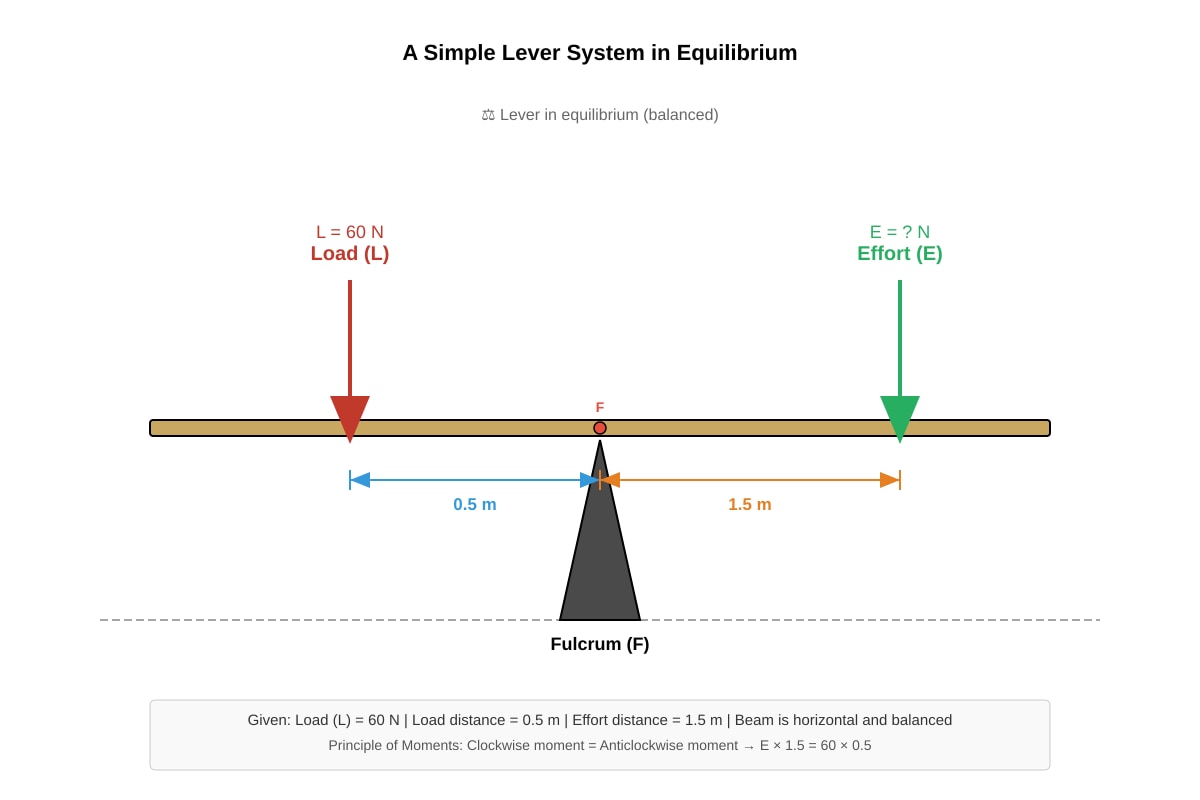
<image_placeholder> id: Q13-fig1 type: diagram linked_question: Q13 description: A simple lever system with a fulcrum, load, and effort clearly marked labels: Fulcrum (F), Load (L = 60 N) at 0.5 m from fulcrum, Effort (E) at 1.5 m from fulcrum on opposite side; lever shown as balanced horizontal beam values: Load = 60 N, load distance = 0.5 m, effort distance = 1.5 m must_show: Fulcrum position, load and effort arrows pointing downward, distances clearly marked, beam balanced horizontally, all numerical values labelled </image_placeholder>

The diagram shows a simple lever in equilibrium.

(a) Calculate the moment of the load about the fulcrum. Show your working and state the unit.

_________________________________________________________________ [2]

(b) Calculate the effort force E needed to balance the lever. Show your working.

_________________________________________________________________ [2]

(c) State one way to reduce the effort needed to balance the same load, without changing the load itself.

_________________________________________________________________ [1]


Question 14 (5 marks)

A student investigates how the extension of a spring changes with the load applied. The results are recorded in the table below:

Load / N0123456
Extension / mm081624324052

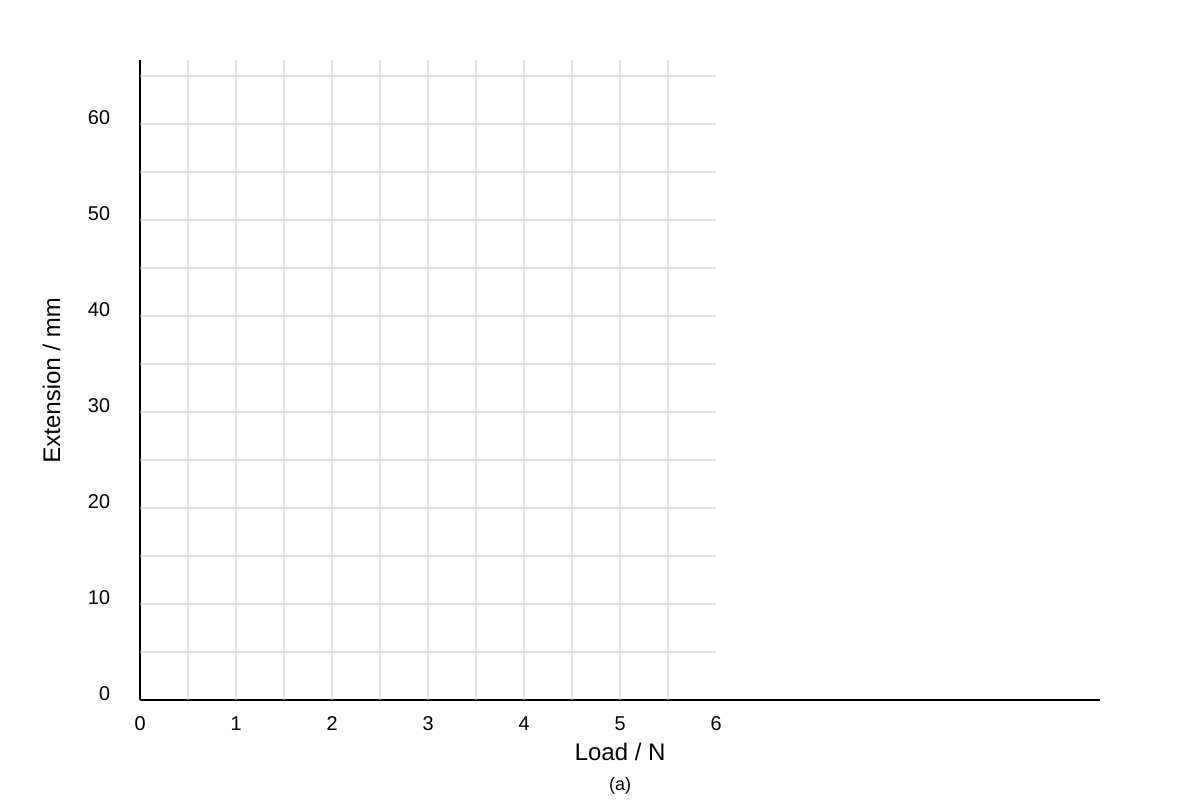
(a) Plot a graph of extension against load for these results. Use the grid provided.

<image_placeholder> id: Q14-fig1 type: graph linked_question: Q14(a) description: Blank grid for plotting extension against load with labelled axes labels: Vertical axis "Extension / mm" from 0 to 60 in intervals of 10; Horizontal axis "Load / N" from 0 to 6 in intervals of 1; grid lines at 2 mm and 0.5 N intervals values: Scale ranges as specified; data points to be plotted at (0,0), (1,8), (2,16), (3,24), (4,32), (5,40), (6,52) must_show: Properly labelled axes with units, linear scale, grid lines, enough space for all data points </image_placeholder>

_________________________________________________________________ [2]

(b) Using your graph or the data, determine the extension when a load of 2.5 N is applied.

Extension = _______________ mm [1]

(c) The student concludes that the spring follows Hooke's Law for all loads up to 6 N. Explain whether this conclusion is correct, using data from the table to support your answer.

_________________________________________________________________ [2]


Question 15 (5 marks)

An electric kettle has a power rating of 2000 W. It is used to heat 1.5 kg of water from 25°C to 100°C. The specific heat capacity of water is 4200 J/(kg·°C).

(a) Calculate the energy needed to heat the water. Use the formula: Q = mcΔθ

_________________________________________________________________ [2]

(b) Calculate the minimum time needed for the kettle to heat the water if all electrical energy is converted to heat energy. Use the formula: P = E/t

_________________________________________________________________ [2]

(c) In practice, the actual time taken is longer than your answer to (b). Suggest one reason for this.

_________________________________________________________________ [1]


Question 16 (5 marks)

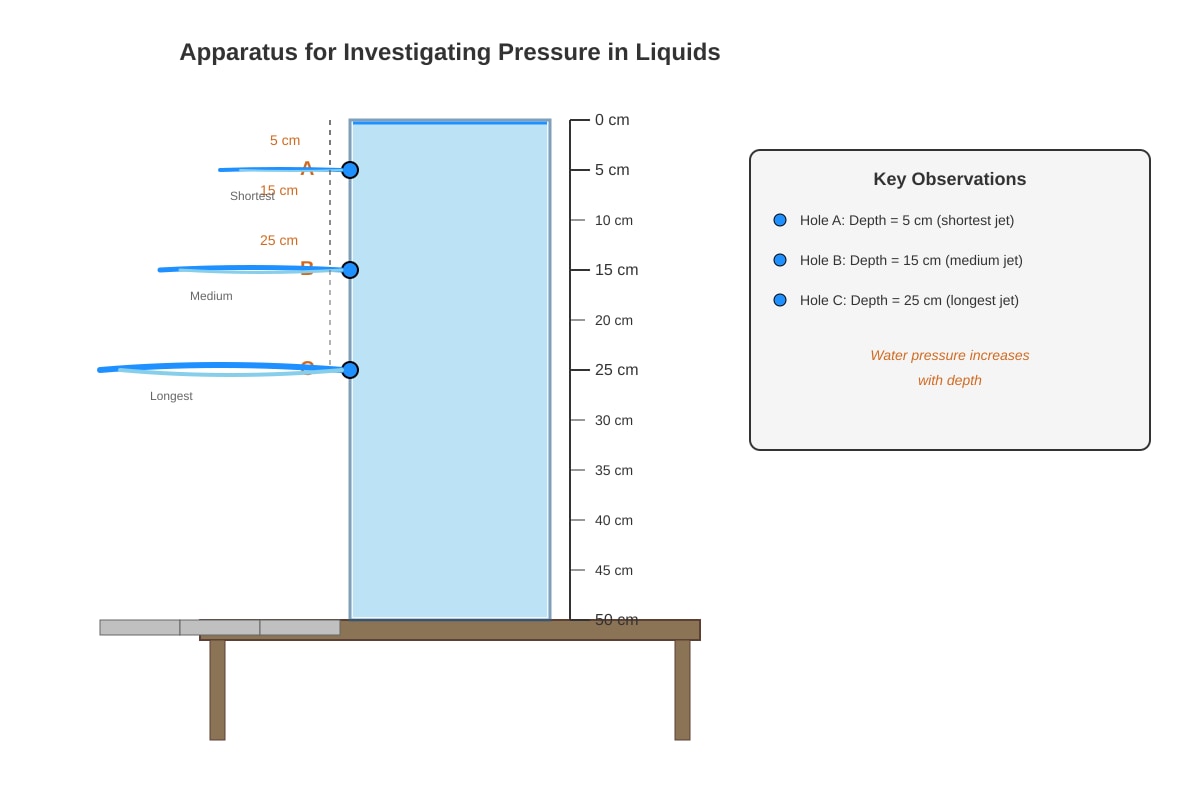
<image_placeholder> id: Q16-fig1 type: experimental_setup linked_question: Q16 description: Apparatus for investigating pressure in liquids at different depths labels: Tall transparent cylinder with water; three holes at different depths (A at top, B in middle, C at bottom) on one side; ruler scale marked in cm along side; water jets shown emerging horizontally from each hole with different lengths values: Depth of A = 5 cm, B = 15 cm, C = 25 cm from water surface; jet from C longest, from A shortest must_show: Cylinder with water, three horizontal holes with water jets, ruler with depth markings, different jet lengths clearly visible, all labels A, B, C </image_placeholder>

The diagram shows an experiment to investigate how water pressure changes with depth.

(a) Compare the horizontal distances travelled by the water jets from holes A, B, and C.

_________________________________________________________________ [1]

(b) Using your answer to (a), state how water pressure changes with depth.

_________________________________________________________________ [1]

(c) Explain why the water jets travel horizontally when they first emerge from the holes, then curve downward.

_________________________________________________________________ [2]

(d) Suggest one change to the apparatus that would allow you to investigate whether pressure at a given depth depends on the density of the liquid, not just water.

_________________________________________________________________ [1]


Section C: Application and Analysis (Questions 17-20)

20 marks


Question 17 (5 marks)

A forklift truck is used to lift pallets of boxes in a warehouse. On one occasion, the forklift lifts a 500 kg pallet through a vertical height of 3.0 m in 5.0 seconds.

(a) Calculate the work done by the forklift in lifting the pallet. (Take g = 10 N/kg)

_________________________________________________________________ [2]

(b) Calculate the power output of the forklift motor during this lift.

_________________________________________________________________ [2]

(c) The forklift has a mechanical advantage of 4.0 in its lifting mechanism. Explain what this tells you about the relationship between the effort force and the load force in this system.

_________________________________________________________________ [1]


Question 18 (5 marks)

<image_placeholder> id: Q18-fig1 type: diagram linked_question: Q18 description: A compound pulley system with two fixed pulleys and two movable pulleys supporting a load labels: Load (L) suspended from lower block, effort rope (E) pulled upward; four rope segments supporting the lower block; arrows showing rope directions values: Load = 800 N, system shown in equilibrium must_show: Upper fixed pulley block with two pulleys, lower movable pulley block with two pulleys, load suspended, rope threading clearly shown, effort direction indicated, all four supporting segments visible </image_placeholder>

The diagram shows a block and tackle pulley system with four supporting rope segments.

(a) Determine the velocity ratio of this pulley system. Explain your reasoning.

_________________________________________________________________ [2]

(b) Assuming the system is ideal (no friction, no weight of pulleys), calculate the effort force needed to lift the 800 N load.

_________________________________________________________________ [2]

(c) In practice, the actual effort needed is 250 N. Calculate the efficiency of this pulley system.

_________________________________________________________________ [1]


Question 19 (5 marks)

A student designs an experiment to compare the thermal insulation properties of different materials. She wraps hot water bottles with different materials and records the temperature of the water every 5 minutes for 30 minutes.

(a) State the independent variable and the dependent variable in this experiment.

Independent variable: _________________________________________________

Dependent variable: _________________________________________________ [2]

(b) Suggest two controlled variables that should be kept constant to make this a fair test.


_________________________________________________________________ [2]

(c) Explain why recording temperature over 30 minutes gives more reliable results than recording after just 5 minutes.

_________________________________________________________________ [1]


Question 20 (5 marks)

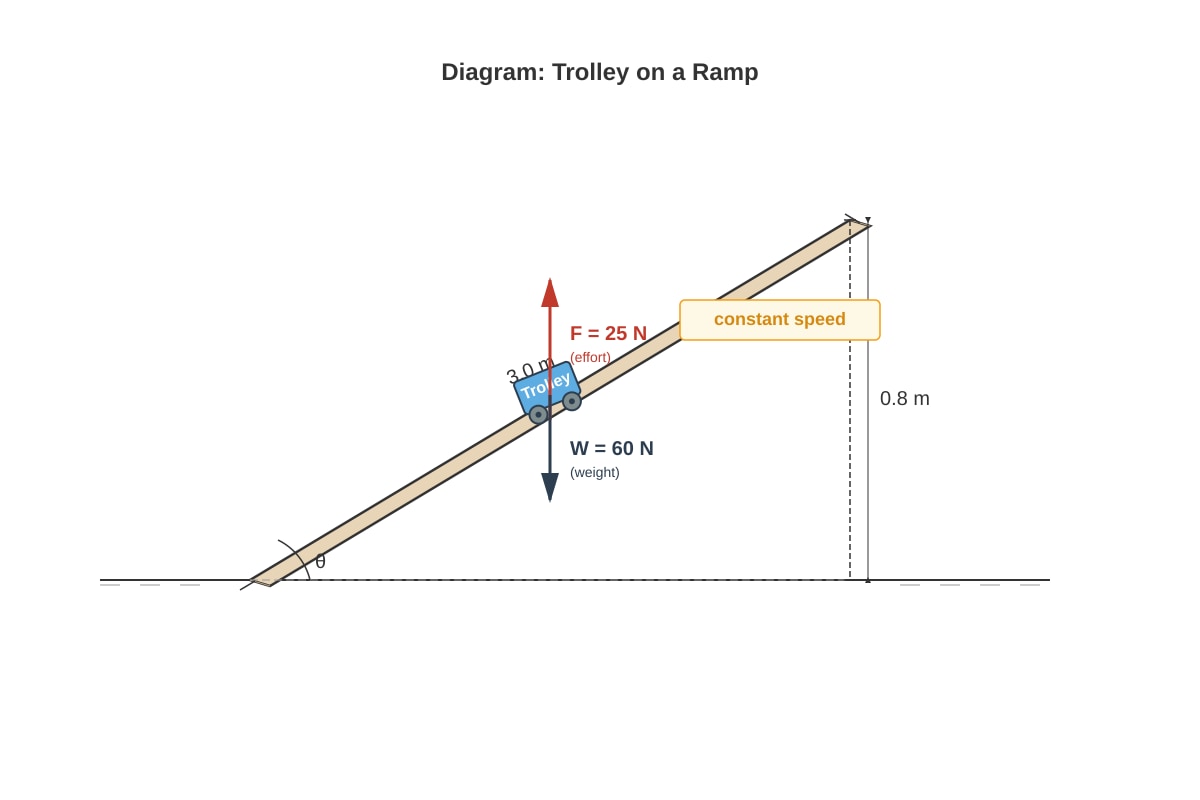
<image_placeholder> id: Q20-fig1 type: diagram linked_question: Q20 description: A ramp with a trolley being pushed up at constant speed by a force parallel to the ramp surface labels: Trolley on ramp inclined at angle θ to horizontal; ramp length = 3.0 m; vertical height = 0.8 m; effort force F = 25 N parallel to ramp pointing upward; load (weight W = 60 N) acting vertically downward from trolley values: Ramp length 3.0 m, height 0.8 m, effort force 25 N, weight 60 N, constant speed indicated must_show: Inclined ramp with angle θ, trolley clearly shown, arrow for effort force parallel to ramp surface, weight arrow vertically downward, dimensions labelled, "constant speed" note </image_placeholder>

A student pushes a trolley up a ramp at constant speed, as shown in the diagram.

(a) Explain why the work done against gravity (useful work output) is less than the work done by the 25 N effort force.

_________________________________________________________________ [2]

(b) Calculate the useful work done in raising the trolley through the vertical height of 0.8 m.

_________________________________________________________________ [2]

(c) Calculate the efficiency of the ramp as a simple machine.

_________________________________________________________________ [1]


END OF PAPER

Answers

<!-- TuitionGoWhere generation metadata: stage=5-2; model=moonshotai/kimi-k2.6:free; model_label=Kimi K2.6 Free; generated=2026-06-09; Sources: Stage 4-0 LLM templates, syllabus context, and Stage 2 evidence where available. -->

TuitionGoWhere Practice Paper - Science Secondary 1

Answer Key and Marking Scheme

Subject: Science | Level: Secondary 1 (G3) | Version: 3 of 5 | Total Marks: 60


Section A: Multiple Choice (1 mark each)

QuestionAnswerExplanation
1BAt constant velocity, resultant force is zero (Newton's First Law). The push force equals the opposing friction force.
2AAs the ball rises, it slows down—kinetic energy decreases while gravitational potential energy increases. At the very highest point, this conversion completes (KE → GPE).
3BDensity = Mass ÷ Volume (ρ = m/V). This is the defining relationship for density.
4DGPE = mgh = 50 × 10 × 4 = 2000 J
5DVelocity is a vector (has magnitude and direction). Mass, speed, and distance are scalar quantities.
6BTotal distance = 120 + 80 = 200 km; Total time = 2 + 1.5 = 3.5 h; Average speed = 200/3.5 = 57.1 km/h
7BWater displacement (Archimedes' principle) is the standard method for irregular solids.
8BPrinciple of moments: clockwise moment = anticlockwise moment for equilibrium.
9BPressure = Force/Area. Smaller area → greater pressure for same force. Unit is pascal (Pa), not newtons.
10BVelocity ratio = effort distance/load distance; 4 = 8/load distance; load distance = 8/4 = 2 m

Section B: Structured Response


Question 11 (5 marks)

(a) Volume of cube [1]

Method: For a cube, V = side³

  • V = (3.0)³ = 3.0 × 3.0 × 3.0 = 27 cm³

Marking: Correct formula or correct answer with unit [1]


(b) Density of the metal [2]

Method: ρ = m/V

  • ρ = 216 g / 27 cm³ = 8.0 g/cm³

Working [1], correct answer with unit [1]

Common error: Forgetting to cube the side, or using 3 × 3 = 9 instead of 27


(c) Identification of metal [2]

Answer: The metal is iron [1]

Reasoning: The calculated density (8.0 g/cm³) is much closer to iron (7.9 g/cm³) than to aluminium (2.7 g/cm³). The small difference (≈1.3%) is likely due to experimental measurement uncertainty [1].

Alternative acceptable answer: The density is approximately 7.9 g/cm³, matching iron.

Key concept: Density is a characteristic property used to identify materials.


Question 12 (5 marks)

Expected visual features from Q12-fig1: Distance-time graph with three sections—A rising steeply (0-10 min, 0-1200 m), B horizontal (10-15 min), C rising less steeply (15-30 min, 1200-1800 m)

(a) Speed during section A [2]

Method: Speed = gradient = Δdistance/Δtime

  • Speed = (1200 − 0) m / (10 − 0) min = 1200/10 = 120 m/min

Or converted: 120 m/min = 2 m/s

Formula [1], correct substitution and answer with unit [1]


(b) Motion during section B [1]

Answer: The cyclist is stationary (at rest) / not moving.

Explanation: The horizontal line shows zero gradient, meaning no change in distance over time. The distance remains constant at 1200 m for 5 minutes.

Key concept: Zero gradient on a distance-time graph = stationary object.


(c) Comparison of speeds in A and C [2]

Answer: Speed in section A is greater than speed in section C [1]

Explanation: The gradient of section A is steeper than the gradient of section C. Since speed equals the gradient of a distance-time graph, a steeper gradient means greater speed [1].

Numerical check: Speed in C = (1800−1200)/(30−15) = 600/15 = 40 m/min, which is less than 120 m/min


Question 13 (5 marks)

Expected visual features from Q13-fig1: Horizontal lever with fulcrum, load 60 N at 0.5 m on one side, effort E at 1.5 m on other side, balanced

(a) Moment of the load [2]

Method: Moment = Force × perpendicular distance from pivot

  • Moment = 60 N × 0.5 m = 30 Nm (or 30 N·m)

Formula: Moment = F × d [1]; correct substitution and answer with unit [1]

Key concept: Moment (torque) measures the turning effect of a force.


(b) Effort force E [2]

Method: For equilibrium, clockwise moment = anticlockwise moment

  • Moment of load = Moment of effort
  • 30 Nm = E × 1.5 m
  • E = 30/1.5 = 20 N

Principle of moments stated or applied [1]; correct answer [1]


(c) Reducing the effort [1]

Answer: Any one of:

  • Increase the effort distance (move effort further from fulcrum) [1]
  • Decrease the load distance (move load closer to fulcrum) [1]

Key concept: Lever systems trade force for distance using the principle of moments.


Question 14 (5 marks)

(a) Graph plotting [2]

Expected visual from Q14-fig1: Graph with load (0-6 N) on x-axis, extension (0-60 mm) on y-axis, points plotted at (0,0), (1,8), (2,16), (3,24), (4,32), (5,40), (6,52)

Marking points:

  • Correct axes with labels and units [1]
  • Correctly plotted points and reasonable straight line through first 5 points, with point at (6,52) noticeably off the straight line [1]

Common error: Drawing a single straight line through all points misses that Hooke's Law fails after 5 N.


(b) Extension at 2.5 N [1]

Method: From the linear part of the graph, extension is proportional to load.

  • At 2 N: 16 mm; at 3 N: 24 mm
  • At 2.5 N: (16 + 24)/2 = 20 mm

Or by direct proportion: extension = 8 × load, so 8 × 2.5 = 20 mm

Answer: 20 mm [1]


(c) Hooke's Law conclusion [2]

Answer: The conclusion is not correct / only partially correct [1]

Explanation: Hooke's Law states that extension is directly proportional to load, meaning the graph should be a straight line through the origin. From 0 to 5 N, the extension increases by 8 mm per Newton (constant ratio), confirming proportionality. However, from 5 N to 6 N, the extension increases by 12 mm (not 8 mm), so the ratio is no longer constant. The spring has exceeded its limit of proportionality [1].

Key concept: Hooke's Law (F = kx) only applies within the elastic limit/limit of proportionality.


Question 15 (5 marks)

(a) Energy to heat water [2]

Method: Q = mcΔθ

  • Q = 1.5 kg × 4200 J/(kg·°C) × (100 − 25)°C
  • Q = 1.5 × 4200 × 75
  • Q = 472 500 J or 4.725 × 10⁵ J

Formula [1]; correct substitution and answer with unit [1]


(b) Minimum time [2]

Method: P = E/t, therefore t = E/P

  • t = 472 500 J / 2000 W
  • t = 236.25 s236 s (or 3 minutes 56 seconds)

Rearrangement or correct formula [1]; correct answer [1]

Note: Accept 236 s or 240 s (to 2 s.f.) or exact value.


(c) Longer actual time [1]

Answer: Any one valid reason:

  • Heat energy is lost to the surroundings (air, kettle body) [1]
  • Not all electrical energy is converted to heat in the water [1]
  • Some energy is needed to heat the kettle itself (metal body) [1]
  • Energy losses due to evaporation of some water [1]

Question 16 (5 marks)

Expected visual from Q16-fig1: Water cylinder with three holes at depths 5 cm, 15 cm, 25 cm; water jets with C longest, B medium, A shortest

(a) Comparing jet distances [1]

Answer: The water jet from C travels furthest, from B travels an intermediate distance, and from A travels shortest [1].

Or equivalent statement ordering the distances correctly.


(b) Pressure and depth relationship [1]

Answer: Water pressure increases with depth [1].

The deeper the hole, the greater the pressure, the faster the water emerges, the further the jet travels.


(c) Horizontal then curved motion [2]

Explanation of horizontal start: The water emerges through a horizontal hole, so the initial pressure force acts perpendicular to the container wall, giving the water a horizontal velocity [1].

Explanation of downward curve: Once outside, gravity acts downward on the water, causing it to accelerate downward and follow a parabolic (curved) path [1].

Key concept: Motion has horizontal and vertical components; gravity only affects the vertical component (projectile motion basics).


(d) Investigating density effect [1]

Answer: Replace the water with a different liquid of known different density (e.g., oil, salt water, alcohol) but keep the depth of the hole the same [1].

Or: Use the same apparatus with water at different temperatures (density changes slightly).


Section C: Application and Analysis


Question 17 (5 marks)

(a) Work done [2]

Method: Work done = Force × distance = weight × height = mgh

  • Weight = 500 kg × 10 N/kg = 5000 N
  • Work = 5000 N × 3.0 m = 15 000 J (or 1.5 × 10⁴ J)

Formula W = Fd or W = mgh [1]; correct substitution and answer with unit [1]


(b) Power output [2]

Method: P = Work/time = W/t

  • P = 15 000 J / 5.0 s
  • P = 3000 W (or 3.0 kW)

Formula [1]; correct answer with unit [1]

Common error: Using P = Fv also works: v = 3.0/5.0 = 0.6 m/s; P = 5000 × 0.6 = 3000 W


(c) Meaning of mechanical advantage [1]

Answer: A mechanical advantage of 4.0 means the load force is 4 times greater than the effort force, or equivalently, the effort force needed is only 1/4 of the load force [1].

Key concept: Mechanical advantage = Load/Effort; values > 1 mean force multiplication.


Question 18 (5 marks)

Expected visual from Q18-fig1: Block and tackle with 4 supporting rope segments, load 800 N, effort rope pulled upward

(a) Velocity ratio [2]

Reasoning: The velocity ratio equals the number of supporting rope segments that share the load. In this system, there are 4 rope segments directly supporting the movable block [1].

Answer: Velocity ratio = 4 [1]

Key concept: For simple block and tackle, VR = number of supporting segments.


(b) Effort force (ideal) [2]

Method: For ideal machine, Mechanical Advantage = Velocity Ratio = 4

  • MA = Load/Effort
  • 4 = 800 N / E
  • E = 800/4 = 200 N

Or: The 800 N load is shared by 4 rope segments, so each segment tension = 800/4 = 200 N [1]; correct answer with reasoning [1]


(c) Efficiency [1]

Method: Efficiency = (MA/VR) × 100% = (Actual MA / Theoretical MA) × 100%

Actual MA = Load/Effort = 800/250 = 3.2

Efficiency = (3.2/4.0) × 100% = 80%

Or: Efficiency = (Useful work output / Total work input) × 100%

Correct answer [1]


Question 19 (5 marks)

(a) Variables [2]

VariableAnswer
Independent variableThe type of insulating material used (or different materials) [1]
Dependent variableThe temperature of the water (after fixed time intervals / rate of temperature drop) [1]

Note: Both must be clearly stated with the quantity, not just "material" or "temperature."


(b) Controlled variables [2]

Any two valid:

  • Initial temperature of the hot water [1]
  • Volume/mass of water in each bottle [1]
  • Type/shape of hot water bottle used [1]
  • Ambient/surrounding temperature [1]
  • Time intervals between temperature readings [1]
  • Thickness of insulating material wrapped [1]

(c) Reliability with longer timing [1]

Answer: A 30-minute period allows a greater temperature drop to be measured, making differences between materials more noticeable and easier to distinguish [1]. Short periods may show very small changes that are within measurement uncertainty of the thermometer [1].

Or: Longer time reduces percentage error in timing and temperature measurement.


Question 20 (5 marks)

Expected visual from Q20-fig1: Ramp 3.0 m long, 0.8 m high, trolley pushed by 25 N parallel to ramp at constant speed, weight 60 N

(a) Why useful work is less than work by effort [2]

Answer: The effort force (25 N) acts over the full 3.0 m length of the ramp [1].

However, only the vertical component of this motion overcomes gravity. The useful work (against gravity) = weight × vertical height = 60 × 0.8 = 48 J, while total work input = 25 × 3.0 = 75 J.

The difference (75 − 48 = 27 J) is work done against friction between the trolley and the ramp surface [1].

Key concept: Simple machines are not 100% efficient; friction dissipates energy as heat.


(b) Useful work done [2]

Method: Useful work = weight × vertical height = mgh

  • Useful work = 60 N × 0.8 m = 48 J

Or using the ramp relationship: The vertical height gain represents the actual gravitational potential energy increase.

Formula [1]; correct answer with unit [1]


(c) Efficiency [1]

Method: Efficiency = (Useful work output / Total work input) × 100%

  • Total work input = 25 N × 3.0 m = 75 J
  • Efficiency = (48/75) × 100% = 64%

Or using MA/VR: VR = 3.0/0.8 = 3.75; MA = 60/25 = 2.4; Efficiency = 2.4/3.75 = 0.64 = 64%

Answer: 64% or 0.64 [1]


END OF ANSWER KEY