AI Generated Exam Paper
Secondary 1 Science Practice Paper 3
Free Sec 1 Science Practice Paper 3, HY3 AI version, with questions, answers, and syllabus-aligned practice for Singapore students.
These static practice materials are generated from the site's syllabus and paper-generation workflow, with source and model context shown so students and parents can evaluate the material before use.
Questions
Free quiz and exam paper access
Enter your details to view this paper
Your access is remembered on this device.
Answers
TuitionGoWhere Practice Paper — Answer Key (Version 3)
Subject: Science | Level: Secondary 1 | Topic: Physical Sciences | Total Marks: 40
Section A: Forces and Motion (14 marks)
Q1 [1 mark]
- Answer: Frictional force (or friction).
- Teaching note: Friction is a force that opposes motion between two surfaces in contact. When the book slides, the table exerts friction against the push.
Q2 [1 mark]
- Answer: 12 N.
- Teaching note: Weight is defined as the gravitational force acting on an object. The spring balance reads 12 N, so gravitational force = 12 N.
Q3 [2 marks]
- Answer: Pressure increases. [1] The weight (force) stays at 20 N but the contact area becomes smaller; since pressure = force ÷ area, a smaller area gives higher pressure. [1]
- Marking: 1 for correct direction, 1 for correct reasoning with formula idea.
- Common mistake: Saying force changes when only area changes.
Q4 [3 marks]
- Working: Work done = Force × Distance [1] = 18 N × 2.5 m [1] = 45 J [1]
- Teaching note: Work is done when a force moves an object in its direction. Units are joules (J).
Q5 [2 marks]
- Answer: 0 J. [1] Work = Force × displacement; displacement is 0 m while held stationary, so work = 30 N × 0 m = 0 J. [1]
- Common trap: Students multiply 30 N × 1.2 m wrongly; height above ground is not displacement during holding.
Q6 [2 marks]
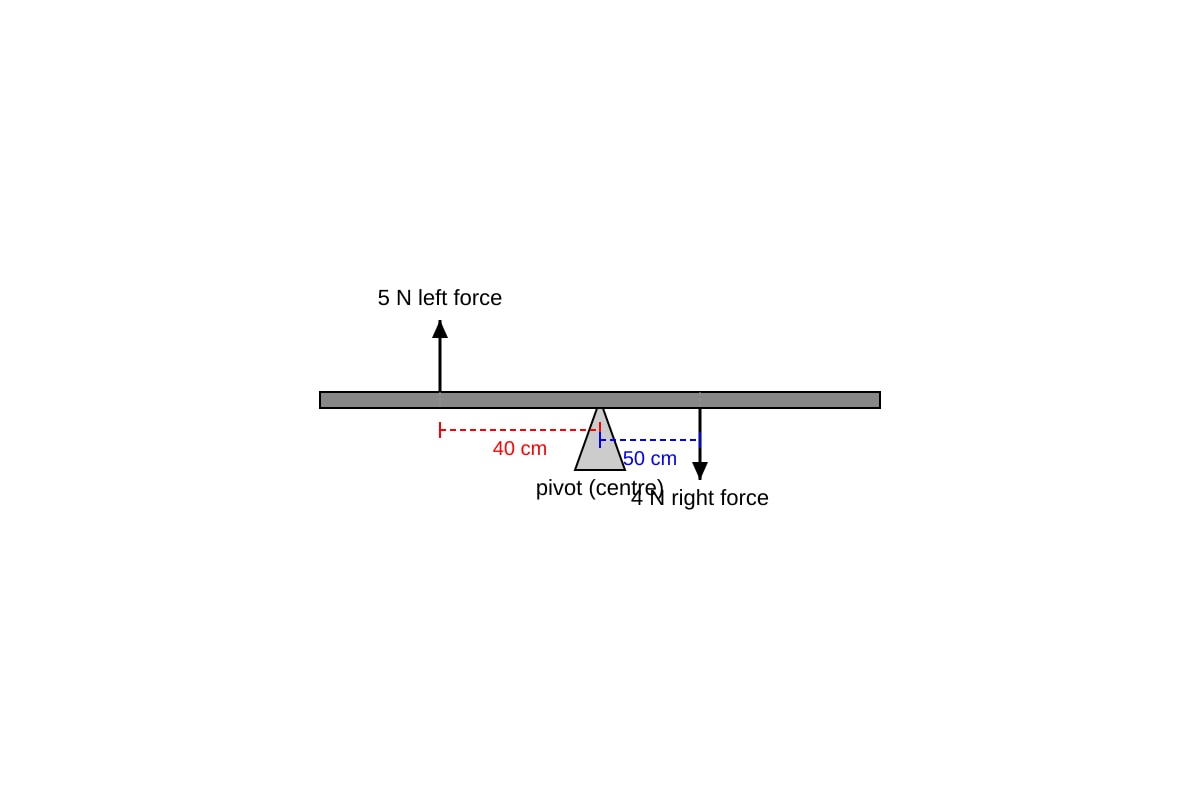
- Working: Moment = Force × perpendicular distance [1] = 5 N × 40 cm = 200 N·cm [1]
- Teaching note: Moment is turning effect about pivot. Use perpendicular distance from pivot to force line.
Q7 [2 marks]
- Answer: Chemical energy → Gravitational potential energy. [1] The boy does work against gravity, increasing the dumbbell's height, so muscle chemical energy becomes stored GPE. [1]
Section B: Energy and Heat (14 marks)
Q8 [2 marks]
- Answer: Renewable: biomass/wind/sun/hydropower (any 1). [1] Non-renewable: coal/crude oil/natural gas (any 1). [1]
Q9 [1 mark]
- Answer: Chemical energy → Electrical energy → Light energy (accept Chemical → Light with electrical intermediate).
Q10 [1 mark]
- Answer: Carbon dioxide.
Q11 [2 marks]
- Answer: When heated, the strip expands and bends, breaking contact to stop heating; when cooled, it contracts and reconnects to allow heating again. [2] This keeps temperature near set value.
- Marking: 1 for expansion breaks contact, 1 for contraction reconnects / maintains temperature.
Q12 [1 mark]
- Answer: From higher temperature to lower temperature.
Q13 [2 marks]
- Working: Sound energy = Total – Kinetic = 100 J – 70 J = 30 J. [2]
- Teaching note: Energy cannot be destroyed; it converts to other forms summing to input.
Q14 [2 marks]
- Any two: switch off appliances when not in use, use LED lights, reduce aircon usage, insulate windows. [1+1]
Section C: Electricity and Light (12 marks)
Q15 [1 mark]
- Answer: 230 V.
Q16 [2 marks]
- Answer: Cell = two lines (long thin + short thick) ; Ammeter = circle with A inside. [1+1]
- Teaching note: Standard circuit symbols from syllabus.
Q17 [1 mark]
- Answer: The other lamps stay lit (continue to work).
Q18 [1 mark]
- Answer: Fuse or circuit breaker (or earth wire).
Q19 [2 marks]
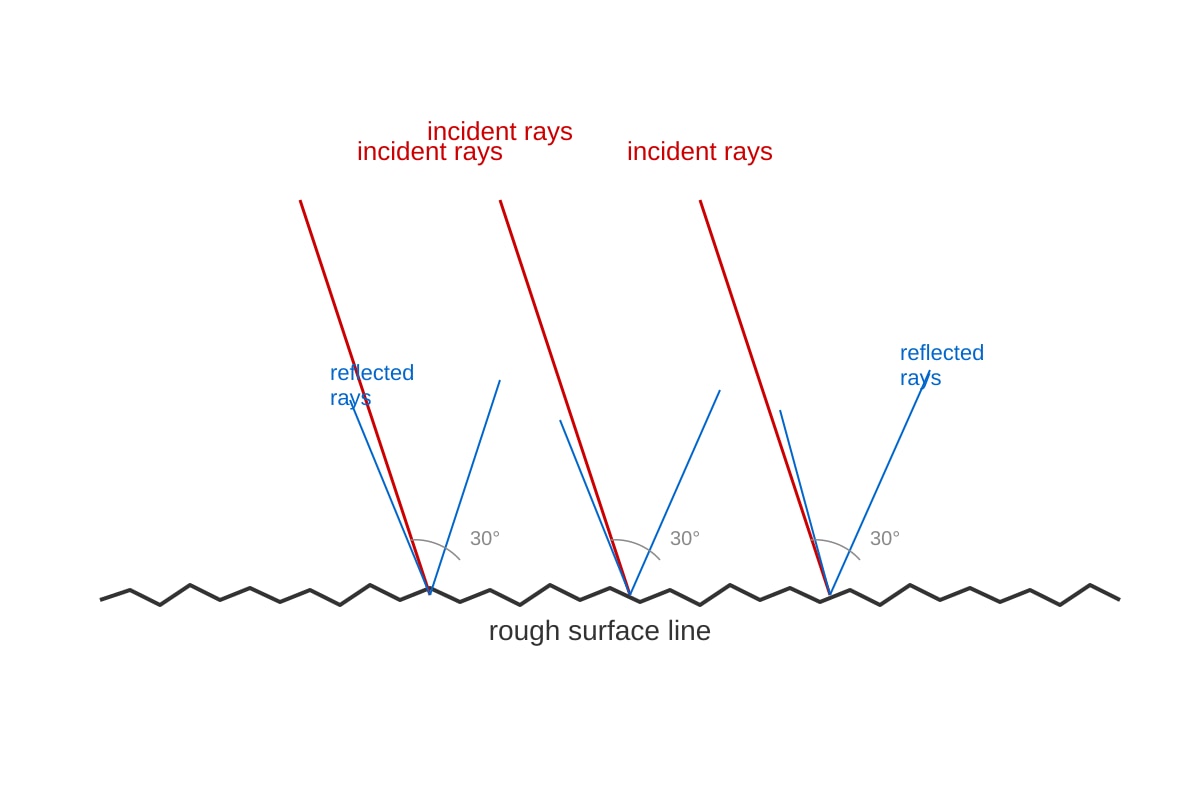
- Answer: The rays undergo diffuse reflection; they scatter in many different directions because the surface is rough. [2]
- Image note: Diagram must show incident rays parallel, reflected rays diverging randomly from surface.
Q20 [2 marks]
- Answer: A closed circuit [1] and a voltage source (e.g., cells) [1] are required for current to flow.
- Teaching note: Current is flow of charges; needs complete loop and potential difference.