AI Generated Exam Paper
Secondary 1 Science Practice Paper 2
Free Sec 1 Science Practice Paper 2, Kimi2.6 AI version, with questions, answers, and syllabus-aligned practice for Singapore students.
These static practice materials are generated from the site's syllabus and paper-generation workflow, with source and model context shown so students and parents can evaluate the material before use.
Questions
Free quiz and exam paper access
Enter your details to view this paper
Your access is remembered on this device.
Answers
TuitionGoWhere Practice Paper - Science Secondary 1
Answer Key and Marking Scheme
Version: 2 of 5
Section A: Multiple Choice and Short Response
Question 1 [1 mark]
Answer: C) Speed
Explanation: Speed is a scalar quantity because it has magnitude only, with no associated direction. Force, velocity, and acceleration are all vector quantities because they have both magnitude and direction.
- Vector quantities: Require magnitude AND direction to be fully specified (e.g., velocity = 5 m/s north)
- Scalar quantities: Only magnitude needed (e.g., speed = 5 m/s)
- Common mistake: Confusing "speed" and "velocity" — velocity includes direction, speed does not.
Question 2 [1 mark]
Answer: B) 20 N
Explanation: Since the box moves at constant velocity, its acceleration is zero. By Newton's First Law, the resultant force on the box must be zero. Therefore, the applied forward force (20 N) must be exactly balanced by the backward frictional force (20 N). These two forces form a pair of balanced forces.
- Key concept: Balanced forces → constant velocity (or rest) → zero resultant force
- Common trap: Students may calculate weight ( N) and select C, but weight acts vertically while friction acts horizontally.
Question 3 [2 marks]
Answer: Chemical energy (in the student's muscles) is converted to gravitational potential energy (of the student) [1]. The student does work against gravity to raise their mass through a vertical height [1].
Explanation: At steady speed, there is no change in kinetic energy. The energy from food (chemical energy) is used to do work against the gravitational force. The work done () increases the student's gravitational potential energy. Note that some chemical energy is also converted to thermal energy (body heat), but the main intentional conversion is to gravitational potential energy.
Question 4 [2 marks]
Answer: Work done is the energy transferred when a force causes an object to move in the direction of the force [1]. Formula: (where is force in newtons, is displacement in metres in the direction of the force) [1].
Explanation: The key understanding is that work requires both a force and movement in the direction of that force. Holding a heavy object stationary involves force but zero displacement, so no work is done in physics terms. The unit of work is the joule (J), which equals one newton-metre (N·m).
Question 5 [2 marks]
Answer: [2]
Working:
- Formula stated: [1]
- Correct substitution and answer with unit: [1]
Explanation: The force and displacement are in the same direction, so we simply multiply. If the force were applied at an angle, we would use where is the angle between force and displacement.
Question 6 [2 marks]
Answer: The person's muscles are constantly contracting and relaxing to maintain the upward force [1]. This involves continuous chemical energy conversion to thermal energy in the muscles, causing fatigue, even though no displacement occurs so no work is done on the box [1].
Explanation: This is a classic distinction between everyday language ("working hard") and physics definition (work = force × displacement in force's direction). In physics: no displacement = no work done. Biologically: muscle contraction requires ATP breakdown (chemical energy → thermal energy), causing tiredness.
Question 7 [2 marks]
Answer:
- Mass of the object [1]
- Height of the object above the reference level [1]
Explanation: Gravitational potential energy is calculated as , where is mass and is height. Increasing either factor increases the GPE. The acceleration due to gravity ( N/kg on Earth) is constant at a given location, so it is not considered a "factor" that can be varied in typical problems at this level.
Question 8 [2 marks]
Answer: [2]
Working:
- Formula stated or implied: [1]
- Correct substitution with unit: [1]
Explanation: As the ball falls, this 20 J of gravitational potential energy is converted to kinetic energy (ignoring air resistance). By the conservation of energy, the maximum kinetic energy at impact equals the initial gravitational potential energy.
Question 9 [2 marks]
Answer: A moving car possesses kinetic energy because kinetic energy is the energy of motion, given by [1]. When brakes are applied, the kinetic energy is converted mainly to thermal energy (heat) in the brake pads, discs, and tyres due to friction [1].
Explanation: The kinetic energy depends on both mass and speed squared (), so doubling the speed quadruples the kinetic energy. This explains why high-speed crashes are much more dangerous — much more energy must be dissipated.
Question 10 [2 marks]
Answer: Energy cannot be created or destroyed, only converted from one form to another [1], and the total energy in an isolated system remains constant [1].
Explanation: This fundamental principle means that in any energy transfer or transformation, we can always account for all the energy. "Lost" energy has not disappeared — it has typically become thermal energy dispersed in the surroundings, making it less useful.
Section B: Structured Response and Calculations
Question 11 [4 marks]
(a) [1]
[1]
(b) As the student descends, gravitational potential energy is converted to kinetic energy [1]. Since speed is constant, kinetic energy doesn't increase — instead, the lost potential energy is converted to thermal energy (heat) via friction in the descent mechanism/ropes, or the student controls the rate using muscle tension [1].
Explanation for (b): At constant speed, the net force is zero. The downward gravitational force is balanced by an upward force (from friction in equipment or the student's controlled grip). The continuous conversion of GPE without KE gain implies energy dissipation as thermal energy.
Question 12 [4 marks]
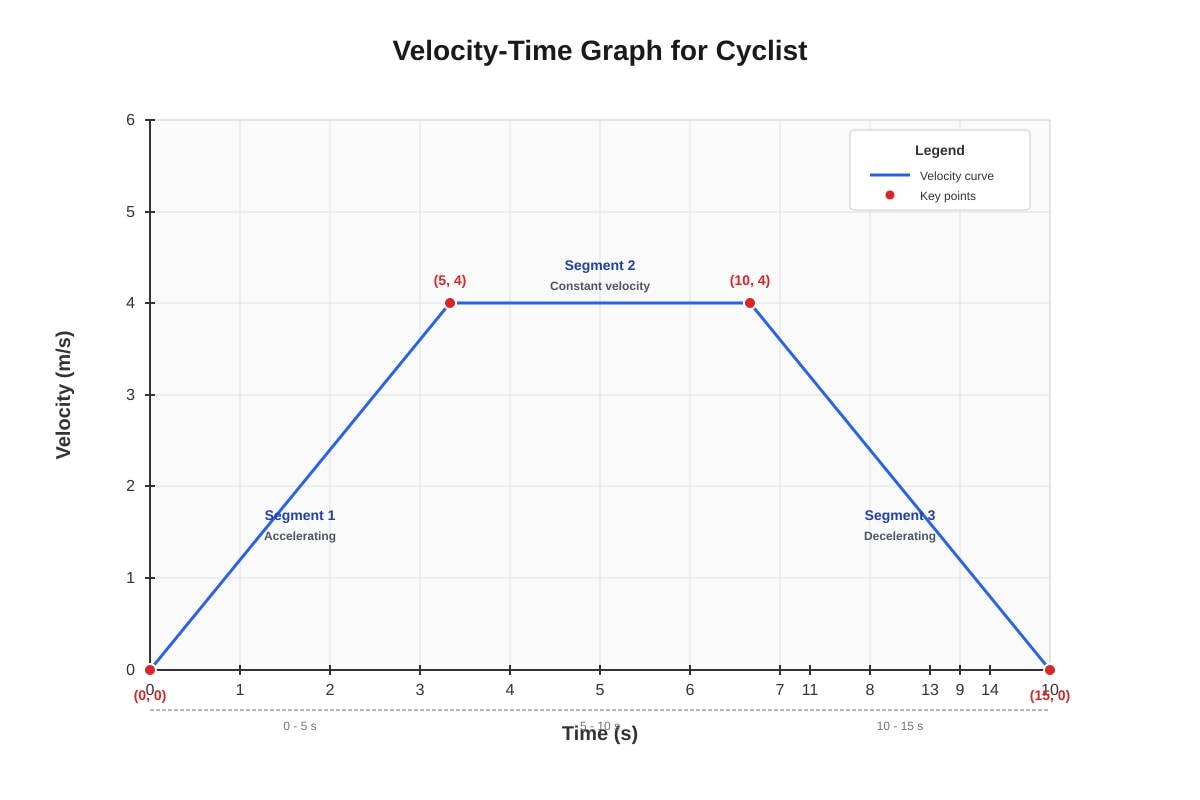
<image_placeholder reference: Velocity-time graph with three segments — 0-5 s acceleration, 5-10 s constant velocity, 10-15 s deceleration>
(a) The cyclist accelerates uniformly from rest to 4 m/s [1].
(b) Total distance = area under graph
= Area of triangle (0-5 s) + Area of rectangle (5-10 s) + Area of triangle (10-15 s) [1]
[1]
(c) Acceleration = gradient = [1]
Explanation: The area under a velocity-time graph always gives displacement (or distance, if motion is in one direction). For constant acceleration, we can use the triangle/rectangle formulas. Note that acceleration during constant velocity (5-10 s) is zero, and during deceleration (10-15 s) is negative: .
Question 13 [4 marks]
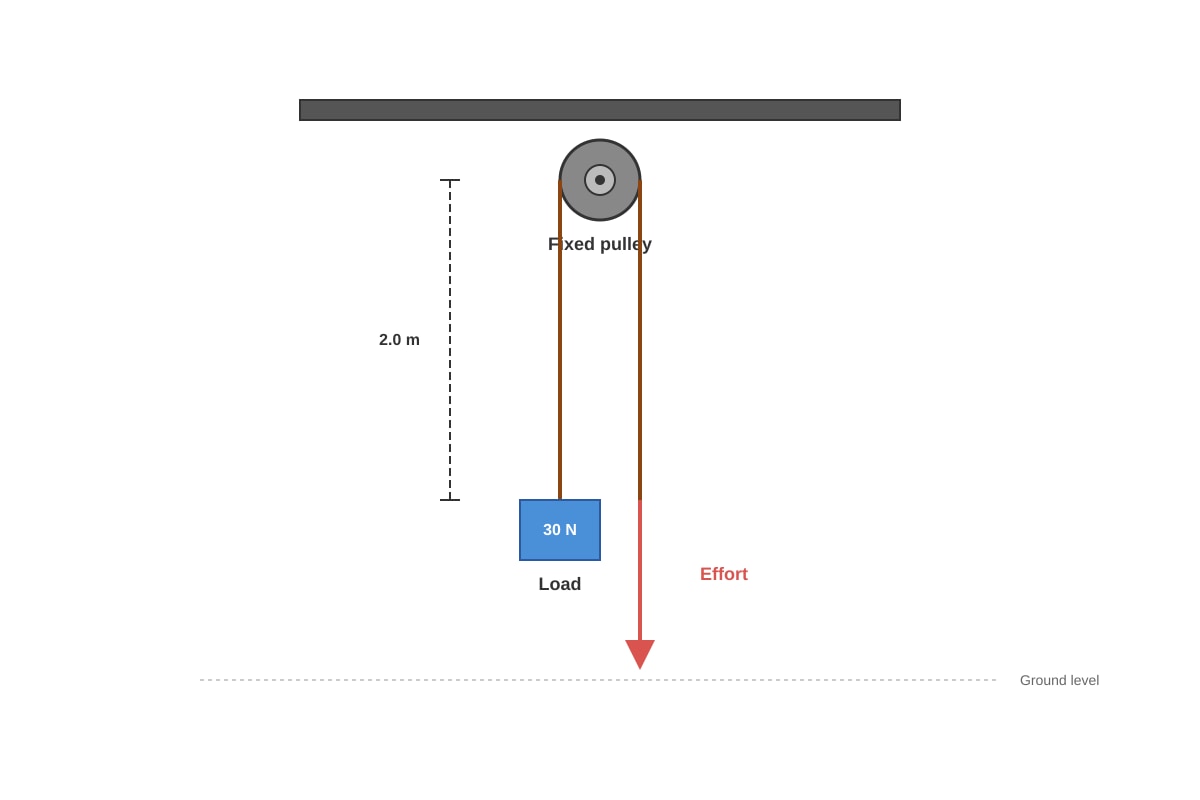
<image_placeholder reference: Single fixed pulley with 30 N load raised 2.0 m, effort applied through 2.0 m>
(a) [2]
(b) A single fixed pulley changes the direction of the force but does not provide any force advantage [1]. The effort distance equals the load distance, and the effort force equals the load force (ignoring friction), so mechanical advantage = load force / effort force = 1 [1].
Explanation: Mechanical advantage (MA) = . For a single fixed pulley: MA = 1 (no force advantage), but it allows pulling downward to lift upward, which is often more convenient. A single movable pulley gives MA = 2 (ideally), because the effort moves twice the distance of the load.
Question 14 [4 marks]
(a) [1]
[1]
(b) When moving up the slope, some of the 18 J of work done is converted to gravitational potential energy as the car gains height [1]. Therefore, less energy remains as kinetic energy, resulting in a lower speed [1].
Explanation: This is a key energy conservation problem. On flat ground: all work → KE. On slope: work → KE + GPE. Since total energy input is fixed, sharing between two forms means each is less than it would be alone.
Question 15 [4 marks]
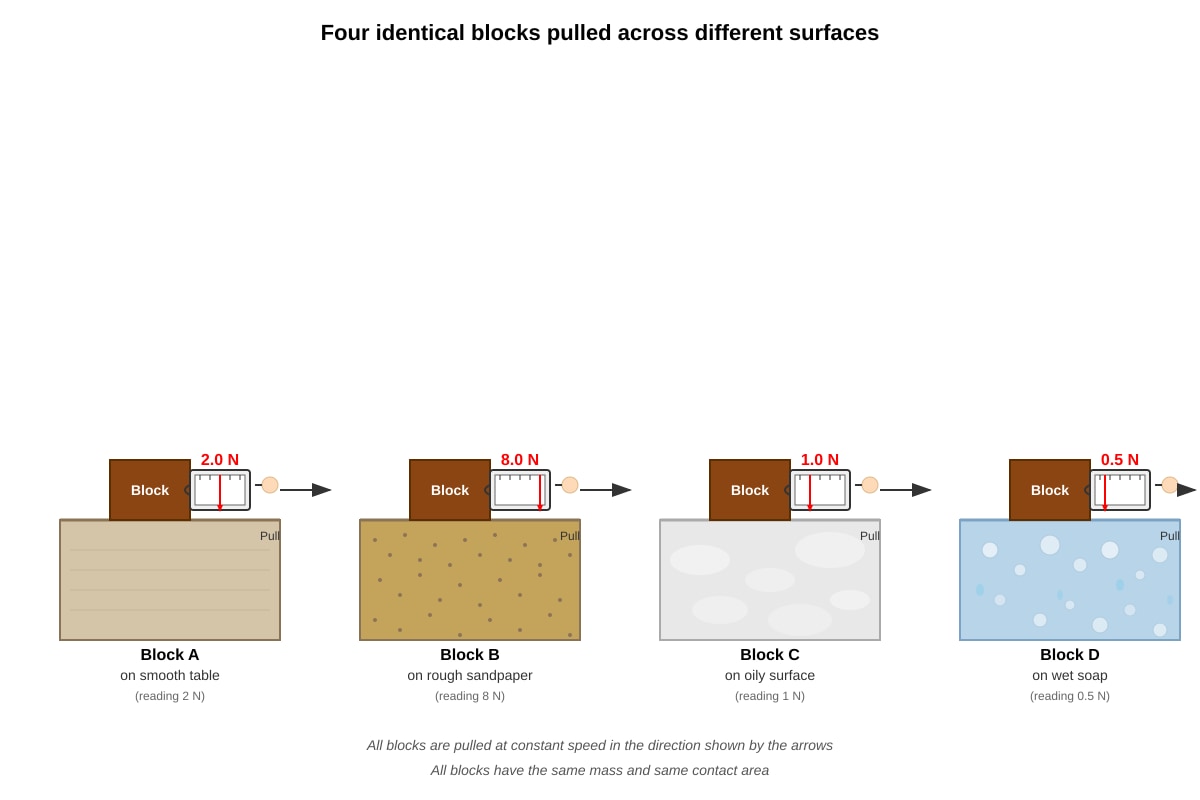
<image_placeholder reference: Four blocks on different surfaces with spring balance readings: A=2N, B=8N, C=1N, D=0.5N>
(a) D, C, A, B (or: wet soap, oily surface, smooth table, rough sandpaper) [1]
(b) Surface A (smooth table) [1] — it provides enough friction for safety and control, but not so much that children cannot slide easily [1].
Alternative acceptable answer: Surface B if reasoning emphasizes safety over slide quality, with appropriate justification.
(c) Apply lubricant/oil to reduce surface roughness at contact [1], OR use wheels/rollers (change sliding to rolling friction) [1].
Explanation: Friction depends on: (1) nature of surfaces in contact, (2) normal force (related to weight). It does NOT depend on contact area (for most practical situations at this level). Polishing surfaces, lubrication, or using ball bearings all reduce friction.
Question 16 [4 marks]
(a) (conservation of energy) [1]
(mass cancels) [1]
[1]
(b) Air resistance acts against the motion, doing negative work and converting some mechanical energy to thermal energy [1]; OR friction at the pivot point dissipates energy as heat [1].
Explanation: This demonstrates that mass cancels out — all objects fall at the same rate (and reach same speed from same height) in the absence of air resistance. In practice, heavier objects with same shape fall slightly faster because air resistance has less proportional effect.
Question 17 [3 marks]
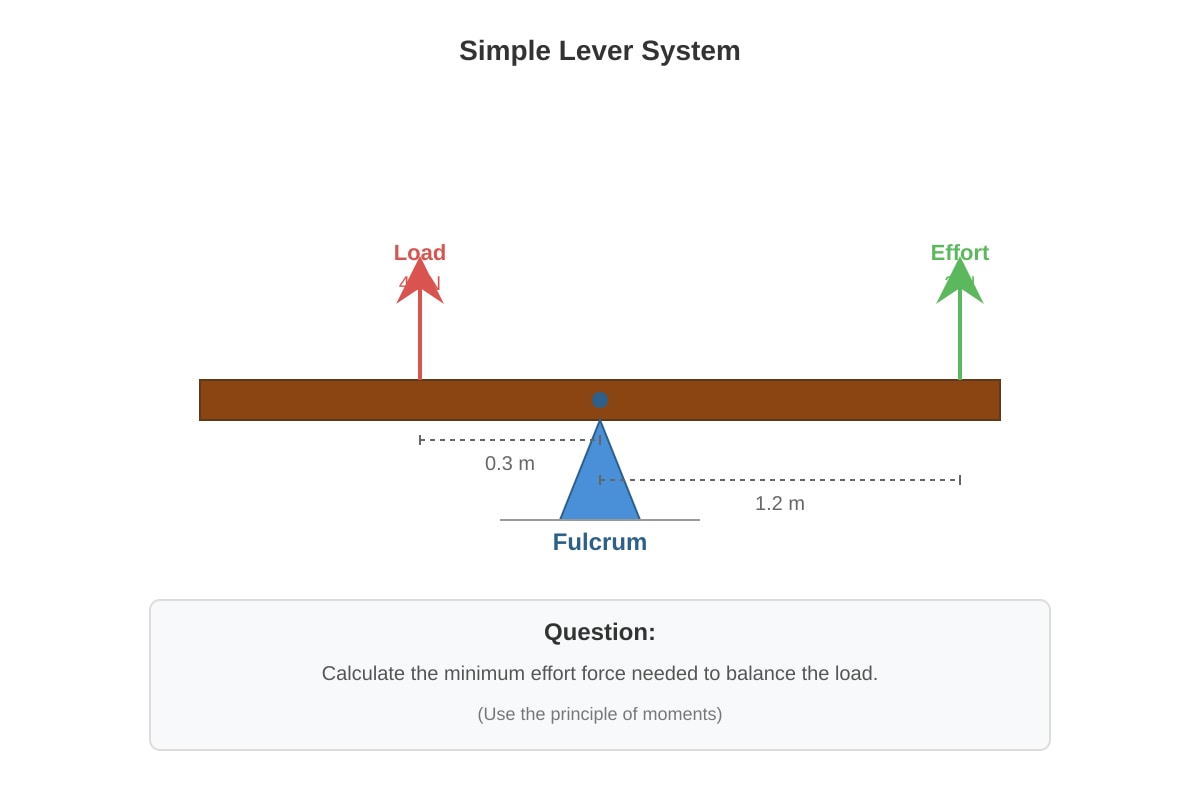
<image_placeholder reference: Lever with fulcrum, load 40 N at 0.3 m, effort at 1.2 m>
Using the principle of moments: clockwise moment = anticlockwise moment [1]
[2]
Explanation: The principle of moments states that for a body in equilibrium, the sum of clockwise moments about any point equals the sum of anticlockwise moments about the same point. A moment is calculated as force × perpendicular distance from the pivot. This lever has a mechanical advantage of 4 (load/effort = 40/10 = 4), meaning it multiplies force but the effort must move through a greater distance.
Question 18 [3 marks]
(a) Gravitational potential energy → kinetic energy [1] (accept: GPE → KE + some thermal/sound energy)
(b) Storing water at a height gives it gravitational potential energy () [1]. The greater the height, the more GPE per unit mass of water, which can be converted to more kinetic energy as it falls, turning the turbine faster and generating more electrical energy [1].
Explanation: Hydroelectric power is a practical application of energy conversion. The height of the reservoir is crucial — doubling the height doubles the available energy per unit mass of water (if flow rate is maintained).
Section C: Application and Synthesis
Question 19 [6 marks]
<image_placeholder reference: Inclined plane experiment setup with adjustable angle, toy car, timing equipment, different surface materials>
(a)
- Independent variable: Angle of the slope (or height of the slope) [1]
- Dependent variable: Time taken for the toy car to travel down the slope (or speed of the car) [1]
(b) Any two from:
- Mass of the toy car [1]
- Surface material of the slope [1]
- Starting position of the car on the slope [1]
- Length of the slope [1]
- Shape/size of the car [1]
(c) Repeating allows identification of anomalous results and reduction of random errors [1]. Calculating the mean gives a more reliable estimate of the true value by averaging out variations due to reaction time, slight release differences, etc. [1].
Explanation: This tests understanding of fair test principles. Only ONE variable should change (independent); all others must be controlled. The dependent variable is what you measure. Repeats improve reliability — consistency of results — while using a range of values for the independent variable improves validity.
Question 20 [6 marks]
(a) In traditional braking, the kinetic energy of the vehicle is converted entirely to thermal energy (heat) in the brakes [1]. This thermal energy is dissipated into the surroundings and cannot be recovered or reused, so the energy is "wasted" [1].
(b) Kinetic energy (of the moving wheels) → Electrical energy (in the generator) → Chemical energy (stored in the battery) [2]
Accept: Kinetic → Electrical → Chemical [2], or Kinetic → Electrical [1] with battery storage implied.
(c) [1]
Electrical energy stored = [1]
Explanation: Regenerative braking exemplifies improved energy efficiency. The 60% capture rate means 40% is still lost (mainly as heat), but this compares favourably with near-zero recovery in traditional braking. The calculation shows the substantial energy involved in vehicle motion — 81 kJ can power the car's electrical systems or supplement acceleration.
End of Answer Key
Total marks: 60
Marking Summary
| Section | Marks | Question Range |
|---|---|---|
| A | 18 | 1–10 |
| B | 30 | 11–18 |
| C | 12 | 19–20 |
| Total | 60 |
This answer key provides teaching explanations alongside marking points. In live marking, only the specific mark-scoring statements need to be present in student answers.