AI Generated Exam Paper
Secondary 1 Science Practice Paper 2
Free AI-Generated Secondary 1 Science Practice Paper 2 practice paper with questions and answers for Singapore students. This page is rendered as a direct URL so the questions and answers can be discovered without pressing in-page buttons.
These static practice materials are generated from the site's syllabus and paper-generation workflow, with source and model context shown so students and parents can evaluate the material before use.
Questions
TuitionGoWhere Practice Paper - Science Secondary 1
TuitionGoWhere Practice Paper (AI) - Version 2
Subject: Science
Level: Secondary 1
Paper: Physical Sciences Practice Paper
Duration: 1 hour 30 minutes
Total Marks: 80 marks
Name: ________________________
Class: ________________________
Date: ________________________
Instructions
- This paper consists of Section A (Multiple Choice), Section B (Structured Questions), and Section C (Extended Response).
- Answer all questions.
- Write your answers in the spaces provided.
- Show all working for calculations.
- The use of calculators is allowed.
Section A: Multiple Choice Questions [20 marks]
Choose the best answer for each question. Write the letter of your choice in the brackets provided.
1. A student lifts a 5 kg bag from the ground to a table 0.8 m high. What is the main energy conversion taking place? [1 mark]
A. Kinetic energy → Gravitational potential energy
B. Chemical energy → Gravitational potential energy
C. Gravitational potential energy → Kinetic energy
D. Thermal energy → Chemical energy
Answer: ( )
2. Which of the following statements about work done is correct? [1 mark]
A. Work is done when a force is applied to an object
B. Work is done only when an object moves in the direction of the applied force
C. Work is measured in Newtons
D. Work done depends only on the magnitude of the force applied
Answer: ( )
3. A brick rests on a table with its largest face in contact with the surface. If the brick is turned so that its smallest face is in contact with the table, what happens to the pressure exerted on the table? [1 mark]
A. Pressure increases because the contact area decreases
B. Pressure decreases because the contact area decreases
C. Pressure remains the same because the weight is unchanged
D. Pressure increases because the weight increases
Answer: ( )
4. The diagram shows a lever in equilibrium. If the distance from the pivot to the 20 N force is 0.3 m, what is the moment of this force about the pivot? [1 mark]
A. 6 N⋅m
B. 20 N⋅m
C. 0.3 N⋅m
D. 66.7 N⋅m
Answer: ( )
5. When light hits a rough surface, which type of reflection occurs? [1 mark]
A. Specular reflection
B. Diffuse reflection
C. Total internal reflection
D. Partial reflection
Answer: ( )
Section B: Structured Questions [45 marks]
6. A student conducts an experiment to investigate how the height of a ramp affects the speed of a toy car at the bottom. [8 marks]
(a) State a suitable hypothesis for this investigation. [1 mark]
(b) Identify the following variables in this experiment: [3 marks] (i) Independent variable: _________________________ (ii) Dependent variable: __________________________ (iii) One controlled variable: ______________________
(c) The student measures the time taken for the car to travel 2 m at the bottom of the ramp. Explain how this measurement helps determine the car's speed. [2 marks]
(d) Suggest one way to improve the reliability of the results. [1 mark]
(e) State the energy conversion that occurs as the car rolls down the ramp. [1 mark]
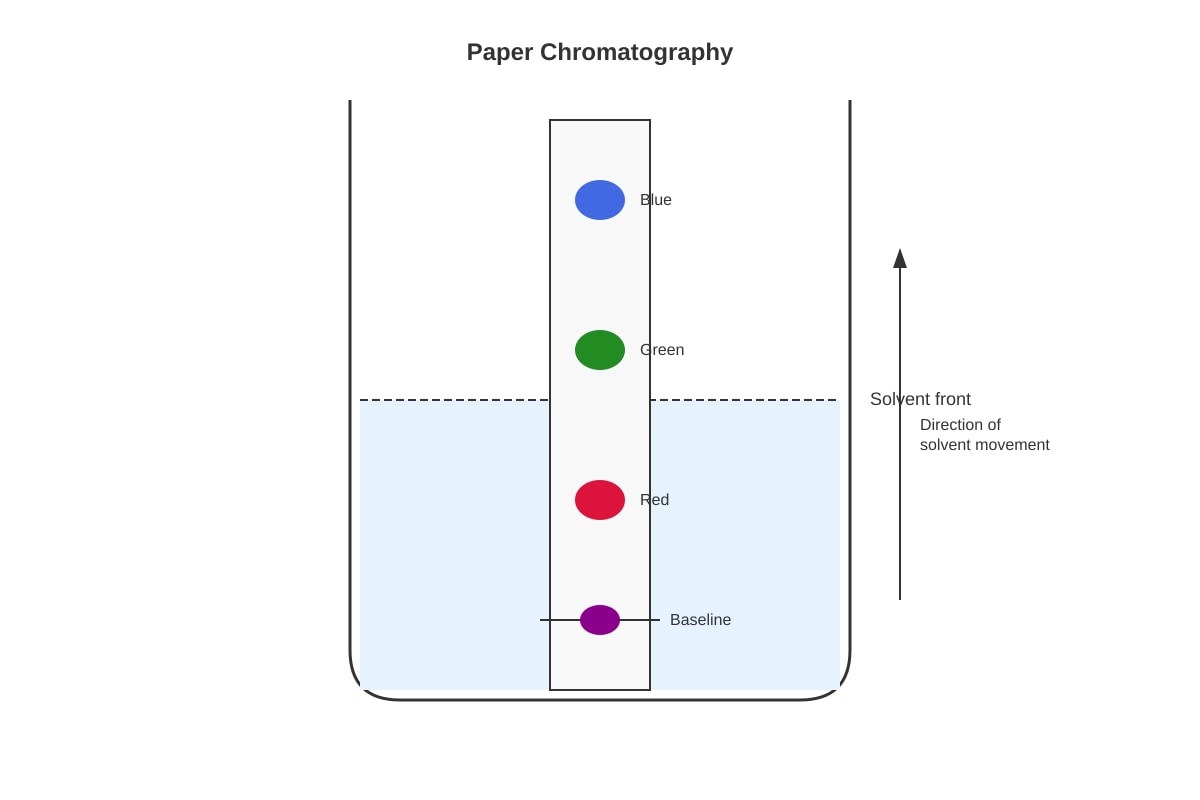
7. The diagram shows the separation of a mixture using paper chromatography. [10 marks]
[Diagram shows chromatography paper with solvent front at top and three colored spots at different heights: blue spot near top, green spot in middle, red spot near bottom]
(a) Explain how paper chromatography separates the components of a mixture. [3 marks]
(b) Based on the chromatogram, which component is most soluble in the solvent? Give a reason for your answer. [2 marks]
Component: ___________________________________ Reason: ____________________________________
(c) A student wants to use a different solvent for the same mixture. Predict what might happen to the separation pattern and explain your prediction. [3 marks]
(d) State two advantages of using chromatography for mixture analysis. [2 marks]
8. A chemical container has a flammable hazard symbol and contains ethanol. [6 marks]
(a) State two safety precautions that should be taken when using this chemical. [2 marks]
(b) Ethanol has a boiling point of 78°C while water has a boiling point of 100°C. Suggest a method to separate a mixture of ethanol and water, and explain why this method would work. [4 marks]
Method: ___________________________________
Explanation: _______________________________
9. The diagram shows a microscope view of a plant cell. The cell appears to be 4.8 mm long when viewed with a 10× eyepiece lens and 40× objective lens. [7 marks]
(a) Calculate the total magnification of the microscope. [1 mark]
Total magnification = _______________________
(b) Calculate the actual length of the cell in micrometers. Show your working. [3 marks]
Working:
Actual length = _________________ μm
(c) The cell has a large central vacuole. Explain how this structure helps the plant cell maintain its shape. [2 marks]
(d) Name one other structure visible in plant cells but not in animal cells. [1 mark]
10. A student investigates the factors affecting the dissolving rate of sugar in water. [14 marks]
(a) The student tests the effect of water temperature on dissolving rate. State the hypothesis for this investigation. [1 mark]
(b) Describe how the student could measure the dissolving rate of sugar. [2 marks]
(c) The student obtains the following results:
| Water Temperature (°C) | Time to dissolve completely (s) |
|---|---|
| 20 | 180 |
| 40 | 90 |
| 60 | 45 |
| 80 | 23 |
(i) Describe the relationship between water temperature and dissolving time. [2 marks]
(ii) Calculate the dissolving rate at 60°C if 5 g of sugar was used. Express your answer in g/s. [2 marks]
Working:
Dissolving rate = _________________ g/s
(d) The student repeats the experiment using crushed sugar instead of sugar cubes. Predict and explain how this change would affect the dissolving time. [3 marks]
Prediction: _______________________________
Explanation: ______________________________
(e) Apart from temperature and particle size, state two other factors that could affect the dissolving rate of sugar in water. [2 marks]
(f) Explain why it is important to use the same volume of water in each test. [2 marks]
Section C: Extended Response [15 marks]
11. A construction worker uses a pulley system to lift building materials to different floors of a construction site. [15 marks]
(a) The worker applies a force of 200 N to lift a 300 N load through a vertical distance of 4 m.
(i) Calculate the work done by the worker. [2 marks]
Working:
Work done = _________________ J
(ii) Calculate the work done against gravity on the load. [2 marks]
Working:
Work done = _________________ J
(iii) Calculate the efficiency of the pulley system. [3 marks]
Working:
Efficiency = _________________ %
(b) Explain why the pulley system is not 100% efficient. [2 marks]
(c) The worker then uses the same pulley system to lower the same load from the 4th floor to the ground floor, a distance of 12 m.
(i) State the energy conversion that occurs as the load is lowered. [1 mark]
(ii) If the load is lowered at constant speed, calculate the work done by gravity on the load. [2 marks]
Working:
Work done = _________________ J
(d) Suggest two ways the worker could improve the efficiency of the pulley system. [2 marks]
(e) Explain how the principle of moments applies when the worker uses a crowbar as a lever to move heavy objects. [1 mark]
END OF PAPER
Answers
TuitionGoWhere Practice Paper - Science Secondary 1 (Answer Key)
TuitionGoWhere Practice Paper (AI) - Version 2 - ANSWERS
Section A: Multiple Choice Questions [20 marks]
1. B - Chemical energy → Gravitational potential energy
The student's muscles convert chemical energy from food into gravitational potential energy as the bag is lifted higher.
2. B - Work is done only when an object moves in the direction of the applied force
Work = Force × Distance moved in the direction of force. If there's no movement or movement perpendicular to force, no work is done.
3. A - Pressure increases because the contact area decreases
Pressure = Force ÷ Area. Same weight (force) over smaller area results in higher pressure.
4. A - 6 N⋅m
Moment = Force × Perpendicular distance = 20 N × 0.3 m = 6 N⋅m
5. B - Diffuse reflection
Rough surfaces cause light rays to reflect in many different directions (diffuse reflection).
Section B: Structured Questions [45 marks]
6. Investigation of ramp height and car speed [8 marks]
(a) [1 mark] If the height of the ramp increases, then the speed of the car at the bottom will increase.
- Accept any testable hypothesis linking ramp height to car speed
- Must be in predictive format (if...then... or similar)
(b) [3 marks] (i) Independent variable: Height of ramp [1 mark] (ii) Dependent variable: Speed of car at bottom/time taken to travel 2m [1 mark] (iii) One controlled variable: Mass of car/length of ramp/surface of ramp/starting position [1 mark]
(c) [2 marks] Speed can be calculated using the formula speed = distance ÷ time [1 mark]. By measuring the time to travel a known distance (2 m), the speed can be determined [1 mark].
(d) [1 mark] Repeat the experiment multiple times and calculate an average/Use multiple trials
- Accept: Use more accurate timing equipment/Ensure consistent release method
(e) [1 mark] Gravitational potential energy → Kinetic energy
7. Paper chromatography [10 marks]
(a) [3 marks] Different components have different solubilities in the solvent [1 mark]. The solvent moves up the paper by capillary action [1 mark]. More soluble components travel further up the paper than less soluble ones [1 mark].
(b) [2 marks] Component: Blue component [1 mark] Reason: It traveled the furthest distance up the paper/highest position [1 mark]
(c) [3 marks] The separation pattern would change [1 mark] because different solvents have different polarities/properties [1 mark]. Components may travel different distances or in different order depending on their solubility in the new solvent [1 mark].
(d) [2 marks]
- Requires only a small sample/Quick and simple method [1 mark]
- Can separate multiple components simultaneously/Can identify unknown substances [1 mark]
8. Chemical safety and separation [6 marks]
(a) [2 marks]
- Keep away from open flames/heat sources/sparks [1 mark]
- Use in well-ventilated area/Wear safety goggles/Use water bath for heating [1 mark]
(b) [4 marks] Method: Fractional distillation/Distillation [1 mark]
Explanation: Ethanol and water have different boiling points [1 mark]. When heated, ethanol will boil first at 78°C [1 mark] and can be collected as vapor and condensed back to liquid, leaving water behind [1 mark].
9. Microscopy and plant cells [7 marks]
(a) [1 mark] Total magnification = 10 × 40 = 400×
(b) [3 marks] Working: Actual length = Image length ÷ Total magnification [1 mark] = 4.8 mm ÷ 400 = 0.012 mm [1 mark] = 0.012 × 1000 = 12 μm [1 mark]
(c) [2 marks] The vacuole is filled with cell sap which creates turgor pressure [1 mark]. This pressure pushes against the cell wall, keeping the cell rigid and maintaining its shape [1 mark].
(d) [1 mark] Cell wall/Chloroplast
10. Dissolving rate investigation [14 marks]
(a) [1 mark] If the water temperature increases, then the dissolving rate of sugar will increase/time to dissolve will decrease.
(b) [2 marks] Measure the time taken for a fixed mass of sugar to dissolve completely [1 mark]. Dissolving rate = mass of sugar ÷ time taken [1 mark].
(c) (i) [2 marks] As water temperature increases, the time to dissolve decreases [1 mark]. There is an inverse relationship between temperature and dissolving time [1 mark].
(ii) [2 marks] Working: Dissolving rate = 5 g ÷ 45 s [1 mark] = 0.11 g/s [1 mark]
(d) [3 marks] Prediction: Dissolving time would decrease/sugar would dissolve faster [1 mark]
Explanation: Crushed sugar has a larger surface area than sugar cubes [1 mark]. Larger surface area allows more contact between sugar and water, increasing the rate of dissolving [1 mark].
(e) [2 marks]
- Stirring/Agitation [1 mark]
- Concentration of solution/Amount of solvent [1 mark]
(f) [2 marks] To ensure fair testing/control variables [1 mark]. Different volumes would affect the concentration and dissolving rate, making results unreliable [1 mark].
Section C: Extended Response [15 marks]
11. Pulley system and energy [15 marks]
(a) (i) [2 marks] Working: Work done = Force × Distance = 200 N × 4 m [1 mark] Work done = 800 J [1 mark]
(ii) [2 marks] Working: Work done = Force × Distance = 300 N × 4 m [1 mark] Work done = 1200 J [1 mark]
(iii) [3 marks] Working: Efficiency = (Useful work output ÷ Total work input) × 100% [1 mark] = (800 J ÷ 1200 J) × 100% [1 mark] Efficiency = 66.7% [1 mark]
(b) [2 marks] Energy is lost due to friction in the pulley system [1 mark]. Some energy is converted to heat and sound rather than useful work [1 mark].
(c) (i) [1 mark] Gravitational potential energy → Kinetic energy (and thermal energy due to friction)
(ii) [2 marks] Working: Work done = Force × Distance = 300 N × 12 m [1 mark] Work done = 3600 J [1 mark]
(d) [2 marks]
- Lubricate the pulley to reduce friction [1 mark]
- Use lighter rope/Use better quality pulleys with ball bearings [1 mark]
(e) [1 mark] The crowbar acts as a lever where the moment of the applied force equals the moment of the load when in equilibrium/For the lever to work, clockwise moments must equal anticlockwise moments.
Marking Scheme Summary:
- Section A: 1 mark per question = 20 marks
- Section B: Variable marks as indicated = 45 marks
- Section C: Variable marks as indicated = 15 marks
- Total: 80 marks
Grade Boundaries (Suggested):
- A: 72-80 marks (90-100%)
- B: 64-71 marks (80-89%)
- C: 56-63 marks (70-79%)
- D: 48-55 marks (60-69%)
- E: 40-47 marks (50-59%)