AI Generated Exam Paper
Secondary 1 Science Practice Paper 1
Free Sec 1 Science Practice Paper 1, Kimi2.6 AI version, with questions, answers, and syllabus-aligned practice for Singapore students.
These static practice materials are generated from the site's syllabus and paper-generation workflow, with source and model context shown so students and parents can evaluate the material before use.
Questions
Free quiz and exam paper access
Enter your details to view this paper
Your access is remembered on this device.
Answers
Secondary 1 Science Quiz - Physical Sciences: ANSWER KEY
Total Marks: 60 marks
Section A: Multiple Choice and Short Response
1. [2 marks]
Answer: C (Force) [2 marks]
Explanation: A vector quantity has both magnitude and direction.
- Mass (A) is a scalar – it has only magnitude (e.g., 5 kg) with no direction.
- Speed (B) is a scalar – it tells us how fast something moves but not in which direction.
- Force (C) is a vector – it has magnitude (e.g., 10 N) and acts in a specific direction (e.g., to the right). [1 mark for correct choice]
- Energy (D) is a scalar – it has magnitude only (e.g., 50 J).
Teaching note: Remember the key test: "Does it have a direction?" If yes, it's a vector. Common vectors in Sec 1: force, velocity, displacement, acceleration, weight. Common scalars: mass, speed, distance, energy, temperature, time.
2. [2 marks]
Answer: 450 g [2 marks]
Working:
- Reading on balance = 452 g
- Zero error = +2 g (reads 2 g too high)
- Actual mass = 452 g − 2 g = 450 g [1 mark for method, 1 mark for answer]
Teaching note: A positive zero error means the instrument reads higher than the true value, so we subtract. If the zero error were negative (−2 g), we would add. Always check: does the reading need to be corrected up or down?
3. [2 marks]
Answer: Kinetic energy of wind → Mechanical energy of turbine blades → Electrical energy [2 marks]
Marking breakdown:
- Kinetic energy of wind → mechanical/kinetic energy of turbine [1 mark]
- Mechanical energy → electrical energy [1 mark]
Teaching note: Remember that energy cannot be created or destroyed, only converted. The wind has kinetic energy due to air movement; this turns the blades (mechanical energy), which spin a generator to produce electricity. Avoid saying "wind energy" as this is vague – specify kinetic energy.
4. [2 marks]
Answer: A scalar quantity has magnitude only; a vector quantity has both magnitude and direction. [2 marks]
Marking breakdown:
- Scalar has magnitude only [1 mark]
- Vector has magnitude and direction [1 mark]
Teaching note: Examples help fix this: scalar = 5 kg (just a number with unit); vector = 5 N to the left (needs number, unit, AND direction). Weight is a vector (gravitational force acting downward); mass is a scalar.
5. [3 marks]
Answer: Gravitational potential energy lost = 1.0 J [3 marks]
Working:
- Formula: GPE = mgh [0.5 mark]
- m = 50 g = 0.050 kg (convert to kg!) [0.5 mark]
- g = 10 N/kg
- h = 2.0 m
- GPE = 0.050 × 10 × 2.0 = 1.0 J [1.5 marks for substitution and calculation]
Teaching note: Common error: forgetting to convert grams to kilograms. In physics formulas, mass must be in kg for SI units. Another check: 50 g is very light and 2 m is moderate, so 1 J is reasonable. If you got 1000 J, you used 50 kg instead of 0.050 kg.
6. [3 marks]
(a) [1 mark]
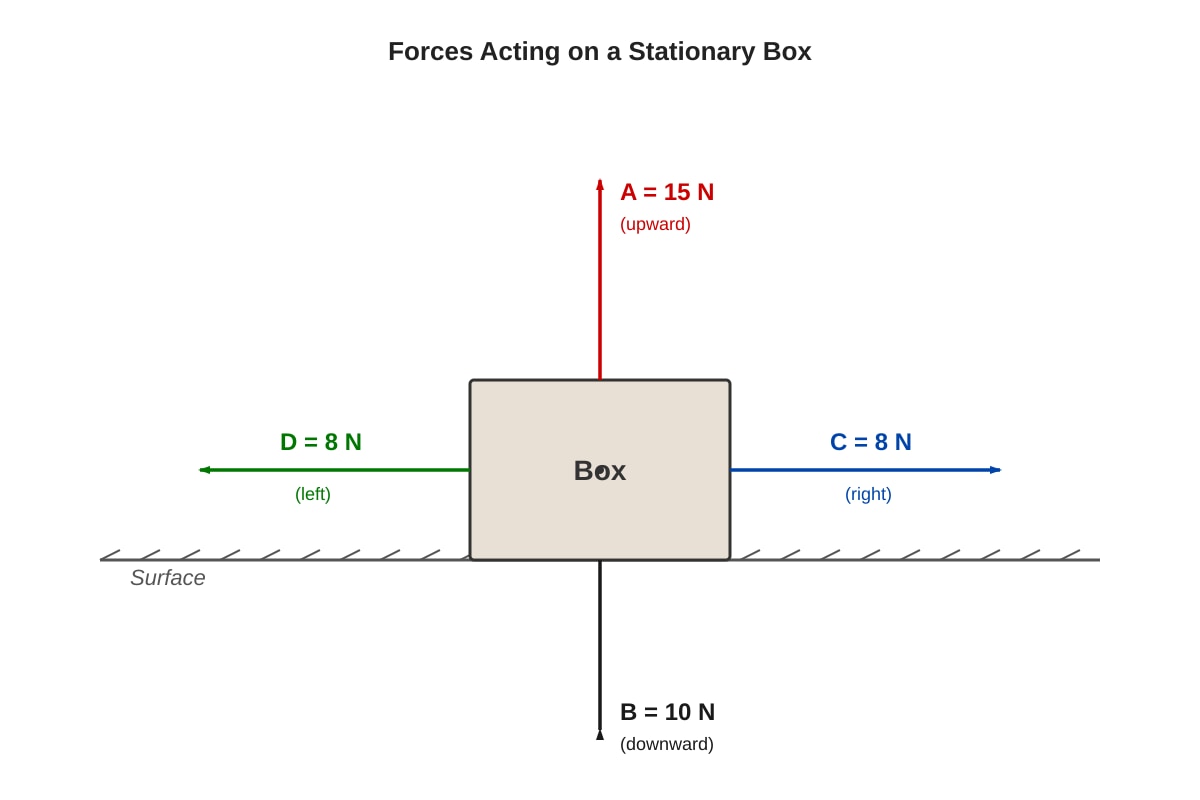
Answer: Resultant vertical force = 15 − 10 = 5 N upward [1 mark]
(b) [2 marks]
Answer: The box will not move horizontally. [1 mark] The horizontal forces C and D are equal in magnitude (8 N) but opposite in direction, so they cancel out (resultant horizontal force = 0). [1 mark]
Teaching note: For equilibrium, resultant force must be zero in all directions. The box is NOT in vertical equilibrium (5 N upward resultant), so it may accelerate upward or be about to lift off if this exceeds the normal reaction. The question tests whether you analyse each direction separately.
7. [4 marks]
(a) [1 mark]
Answer: Total distance = 3.0 + 4.0 = 7.0 km [1 mark]
(b) [2 marks]
Working:
- Displacement forms the hypotenuse of a right-angled triangle.
- Using Pythagoras: displacement = √(3.0² + 4.0²) [1 mark]
- = √(9.0 + 16.0) = √25.0 = 5.0 km [1 mark]
(c) [1 mark]
Answer: Distance is the total path length travelled (scalar); displacement is the straight-line distance from start to finish with direction (vector). [1 mark]
Teaching note: Always draw the vector diagram for displacement problems. The 3-4-5 triangle is common in exams. Displacement needs a direction for full marks in some contexts (e.g., "5.0 km at 053°" or "5.0 km northeast").
8. [3 marks]
(a) [2 marks]
Working:
- Formula: GPE = mgh [0.5 mark]
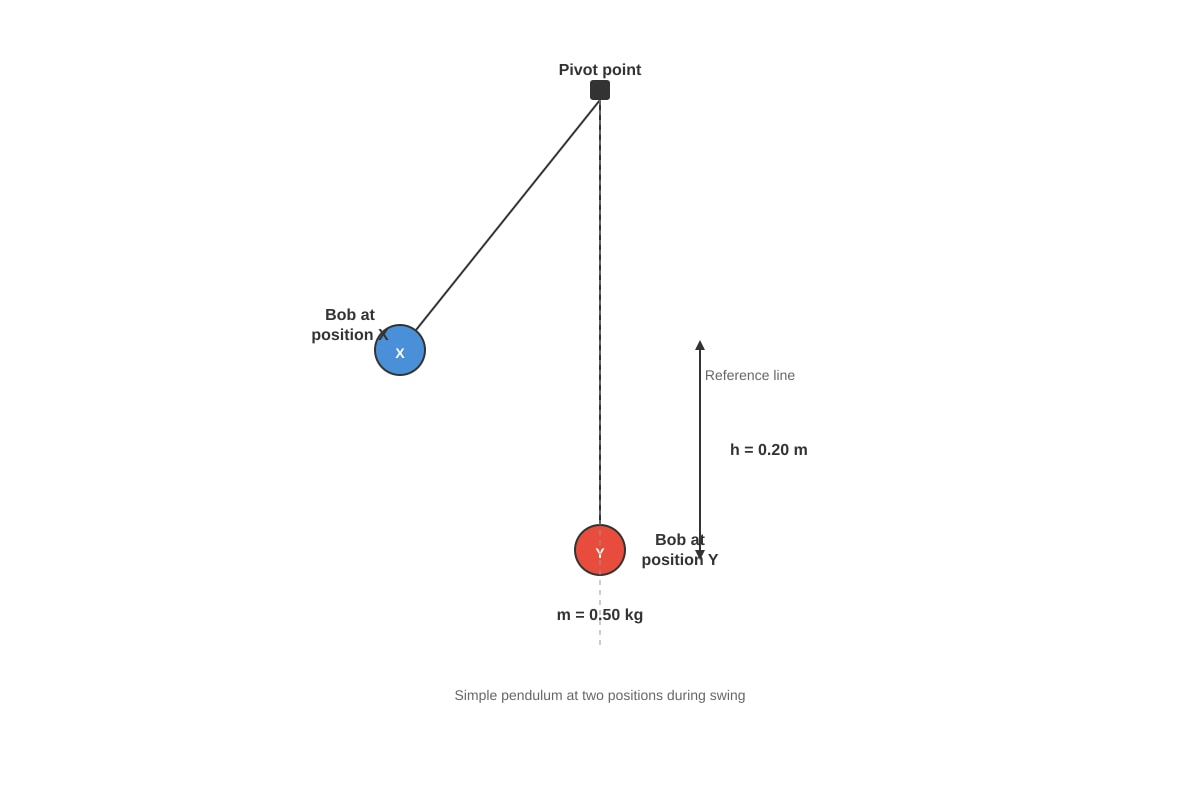
- m = 0.50 kg, g = 10 N/kg, h = 0.20 m
- GPE = 0.50 × 10 × 0.20 = 1.0 J [1.5 marks for substitution and calculation]
(b) [1 mark]
Answer: 1.0 J [1 mark]
Explanation: By conservation of energy, all GPE at the highest point converts to kinetic energy at the lowest point (assuming no air resistance). This is a key principle: total mechanical energy is conserved in an ideal system.
Section B: Structured Questions
9. [4 marks]
(a) [2 marks]
Working:
- Formula: a = (v − u)/t [0.5 mark]
- u = 0 m/s (from rest), v = 20 m/s, t = 10 s
- a = (20 − 0)/10 = 2.0 m/s² [1.5 marks for substitution and answer]
(b) [2 marks]
Working:
- Formula: F = ma [0.5 mark]
- m = 1200 kg, a = 2.0 m/s²
- F = 1200 × 2.0 = 2400 N [1.5 marks for substitution and answer]
Teaching note: These are the two fundamental equations of motion for constant acceleration. Remember: F = ma means force causes acceleration. Direction matters – if slowing down, acceleration would be negative (deceleration).
10. [4 marks]
(a) [2 marks]
Working:
- Work done = force × vertical distance moved in direction of force
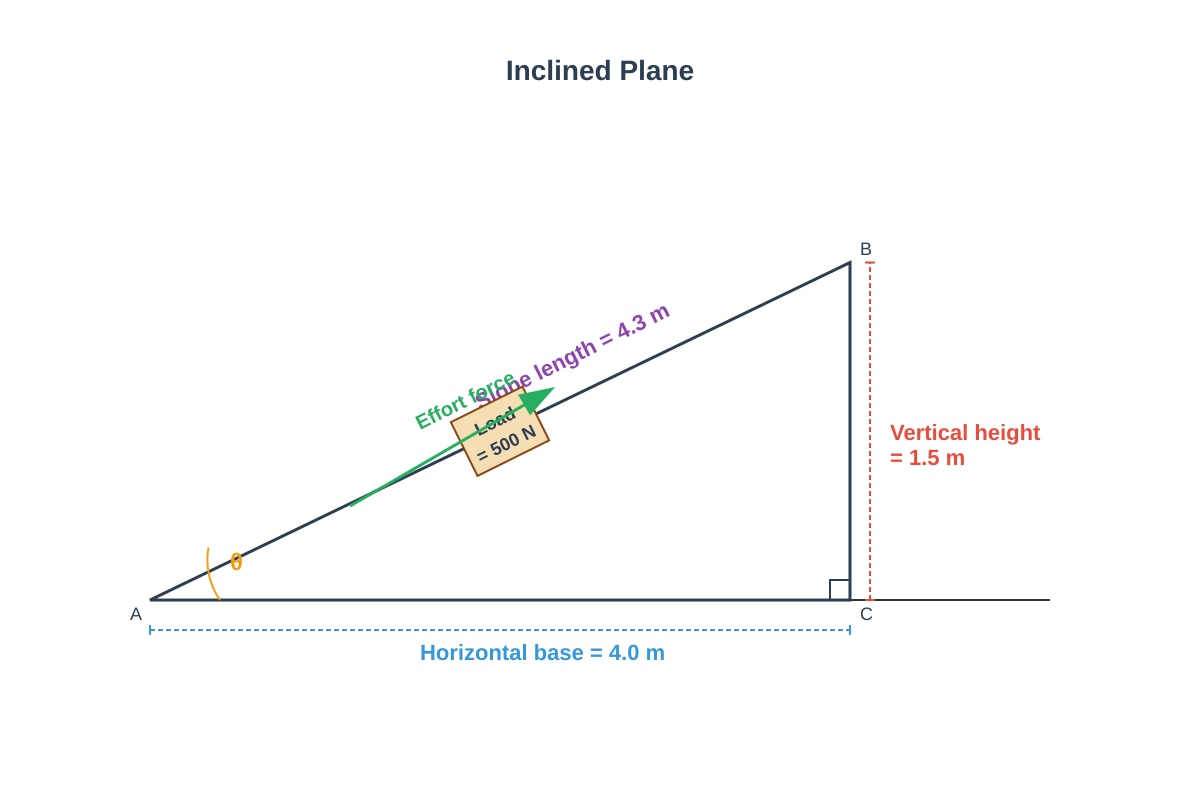
- = weight × height = 500 N × 1.5 m [1 mark]
- = 750 J [1 mark]
(b) [2 marks]
Answer: The effort force is applied over a longer distance (4.3 m along slope vs 1.5 m vertically). [1 mark] Since work = force × distance, for the same work (750 J), a smaller force acting over a longer distance produces the same work as a larger force acting over a shorter distance. [1 mark]
Teaching note: This is the principle of simple machines: they multiply force at the expense of distance. The inclined plane is a force multiplier. Without friction: effort × slope length = load × vertical height.
11. [4 marks]
(a) [2 marks]
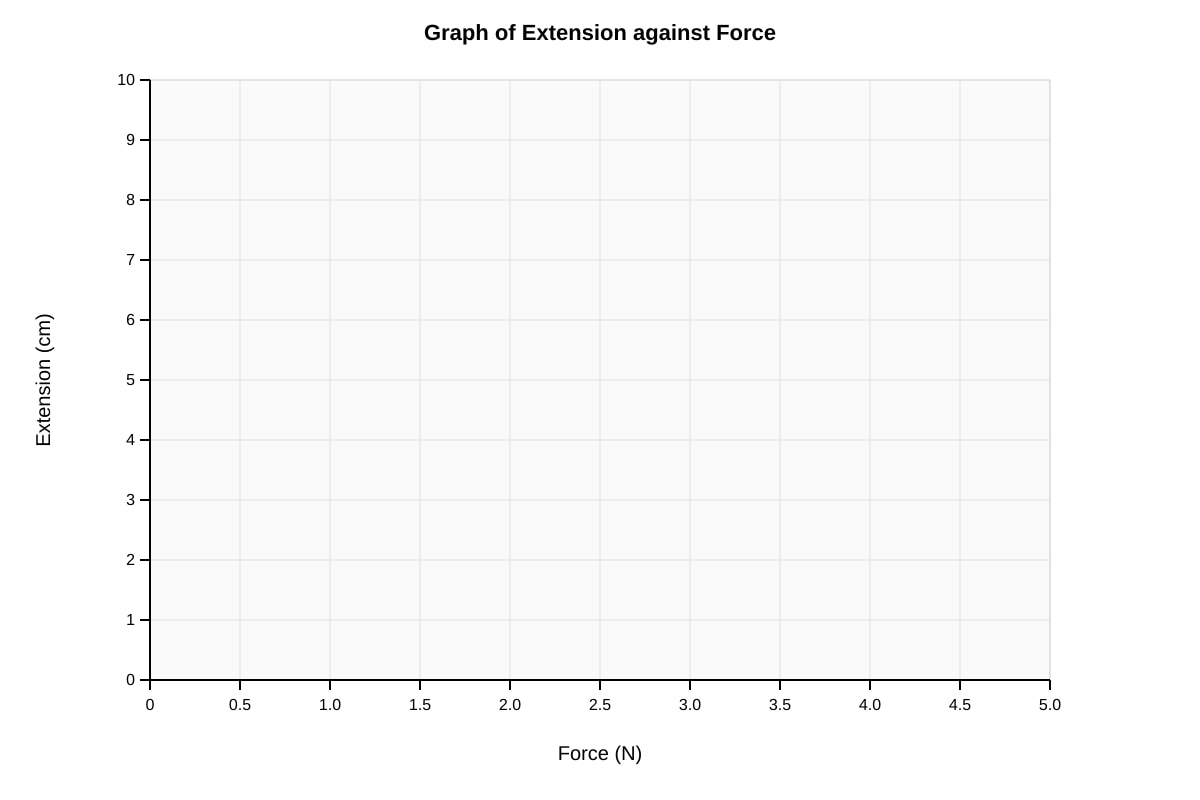
Expected graph: Points plotted at (0,0), (1,2), (2,4), (3,6), (4,7.5), (5,9.0) with best-fit straight line through first four points, then curve/change of gradient. [2 marks for correct plotting and line]
Marking breakdown:
- All 6 points correctly plotted [1 mark]
- Best-fit line showing change at or near 3.0 N [1 mark]
(b) [1 mark]
Answer: From graph: 5.0 cm (accept 4.8–5.2 cm) [1 mark]
(c) [1 mark]
Answer: 3.0 N [0.5 mark]. Above this force, the graph curves/is no longer a straight line through the origin/proportionality is lost [0.5 mark].
Teaching note: Hooke's Law states F = kx (extension proportional to force) valid only within the limit of proportionality. The point where the graph deviates from straight-line marks this limit. Never say "spring breaks" – it hasn't broken, just exceeded its elastic limit.
12. [4 marks]
(a) [1 mark]
Answer: Latent heat / thermal energy is absorbed to overcome bonds between molecules; internal potential energy increases. [1 mark]
(b) [2 marks]
Working:
- Formula: Q = ml [0.5 mark]
- m = 0.40 kg, l = 334 kJ/kg = 334 000 J/kg
- Q = 0.40 × 334 000 = 133 600 J or 134 kJ or 1.34 × 10⁵ J [1.5 marks]
(c) [1 mark]
Answer: The energy supplied is used to break intermolecular bonds / increase separation between molecules (increase potential energy) rather than increase kinetic energy of molecules. [1 mark] Since temperature depends on average kinetic energy, temperature stays constant during phase change.
Teaching note: "Latent" means hidden – the energy seems to disappear because there's no temperature change, but it's doing internal work against molecular forces. This is why melting ice at 0°C needs energy but stays at 0°C.
13. [4 marks]
(a) [2 marks]
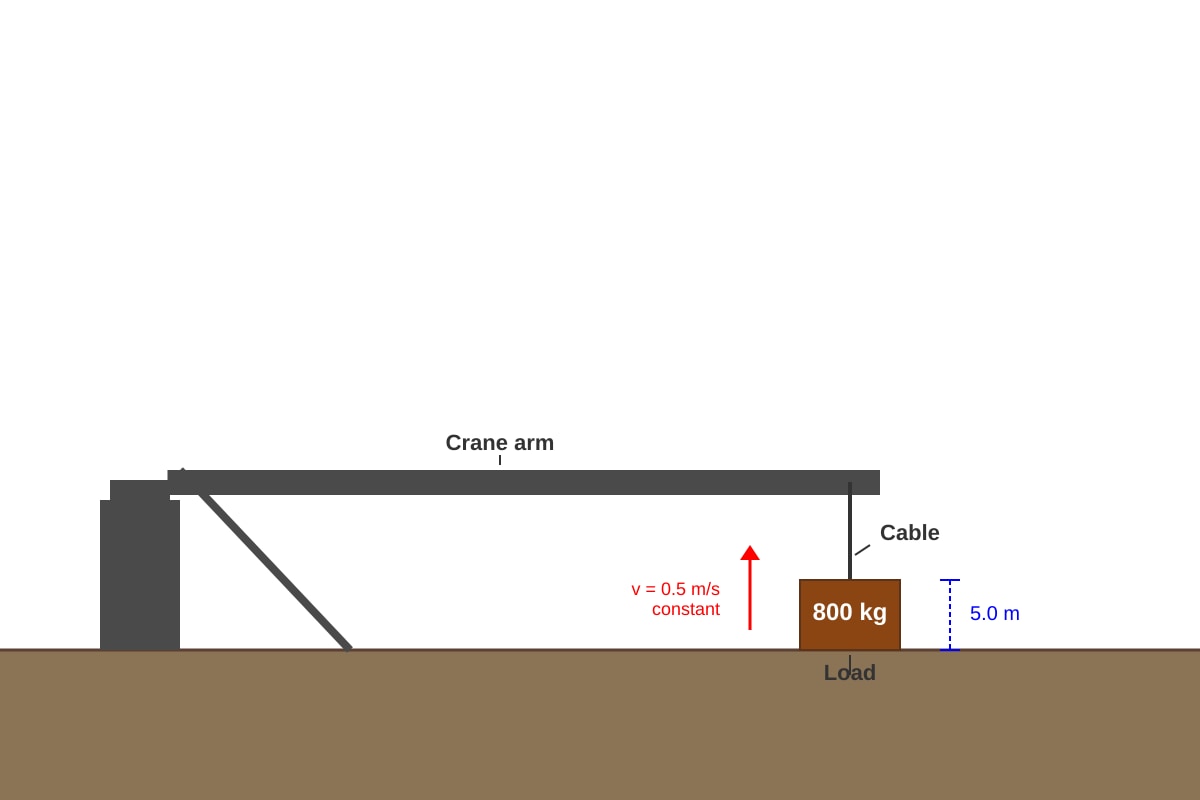
Working:
- At constant velocity, upward force (tension) = downward force (weight) [0.5 mark]
- Weight = mg = 800 × 10 = 8000 N [1 mark]
- Tension = 8000 N [0.5 mark]
(b) [2 marks]
Answer: The motor must also do work against: [1 mark for any one]
- Friction in the pulley system / cable
- Air resistance on the load
- Moving parts of the crane itself
- Inefficiency/heat in the motor [1 mark]
Teaching note: "Constant velocity" is the key phrase telling us ΣF = 0 (Newton's First Law). Don't be tempted to add extra force "to keep it moving" – that's Aristotelian physics, not Newtonian! The power is greater because of energy losses, not because more force is needed to accelerate.
14. [4 marks]
(a) [2 marks]
Working:
- At maximum height, final velocity v = 0
- Using: v² = u² + 2as, where a = −g = −10 m/s² [0.5 mark]
- 0 = (20)² + 2(−10)s [0.5 mark]
- 0 = 400 − 20s
- 20s = 400, s = 20 m [1 mark]
(b) [2 marks]
Working:
- Time to reach maximum height: v = u + at [0.5 mark]
- 0 = 20 + (−10)t, t = 2.0 s [0.5 mark]
- By symmetry (same path down), total time = 2.0 + 2.0 = 4.0 s [1 mark]
Alternative working for (b): Using s = ut + ½at² with s = 0 (returns to start):
- 0 = 20t + ½(−10)t² → 0 = 20t − 5t² → 5t(4 − t) = 0 → t = 0 or t = 4.0 s
Teaching note: The symmetry of vertical motion under gravity is powerful – time up equals time down, and speed of return equals speed of projection (without air resistance). Always draw the velocity-time triangle to visualise.
15. [4 marks]
(a) [2 marks]
Working:
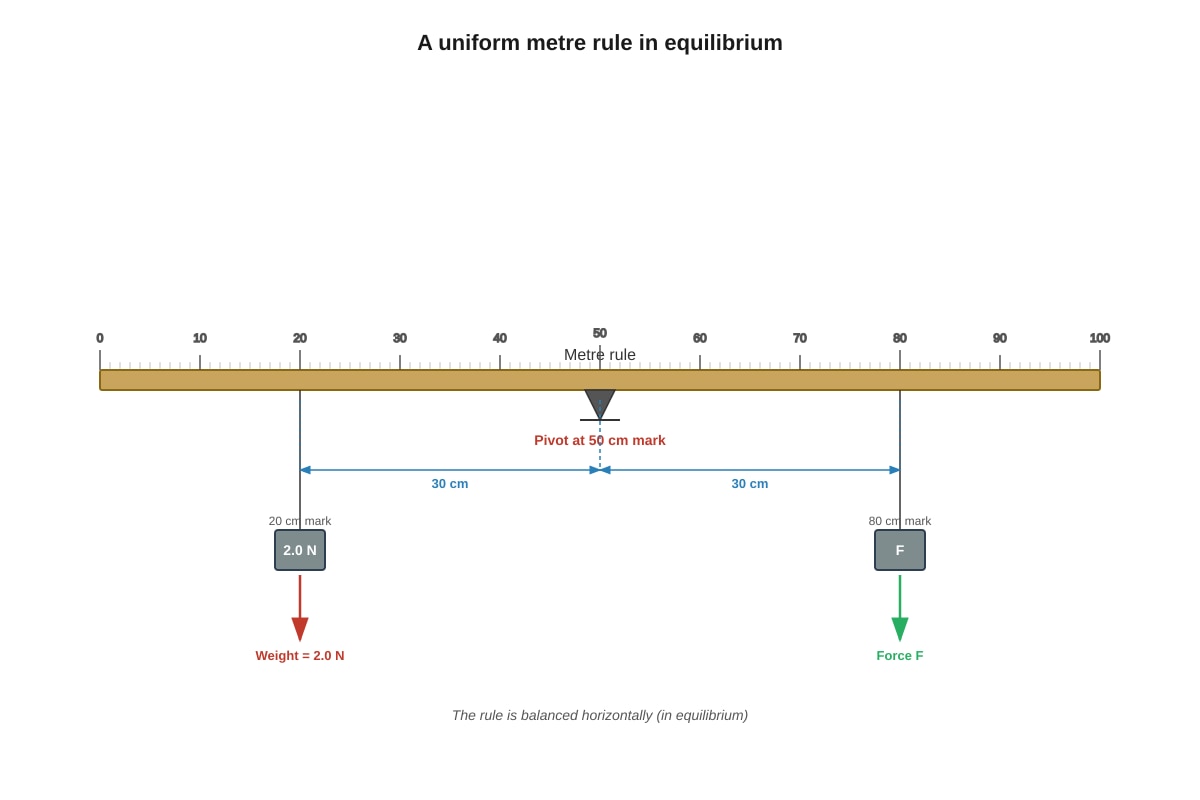
- Moment = force × perpendicular distance from pivot [0.5 mark]
- Distance = 50 − 20 = 30 cm = 0.30 m [0.5 mark]
- Moment = 2.0 × 0.30 = 0.60 N m (anticlockwise) [1 mark]
(b) [2 marks]
Working:
- For equilibrium: sum of clockwise moments = sum of anticlockwise moments [0.5 mark]
- F × (80 − 50) = 2.0 × (50 − 20) [0.5 mark]
- F × 0.30 = 2.0 × 0.30
- F = 2.0 N [1 mark]
Teaching note: The principle of moments: balanced lever means no net turning effect. Always measure distances from the pivot, not from the ends. The unit is N m (newton-metre), not N/m or m/N. Notice this is a balanced lever because both forces are equidistant from pivot with equal magnitudes.
Section C: Longer Response
16. [4 marks]
(a) [3 marks]
Independent variable: Angle of the ramp / steepness of ramp [1 mark]
Dependent variable: Speed of trolley / time to travel fixed distance [1 mark]
Controlled variable: Any one from: same trolley, same starting position, same ramp surface, same distance measured [1 mark]
(b) [1 mark]
Answer: To ensure the same initial gravitational potential energy / height / starting energy each time; this makes the investigation a fair test. [1 mark]
Teaching note: "Fair test" is the key concept in scientific inquiry. Only ONE variable should change. If starting position varies, initial GPE varies, so speed changes for two reasons, making conclusions invalid.
17. [4 marks]
(a) [2 marks]
Answer:
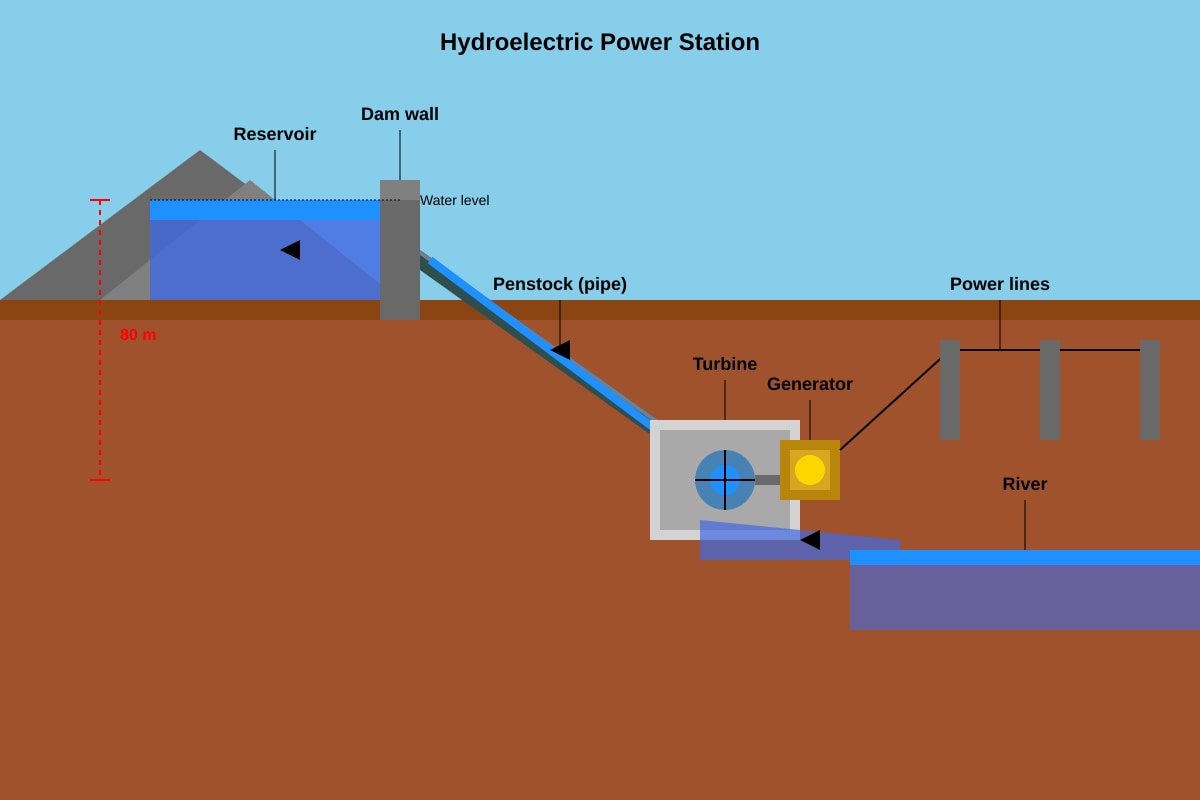
- GPE of water in reservoir → KE of flowing water [0.5 mark]
- KE of water → mechanical KE of turbine blades [0.5 mark]
- Mechanical energy of turbine → electrical energy in generator [0.5 mark]
- Electrical energy transmitted via power lines [0.5 mark]
(b) [1 mark]
Answer: Any one from: renewable/does not run out; no greenhouse gas emissions during operation; no air pollution; low running costs once built [1 mark]
(c) [1 mark]
Answer: Requires a suitable river with sufficient water flow; needs a valley to dam for reservoir; requires sufficient height difference/head for adequate water pressure. [1 mark]
Teaching note: Hydroelectric is excellent for base-load power in suitable locations, but geography-dependent. Pumped storage (reversible turbines) can store energy by pumping water uphill when demand is low.
18. [4 marks]
(a) [2 marks]
Working:
- Weight = mg = 60 × 10 = 600 N [0.5 mark]
- Work = force × distance = 600 × 4.0 [0.5 mark]
- = 2400 J [1 mark]
(b) [2 marks]
Working:
- Formula: Power = work done / time taken [0.5 mark]
- = 2400 / 8.0 [0.5 mark]
- = 300 W [1 mark]
Teaching note: 300 W is about half a horsepower – reasonable for a short burst of stair climbing. For comparison, a fit human can sustain ~100 W for long periods. Always check that working makes physical sense.
19. [4 marks]
(a) [2 marks]
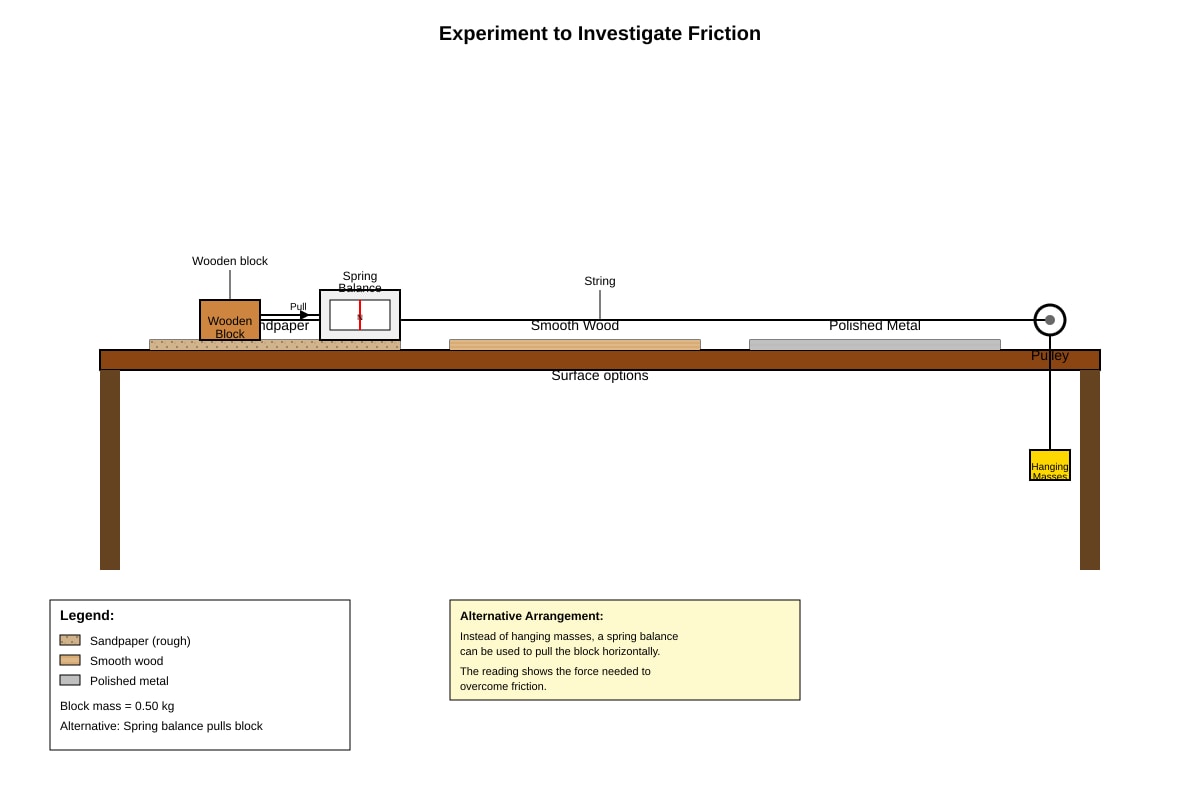
Answer: Place the block on each surface in turn. Pull the block at constant speed using the spring balance. [1 mark] The surface requiring the smallest force reading to maintain constant speed has the least friction. [1 mark]
(b) [1 mark]
Answer: Sandpaper has a rougher surface / more irregularities / greater surface roughness at microscopic level, leading to more interlocking and contact points between surfaces. [1 mark]
(c) [1 mark]
Answer: Oil fills irregularities on surfaces / separates the surfaces with a fluid layer / reduces direct contact between surfaces, so interlocking is reduced. [1 mark]
Teaching note: Friction arises from two main factors: surface roughness (mechanical interlocking) and adhesive forces between molecules. Lubrication addresses both by providing a slippery separating layer.
20. [4 marks]
(a) [2 marks]
Working:
- Formula: KE = ½mv² [0.5 mark]
- = ½ × 0.10 × (2.0)² [0.5 mark]
- = ½ × 0.10 × 4.0 = 0.20 J [1 mark]
(b) [2 marks]
Answer: The string exerts a force toward the centre of the circle (centripetal force). [1 mark] Although speed is constant, velocity is changing (direction changes continuously), so there is acceleration toward the centre. Work = force × displacement in direction of force; the force is always perpendicular to velocity, so no work is done in direction of motion, but the explanation tests understanding that circular motion requires continuous force. [1 mark for circular motion explanation]
Correction/Clarification for teaching: Actually, in ideal uniform circular motion, the tension does NO work on the ball because force is always perpendicular to displacement. However, the student needs to explain that:
- A force IS needed to change direction (Newton's First Law: without force, straight-line motion)
- The speed stays constant because tension is perpendicular to velocity
- Energy stays constant, so KE is constant
Accept answers that recognise the tension's role in changing direction while not changing speed/energy. [2 marks for clear explanation of direction change without energy change]
Teaching note: This is a subtle point. Work = Fd cos θ. In circular motion, θ = 90°, so cos 90° = 0. No work, no energy change, but force is essential for circular motion. Don't say "force keeps it moving" – force changes direction.
END OF ANSWER KEY